
Amazon Lists 250 Million Products From Rival Sites in Effort to Battle Agents


For more than a year, Amazon has blocked outside shopping agents from its site while finding ways for its own customers to shop elsewhere. Now a new wave of AI assistants like Meta’s Muse is raising the stakes.
In recent months Amazon has stepped up its Shop Direct initiative, which promotes products from brands that don’t sell on Amazon’s site, potentially giving shoppers less reason to turn to outside AI tools that can buy across retailers. The company now has 250 million listings that link to products sold elsewhere, about 2.5 times as many as in March, and is highlighting the goods more prominently through curated style edits and other displays on its site.
Amazon says it’s continuing to innovate on how and where it’s showing outside products to customers. As part of that, Amazon has added items from big brands such as Alo Yoga and Warby Parker and introduced dedicated pages for showcasing outside listings from brands. It’s also started showing more product details on its own site before shoppers click through to an outside retailer.
Amazon has been testing new placements since March. Combined with the surge in Shop Direct listings, the moves represent a significant expansion that mixes in brands’ off-site product listings across Amazon’s selection. Earlier on, the Shop Direct products had mostly appeared in Amazon’s search bar and suggestions in its Alexa shopping chatbot.
“Amazon is increasingly a destination where customers can find and buy products not just from our store,” an Amazon spokesperson said. “Tens of millions of customers have discovered hundreds of millions of unique products from other stores through Shop Direct since the program launched, and Shop Direct products are appearing in hundreds of millions of searches monthly. We’re pleased with the foundation we’re building—broad selection, quality search results, and a growing customer response that reinforces our commitment to making every product discoverable, no matter where it’s sold.”
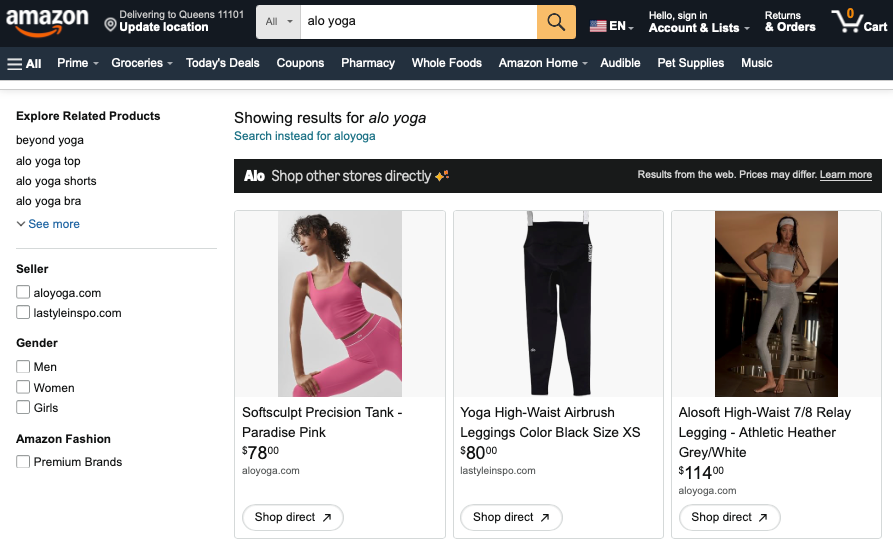
Yet for all that growth, the effort remains a mystery to many online merchants. Eleven people who run e-commerce sites or work with merchants, representing hundreds of sellers overall, said they have little insight into when or why outside products show up on Amazon. Those whose products do appear say they’ve seen few sales as a result. Several also said they haven’t heard much from their own Amazon reps in the past six months about Shop Direct.
Earlier this month, for instance, e-commerce agency Nectar noticed Amazon listings for products sold on two of its clients’ direct-to-consumer sites, according to Co-CEO Jason Landro. Amazon didn’t tell Nectar or its clients ahead of time that it would be listing the products, and Nectar found out only when the listings went live.
Katharine McKee, founder of Morphology Consulting, an e-commerce consultancy that works with around 50 brands across six clients, said Amazon started showing links to buy some clients’ products on other retailers’ sites sometime between late July and October, though she wasn’t sure exactly when they first went live.
The listings can come and go on Amazon without notice. Jason Boyce, CEO of e-commerce agency Avenue7Media, said he noticed Amazon showing listings that linked to other retail sites at the end of 2025 that disappeared sometime in the second quarter of this year.
Some merchants also say they’ve noticed issues with listings on Amazon that show product information that doesn’t match what they’re actually selling on their sites—the same kind of errors Amazon cited when it blocked outside AI shopping bots last year. CEO Andy Jassy has said outside technology doesn’t offer a good customer experience, though Amazon is open to letting outside shopping tools in if they improve and offer attractive economics.
The product links also don’t always go to the brands’ own direct-to-consumer sites. For one wellness brand, Amazon directed shoppers to a page from a retailer that isn’t an authorized reseller of the products, McKee said.
Scaling up Shop Direct could represent a big change for Amazon, which has long moved cautiously with major changes to its retail site, the heart of its $588 billion commerce and ads business. The company launched outside product listings in Amazon in February 2025 and two months later added a Buy for Me feature, which uses agents to complete outside purchases without leaving Amazon’s site, moves that came as OpenAI and Google were gearing up to add AI checkouts.
AI shopping has had false starts before, with OpenAI scrapping a high-profile ChatGPT checkout push in March, and using AI to buy things is far from a mainstream consumer habit. Still, signs are emerging that the latest crop of AI consumer apps is starting to actually generate orders—and could represent an eventual threat to Amazon’s dominant role in how people shop online.
Omar Qari, CEO of e-commerce software seller Logicbroker, said his clients have seen a handful of Muse orders in the past few weeks while not seeing many Shop Direct–driven sales since the Amazon program began. “I was just surprised that anybody” was shopping via an agent, Qari said.
Amazon’s Reach
Amazon has pushed beyond its own site before with services like Buy with Prime, which lets outside merchants offer Amazon’s checkout and speedy delivery, features they actively select. With Shop Direct, merchants have to opt out of inclusion.
Amazon says the technology powering its AI shopping features crawls publicly available data, much as other tools do, and abides by websites’ robots.txt instructions on what bots are allowed. Merchants are considered for Shop Direct unless they ask to be excluded, an option Amazon says has been in place since the program first launched.
The features sparked blowback early this year from some merchants who complained that they were included without a heads-up, and who said the feature pulled incorrect product details that led to erroneous orders.
Still, some who work with online brands, including ones that sell on sites powered by e-commerce giant Shopify, saw potential benefits in features that provided visibility on Amazon.
“If you’re going to put our Shopify listings on Amazon in front of a billion people, great, more money for us. [Amazon has] much better reach than our Shopify site,” said McKee, the e-commerce consultant.
At the same time, Amazon has had to grapple with the same challenges other agentic shopping efforts face. Retail sites, rife with features like pop-up windows and promo codes for new shoppers, are hard for AI tools to navigate, and pricing and in-stock information can quickly go stale.
Early on, Amazon’s shopping agent software, built around Anthropic models, had trouble navigating some retail websites, according to people with knowledge of the project. Amazon also had to direct the agent to check sites frequently to get current product data, and engineers needed to confirm the AI’s findings, one person with knowledge of the project said.
In March, Amazon announced more integrations with a number of e-commerce feed providers, which compile retailers’ product information in real time. Those included Feedonomics, owned by Shopify competitor Commerce (formerly BigCommerce), as well as Salsify and CedCommerce. Amazon recently added another provider, VersaFeed.
Amazon says it’s choosing which products to show through Shop Direct based on the quality of the product listing and whether something is in stock, among other factors. It has received requests from large and small brands alike asking to be included.
Amazon is also laying the groundwork for brands to better track the sales Shop Direct drives. The company says that, based on URL tags added to links to show where visitors come from, companies can see what traffic Shop Direct is driving to their sites. Amazon is also building more reporting capabilities to track the benefits of showing up in Shop Direct.