
Survey Statistics: how to measure hospital quality ?
 1


Last week we chatted about hopes for a new edition of Lumley 2010.

Alan Zaslavsky recommends this textbook in his course. After taking the course in 2011, I asked Alan to advise my PhD. Alan’s work extends across most topics in Lumley’s textbook and beyond. One focus is statistical issues in measuring the quality of a hospital: how can we compare hospitals who see different distributions of patients (i.e. casemix) ? Zaslavsky 2001 explains a few approaches, including direct standardization.

Let:
- Y = complications
- X = sickness of the patient
- R = hospital, can be A or B
- Y(A) = complications if treated by hospital A
- Y(B) = complications if treated by hospital B
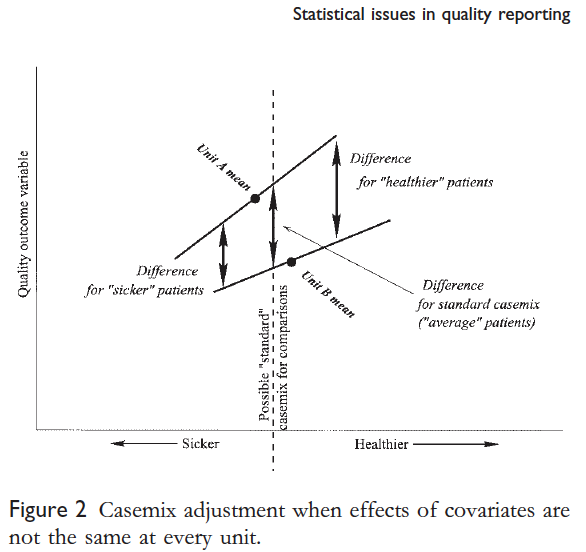
To compare hospitals A and B, we want to compare Y(A) versus Y(B). We cannot do this for one patient, because at least one of Y(A) or Y(B) is not observed. But we can compare averages. We can compare E(E(Y(A) | X, R = A)) versus E(E(Y(B) | X, R = B)) where the outer expectations are with respect to some standard casemix of X. Direct standardization estimates the inner expectations with the mean in each X stratum. As Zaslavsky 2001 points out, this needs modification if there are no patients in a stratum, or when X is continuous. Instead, the inner expectations can be estimated with regression models.
See Figure 2 from Zaslavsky 2001:
Lumley 2010 points out that direct standardization is mathematically equivalent to poststratification:
