
AI Police Reports and Fair Trials: The Draft Nobody Can Cross-Examine


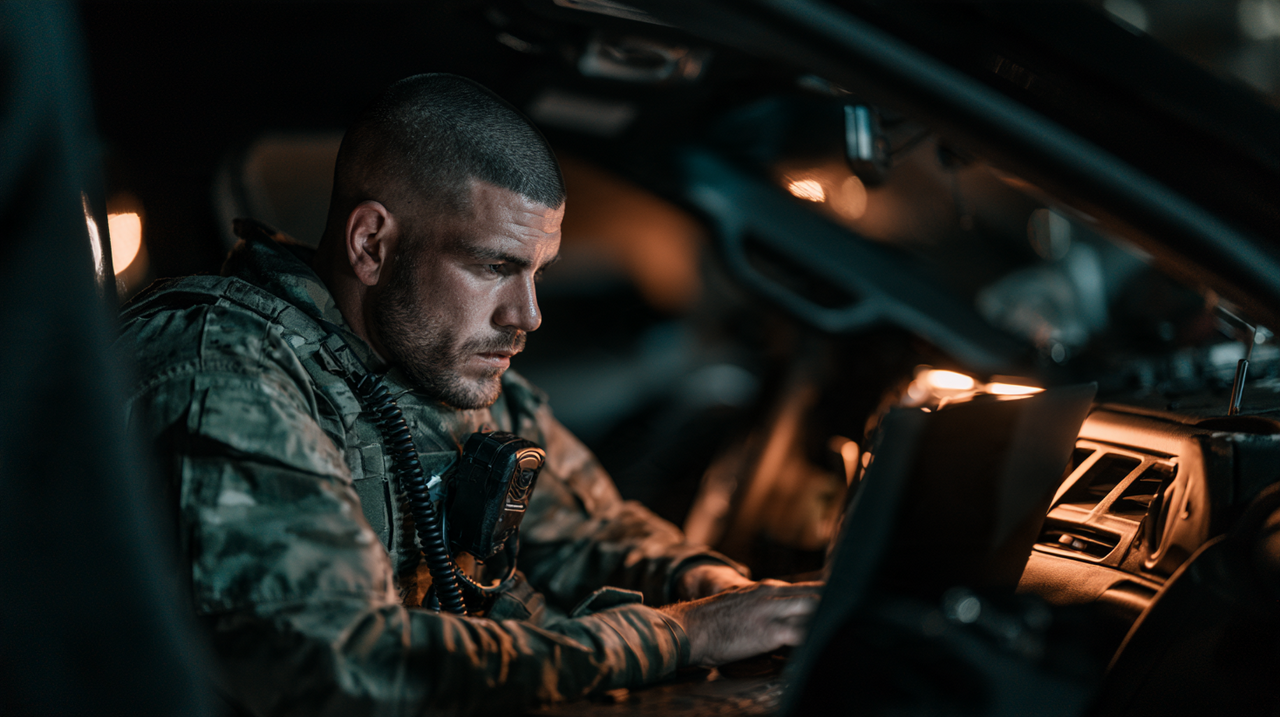
Somewhere behind a police call in Heber City, Utah, a television was playing Disney's The Princess and the Frog. The officer's body-worn camera picked it up, because body-worn cameras pick up everything: the hum of a refrigerator, a dog, a film. That audio went into an artificial intelligence system the department had bought to turn recordings into police reports. The system did exactly what it was built to do. It listened, it narrated, and it produced a document in which the officer turned into a frog.
The story went around the world in January 2026. Sergeant Rick Keel of the Heber City Police Department told FOX 13 News that “the body cam software and the AI report writing software picked up on the movie that was playing in the background, which happened to be 'The Princess and the Frog.'” He added the line every department has since repeated in some form: “That's when we learned the importance of correcting these AI-generated reports.” FOX 13 reported the offending narrative came from Draft One, sold by Axon, the largest supplier of body cameras to American police. Heber City had been trialling it alongside a rival called Code Four. The department kept using AI. It simply added more review.
Here is the thing about the frog. It is the safest error the technology can make, because it is self-cancelling. No sergeant approves it, no prosecutor files it, no judge reads it without laughing, and no defendant goes to prison because of it. An error that absurd is a smoke alarm, not a fire. It tells you the machine is in the building.
The error that should frighten you is the one that reads perfectly. It is grammatical, plausible, consistent with the rest of the narrative, and wrong by a single preposition. It is the difference between a suspect who reached toward his waistband and a suspect who reached into it. One describes an ambiguous movement. The other describes a man going for a gun, and can justify a shooting, a search, a charge, a plea. They differ by two letters, and no reviewer on earth reliably catches that at eleven at night at the end of a twelve-hour shift, six calls deep, with the machine's version already on the screen looking finished.
That asymmetry is the whole problem. And Wyoming has just walked into it.
What the Cowboy State Bought Before It Decided Anything
On 23 August 2026, Cowboy State Daily reporter Kolby Fedore published an account of police departments in Casper, Evanston and Sheridan each testing artificial intelligence to write reports and look at evidence. Only one vendor was named. Evanston, according to Police Chief Mike Vranish, is testing Code Four, software founded in April 2025 by two MIT students, George Cheng and Dylan Nguyen, and now used by roughly 165 law enforcement agencies. Code Four, Fedore noted, markets itself as “The AI Detective That Never Sleeps.”
The company's own site is less whimsical and more instructive. It promises a 65 per cent average reduction in report writing time, fifty dollars per officer per month, and eighty thousand dollars in annual budget saved per department. Its report product “ingests audio, visual, and other meta data from each frame of an officer's body-worn camera to create a comprehensive narrative of every situation.” A companion product, INSIGHTS, described in sponsored content Cheng wrote for the trade publication Police1 in July 2026, pulls “digital evidence, records and jail-management data, body-camera footage, phone dumps, call logs, recorded audio and case files into a single layer a detective can question directly.” It can draft warrants, affidavits and prosecutor jackets.
Read that list slowly. A warrant application persuades a judge to let the state enter your home; an affidavit of probable cause persuades a judge to hold your body. These are not administrative artefacts. They are the hinges on which constitutional rights swing.
Fedore's reporting established the gap that gives this story its edge. No Wyoming law specifically requires an original AI-generated police report to survive after an officer edits it, and none requires the finished report to disclose that a machine helped write it. The technology is in the building. The rules are not.
Gay Woodhouse, Wyoming's thirty-second attorney general from 1998 to 2001 and the first woman to hold the office, previously an assistant United States attorney and chief deputy attorney general, told Cowboy State Daily that “the thing that worries me about AI is just the ability to hallucinate,” and that Wyoming needs “to get on it.” She put her finger on the mechanism: “The main thing in criminal prosecutions is disclosure.” And then, with the dry economy of a former prosecutor: “It'd be awful to lose a case because you used AI and didn't disclose it.”
Casper criminal defence attorney Keith Nachbar called it “uncharted territory” and delivered the sentence that ought to be nailed above every police chief's desk in the state: “AI isn't going to be taking the witness stand.” Then a question nobody in Wyoming can answer: “How do you look behind the curtain and figure out what AI thought?”
Evanston Police Chief Mike Vranish supplied the counterweight every department offers. AI can do in minutes what takes officers hours. But a camera cannot smell the gunpowder hanging in a room, or the alcohol on a driver's breath. So, said Vranish, “everything's got to be verified and validated by an actual person.”
That last sentence is the load-bearing beam of the entire industry. We will come back to whether it holds.
Two Letters and a Life
A generative model producing a police narrative from body-camera audio and video is not reasoning about what happened. It is producing the most probable next token given everything before it. When the input is clear, the output is usually fine. When the input is ambiguous, and a real incident is nothing but ambiguity, the model does not flag the ambiguity. It resolves it, picking the likelier phrasing and writing it with the same fluency it uses for the parts it got right. There is no tonal difference between the sentences it knows and the sentences it guessed.
Human officers make errors too, and police reports have always been contested documents. The difference is the shape of the error. A tired officer produces a report with the texture of exhaustion: gaps, hedges, “I believe”, “it appeared that”, the occasional flat contradiction a defence lawyer can hold up in cross-examination. Those artefacts are evidence, telling a jury how confident the witness actually was. Machine prose has no such texture. It is uniformly confident, smoothing hedges into assertions because assertions are more probable in the training distribution of police reports than hedges are. The uncertainty that lived in the officer's memory is laundered out before anyone reads it.
The research base bears this out with unusual precision. In May 2026, criminologist Ian T. Adams of the University of South Carolina and colleagues Matt Barter, Kyle McLean, Irick A. Geary Jr, Alexis Fabila and Josh McCrain published a study on CrimRxiv titled “A Good College Essay but a Bad Police Report.” They ran a triple-blind evaluation in which 92 expert reviewers, sergeants and above with an average of 21.8 years of responsibility for approving reports, assessed 80 police reports, 20 drafted with Axon's Draft One. The reviewers did not know which was which.
Two findings matter. AI-assisted reports were rated substantively and significantly worse on accuracy, an effect moving a report from roughly the fiftieth percentile to the thirty-sixth, and text analysis found them longer-worded, more complex and less readable. They read like good college essays. They were worse police reports. And the expert reviewers could not tell which reports were written with AI. Their accuracy on that question was no better than a coin flip.
Hold those together. The exact people whose review is supposed to be the safeguard rated AI reports as less accurate whilst being unable to identify them. They sensed something was off and could not locate it. That is the signature of a failure mode human review is structurally poor at catching.
The Signature Stays, the Perception Goes
A police report's evidentiary power does not come from its literary quality. It comes from provenance. It is a contemporaneous account written by a person who was present, who perceived events through functioning senses, who can be cross-examined about those perceptions, who can be impeached with prior inconsistent statements, and who faces professional and sometimes criminal jeopardy for falsifying it. Every one of those guarantees attaches to a human being standing in a room.
Chief Vranish put it better than most legal scholars: a camera cannot smell the gunpowder hanging in a room, or the alcohol on a driver's breath. That is not a quaint remark about sensor limitations. It is a statement about the epistemology of the document. The camera captures a slice of a person's perception; the model writes a narrative from the slice and presents it as the whole.
What AI drafting does, quietly, is sever the sentence from the perception whilst leaving the signature in place. The officer still signs. The report still enters the file as his account. But a proportion of its sentences, and nobody can say which, originated not in his memory of the room but in a model's reconstruction of what a room like that usually sounds like.
This is what the machine is for. Comprehensiveness, which Code Four promises, is precisely the property a human account does not have and should not claim. Officers miss things, and the gaps in an honest report are informative. A machine that fills them is not improving the document; it is contaminating it with plausible invention.
The academic literature has caught up faster than the statutes have. In March 2026, a team led by Muffy Calder and Marion Oswald, with Elizabeth McClory-Tiarks, Michele Sevegnani and Evdoxia Taka, submitted a paper to arXiv titled “Responsible AI in criminal justice: LLMs in policing and risks to case progression.” They mapped 15 policing tasks that large language models could plausibly handle, from transcription and translation to witness statement generation, corroboration identification and police report generation, and set against them 17 categories of risk illustrated with more than 40 worked examples of how those risks propagate through a case.
Their taxonomy of output risk begins with completeness, meaning omissions and additions, and accuracy, meaning outright factual error. In one proof-of-concept trial they describe, a system produced a description of a witness as “a woman of average height and brown hair” when no such description had been given in the interview. Nobody was turned into an amphibian. A physical description simply appeared, from nowhere, in a document later read as a record of what a witness said. That is the plausible error, and it survives review because there is nothing about it to catch.
The Draft That Was Never Born
Now the design question, where this stops being a technology story and becomes a legal one.
In July 2025, Electronic Frontier Foundation investigators Matthew Guariglia and Dave Maass published a records-based investigation into Axon's Draft One under the headline “Axon's Draft One Is Designed to Defy Transparency.” Their central finding was not that the software hallucinated. It was that the software forgets.
Draft One, they found, does not save the draft it generates, nor any edited versions. An officer generates a narrative, copies it into the report, and the draft disappears when the window closes. The EFF quoted an Axon official explaining the rationale with startling candour: “the last thing we want to do is create more disclosure headaches for our customers.”
Sit with that sentence. It is not an engineering trade-off. It is a legal strategy. The product does not retain the machine's first draft because retaining it would generate discoverable material, and discoverable material creates work for prosecutors and ammunition for the defence.
The downstream effects landed where you would expect. Auditing meant trawling individual logs or keyword-searching, and only where a department had voluntarily inserted disclosure language. The Palm Beach County Sheriff's Office, which required a disclosure line, could identify more than three thousand Draft One reports. The Lafayette Police Department could not identify one, having no marker to search for.
Non-retention is not an oversight. It is the feature that makes the practice legally survivable, converting an auditable pipeline into an unauditable one by destroying evidence before anyone has standing to ask for it.
The constitutional problem arrives immediately. Under Brady v. Maryland, decided in 1963, prosecutors must disclose evidence favourable to the accused that is material to guilt or punishment, regardless of good faith. Under Giglio v. United States, decided in 1972, that duty extends to information bearing on the credibility of government witnesses. A machine-generated first draft that differs materially from the signed report is, by definition, impeachment material about the officer's account. If the report says the suspect reached into his waistband and the draft said toward, the defence is entitled to know. If the officer corrected a dozen machine errors, that speaks to how much of the final document is his own recollection. If he corrected none, that speaks louder still.
You cannot disclose what does not exist. And when the non-existence is engineered by the vendor for the stated purpose of avoiding disclosure headaches, the ordinary comfort that Brady is a duty rather than a preservation mandate looks thin.
The Calder and Oswald team recorded what happens when a force takes preservation seriously. In a Hertfordshire Constabulary pilot of an AI interview assistant, the need “to disclose all versions of the transcript and statement produced by officers when using ADA ... impacts on workload for the Disclosure officer.” Doing this lawfully is expensive. Doing it cheaply means not doing it lawfully.
The Witness Who Cannot Be Called
Nachbar's line, that AI is not going to be taking the witness stand, is not a flourish. It sits on an unresolved constitutional question American courts have circled for twenty years.
The Sixth Amendment guarantees a defendant the right to be confronted with the witnesses against him. In Crawford v. Washington, decided in 2004, the Supreme Court held that testimonial statements cannot be admitted unless the declarant is unavailable and the defendant has had a prior opportunity for cross-examination. In Melendez-Diaz v. Massachusetts, decided in 2009, Justice Scalia wrote that forensic certificates of analysis were testimonial statements akin to affidavits, so the analysts who prepared them were witnesses the defendant could confront. In Bullcoming v. New Mexico, decided in 2011, Justice Ginsburg wrote for a five to four majority that the state could not launder that requirement by putting a different analyst on the stand to describe a report he had neither signed, performed nor observed. Surrogate testimony does not satisfy the clause.
The line those cases draw is about accountability for accusation. The state does not get to accuse through a document and then produce someone who can only vouch for the process in general terms.
An AI-drafted report sits awkwardly across that line, in a way that favours the prosecution. Machine output is generally not treated as a “statement” by a “witness” at all, because the Confrontation Clause has been read to govern human declarants. The Berkeley law professor Andrea Roth mapped this terrain in “Machine Testimony,” published in the Yale Law Journal in 2017. Machine sources of accusation, particularly proprietary software built for litigation, may function as witnesses against a defendant, she argued, and “black box dangers,” meaning errors that render a machine false by design, inarticulate or analytically unsound, are analogous to the hearsay dangers confrontation exists to expose. Machine testimony substituted for human testimony lets the state evade responsibility for its accusations.
Now apply it. The officer takes the stand. He is confrontable, and can be asked what he saw, what he smelled, what he remembers. But the sentence being challenged may not have originated with him. It came from a model. He can be asked whether he agrees with it now, which is a different question. And the thing that produced it cannot be cross-examined on its reliability, its error rate, its behaviour when the audio is poor, or its tendency to resolve ambiguity towards the incriminating reading.
The officer becomes, functionally, a surrogate witness for a process he did not perform and cannot describe. Bullcoming says the state cannot do that with a laboratory analyst. Nothing yet says it cannot do it with a language model. That gap is Nachbar's question about looking behind the curtain, restated in constitutional terms, and the current answer in Wyoming is that you cannot, because the curtain does not exist and neither does the draft behind it.
When the File Becomes the Memory
The sharpest point in the Cowboy State Daily piece is also the least discussed anywhere else. Fedore's account of Nachbar's concern runs like this. Six months on, an officer may no longer independently remember whether a suspect reached toward his waistband or into it, precisely what somebody said, or where everyone was standing. He returns to the report to refresh his memory, as officers routinely do before testifying. If the machine put the wrong detail there first, the report can begin informing the memory it was supposed to preserve.
This practice is not a loophole. It is formally sanctioned. Federal Rule of Evidence 612, and its analogues across the states, governs writings used to refresh a witness's memory, granting the adverse party the right to produce the writing, inspect it, cross-examine on it and introduce relevant portions. The rule assumes a document written by the witness, from the witness's own perception, reactivating the witness's own encoded memory. It has teeth, too. Under subsection ©, if a writing is not produced as ordered and the prosecution is at fault in a criminal case, the court must strike the witness's testimony or, if justice so requires, declare a mistrial. That mandatory remedy was written for a world in which the writing still exists.
The psychological literature has spent fifty years showing that the assumption underneath Rule 612 is fragile. The misinformation effect, the body of work most associated with Elizabeth Loftus, who published a retrospective on the idea's history in Legal and Criminological Psychology in 2026, shows that memory for an event is not sealed at the moment of the event. Post-event information modifies the memory itself, and misleading detail embedded in an apparently trustworthy narrative account is one of the classic delivery mechanisms. People do not merely repeat the misinformation. They come to remember it, with confidence, as something they perceived.
Now consider what an AI-drafted report is, structurally. It is post-event information, embedded in an apparently trustworthy narrative account, carrying the officer's own signature, which makes it maximally authoritative to him. It is reviewed under time pressure, then read again months later to reconstruct details he no longer independently recalls.
That is not a document refreshing a memory. That is close to an optimal protocol for installing one.
The consequence is that the testimony a jury hears may be sincere, confident, internally consistent, and derived from a sentence a language model generated because it was probable. The officer is not lying. He genuinely remembers it that way now. Cross-examination, built to detect deception and inconsistency, is close to useless against a witness who has been honestly contaminated. And the one artefact that could have exposed it, the original draft showing that “into” was never his word, has been deleted by design.
The Load-Bearing Human
Every deployment of this technology rests on one assurance, and Vranish stated it in its purest form: everything has to be verified and validated by an actual person.
The research on whether humans perform that role well is not encouraging, and it is not new. Raja Parasuraman and Dietrich Manzey's 2010 review in Human Factors synthesised decades of evidence that people under-monitor automated systems and accept incorrect automated advice rather than challenge it, even when contradictory information is available. The effect shows up in aviation, medicine, process control and the military, driven partly by a perception that automated systems are inherently superior and partly by the cognitive cost of checking.
Automation bias is worst under exactly the conditions that motivate buying this software: high workload, time pressure, fatigue and a high base rate of correct outputs, which trains the reviewer to expect correctness. A tool that is right ninety-five per cent of the time is more dangerous to review than one right sixty per cent of the time, because the reviewer stops looking.
The vendors know this. Code Four knows it well enough to have engineered a countermeasure that is also, inadvertently, a confession. As StateScoop's Keely Quinlan reported in July 2026, the company embeds hidden “Easter eggs” in AI-generated drafts, seldom-used words such as “axolotl,” which officers must find and remove before filing. Chief executive George Cheng explained the logic: “That basically prevents them from just copy and pasting everything from the AI at face value, and they actually have to make some edits.”
Read that as an admission, because it is one. The company built a booby trap into its own output because it did not trust officers to read the output. That is a more damning verdict on human review than anything a defence lawyer has said, and it does not solve the problem. Removing an obviously alien word proves the officer scanned for an alien word. It proves nothing about whether he verified that “into” should have been “toward.”
And the productivity premise that justifies accepting the risk is itself unproven. Adams and colleagues published a pre-registered randomised controlled trial in the Journal of Experimental Criminology in 2024, titled “No man's hand: artificial intelligence does not improve police report writing speed,” covering 85 officers across 755 reports with a check across 6,084 reports over a full year. AI assistance did not significantly affect how long reports took. In May 2026 the ACLU's Jay Stanley set that null result alongside a 2025 study by Walley and Glasspoole-Bird finding an 18.5-minute increase in time per incident.
So the ledger reads: unverified time savings, measurably worse accuracy, reviewers who cannot identify AI text at better than chance, a documented tendency to rubber-stamp machine output, and a vendor countermeasure that concedes the point. Against that, a claimed sixty-five per cent cut in report writing time and eighty thousand dollars a year.
The Exemption That Wrote Itself
Wyoming did have a chance to draw a line, and what happened to it is instructive.
House Bill 91 of the 2026 budget session would have barred government entities from using artificial intelligence to calculate and assign social scores, and from identifying people using biometric data or gathered images. It reached the House Judiciary Committee on 10 February 2026, and on 19 February the committee recommended amendment and passage. Cowboy State Daily reported that the amendment specifically exempted law enforcement uses of AI for investigating, reporting or prosecuting violations of the criminal code, and that the committee approved it seven to one. The bill died without reaching a vote of the full House.
State the sequence plainly. The one piece of Wyoming legislation aimed at constraining government AI was amended so that the most consequential use of it, the production of documents that put people in cells, was carved out. Then it failed anyway.
Other states moved differently. Utah's SB 180, sponsored by Senator Stephanie Pitcher, a Democrat from Millcreek and a former prosecutor, passed unanimously and took effect on 7 May 2025. It requires agencies to hold a written generative AI policy, a disclaimer on any AI-assisted report, and officer certification that the output was reviewed for accuracy. Pitcher's framing, quoted by Governing's Logan Seacrest in July 2026: “I felt like it was something that it's better for us to get ahead of, instead of playing catch-up.”
California went further. Senate Bill 524, signed by Governor Gavin Newsom on 10 October 2025 and effective from 1 January 2026, requires a written disclosure on every page of any report produced fully or partly by AI, bars vendors from selling the information agencies feed into the system, and, critically, requires departments to retain the first draft along with audit trails identifying the footage or audio that informed it. That retention provision is the mechanism letting judges, defence attorneys and auditors see which portions of a report the officer wrote and which the computer did. California Senator Jesse Arreguín, quoted by Seacrest: “We're not going to gamble with personal liberty. AI hallucinations happen at significant rates.”
As of October 2026, those remain the only two states to have enacted laws on AI-generated police reports, according to a state-by-state tracker maintained by Barricade. Everywhere else the attempts have stalled. New York's S10425/A9253-A lapsed when the Legislature adjourned on 5 June 2026, with reintroduction expected in 2027. Minnesota's SF 4575/HF 4536 died without a hearing in May. Virginia's HB 1294 was carried over to 2027. Even Utah's own 2026 follow-up, SB 205, which would have required annual policy review and public posting of policies, died in the House in March.
Some prosecutors have not waited. The King County Prosecuting Attorney's Office in Washington, which covers Seattle, instructed police not to submit AI-generated narratives, citing concerns about the products on the market. The people who have to prove these cases beyond reasonable doubt decided the documents were a liability.
They are not alone. In Hays County, Texas, KUT 90.5's Leigh Walden reported in September 2026, the sheriff's office trialled Draft One for three months before county commissioners voted three to two to deny funding for an expanded Axon AI contract worth $4.5 million over ten years. In nearby Kyle, the police department uses several Axon AI tools but not Draft One for reports, at the request of the district attorney's office. Gregg Cox, Hays County's first assistant district attorney, explained why the document matters: “The offense report serves a lot of purposes.” It drives charging decisions, plea offers and whether a case goes to trial. “I would much rather have them write a detailed report themselves based on what they observed,” he said, worrying that machine drafts could weaken officers' own recall of what happened. That is the memory contamination problem, seen from the prosecutor's desk.
This is not a peculiarly American drift. In a paper submitted to arXiv in December 2025, Evdoxia Taka, Temitope Lawal, Kyriakos Kotsoglou and colleagues including Calder, Sevegnani, McClory-Tiarks and Oswald set out a methodology for charting probabilistic AI tools across the criminal justice stages of England and Wales, reporting heavy reliance on private sector providers alongside growing interest in large language models. Adoption is happening force by force, vendor by vendor, ahead of any governance layer.
Public deliberation, where anyone has attempted it, is more discriminating than procurement. In August 2026, Mackenzie Jorgensen, Jo Reilly, Alex Sutherland and Miri Zilka submitted a study to arXiv describing a workshop in which 30 community representatives, police officers and academics assessed 13 AI use cases in policing with an explicit focus on racial bias. On AI-assisted processing of reports, participants asked whether time saved is offset by time spent verifying. Foregrounding racial equity, the authors found, did not narrow the deliberation but pushed it towards first-principles questions: does this tool work, will it deliver genuine benefit, and will that benefit reach everyone.
Nobody asked those questions in Casper before the trial started, because in Wyoming nobody has to.
Nobody asked them when it ended, either. In a report syndicated by GovTech on 8 October 2026, the Casper Star-Tribune's Dylan Farrell described how Casper City Council had unanimously approved a one-year, $58,800 contract for TRULEO, letting the police department use the software full-time after a test the council had approved on 7 April. Both decisions went through on the consent agenda, the part of a meeting reserved for business considered too routine to debate, and the contract passed with little public discussion. TRULEO advertises AI-assisted report writing, summaries of encounters, automated review of body-camera footage and “AI-assisted interviews.” Most council members declined to comment. The coverage contains no statement about whether defendants will be told when a machine helped write the reports against them.
What Would Actually Fix This
The answer to Nachbar's closing question, what happens to the right to a fair trial when the ghost author of the foundational document cannot be questioned, is not that trials become unfair in some diffuse atmospheric sense. It is more specific than that.
A fair trial is an adversarial testing mechanism, and it works by making every link in the chain from perception to verdict contestable. The defendant can challenge the search, the arrest, the identification, the forensic analysis, the officer's account and the officer's credibility. Each challenge targets a human who can be put under oath and asked to explain themselves.
AI drafting inserts a link immune to every one of those tools. The model cannot be sworn, cannot be impeached, cannot be asked why it chose a preposition, and cannot be shown to have been wrong before, because the record of its previous drafts has been deleted. It has no jeopardy, so it has no incentive to accuracy. And because its output is fused into a signed human document, the defence cannot identify which links are machine-made. The result is not a rigged trial. It is a trial testing the wrong thing: an officer's present agreement with a narrative rather than his actual perception of an event.
That is fixable, and it does not require Wyoming to ban the technology. Four requirements would do most of the work.
Retain the original draft. Every machine-generated first draft should be preserved, versioned, timestamped and disclosed in discovery alongside the final report. California has shown a legislature can write this. It costs storage, which is cheap, and it restores the ability to see what changed. Without it, Brady and Giglio obligations attach to an artefact engineered out of existence, and Rule 612's production requirement, with its mandatory strike-or-mistrial remedy, applies to a document nobody can produce.
Disclose on the face of the report. Not in a settings menu, not as an optional agency policy, but as a mandatory statement on the document itself, as California requires on every page. Woodhouse's warning is the operative one: it would be awful to lose a case because you used AI and did not disclose it. It would be worse to win one.
Attach provenance metadata. The report should record which model and version produced it, what source material it consumed, and which body-camera or audio file it derived from. Systems engineering risks in the Calder and Oswald taxonomy include version tracking, tool chaining and supplier dependency for a reason. A defence expert cannot evaluate a system that will not say what it is, and a system silently updated between the incident and the trial cannot be tested at all.
Prohibit AI drafting where the officer's own perception is the evidence. Where the contested fact is what an officer saw, heard, smelled or believed in the moment, and above all in use-of-force cases, the account must be written by the human before he is shown any machine draft, exactly as a witness statement is taken before the witness is shown someone else's version. Vranish made the argument for this rule himself without quite drawing the conclusion. If the camera cannot smell the room, the sentences describing the room should not come from the camera.
None of this is technologically demanding. It has not happened because the current arrangement suits everyone with power in the room. Departments get their hours back, or believe they do. Vendors avoid disclosure headaches. Prosecutors, most of them, do not have to think about it.
The person for whom the arrangement is not convenient is the defendant, who is the one party in the courtroom without a procurement budget, and whose case now rests on a document with an author who cannot be called, cannot be cross-examined, and whose first version was deleted before anyone knew there would be a trial. Wyoming is running the experiment on him right now, in three towns, at fifty dollars per officer per month in Evanston and a little under sixty thousand dollars a year in Casper.
References
- Fedore, Kolby. Cowboy State Daily, 2026. “Wyoming Police Departments Testing AI To Generate Reports, Look At Evidence.” https://cowboystatedaily.com/2026/08/23/wyoming-police-departments-test-using-ai-to-generate-reports-look-at-evidence/
- Code Four. Company website and product pages, 2026. https://www.codefour.us/
- Cheng, George. Police1 (sponsored content by Code Four), 2026. “The operating system the modern detective never had.” https://www.police1.com/police-products/investigation-software/the-operating-system-the-modern-detective-never-had
- Quinlan, Keely. StateScoop, 2026. “Police AI platform uses 'Easter eggs' to verify human review.” https://statescoop.com/police-ai-platform-code-four-human-review/
- Guariglia, Matthew and Maass, Dave. Electronic Frontier Foundation, 2025. “Axon's Draft One Is Designed to Defy Transparency.” https://www.eff.org/deeplinks/2025/07/axons-draft-one-designed-defy-transparency
- Calder, Muffy; Oswald, Marion; McClory-Tiarks, Elizabeth; Sevegnani, Michele; and Taka, Evdoxia, 2026. “Responsible AI in criminal justice: LLMs in policing and risks to case progression.” arXiv:2603.18116. https://arxiv.org/abs/2603.18116
- Jorgensen, Mackenzie; Reilly, Jo; Sutherland, Alex; and Zilka, Miri, 2026. “Negotiating Risk Boundaries in AI for Policing Through Mixed-Stakeholder Deliberation.” arXiv:2608.05418. https://arxiv.org/abs/2608.05418
- Taka, Evdoxia; Lawal, Temitope; Calder, Muffy; Sevegnani, Michele; Kotsoglou, Kyriakos; McClory-Tiarks, Elizabeth; and Oswald, Marion, 2025. “Mapping the Probabilistic AI Ecosystem in Criminal Justice in England and Wales.” arXiv:2512.04116. https://arxiv.org/abs/2512.04116
- Adams, Ian T.; Barter, Matt; McLean, Kyle; Geary, Irick A. Jr; Fabila, Alexis; and McCrain, Josh. CrimRxiv, 2026. “A Good College Essay but a Bad Police Report: A Triple-Blind Expert Evaluation of AI-Assisted Police Reporting.” https://www.crimrxiv.com/pub/u7azgqzd/release/1
- Adams, Ian T. et al. Journal of Experimental Criminology, 2024. “No man's hand: artificial intelligence does not improve police report writing speed.” https://link.springer.com/article/10.1007/s11292-024-09644-7
- Stanley, Jay. American Civil Liberties Union, 2026. “Studies Question Value of AI-Assisted Police Reports.” https://www.aclu.org/news/privacy-technology/studies-question-value-of-ai-assisted-police-reports
- Seacrest, Logan. Governing (R Street Institute), 2026. “The Risky Marriage of AI and Police Reports.” https://www.governing.com/policy/the-risky-marriage-of-ai-and-police-reports
- Constantino, Mya. FOX 13 News Utah, 2026. “AI programs used by Heber City police claim officer turned into a frog.” https://www.fox13now.com/news/local-news/summit-county/how-utah-police-departments-are-using-ai-to-keep-streets-safer
- Roth, Andrea L. Yale Law Journal, volume 126, 2017. “Machine Testimony.” https://yalelawjournal.org/article/machine-testimony
- Loftus, Elizabeth F. Legal and Criminological Psychology, 2026. “The history of an idea: The misinformation effect.” https://bpspsychub.onlinelibrary.wiley.com/doi/10.1111/lcrp.70020
- Supreme Court of the United States. Brady v. Maryland, 373 U.S. 83 (1963). https://supreme.justia.com/cases/federal/us/373/83/
- Supreme Court of the United States. Giglio v. United States, 405 U.S. 150 (1972). https://supreme.justia.com/cases/federal/us/405/150/
- Supreme Court of the United States. Melendez-Diaz v. Massachusetts, 557 U.S. 305 (2009). https://tile.loc.gov/storage-services/service/ll/usrep/usrep557/usrep557305/usrep557305.pdf
- Supreme Court of the United States. Bullcoming v. New Mexico, 564 U.S. 647 (2011). https://tile.loc.gov/storage-services/service/ll/usrep/usrep564/usrep564647/usrep564647.pdf
- Legal Information Institute, Cornell Law School. Federal Rule of Evidence 612, “Writing Used to Refresh a Witness.” https://www.law.cornell.edu/rules/fre/rule_612
- Parasuraman, Raja and Manzey, Dietrich H. Human Factors, 2010. “Complacency and Bias in Human Use of Automation: An Attentional Integration.” https://journals.sagepub.com/doi/10.1177/0018720810376055
- Wyoming Legislature, 2026 Budget Session. House Bill 91, government use of artificial intelligence. https://legiscan.com/WY/bill/HB0091/2026
- Farrell, Dylan. Casper Star-Tribune, via GovTech, 2026. “In Casper, Wyo., a Green Light for AI Police Bodycams.” https://www.govtech.com/artificial-intelligence/in-casper-wyo-a-green-light-for-ai-police-bodycams
- Barricade, 2026. “AI Police Report Laws by State: 2026 Tracker” (updated October 2026). https://barricade.tech/articles/ai-police-report-laws-by-state
- Walden, Leigh. KUT 90.5, 2026. “Austin-area law enforcement is testing AI-assisted police reports.” https://www.kut.org/crime-justice/2026-09-30/police-ai-hays-county-san-marcos-kyle-district-attorney

Tim Green UK-based Systems Theorist & Independent Technology Writer
Tim explores the intersections of artificial intelligence, decentralised cognition, and posthuman ethics. His work, published at smarterarticles.co.uk, challenges dominant narratives of technological progress while proposing interdisciplinary frameworks for collective intelligence and digital stewardship.
His writing has been featured on Ground News and shared by independent researchers across both academic and technological communities.
ORCID: 0009-0002-0156-9795 Email: tim@smarterarticles.co.uk
Listen to the free weekly SmarterArticles Podcast