
Teaching Students to See What They Miss
 8


Why attention matters
In my high school Narrative Medicine course, many students are interested in careers in medicine, while others plan to enter fields such as coaching, physical or occupational therapy, teaching, or other professions centered on human relationships. One of the first things they learn is that paying close, critical attention is not simply a desirable quality. It is fundamental to understanding and responding to the experiences of others.
Attention can also help build trust. A patient who senses that a healthcare provider is distracted or rushing through an encounter may be less inclined to share information openly. Active listening and focused attention, on the other hand, communicate that a patient’s experience matters. But these habits are not limited to medicine. The ability to notice carefully, listen without immediately reaching conclusions, and remain alert to what another person may be communicating is valuable in any profession built around human relationships.
A painting allows students to linger. They can look, reconsider, question an initial impression, and look again.
Narrative medicine provides students with opportunities to develop these habits by attending closely to the stories and experiences of others. Those stories are not communicated only through words. Facial expressions, gestures, silence, physical surroundings, images, music, and other forms of expression can also convey meaning. Learning to attend to them requires students to slow down, notice details, and become aware of the difference between what they actually observe and what they assume or interpret.
Visual art offers an especially useful space in which to practice this kind of attention. A painting allows students to linger. They can look, reconsider, question an initial impression, and look again. In this lesson, Sir Luke Fildes’s The Doctor becomes a laboratory for practicing attention before students consider how those same habits of careful observation might apply to listening to and understanding another human being.

About the painting
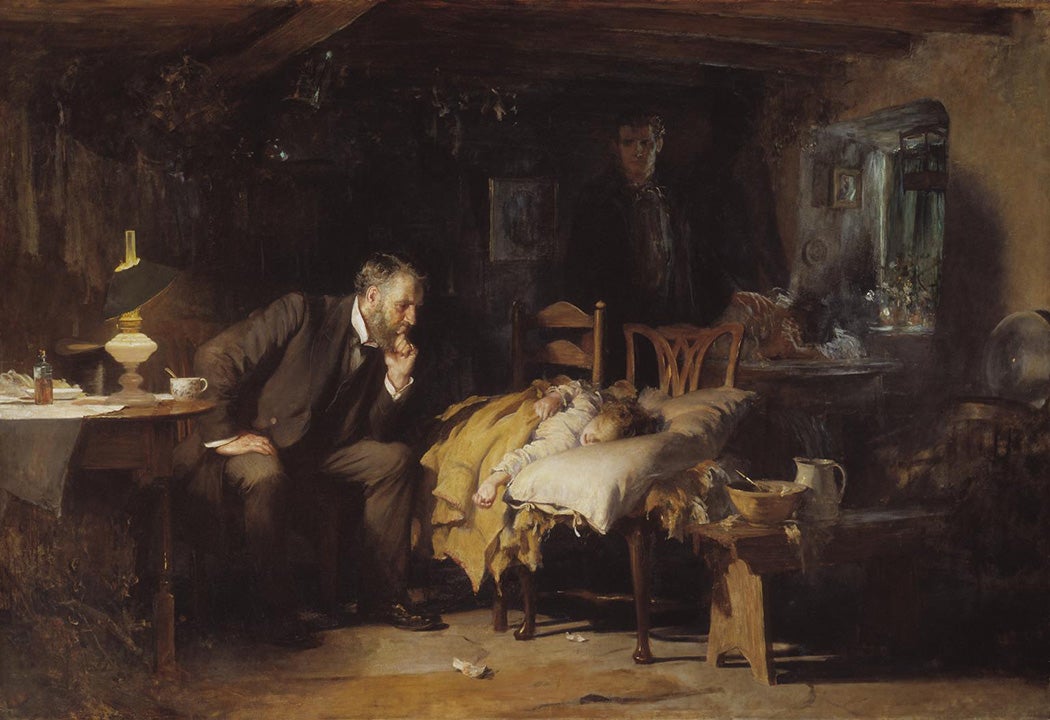
The Doctor, by British artist Sir Luke Fildes, was commissioned in 1890 by the sugar merchant and philanthropist Henry Tate and first exhibited in 1891. Fildes drew upon a profound personal tragedy in choosing his subject: the death of his one-year-old son, Philip, from typhoid fever on Christmas morning in 1877. The compassion and devotion of the attending physician, Dr. Gustavus Murray, made a lasting impression on Fildes and helped inspire his portrayal of the physician at the child’s bedside.
The painting depicts a doctor keeping vigil over a critically ill child in the family’s modest home. Although a number of diagnostic instruments—including the stethoscope and thermometer—were already established in medical practice by this time, they are notably absent from the scene. Instead, Fildes directs the viewer’s attention toward the doctor’s intense observation of the child and the relationship between physician and patient. The child’s parents remain largely in shadow in the background, while light draws the eye toward the patient and doctor.
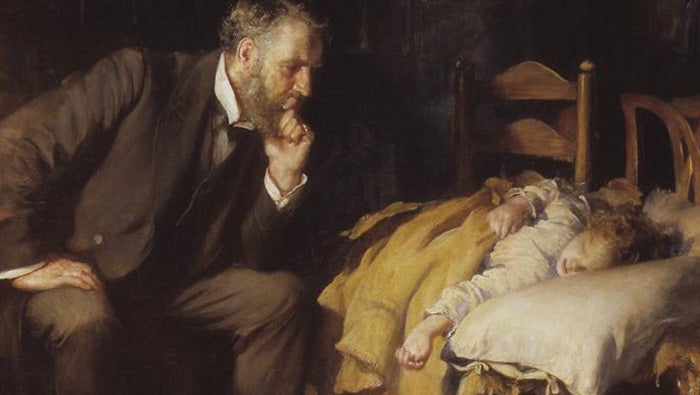
This combination of visible detail and deliberate ambiguity makes The Doctor particularly well suited to a lesson in close observation. Before students begin the activity, I provide very little historical context about the painting. Its background and possible meanings can be explored later; initially, students are asked simply to look. This allows them to encounter the painting on their own terms and to become aware of what they notice, what they overlook, and what they may assume.
Lesson at a glance
Course: Narrative Medicine
Grade Level: 11 and 12
Number and Length of Class Periods: One 1-hour class period (excluding pre-activities)
Number of Students: 10 – 25
Required Material and Technology:
1. A computer, whiteboard, and projector are preferred, but not required. A physical print of The Doctor will work well too.
2. Mini-whiteboards and markers for student use or paper and pencil.
Learning Objectives:
By the end of this lesson, students should be able to:
• Practice sustained visual observation by identifying fine details, spatial relationships, and other visual elements that may be overlooked during an initial viewing.
• Distinguish observation from interpretation by identifying what is directly visible and recognizing when assumptions or inferences are being made.
• Connect close observation to “radical listening” by applying the habits of attention, patience, curiosity, and openness developed through slow looking to the careful listening central to Narrative Medicine.
Pre Activity: One class prior to this class, watch the Google Talk from Amy Herman, based on her book, Visual Intelligence.
We also read together in class Virginia Seymour’s JSTOR Daily article, “Cultivating the Art of Slow Looking.”
Before the lesson: Introducing slow looking
Before beginning the activity with The Doctor, students are introduced to the practice of close visual observation through Virginia Seymour’s JSTOR Daily article, “Cultivating the Art of Slow Looking.” We read the article together in class, paying particular attention to Seymour’s invitation to resist the impulse to interpret an image immediately and instead spend time examining what is actually there. Her approach encourages viewers to look separately at the subject, foreground, and background, allowing details and relationships to emerge gradually.
Students also watch Amy Herman’s Google Talk Visual Intelligence: Sharpen Your Perception, Change Your Life based on her book Visual Intelligence. Herman’s work reinforces the idea that careful observation is a skill that can be practiced and improved, and that what we fail to notice can be as significant as what initially captures our attention.
Weekly Newsletter
"*" indicates required fields
At this stage, I do not introduce The Doctor or explain how these ideas will be applied to the painting. I want students first to encounter slow looking as a practice and then experience for themselves what happens when they put it to use. The following class moves from theory to practice as students apply these techniques to a sustained examination of Fildes’s work.
First look: What do you see?
Students gather closely around a large print of Sir Luke Fildes’s The Doctor. The painting may also be projected on a whiteboard or screen using the native IIIF viewer available on JSTOR. At this point, I offer no additional information about the painting or guidance about what students should be looking for.
Each student is given a mini whiteboard and marker and asked to spend several minutes silently observing the painting and recording everything they notice. Students do not share their observations during this initial period. This allows each student to encounter the image independently, without having their attention directed by what someone else has already noticed.
I encourage students to be as specific as possible and to continue looking even when they think they have exhausted what there is to see. The silence and sustained observation are intentional. Students often discover that after the most obvious features of an image have been identified, smaller details begin to emerge. This initial observation also provides a baseline that students can return to later in the lesson as they consider how—and whether—their way of seeing has changed.
Looking again: Putting “slow looking” into practice
After the initial observation period, students pause to consider how their experience compares with Virginia Seymour’s description of “slow looking.” I ask them to think about what happened as they continued looking after their first impressions had formed. Did they reach a point when they thought they had seen everything? Did additional details begin to emerge when they continued looking?
The goal is not to determine who has observed the painting “correctly,” but to demonstrate how sustained attention can complicate an initial impression and reveal information that was present all along.
Students then return to The Doctor, this time deliberately applying the approach introduced in the JSTOR Daily article. Rather than taking in the painting as a whole, they examine its subject, foreground, and background separately, continuing to record new observations on their whiteboards. This second look gives students an opportunity to put Seymour’s ideas into practice and to compare deliberate, sustained observation with their initial encounter with the painting.
After several minutes, I ask: What did sustained attention allow you to see that a quick glance did not?
Students begin sharing their observations with the class. As the discussion develops, details that may initially have escaped notice often emerge: the use of light and shadow, the figures in the background, the doctor’s top hat, the mismatched chairs, and the paper on the floor. Students also begin to recognize that their classmates may have noticed details they themselves overlooked.
The goal is not to determine who has observed the painting “correctly,” but to demonstrate how sustained attention can complicate an initial impression and reveal information that was present all along.
Observation or interpretation?
As students share what they have noticed, additional details often emerge. The figures in the background, presumably the child’s mother and father, may initially receive little attention because the viewer’s eye is drawn more immediately to the illuminated child and the doctor at the bedside.
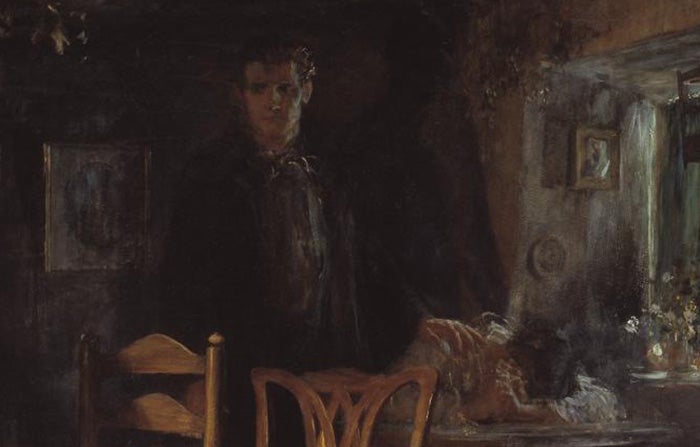
At this point, I introduce another distinction: the difference between observation (what is directly visible) and interpretation (what the viewer infers or assumes based on what is visible). As students describe the scene, I ask them to identify the visual evidence that supports their interpretations.
For example, a student might say, “The mother is devastated.” Rather than accepting or rejecting that interpretation, I ask: What do you actually see that makes you say that? Students may point to the woman’s lowered head, her posture, or the way she appears to lean toward the man beside her. We can then distinguish between the observable details and the meaning we have assigned to them.
The purpose is not to discourage interpretation. Interpretation is an essential part of making meaning. Rather, students begin to recognize how quickly an observation can become an assumption and how important it is to remain aware of the difference. This distinction becomes particularly significant later in the lesson when students consider what close observation and careful interpretation might mean when attending to another person’s story.
What’s missing?
After students have considered what they can see in the painting, I shift the question: What don’t you see? We return to the doctor’s intense focus on the child and look for the objects we might expect to find in a medical encounter. Students eventually notice the absence of visible medical equipment or diagnostic instruments. Although tools such as the stethoscope and thermometer were already in medical use when Fildes created The Doctor, none appears in the scene.
For contemporary students, the absence of technology also invites comparison with their own experiences of healthcare. There is no computer screen competing for the doctor’s attention, no electronic chart, and no visible barrier between physician and patient. The absence of visible medical technology draws attention instead to what Fildes has placed at the center of the encounter: the doctor’s sustained attentiveness to the child.
I then ask students to consider whether absence itself can communicate something. What does Fildes allow us to notice by leaving other things out?
What might “slow looking” have to do with narrative medicine?
Students are encouraged to think beyond the work. Just as a viewer can glance at an image, form an immediate impression, and overlook important details, we can do something similar when listening to another person. We may hear the beginning of a story and assume we know where it is going, interpret another person’s experience through our own expectations, or become so focused on what we expect to hear that we miss what is actually being communicated.
I then pose a second question: Can there be such a thing as “slow listening”?
Students consider what slow listening might require: resisting the urge to interrupt or immediately respond, remaining attentive to details, allowing for silence, recognizing assumptions, and being willing to reconsider an initial interpretation. We return to the distinction made earlier in the lesson between observation and interpretation and consider whether a similar distinction exists between what another person actually tells us and what we infer from what we have heard. Slow listening, or what Dr. Rita Charon, one of the founders of narrative medicine, refers to as “radical listening,” is one of the fundamental building blocks of narrative medicine.
This is the point at which the lesson moves most explicitly from visual literacy to narrative medicine. The skills students have practiced while looking at The Doctor—attention, patience, curiosity, and awareness of their own interpretations—become a way of thinking about what it means to attend closely to another person’s story.
Reflective writing and the final look
After considering what slow looking and slow listening might have in common, students turn the practice of attention inward through a seven-minute reflective writing exercise. I give them the following prompt: What is something important about you that might be missed by someone who wasn’t paying close attention?
Students write quietly for seven minutes. There is no expectation that they disclose anything deeply personal; each student determines what feels appropriate to share. The purpose of the exercise is to move the idea of attention beyond an abstract concept and allow students to consider what it feels like to be the person who is (or is not) fully seen by someone else.
More to Explore
How to Look at Art and Understand What You See
Virginia Seymour April 13, 2023 There are dozens of ways of looking at visual art. None of them are wrong, but certain methods facilitate deeper connection and understanding.
When the writing period ends, students are invited, but not required, to share what they have written. Voluntary sharing often adds another dimension to the lesson as students hear how differently their classmates have interpreted the same prompt. It also provides an opportunity to practice the attentive listening they have just been discussing.
Finally, we return to The Doctor one more time. I ask students to look silently at the painting before posing two final questions:
What do you see now that you did not see the first time?
Did the painting change, or did you?
By returning to the same image at the end of the lesson, students can consider not only whether they notice additional details but also whether the process of sustained looking, discussion, interpretation, and reflection has changed the way they encounter what was in front of them all along.
Closing discussion and assessment
The lesson concludes with a five-minute discussion centered on one final question: What does it mean to pay attention?
Students are asked to identify one lesson from the day’s experience that could apply beyond looking at art—to listening to another person, reading literature, interviewing someone, teaching, or caring for a patient. Their responses provide an informal assessment of whether they can transfer the practice of close attention beyond the visual exercise.
As a final exit reflection, students may complete the sentence: “Paying attention means more than noticing because…”This provides a brief written measure of each student’s understanding of the lesson’s central idea.
Homework: For next class, have students read the article “What a century-old painting taught me about being present as a physician today” by Bryan Vartabedian.
Activity Summary
Fifteen minutes:
1. Students will gather closely to observe a print of the painting The Doctor, by Sir Luke Fildes or it may also be projected on a whiteboard using this image.
2. Each student will be given a mini whiteboard and markers. They will write down everything they observe in the painting, without sharing with one another what they see.
3. We note the use of light and shadow to focus the observer’s attention on the patient, then the doctor. Only after studying the painting for a while do the other figures in the room, presumably the patient’s father and mother appear in the background. Other elements, such as the doctor’s top hat, the mis-matched chairs, and the paper on the floor may go unnoticed altogether.
Five minutes:
4. We discuss the doctor’s focus on the child, then students are asked what is missing in the painting. Eventually they notice that there is no medical equipment, no chart, no computer. Everything depends on the doctor’s keen attentiveness to his patient.
Ten minutes:
5. In-class writing assignment based on the following prompt:
“What is something important about you that might be missed by someone who wasn’t paying close attention?”
Ten minutes:
6. Students will volunteer to share what they have written. Before sharing begins, introduce the idea of “slow listening” or “radical listening.” Ask students to consider whether the same habits they practiced while looking at the painting—patience, attention, curiosity, and resisting immediate interpretation—can also be practiced while listening to another person. As classmates share, students are asked to listen without interrupting or preparing a response. Then ask: What did you notice when you listened in the same deliberate way that you looked?
Ten minutes:
7. Students will look at the painting one more time. They will be asked, “What do you see now that you did not see the first time? Did the painting change, or did you?”
Five minutes:
8. Closing discussion: What does it mean to pay attention? Students will be asked to identify one lesson from today’s experience that could apply beyond looking at art to listening to another person, reading literature, interviewing someone, or caring for a patient.
The post appeared first on JSTOR Daily.