Algae Safety In Home Experiments: Thinking about risk for good practice

Here are my reflections on the safety of working with algae strains in my current lab setting. I am a Bayesian and think that probabilities are ultimately subjective. Therefore my views on risk are formed within that philosophical framework. I am not a medical professional nor is this advice. These are just my personal notes.
Working with chlorella vulgaris
It is probably safe to work with the chlorella vulgaris algae strain in a home lab setting. I've grown it in the bioreactor several times¹ without any personal health incidents so far. But this is clearly conditional on how I've used it; I don't drink the samples that I receive. I generally minimise exposure. I keep the algae separate from my kitchen or anything edible. After I work with it I wash my hands, and keep the tabletop clean.
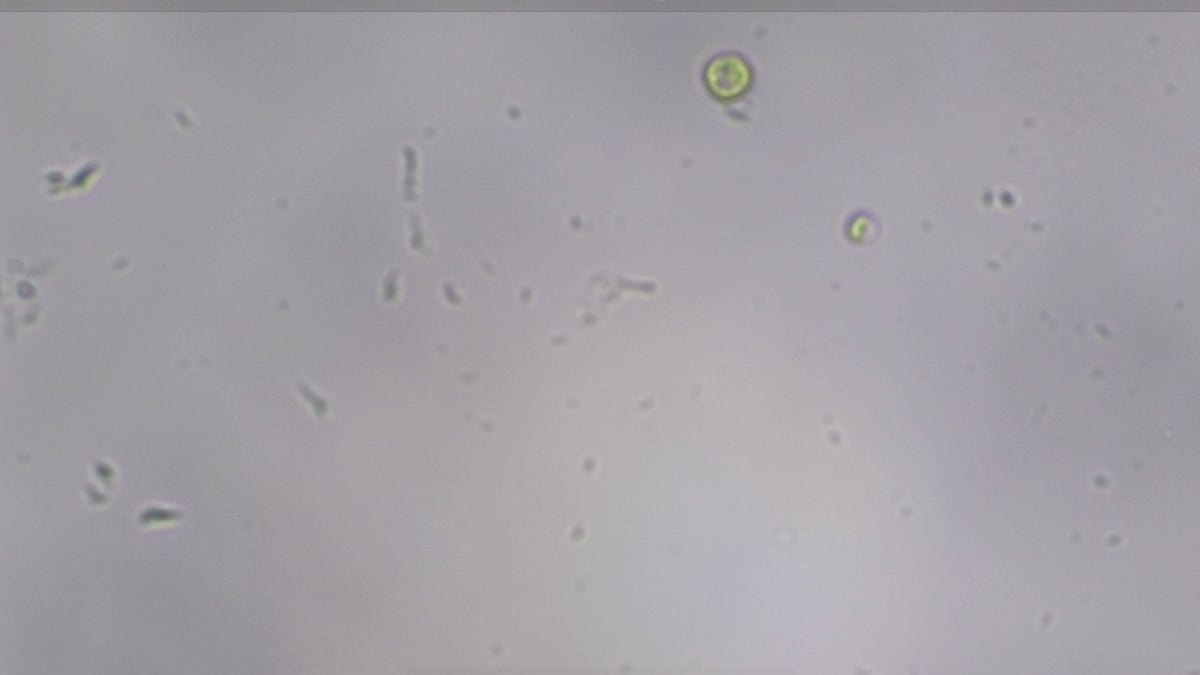
Here is an image of chlorella vulgaris that I took with my Swift T380 microscope².
There are also secondary reasons behind the decision that this is low risk. I wouldn't call these mechanistic pieces of evidence, but I think they are worth considering.
First, chlorella isn't in the pathogenic category of the HSE executive report³. As such, Chlorella vulgaris is sold by high school suppliers for experiment purposes. It is also easily available online. Both of these facts provide 'proxy' evidence for safety - if chlorella wasn't safe, then this state of affairs would be unlikely.
The number of cases reported of chlorella causing issues is lower than my baseline number of reports if something were pathogenic. I got Claude to compile a numerical tally of cases. The number is low, and these reports seem to have occurred in specialised circumstances. The table is below.
There is one interesting paper dug up from 1994⁴ about an asthma case at a factory producing Chlorella tablets in Singapore, but I'm discounting this. Even if this was the case, it's likely that the exposure was much higher than my lab setting. Also, there are no dry powders that I'm dealing with that I inhale.
Claude references only two reports of infection, but both of these coincide with wounds or trauma in freshwater.
My subjective view is that growing chlorella is closer in risk to culturing yeast in sourdough, versus riding a motorcycle. If I am willing to ride a motorcycle, then I should be willing to grow some algae!
Investigating the safety of other strains
There are two more strains that I want to try to culture - Scenedesmus quadricauda and Dunaliella salina. Scenedesmus quadricauda is freshwater algae that I've recently ordered. Dunaliella salina is saltwater algae that I plan to order soon.
These strains also appear low risk. But I still wanted to do some due diligence on the safety of each of these strains. I asked GPT Astra about this:
GPT Astra references the safety rating that the Culture Collection Of Algae and Protozoa (CCAP) give to their own samples. The CCAP is a British supplier of biological samples.
To make a bigger sample, I got Astra to scrape the rating of each strain from the CCAP website, as well as the American ATCC (American Type Culture Collection) classification. Both organisations self-rate each of these algae strains as either British Hazard Class 1, or American BSL 1. This is the lowest risk classification for both organisations, and the table is below.
I then manually checked each website to make sure there was no hallucination by the LLM in scraping. The following tables are screenshotted from the CCAP website for Scenedesmus quadricauda, and Dunaliella salina, respectively.
The CCAP classification of Hazard class 1 is described in a British Health and Safety Executive document here, as 'Unlikely to cause human disease'. In the executive document, organisms labelled as hazard class 1 aren't listed. Only organisms of level 2 and above are there, and none of the strains above were mentioned. The classifications done by the CCAP are self declared.
This makes me think these two strains are low risk to handle.
Other risks
Nothing is truly risk free. First, there is the risk that you don't get what you order. I generally check samples with a microscope to confirm what I've ordered. But before that step, the only fix is supplier trust.
The second risk is that the sample isn't completely pure. As with any biological sample, it's hard to avoid contamination. It's likely that other bacteria or organisms might be present in the sample. And so we have secondary risks from other organisms coinciding with the sample. At the moment, this is the biggest risk but I still think it's low. The evaluation of such risks will be dedicated to a different blogpost.
The problem of trust and also the purity of samples is something I'd like to write more about in this blog - stay tuned! Also bear in mind that I don’t know what I don’t know.
References
Suppliers - none of which are endorsements
- Blades Biological
- CCAP catalogue (Culture Collection of Algae and Protozoa, SAMS, Oban)
- ATCC (American Type Culture Collection)
Links
- Blades Biological product pages: Chlorella vulgaris, Scenedesmus quadricauda, Dunaliella salina
- Blades Biological care sheets: Algae and Protozoa Care Sheet, Complete Guide to Culturing Scenedesmus, Growing Scenedesmus Quadricauda: A Beginner's Guide
- CCAP strain pages: CCAP 211/11B, CCAP 276/21, CCAP 276/4B, CCAP 19/18
- Blades Biological terms and conditions ("Care Of Goods & Specimens")
- ATCC product pages: ATCC 30821, ATCC 11460, ATCC 30861
- CCAP prices and hazard notes
References
¹ So My Friend Made Me A Bioreactor...; An Agentic Home Bioreactor; Calibrating Algae Grower Mini-fridge system
² I Observed Some Brownian Motion At Home
³ Advisory Committee on Dangerous Pathogens, The Approved List of biological agents, Health and Safety Executive, sixth edition, 2026.
⁴ Ng TP, Tan WC, Lee YK. Occupational asthma in a pharmacist induced by Chlorella, a unicellular algae preparation80344-0). Respiratory Medicine 1994; 88: 555–557.

 点赞
 收藏
 点踩
 分享