Can We Eat Our Way Out Of An Ecological Disaster?

When Rachel Bowman first tried to bring lionfish to restaurants and grocery stores in the Florida Keys in 2012, it was a hard sell. “We weren’t getting that much money for them, and it took a little convincing,” says the commercial lionfish hunter. That’s because the invasive lionfish—flamboyant enough that Bowman likens it to a Mardi Gras drag queen—wasn’t traditionally on the menu.
Native to the tropical waters of the Indo-Pacific, lionfish have infiltrated the western Atlantic, Caribbean, and Gulf of Mexico, where they have become a destructive invasive species ever since the first was recorded near Miami in 1985, likely after being released from the home aquarium trade. With few predators in these new habitats, a single fish can produce more than 2 million eggs a year. Studies have found that just one lionfish can reduce the replenishment of native fish populations on some reefs by nearly 80%.
In 2016, Bowman sold the first lionfish to Whole Foods in South Florida. “That was the ground-breaker,” she says, “because if Whole Foods is promoting something, then people know it’s good. We went from $2 per lb. to $10 per lb. pretty much overnight.” Now, 10 years later, through Keys Fisheries, her fish is sold in stores, and lionfish appears on restaurant menus throughout the area—and in doing so, millions of native reef fish have been saved from predation.
Bowman’s work is part of a growing trend that’s not just about introducing new dishes to the local food scene; creating a market for invasive species may also bring ecological benefits for the local environment.
Invasive species are considered one of the five most critical direct drivers of biodiversity loss, according to the Intergovernmental Science-Policy Platform on Biodiversity and Ecosystem Services (IPBES), whose most recent report in 2023 notes that the global economic toll of dealing with these species cost more than $423 billion in 2019. Once established, invasive species are often impossible to eradicate because they reproduce rapidly, spread across vast, interconnected environments, and often go unchecked until they are established. And the challenge of managing invasive species is particularly acute in the ocean, says Helen Roy, a professor at the U.K. Centre for Ecology & Hydrology and the University of Exeter and a co-chair of the IPBES assessment. It’s a consequence of the openness and connectedness of marine systems, she says.

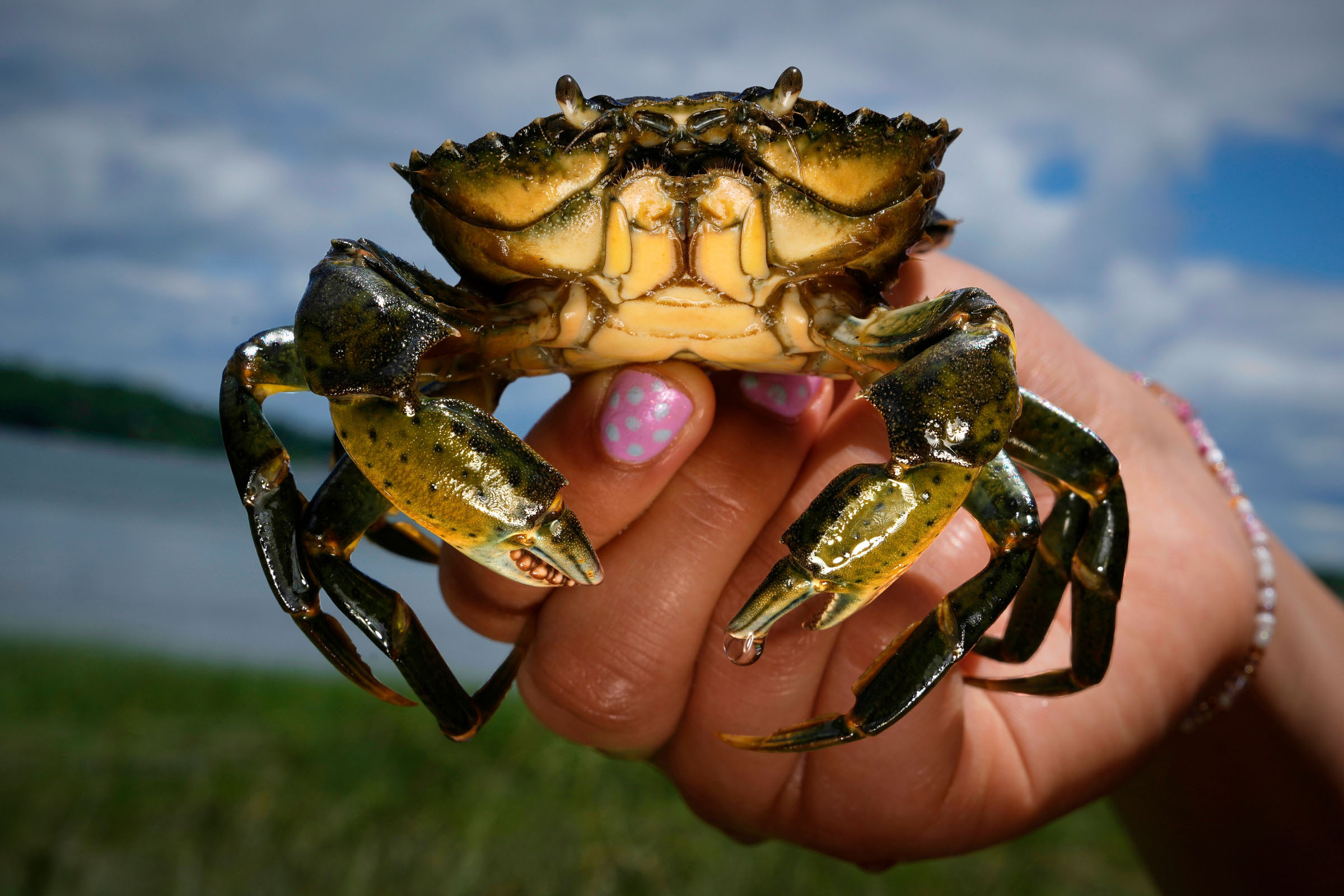
In 2004, conservation biologist Joe Roman coined the term “invasivorism” to describe the idea of eating invasive species to help control their populations. Since then, a growing movement across North America is attempting to transform ecological menaces into culinary commodities, from Florida to Hawai’i, British Columbia, Maine, and the Mississippi River basin. That movement is still expanding: in 2025, for example, 70 restaurants and fish markets across the U.S. participated in Green Crab Week, a national campaign encouraging diners to eat the invasive European green crab.
The goal, says Isabelle Côté, a marine ecologist at Simon Fraser University, is often “functional eradication”: reducing an invasive population to a level where its ecological impacts are considered acceptable. That’s where our dinner tables can help, by turning the removal of the species into an economic opportunity.
David Standridge’s philosophy is all about harvesting what’s plentiful and turning it into something delicious. Since 2022, the James Beard Award-winning executive chef of The Shipwright’s Daughter in Mystic, Conn., has processed more than 10,000 lbs of green crab, making it a menu mainstay.
Commonly considered one of the world’s worst invasive species, the green crab has successfully invaded every continent except Antarctica. The species, native to Western Europe and Africa, has few predators, aggressively hunts its prey, and can consume a wide variety of shellfish, including oysters, clams, mussels, lobsters, and other crabs. One crab can eat more than 40 juvenile soft-shell clams in a day, while also destroying seagrass habitats. And a single green crab can produce up to 185,000 eggs per year, while its larval life stage allows young crabs to drift considerable distances in ocean currents, spreading from one invaded area to another.
Rather than a nuisance, Standridge describes the green crab as tremendously flavorful, producing a beautiful stock that can be used across dishes. “We use them not to eliminate green crab, but to take some pressure off the ecosystem,” he says. Getting green crab onto the menu, however, wasn’t so straightforward.
When Standridge first tried to source the species in 2020, he discovered that Connecticut, like many states, classified green crab as bait and technically couldn’t be sold for human consumption. He finally found a supplier to help in 2021, and then in 2025, a change to a single line of state code allowed green crab and other species on the bait list to be harvested and sold as food. Parks says the market is beginning to take shape. Suppliers across New England now regularly carry green crab alongside other seafood, making it more accessible to chefs.
The green crab’s global spread is only expected to increase with climate change, says Mary Parks, executive director ofGreenCrab.org, a nonprofit organization building culinary markets for the invasive species while raising awareness of its impact. “We used to have these really cold winters and those helped keep green crab populations in check,” says Parks. “But with winters getting warmer and warmer, that population control got taken out of the picture.”
On the other side of the continent, in 2020, the first green crabs were detected on Haida Gwaii, an archipelago off the coast of British Columbia. To slow the species’ establishment, the Council of the Haida Nation launched a full-scale trapping and mitigation program. Over five years, 36 crews removed nearly 2 million crabs, including more than 1.3 million from the Honna and Tarundl estuaries alone. The scale of the invasion has made control difficult, and harvester and marine economic development coordinator Eli Gladstone hopes a viable market for the crabs could help reduce their numbers. But he cautions that commercial demand alone won’t be enough: trapping will also need to become more efficient, and some continued public investment may be necessary.
Communities across the U.S. have been grappling with the ecological and economic impacts of introduced species for decades.
In the 1950s, bluestripe snapper, also known in Hawai’i by its Tahitian name, ta’ape, was introduced to O’ahu, when roughly 3,000 fish were released to bolster fishing opportunities and establish a new food source. But ta’ape, native to the South Pacific, never became a sustained part of Hawai’i’s seafood market. By the 1980s, the overabundant fish was largely considered a “trash fish,” prompting the state’s Department of Aquatic Resources to launch a market-development project in 1985 that used consumer education and supermarket promotions to try to build demand. The effort failed to gain lasting traction: supply was inconsistent, and demand tapered off after the project ended.
Freediver and spearfisher Kimi Werner has seen firsthand just how dramatically the ta’ape has come to dominate the reefs. Where schools of snappers in their native ecosystems might number just a handful, she says Hawai’i’s ta’ape, with its electric-blue stripes and lemon-yellow skin, can blanket the seafloor. “You can see the power of numbers taking over these habitats where native fish belong,” she says.
Since 2019, Conservation International Hawai’i, in partnership with local businesses and organizations including the nonprofit Chef Hui, has been trying to turn that abundance into an opportunity: promoting ta’ape as a food source to reduce its numbers while supporting local fishers and food security. The approach is starting to resonate across Hawai’i’s tourism industry, says Jhana Young, sustainable seafood senior manager with Conservation International Hawai’i. Hotels now serve the fish to staff and guests; Hilton Hawaiian Village alone purchases about 500 lbs a month. In 2025, an average of 27 commercial fishers sold approximately 42,000 lbs of ta’ape statewide, 47% more than in 2018. And a March 2026 “Eat the Invaders” tournament removed more than 1,200 lbs of invasive reef fish from Maunalua Bay in a single weekend, nearly 90% of it ta’ape. Where fishers once received an average of just $0.65 per lb. for ta’ape in the 1980s (about $2.63 today), says Young, today some O’ahu fishers receive as much as $6 per lb.
“When we started, ta’ape was a fish people threw back or used for bait,” says Amanda Corby Noguchi, co-founder of Chef Hui. “Now we regularly get organizations, schools, and hotel properties reaching out to us wanting to be part of it, not the other way around.”

But creating a market for an invasive species also raises the question of whether it can genuinely serve conservation goals—or simply become another fishery. Young argues that it can redirect existing fishing pressure toward a species whose removal benefits the ecosystem. “Fishers are always going to fish. By helping create markets for a species that didn’t exist before, it helps point fishers in the direction of a choice that is ultimately better for nature’s long-term balance.”
More than 4,000 miles away, in the lower Mississippi River basin, Asian carp populations have proliferated since the species was imported to the U.S.from China in the 1970s. They were brought in to control nuisance algae in wastewater-treatment plants and aquaculture ponds, as well as for human consumption. Within a decade, they had escaped confinement and spread into the Mississippi River basin and its major tributaries, including the Illinois and Missouri rivers, disrupting aquatic food webs, harming native fish communities, and interfering with commercial and recreational fishing. The invasive Asian carp is one of the most urgent, far-reaching, and complex environmental challenges facing the U.S., according to the U.S. Fish and Wildlife Service (USFWS). And experts now worry about their potential to reach the Great Lakes.
For Angie Yu, founder of Two Rivers Fisheries in Wickliffe, Ky., the potential of invasive carp was obvious. Yu grew up in China, where carp is a dietary staple—so commonplace, she says, that it is eaten “just like chicken.” When she first read about the Asian carp problem in 2010, she saw an opportunity others in the U.S. had largely overlooked: a fish considered “trash” by many Americans but which had an established market in Asia. She began connecting the fish with Asian markets, eventually exporting to 12 countries. Before the pandemic, nearly 90% of the company’s products were destined for overseas markets. But then shipping disruptions, rising fuel costs, and steep international tariffs made exporting increasingly difficult, prompting Yu to turn her attention to building a domestic market. She has since developed a use-everything model for the fish, making meatballs, patties, dumplings, along with pet food, as well as fish meal and fertilizer from the trimmings, guts, and other waste, while finding uses for the skin and bones. Her carp is now sold in Asian supermarkets across the U.S., and her processing plant can handle up to 40,000 lbs of carp a day. “The fish is not trash,” she says, “it’s a treasure.”
The question now is whether commercial demand for invasive Asian carp can grow large enough to meaningfully reduce their populations. For Peter Stoett, a professor at Ontario Tech University and co-chair of the IPBES Assessment on Invasive Alien Species and Their Control, the key is to “measure the population, not the market.” A growing commercial fishery, more restaurants serving an invasive species, or thousands of pounds harvested may signal that a market is working—but not necessarily that the ecosystem is recovering. Reductions in an invasive species’ numbers or biomass, he says, are the clearest indicators of whether management is working. But measuring that requires sustained monitoring: “Money must be spent monitoring these populations or we won’t know if targets are being met.”
Stoett argues that if a market is used to encourage removal, the commercial activity should exist because the species needs to be reduced, contained, or eradicated—not because the goal is to establish a sustainable fishery for that species. In other words, the conservation objective has to come first, with the market serving as a tool rather than becoming the goal itself. As populations decline, he says, there needs to be ongoing dialogue among scientists, industry, local communities, and government about whether incentives should continue, change, or eventually end.
In Kentucky, there is some evidence that removal efforts are having an effect. The Kentucky Department of Fish and Wildlife Resources has increased its fishing incentive to $0.15 per lb. for invasive carp harvested from Kentucky Lake and Barkley Lake, citing evidence that management efforts are reducing populations in both lakes. Most of the carp processed by Yu comes from those same two lakes. Meanwhile, according to a USFWS spokesperson, around 30 million lbs of invasive carp are removed from Midwestern waters each year.
The idea of harvesting and eating invasive species can sound like an elegant solution: turn an ecological problem into dinner and let appetite do the work. But Roy cautions against treating consumption as a panacea for control. The ecological payoff from harvesting is rarely proportional to the share of a population removed. Taking half of a population, for example, does not necessarily mean halving its impact on the ecosystem.
That does not make the markets emerging around lionfish, green crab, ta’ape, and carp meaningless. They can provide food and income, engage communities and, in some cases, redirect fishing pressure toward invasive or overabundant species whose removal can benefit ecosystems. But Roy stresses that these benefits must be considered separately from the ecological damage caused by an invasion: “There’s no simple sum here.”
Creating demand could theoretically give people an incentive to keep an invasive species abundant, although Côté says she is not aware of evidence that this has happened. And while “nothing beats prevention,” says Stoett, once an aquatic or marine invasion is established and containment is the only realistic option, a market for their safe consumption could provide another tool—one whose economic benefits can be weighed against the ecological impacts of the invasion. The goal, ultimately, is not to eat our way out of an ecological disaster. It is to make sure that, when we eat an ecological problem, we are actually helping to reduce it.
In front of foraging chef Robin Kort’s home on Galiano Island in British Columbia’s Salish Sea, is a sea urchin barren—an underwater desert where kelp once swayed but has since been devoured by the urchins that cover the seafloor like a spikey carpet. Unlike lionfish or Asian carp, red and green sea urchins are native to the region. But when their populations become too abundant, they can have invasive-like effects.
Urchins are remarkably effective grazers. Marine ecologist Anne Salomon, a professor of applied marine ecology and social-ecological system science at Simon Fraser University, says urchins and kelp can coexist when food is plentiful. But when food becomes scarce, urchins form what she calls “active feeding fronts,” stripping away vegetation that provides food, shelter, and habitat for a wide range of marine life. Selective harvesting can help restore kelp forests, Salomon says, but doing so effectively requires sustained effort.
“We have this commercial fishery around sea urchin, and we have, in Vancouver, a huge population that likes eating them,” says Kort, who calls uni “the parmesan of the sea,” describing it as cheesy, creamy, and versatile enough for both sweet and savory dishes. Last year, Kort helped launch an Eat the Invaders event, bringing chefs together to channel people’s appetite for delicious food by cooking with invasive and overabundant species. Part of her effort is to incentivize more harvesting of the older, less desirable but more destructive urchins. “Humans’ greatest power is the amount of stuff we can eat, basically, if we want to,” she says. “So can we use that superpower for good?”

 点赞
 收藏
 点踩
 分享