From Story Seeds To Stories, And Writing An Author’s Note, With Joanna Penn

How do you find and notice story ideas, and how do you turn those into short stories, novels, or as anecdotes for your non-fiction or memoir? Why is an author's note so important in an age of AI, and what might it contain? Joanna Penn shares her thoughts, and her short story, The Black Church, along with its author's note.
In the intro, Ebook Preorders on Smashwords; Two titles per week on Amazon KDP; AI-related Digital Publishing Awards at Frankfurt Book Fair [Publishing Perspectives]; AI webinars in November; JFPenn YouTube;
This show is also supported by my Patrons. Join my Community at Patreon.com/thecreativepenn
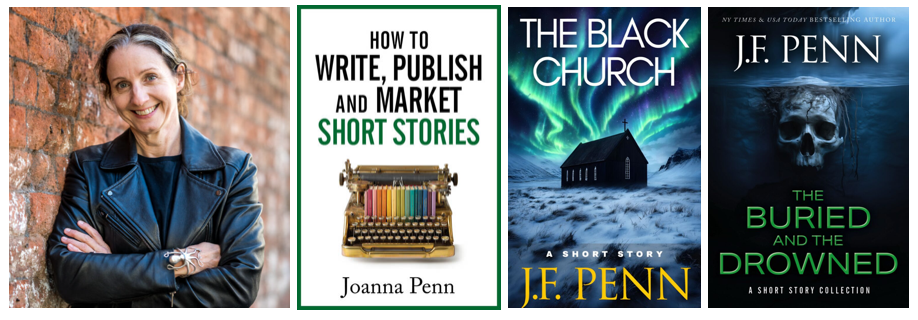
Joanna Penn is an award-winning New York Times and USA Today bestselling author of thrillers, dark fantasy, short stories and travel memoir under J.F. Penn and also writes non-fiction for authors and hosts The Creative Penn Podcast.
You can listen above or on your favorite podcast app or read the notes and links below. Here are the highlights and the full transcript is below.
Show Notes
- From story seeds to stories
- Writing an author's note
- The Black Church, a short story, available as a stand-alone or as part of The Buried and the Drowned collection.
- Author's Note for The Black Church
You can find How to Write, Publish, and Market Short Stories on all platforms, in all formats: www.TheCreativePenn.com/shortstorybook
From story seeds to stories
One of the most common questions that writers get asked is ‘Where do you get your ideas?’ This is a strange question for many of us, since we are often so deluged with ideas that the difficulty is sifting out which ones to turn into a story.
The trick is to tune into your curiosity and start noticing what grabs your interest. As Elizabeth Gilbert writes in Big Magic,
“The universe buries strange jewels deep within us all, and then stands back to see if we can find them.”
What do you see that others don’t? What turns your head while others pass by? What do you want to learn more about? What questions come up for you? What obsessions do you keep returning to? Each of these may be a fragment, a word, or a few lines. I call these story seeds.
An idea, in its earliest form, is like a seed. It’s small, easy to miss, and nothing like the thing it might grow into. You literally can’t tell what it will look like when it’s grown, but there is potential in it.
A seed isn’t a plot, or a character, or a full setting. It might be a line in a book or a film, a headline in the news, something you see in a museum display, or a place that made you feel something. It might be a question that bubbles up, or a feeling that won’t let you go.
You just have to notice these seeds and, importantly, write them down!
Capturing your story seeds
Thoughts and ideas and story seeds will flit through your mind all the time if you let them, but they are fleeting, so you need a way to capture them before they leave once more. It doesn’t matter how you do this, but you need some kind of simple process.
I use the Things app on my iPhone, which syncs to my Mac so I can always access it. Other people use a note-taking app or a physical notebook. It doesn’t matter. You just have to get it down.
My story seeds are often one-liners, quotes, or links to articles I’ve seen that I want to investigate later. They might be passages from books I have underlined, or places I visit, or questions I have while out in the world.
Here are a few examples from my Fiction Ideas file that might even spark ideas for you:
- United Arab Emirates plans world’s first underwater bullet train connecting Dubai to Mumbai
- L’appel du vide. The call of the void. The compulsion to jump.
- “Vengeance of the lost garden.” Ben Okri. A Fire in My Head
- Noah’s Ark on the moon, like the Svalbard seed bank
- The Wicked Bible. Printing error. Thou shalt commit adultery. 1631.
You can see that these are not fully formed ideas. They are just seeds. Most will lie dormant, but some will sprout, appearing in stories or books years later.
When I’m thinking about writing a new short story, I sometimes go to a cafe and sit with a coffee and scroll through my seed folder and notice patterns and see what strikes me as interesting. Sometimes I won’t even know an idea came from a seed I once found, but I look at my list later and discover I had thought about it once before. It’s a wonderful way to plant ideas and later find they have grown into something wild and curious.
If you haven’t already got a way to capture your story seeds, establish a simple process now. Don’t overthink it. Just start noticing and writing them down. They might not make sense at the moment, but they may flower later.
Searching for story seeds
Julia Cameron discusses the idea of an Artist’s Date in her book The Artist’s Way, and this practice has always been important to me. It involves taking time out on your own to go somewhere and fill your creative well, whatever that means to you. For me, it’s often travel to interesting places or visiting museum exhibitions that I know will have nuggets of fascination that may result in full blown story seeds.
On the morning of my fiftieth birthday, in March 2025, we woke up in Iceland next to the Black Church at Búðir on the Snæfellsnes Peninsula, a few hours’ drive northwest of Reykjavík. The small church and graveyard sit on a bed of ancient lava under the gaze of a glacier and there is a sense that time has stopped in this place. As we walked around the church that morning, the place itself became a story seed, and I later wrote The Black Church from that spark.
On the cheaper end of the inspiration spectrum, I often go to the British Museum in London seeking story seeds and over the years, it has provided much inspiration for fiction of different lengths.
An exhibition on religious relics inspired Crypt of Bone, a Viking collection appeared in Day of the Vikings, and one of the main characters in Desecration works as a researcher there. In terms of short stories, a sunken Egypt exhibition inspired The Dark Queen and I saw the actual Bronze Age wooden spars of Seahenge at an exhibition on the ancient world. If you follow your curious impulses, you will find story seeds everywhere.

 点赞
 收藏
 点踩
 分享