Bangladesh’s Vital Garment Industry Struggles Amid Global Energy Crunch

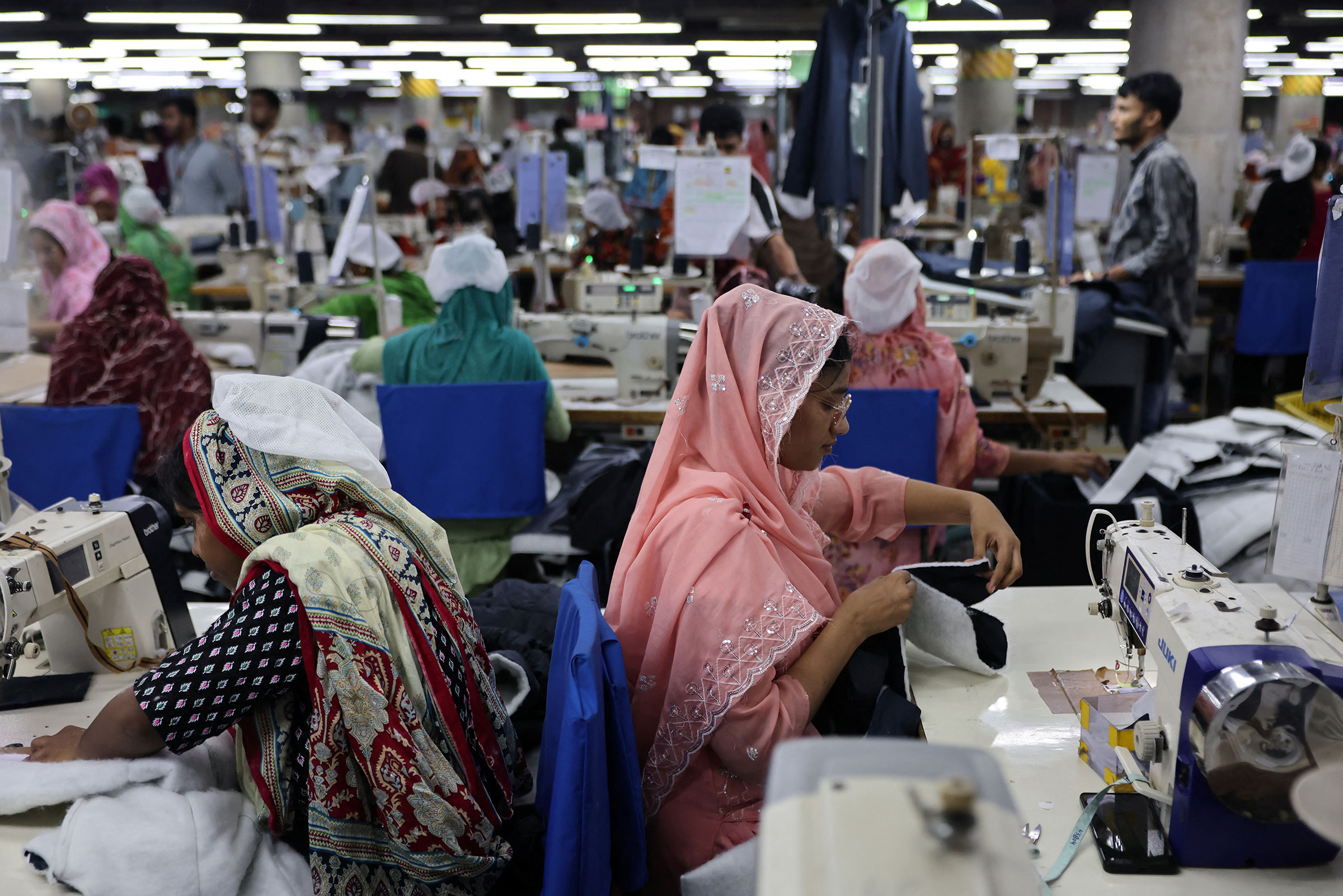
It’s 11 a.m. at Ha-Meem Group’s Ashulia garment factory north of Dhaka and every floor is a whirlwind of feverish labor. Industrial jigsaws slice stacks of denim into precise panels, which nearby seamsters then stitch into jeans, skirts, and jackets.
Next comes washing, ironing, and affixing buttons and zips before the brand labels are attached—Gap, American Eagle, and JCPenney are major clients—and the finished garments are stacked into boxes by some of the group’s 90,000 staff, who together produce 9.3 million apparel items every month.
Read more: What Bangladesh’s New Leader Tarique Rahman Means for South Asia and the World
But suddenly the lights flicker, the workshop dims for a moment, and then full illumination returns accompanied by four cacophonic British-made diesel generators, which automatically splutter into life whenever the gas supply weakens.
“In Bangladesh, the grid electricity is bad, there are frequent interruptions,” says Tanul Chakraborty, head of power, energy and environmental sustainability for Ha-Meem Group. “After gas the most reliable energy in Bangladesh is diesel. Grid electricity is third. Almost the entire economy moves on diesel.”
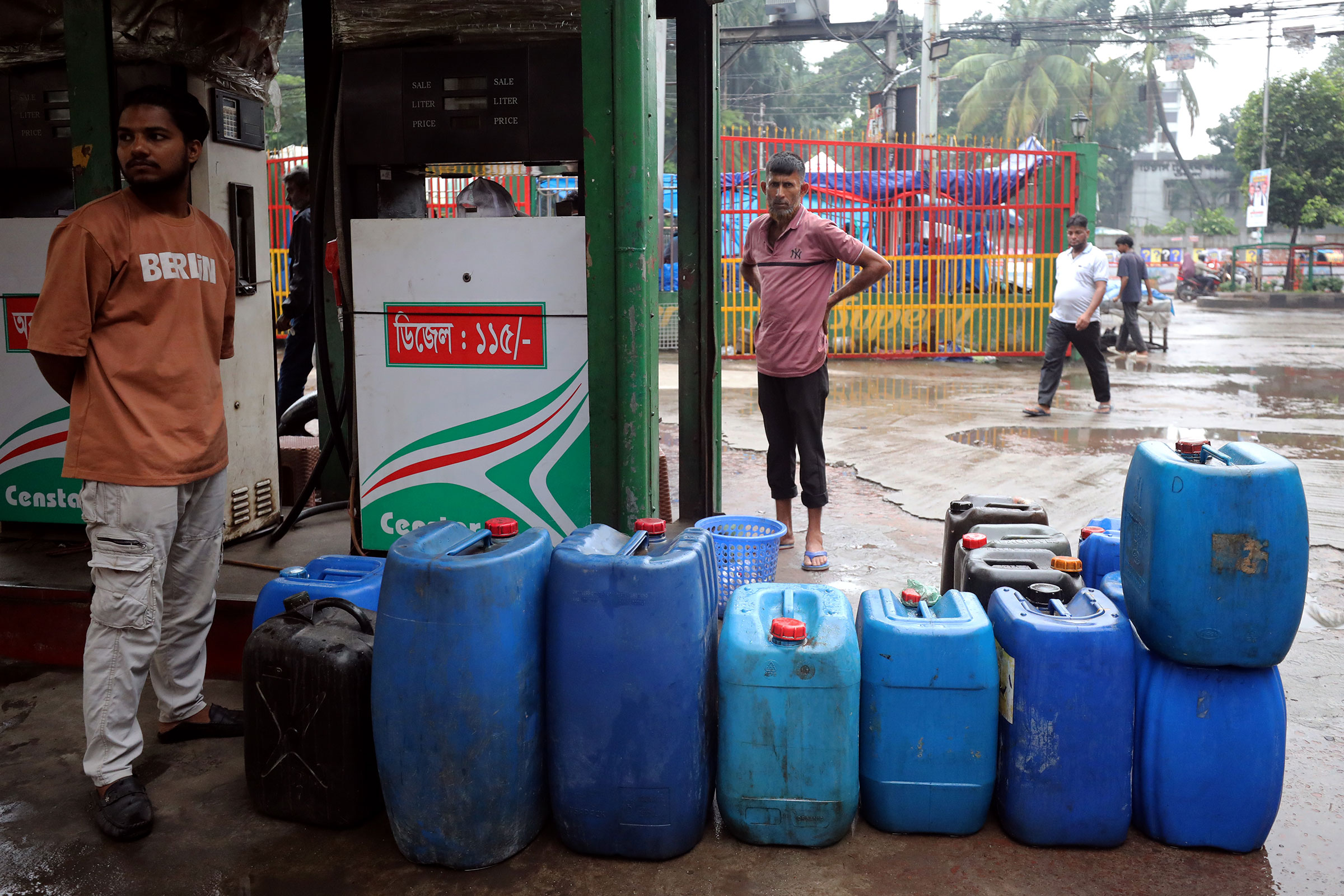
It’s a startling admission given that Bangladesh’s economy is worth $510 billion, South Asia’s second-largest after India. But the nation is in the grip of a severe power crunch, as wars in Ukraine and Iran expose the fragility of its growing dependence on imported fuel. Since Russia’s invasion, industrial gas prices have risen by 150%, and diesel by about 70%. Since the Iran war began, the cost of spot liquefied natural gas (LNG) has nearly tripled.
That’s bad news for a garment industry that is the country’s largest source of formal employment, directly providing 4 million jobs and supporting countless more livelihoods, while generating $38.7 billion last year—over 80% of export earnings. (Ha Meem alone accounted for $1 billion of exports.)
But the strain extends across the Global South, where developing nations struggle with a prolonged energy crisis that disproportionately squeezes the planet’s most deprived. In the Philippines, heavy dependence on imported Gulf oil has forced emergency conservation measures, including four-day working weeks, restrictions on official travel, and flight cancellations. Diesel prices have risen 86% in Nigeria and more than 50% in Tanzania and Ethiopia, driving up the cost of farming, trucking, and electricity from generators—and, in turn, the price of staples such as rice and corn.
“The poorest people, who spend the highest share of their income on food and fuels, will be hit the hardest,” Indermit Gill, World Bank Chief Economist, warned in April.
In Dhaka, a sprawling megacity of almost 40 million that is usually defined by relentless momentum, the nights have grown eerily dark. With the national power shortfall exceeding 3,000 megawatts, the government has imposed sweeping cuts, exempting only essential services such as hospitals and pharmacies. Illuminated billboards along busy commercial corridors now dim soon after sunset, while shops close an hour early. The burden is even heavier in rural villages, where residents have recently endured blackouts lasting as long as 16 hours a day.
For ordinary citizens, daily life has become a relentless calculus: Residents are forced to rise before dawn in the hope that their stove's gas pressure might be strong enough to cook. Other quandaries include how long they can run a fan against the suffocating humidity, and how far the queues will stretch at the gas station. As businesses flounder, a secondary crisis looms: global malnutrition monitors warn that 18.1 million Bangladeshis may soon face food insecurity.
Internal missteps have only tightened external bottlenecks. The country of 175 million drastically underinvested in both transmission infrastructure and domestic gas fields, meaning today it relies on imports from the Middle East for almost half of its energy. But between July and August, imports of LNG plummeted 83% largely owing to disruption around the blockaded Strait of Hormuz as well as a blaze that temporarily disabled one of its two floating regasification terminals.
Last month, thousands of opposition supporters staged a long march to pressure Prime Minister Tarique Rahman—who only took office in February, just weeks before the Iran war broke out—to do more to tackle soaring fuel costs.“Energy is the biggest test for the new government and has become a galvanizing point for the opposition,” says Michael Kugelman, resident senior fellow for South Asia at the Atlantic Council.
While the global energy crisis is tied to geopolitics, Bangladesh’s woes are uniquely entwined. Rahman’s Bangladesh Nationalist Party took power following the popular ouster in 2024 of autocratic former Prime Minister Sheikh Hasina, whom India granted sanctuary, deepening the rift between the neighbors.
Bangladesh imports roughly one-sixth of its electricity from India, which hasn’t been shy in wielding that strategic vulnerability as diplomatic leverage. Compounding the disruption, many of the key architects of national energy policy over Hasina’s 15-year reign have been placed on special duties ostensibly due to their ties to her Awami League party.
Bangladesh also finds itself hostage to shifting Great Power rivalry beyond its neighborhood. Dhaka invested $12.65 billion—chiefly via Moscow-backed loans—in its first nuclear power station in the town of Rooppur built by Russian energy giant Rosatom. The plant was supposed to begin operations in July 2024 but faced repeated delays due partly to the Ukraine war, which complicated payments to Russian banks and blocked the arrival of air and maritime cargo. After finally completing its first controlled nuclear reaction on Oct. 11, it is now expected to go into service in December, although months of staged testing will be required before it reaches a touted output of 1,200 MW.
Complicating matters, the U.S. Sanctioning Russia and Iran Act comes into force on Oct. 18, with provisions including sanctions on senior Russian officials and businesses supporting Russia’s energy sectors. This could mean Dhaka has to secure specific U.S. Treasury waivers or approved payment channels to service its plant debt and buy nuclear fuel.
Meanwhile, Washington is dangling its own alternatives. On Sept. 25, Bangladesh and the U.S. signed a memorandum of understanding (MoU) on strategic civil nuclear cooperation that focuses on small modular reactors. That comes on top of an Agreement on Reciprocal Trade inked in February that committed Dhaka to massive purchases of U.S. commodities, including $15 billion worth of U.S. energy products over a 15-year period.
But Bangladesh is also looking to Washington’s superpower rival. Rahman’s first overseas trip in June was to Malaysia and China. In Beijing, the two nations signed 17 agreements and other instruments to mark a “new era” of bilateral relations, with one explicitly covering renewable energy cooperation. But two of the agreements involved corporate groups subject to U.S. sanctions, and the growing ties between Dhaka and Beijing have caused consternation in Washington, State Department sources tell TIME. Bangladesh is also in advanced negotiations with a Chinese state-owned firm to build a third floating LNG terminal.
Seemingly pulled in every direction, Dhaka is desperate to instill more energy independence. The government recently launched a special incentive package for rooftop solar, slashing import duties on solar equipment from 17% to 1%, while particularly encouraging systems paired with battery storage. Bangladesh added some 200 MW of solar capacity to the national grid over the first half-year, according to government figures. However, that rate must be ramped up sixfold to have any hope of achieving ambitious five-year targets.
“We are actually looking into diversification, new areas where we can source energy from,” Shama Obaed Islam, State Minister for Foreign Affairs, told TIME as part of a panel at the 2026 Bay of Bengal Conversation last week. “We have [also] been looking into solar energy [and] making every citizen self-sufficient in energy.”
But while rooftop solar may work well for homes, it is far less useful for energy-intensive factories. Ha-Meem has 29.2 MW installed on its roofs—one of the largest private solar installations nationwide—though Chakraborty says it is only helpful for perhaps four hours per day when the sun is highest at a factory complex that operates around the clock.
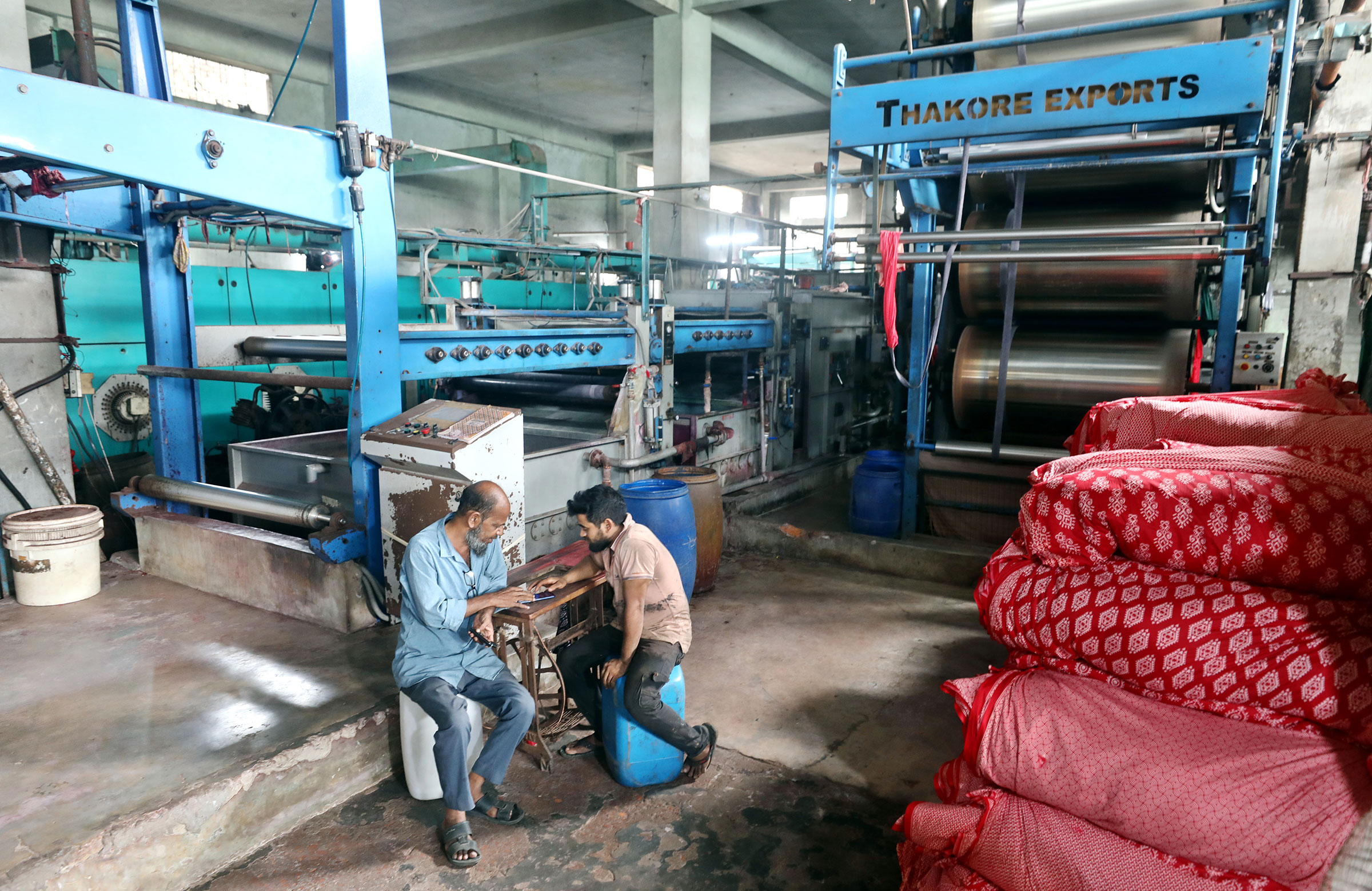
Paradoxically, Ha-Meem has seen demand increase since the energy crisis. It has absorbed orders from some of the more than 400 smaller factories forced out of business in the three years till June (as well as from customers shifting production out of China to skirt Trumpian tariffs.) But with Ha-Meem’s energy bills rising from roughly $200,000 to $300,000 every day, and clients refusing to budge on prices, there is a relentless drive to boost efficiency.
In the office of Ha-Meem Senior Executive Director Brig-Gen (Ret.) Mohammad Abdul Moeen, a computer spreadsheet maps every employee against hourly targets. Workers who fall behind are counseled by managers—“maybe she had some problem with the machine,” says Moeen. “She may have just been tired”—and offered additional support and training. Those who consistently fall short are replaced by some of the dozens of applicants clutching résumés who queue up at the factory gate each morning.
“We may be facing some kind of energy crisis but that’s more reason why we cannot compromise with productivity,” says Moeen.
Moeen’s relentless focus on efficiency is easy to fathom. The garment industry is ruthlessly competitive and manufacturers fear that any rise in costs or supply disruption could see orders shift to rival Vietnam, Cambodia, or Pakistan. However, simply securing energy is not alone sufficient; with many Western brands making ambitious sustainability commitments that rely on shifting away from fossil fuels, how power is generated is also a key concern.
And if preserving Bangladesh’s dominant role in global garment production is precarious, diversifying the economy is harder still. The nation has ambitious goals of ramping up existing pharmaceutical and leather industries, and even moving into autos, medical devices, and semiconductors. But competition is tough, and few serious investors are charmed by candlelight meetings.
Last month, Bangladesh unveiled a new energy roadmap that aims to add 12,940 MW of generation capacity via new solar installations and coal-fired projects, alongside modernization of grid distribution networks and a total of 300 new exploration wells to firm up domestic gas supplies (31 have already been drilled.)
“We are satisfied with that plan,” says Mohammad Hatem, president of the Bangladesh Knitwear Manufacturers and Exporters Association, which represents over 2,500 garment factories. “Within three or four years, maybe there will be no more electricity crisis.”
For now, however, Bangladesh’s garment workers—and billions across the Global South—have little choice but to endure given scant signs of relief in oil markets. In recent days, Yemen’s Houthis have intensified missile and drone attacks on Saudi airports, cities, and oil infrastructure, killing civilians in Riyadh, disrupting flights, and provoking Saudi-led strikes that have stoked fears of a wider regional war.
“It’s a difficult situation for the present government,” says Fazlee Shamim Ehsan, managing director of Fatullah Apparels Ltd., which produces 22,000 finished garments per day. “It would be much better if there was no war in the Middle East.”
—With reporting by Zia Chowdhury/Dhaka

 点赞
 收藏
 点踩
 分享