Z.AI Founders Worked on Research Funded by China Institute That UK Tied to Spies

Four founders of one of China’s most promising artificial intelligence companies, Z.AI Co., worked on research in a joint project with a technology institute that the UK government accused of having “very strong ties” to China’s main spy agency, according to publicly available research papers from China and an “espionage alert” from the UK.
The nearly four-year-long AI research project, which overlapped with the company’s start in 2019, was co-funded by Beijing-based China General Technology Research Institute, or CGTRI, and the National Natural Science Foundation of China, according to a previously unreported 78-page report that the project’s leaders compiled to detail their findings. A CGTRI engineer and one of Z.AI’s founders were among the project’s leaders, and three other Z.AI founders contributed to the research, according to the report.
The report was published on a Chinese government website that provides research funding records.
The UK’s MI5 intelligence service, in the Sept. 30 espionage alert, accused CGTRI of primarily existing to fund academic research that directly improves China’s main spy agency’s “technical capability for espionage.” The first-of-its-kind bulletin said the institute has “very strong ties” to China’s Ministry of State Security and warned of potential criminal consequences for “any institution or individual continuing to conduct research ultimately funded by CGTRI following publication of this espionage alert.”
A spokesperson for China’s embassy in the UK called MI5’s allegations against CGTRI “baseless.”
The Z.AI founders’ work on research partially funded by an alleged Chinese intelligence front highlights the risks cited by some US officials regarding China’s growing prowess in AI — and could add to further scrutiny of Z.AI in particular. The two countries are racing to develop a technology that is transforming the global economy and could give their military services an advantage. The US last year restricted Z.AI’s access to American technology based on allegations the company aided the military with AI research. More recently US officials accused the company of systemically extracting proprietary knowledge from American rivals.
It’s not clear what, if anything, any of Z.AI’s founders may have known about CGTRI’s alleged relationship with Chinese intelligence. The MI5 alert didn’t mention Z.AI.
Z.AI didn’t respond to emailed requests for comment, nor did the four founders involved in the research project. The company previously said the US decision to restrict its access to technology “lacked factual basis” and wouldn’t have a substantial impact on its business.
Reached by phone, a CGTRI representative said the institute doesn’t do any external communication with anyone. Efforts to email CGTRI for comment were unsuccessful.
Liu Chang, a spokesperson for the Chinese Embassy in Washington, declined to address specific questions about Bloomberg’s report.
“I’m not familiar with the specifics,” he said. “The development of AI in China comes from greater self-reliance and strength in science and technology. China advocates AI for good. We firmly oppose attempts to throw mud at China by distorting facts.”
A White House spokesperson referred questions about Z.AI to the Commerce Department, which declined to comment.
In an indication of the importance of AI to US intelligence, President Donald Trump this month appointed Jay Clayton, the director of national intelligence, as his new AI czar. In-Q-Tel, an independent nonprofit investment firm set up by the Central Intelligence Agency in 1999, has made AI-related investments as part of its focus on startups used by the military and intelligence agencies.
Read More: US Moves to Bar China’s DeepSeek From Federal Agencies’ Systems
Chinese AI models have gained in popularity because they are cheaper than US rivals and are closing the performance gap. In the last year, however, US AI labs OpenAI and Anthropic have raised concerns about Chinese rivals including Z.AI, DeepSeek, Moonshot and Minimax allegedly extracting data from American models to try to reproduce some of those capabilities through a technique called distillation.
It’s a practice that’s common across the industry but violates terms of service when used to create a competing technology. OpenAI and Anthropic have warned that models created through this method often lack safeguards designed to block misuse of cyber and biological capabilities.
The Chinese companies haven’t responded to the allegations, though China’s Ministry of Commerce denied intellectual property violations and threatened to take all necessary measures to respond to actions that harm its interests.
Read More: Why Distillation is a Big Worry for US AI Companies: Explainer
The project involving CGTRI and the Z.AI founders ran from January 2018 through December 2021 and had a total approved project budget of CNY2.94 million ($437,000 at the time), according to the researchers’ report. It sought to develop AI tools to analyze social media posts, spot key events and map peoples’ connections, according to the researchers’ report. A key goal of the project was developing a knowledge base of “China-related key persons,” according to the report, which didn’t elaborate on who such people would be.
James Mulvenon, who leads intelligence research and analysis at Virginia-based Pamir Consulting, a national security contractor, reviewed the researchers’ report at Bloomberg’s request. He said the project involved research with both military and civilian uses that seeks to revolutionize how people use AI to identify and track specific individuals.
China’s Ministry of State Security “had an obvious interest in funding this research and reaping the targeting benefits,” said Mulvenon, co-author of a book on Chinese industrial espionage.
Z.AI, also known as Zhipu, was spun out of research done at China’s elite Tsinghua University. The company has received backing from local governments in China, as well as tech giants including Alibaba Group Holding Ltd. and Tencent Holdings Ltd., Bloomberg has reported.
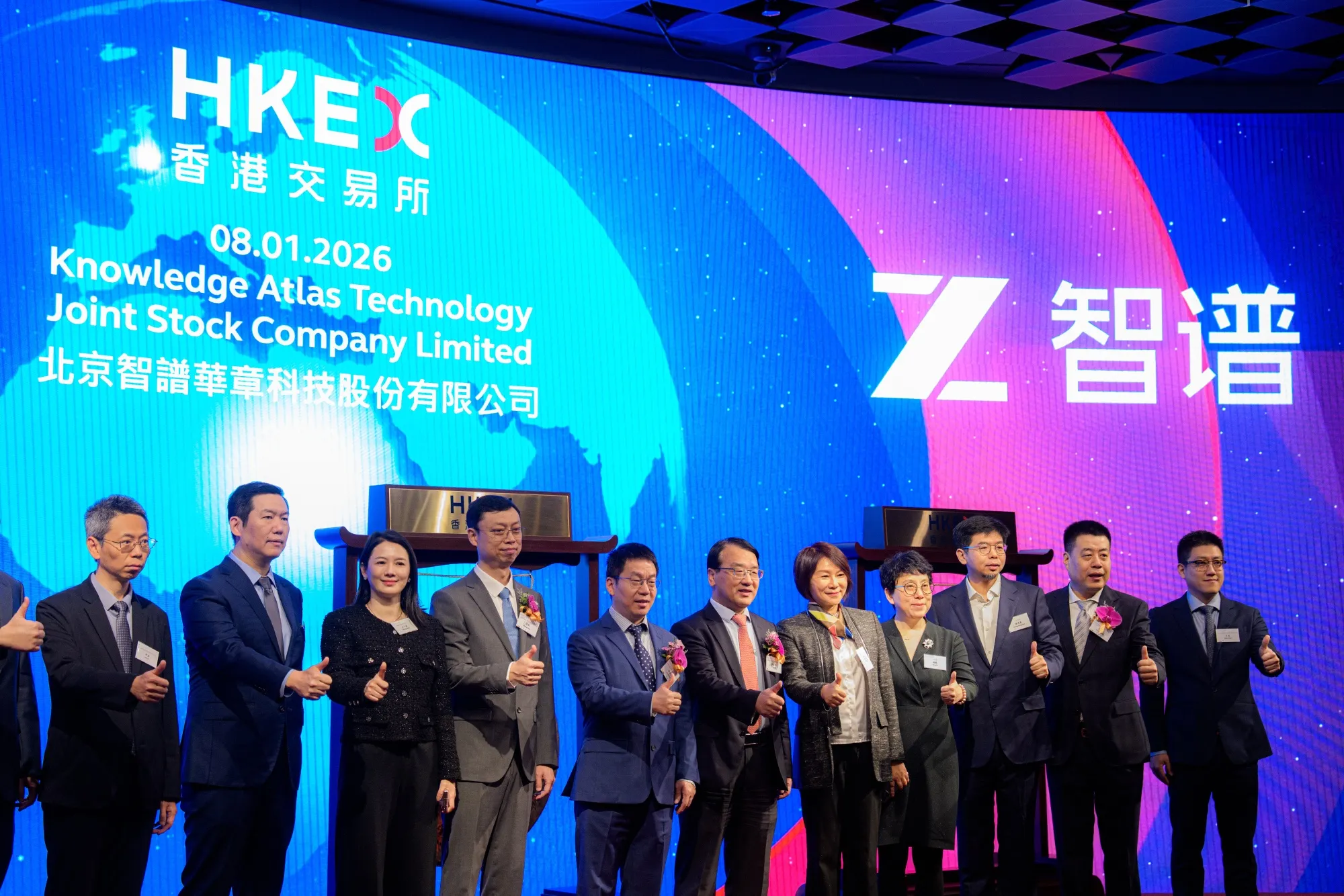
In January 2026, Z.AI became the first major Chinese generative-AI startup to go public with its Hong Kong listing. Its shares have outperformed Hong Kong’s Hang Seng index, rising more than 300% since its IPO versus a 6% decline in the benchmark. Z.AI’s current market capitalization is about $32 billion.
Watch Here: Chinese ‘AI Tiger’ Z.AI Jumps in Hong Kong Debut
In an interim financial report filed last month, Z.AI listed five founders as “key persons” who are part of the company’s “single largest group of shareholders.” Four of them are listed as participating in the AI research project, which was jointly conducted by CGTRI, Tsinghua University and Southeast University, according to the researchers’ report. Neither university responded to requests for comment.
Z.AI co-founder Li Juanzi, a professor in the computer science and technology department at Tsinghua University in Beijing, led the research project alongside CGTRI’s Cao Weibing and another professor from China’s Southeast University, the researchers’ report says. It describes the three as being “jointly responsible for the design of the overall technical plan, coordination of tasks among the three participating institutions, and the overall research progress of the project.”

That report lists three other founders of Z.AI – Tang Jie, Xu Bin and Zhang Peng, who is the company’s chief executive officer – as co-authors of papers, co-inventors on patents, or holders of software copyrights in a directory of all the project’s research achievements. The report explicitly states that nonparticipants can’t be included.
Only one person identified in Z.AI’s interim report as a company founder and “key person” wasn’t named in the project’s documentation, Chairman Liu Debing.
Z.AI’s recent handling of a ledger it posted online detailing vulnerabilities it had found in other companies’ software also raised alarms, according to a report by the China-focused consulting firm Garnaut Global. The company is run by John Garnaut and Matt Pottinger, former national security officials from Australia and the US.
Garnaut Global said its analysis of Z.AI’s ledger, which was established on Aug. 14, showed that Z.AI found 2,436 vulnerabilities in software from Microsoft Corp., Intel Corp., Alphabet Inc.’s Google and other leading Western companies.
Microsoft declined to comment, while Intel and Alphabet didn’t respond to requests for comment.
In the last year or so, some of the more advanced AI models have proven adept at finding flaws in software, some of which hackers might be able to exploit.
In some instances, the companies or computer researchers who find vulnerabilities alert the affected parties so they can be fixed before a hacker exploits them – sometimes for a cash reward. But Z.AI chose to leave most of the affected vendors in the dark, disclosing just 5% of the vulnerabilities to the companies, according to the Garnaut report, which was reviewed by Bloomberg.
Ten days later, Z.AI took the ledger down, replacing it with a notice that the Chinese government would be managing vulnerabilities discovered by the company’s AI models through several databases including one run by the Ministry of State Security, the Garnaut report said.
“Rather than sharing vulnerability details with the affected companies, Zhipu has given China’s peak cyberespionage agency access to these vulnerabilities,” according to the Garnaut report.

 点赞
 收藏
 点踩
 分享