An Artist Who Built Japanese Animation

Welcome! This is another Sunday edition of the Animation Obsessive newsletter, and here’s the plan:
- 1. Reiko Okuyama, artist.
- 2. Animation newsbits.
- 3. The last word.
With that, let’s go!
1. Dissatisfaction
In the ‘50s, something happened in Tokyo. A major film company, Toei, opened a new studio to make cartoons. It was called Toei Doga, and it became a greenhouse for Japanese animation.
Hayao Miyazaki, who joined in 1963, was a latecomer; Isao Takahata had been there since 1959. Miyazaki’s future wife Akemi Ota got hired as an artist in 1958.
Everyone came to Toei Doga for different reasons. Takahata showed up after a certain French film sparked his lifelong interest in animated storytelling. Ota answered Toei’s call for recruits because, as she said, “Particularly at that time, I don’t think there were many jobs where women could make a living by drawing.”
An artist named Reiko Okuyama arrived even earlier, and for a surprising reason. In 1957, she’d applied mostly by mistake. “I didn’t know what animation was,” Okuyama admitted, “and because it was called ‘Doga’ (ドウガ) I mistook it as ‘pictures for children’ (童画, doga).”
Okuyama had expected an illustration job. By accident, she ended up on the ground floor of modern Japanese animation. Passing the test for new animators, she started on The White Snake Enchantress (1958), Toei Doga’s debut feature.
Over time, she would grow into a Toei ace. The press was profiling her by the ‘60s, and she kept animating for years — even for Studio Ghibli in the ‘80s. More recently, a TV drama based on Okuyama (Natsuzora, 2019) made her story famous throughout Japan.
Yet the real Okuyama was a complex, larger-than-life figure. And, for all her talent, she carried a certain dissatisfaction with her career. As she wrote in 1968, “I have never been satisfied with the work I have done.”
When Okuyama first joined Toei, her feelings about the job were a bit mercenary. She wanted to earn money to pay for college, then move abroad and never come back. “However, when I actually jumped into it, despite my initial impressions, I became more captivated by the charm of animation the more I worked on it,” she wrote.
Film after film, she was promoted. By the early ‘60s, she stood among Toei’s few key animators. Her attitude was tough, competitive. Okuyama drew so quickly that she sometimes helped her colleagues finish their work after she’d done hers. “Some people were afraid of her,” said her co-worker Norio Hikone.
At the same time, she was popular with both men and women at Toei. Okuyama was cool — from her personal style to the rock and contemporary jazz (Thelonious Monk) she listened to.
Less cool were the kinds of movies that Toei Doga made at the time.
Back then, animation was known in Japan as manga eiga (“cartoon movies”), a term associated with bright, family-friendly, commercial stuff. The Toei films were marketed as manga eiga, too. None of it suited Okuyama. “Disney’s and Fleischer’s works are very interesting when I see them, and I admire their technique and so on, but I don’t like them that much,” she once wrote.
She was succinct later: “I wasn’t inclined toward commercial works.”
In the early ‘60s, the Toei Doga team started a labor union. “Preparations for forming it were an underground activity,” Okuyama recalled, undertaken in the late night. She was a main member, and it changed her. The union shared and discussed art from all over and, at one point, Okuyama encountered the puppet films of Jiří Trnka. Like she explained in 2003:
Although it was many decades ago now, Trnka’s works captivated me from the first time I saw them. I was an animator at Toei Doga, and I was feeling more than a little dissatisfied with my days of drawing “manga” movies for children. Thankfully, my company sometimes held screenings of overseas animation that could not be seen anywhere else at the time, and I was able to watch works from Europe and the former Soviet Union. I was especially fascinated by animation made in 3D space, since I didn’t have that skill and I could be a pure spectator.I like everything about Trnka, but I particularly like his forms. For example, Oberon [from A Midsummer Night’s Dream] has a design that makes you fall in love with him. I have a rather large art book of A Midsummer Night’s Dream in German. Although it’s very old, every now and then I pull it out to look at it, immersing myself in that world.
In 1978, Okuyama made a list of her favorite animation that included Trnka’s Midsummer Night’s Dream, The Shepherdess and the Chimney Sweep from France and The Snow Queen from the USSR. All had screened at Toei.
You could say that she was made by this era, and the creative environment of the union. Okuyama turned into one of its fiercest, longest-serving members.
When Okuyama married her colleague Yoichi Kotabe in 1963, she and the union had to fight Toei. As artist Kyoko Yamashita said, “When women employees joined the company, they were made to pledge in writing, ‘I will retire when I get married and have children.’ ” Okuyama refused to quit, or even to switch from a salaried position to a contract job, as she was pressured to do.
Once, Yamashita said, higher-ups barred Okuyama from entering the studio gate while holding her new baby. So, she walked inside alone, and her union friends brought the baby after her. Through clashes like that one, Okuyama cut a path for other women to stay in their jobs at Toei Doga. Likewise, she kept using her maiden name; Akemi Ota followed suit after marrying Miyazaki.
Like Ota remembered:
We rarely did anything together, we were just in the same workplace, but I’m glad I was with her. I really felt like I had a great senior at work, and I think having her in front of us made it easier for us juniors to connect with each other.
Besides better working conditions, the union also fought for more creative freedom. That led to Isao Takahata’s Horus: Prince of the Sun (1968). From its violent first scene, Takahata wrote, it was meant to seem “different from previous ‘cartoon movies.’ ”
Miyazaki was the top idea guy on Horus. Less well known is that Okuyama was up there with him. “She was very proactive in suggesting ideas for characters,” Kotabe said. “For Horus: Prince of the Sun, she was second only to Miya-san in coming up with ideas.”
Okuyama was established at Toei by that point — she’d been the lead animator on the Land of Night sequence in The Little Prince and the Eight-Headed Dragon (1963). But her contributions to Horus were on a different level. “I felt like I’d summoned all my strength and gone beyond my abilities,” she wrote. This film, she said in the ‘70s, was the first to make her serious about animation.
She animated a large amount of Horus, but just as important was her design sense. Okuyama drew countless sketches for Hilda, the character at the center of the story (her version was closer to the final product than Miyazaki’s), and she developed the looks of the film’s villain and villagers.
Trnka’s influence stands out in Okuyama’s art from this era. Her characters often look like his puppets, with wistful eyes, odd proportions and complex, organic silhouettes. Her villager drawings have the old-world European flair of Trnka puppet films like The Czech Year. The style differs from Miyazaki’s character sketches for Horus, but it’s clearly visible in the film.
Okuyama kept pushing her skills post-Horus. Her ocean-wave animation for Toei’s Flying Phantom Ship (1969) has been called a precursor to the “Kotabe waves” used in Animal Treasure Island (1971), a technique later adopted at Ghibli. And that Trnka influence kept turning up. Some of Okuyama’s design sketches from the ‘60s and ‘70s all but quote his characters.
Kotabe, Miyazaki, Takahata and a bunch of others had quit Toei by the early ‘70s. There was a sense that the studio was losing interest in high-quality animation. Many expected Okuyama to follow her husband out the door.
“I was thinking of quitting as well,” she said, “but then there was a lockout [in 1972], and staff members who had been in my group for a long time started to be dismissed, so I couldn’t quit even though I knew I couldn’t make anything good [at Toei Doga].”
Her colleague Osamu Kasai once suggested that Okuyama stayed because of her sense of duty and gratitude toward the union. She didn’t leave herself until 1976.
Those last years were rough. Guiding low-budget movies like The Little Mermaid (1975), Okuyama was far from the non-commercial animation she loved. Japanese independents were doing arthouse films like Dojoji Temple (1976) at the time, and they impressed her. But only occasional and imperfect moonlight work, outside Toei, got her anywhere near the experience.
Okuyama still dreamed of more meaningful projects. And, after a stint on Takahata’s 3,000 Leagues in Search of Mother (1976), she and Kotabe returned to Toei as freelancers on Taro the Dragon Boy (1979). It was seen internally as a rebirth of the Horus years. The remaining staff “wanted to make a film like Prince of the Sun again,” Kotabe said.
Taro was commercial, but it drew from traditional Japanese art and stories in ways that resembled what the independents were doing. Okuyama had a big role in its animation and design. Although Kotabe’s characters for Heidi were acclaimed by then, he argued that Okuyama sometimes outclassed him here:
Okuyama created better female characters than I do, whether it’s 3,000 Leagues in Search of Mother or Taro the Dragon Boy. Certainly I draw them too, but I tend to draw cute, squishy girls. Okuyama created good characters with a bit of firmness inside them. That’s why I think my female characters are no match for Okuyama’s after all.
As a couple, the two had been opposites from the beginning. Kotabe was meek at Toei; Okuyama was a powerful force. But they got along and stayed together. Whenever they did fight, Kotabe noted later, he held out the olive branch first: “I don’t remember her ever apologizing to me, though (laughs).”
In the ‘80s, Okuyama animated on Takahata’s Chie the Brat (1981) and Grave of the Fireflies (1988), among other things. Even so, she and Kotabe were looking for an out. Increasingly, Kotabe said, his industry work was “not interesting.”
He ultimately joined Nintendo, where he perfected the designs of characters like Mario, Bowser and Peach. Okuyama started to teach animation and, in the late ‘80s, to work in copper-plate etching. She mostly left animation behind, exchanging it for personal art.
“When Yoichi-san joined Nintendo, I think the question became what Okuyama-san wanted to do,” said Hiroshi Ikeda. He was another Toei veteran at Nintendo — he’d brought Kotabe into the fold. Seeing Okuyama’s art exhibitions and her personal work, Ikeda felt that this was where she really wanted to be.
When Okuyama did animate again, it was as a lead on the independent Restaurant of Many Orders (1991). She used a copper-plate style, finally doing the type of non-commercial animation she loved — something more like Frédéric Back. The same held true in Okuyama’s section of Winter Days (2003).
The former project was especially important to her. Okuyama said in the ‘00s, “It wasn’t until I worked on Tadanari Okamoto-san’s Restaurant of Many Orders that I started to feel glad that I had animation skills.”
That should be taken with a grain of salt — she’d said similar things before, after Horus. But it’s obvious that Okuyama was never really satisfied as a commercial animator. She was an artist’s artist, deep down.
Still, what she did in her long career speaks for itself. In 2004, the scholar Seiji Kanoh released a book called The People Who Built Japanese Animation. It profiles six animators who laid the industry’s foundations — legends like Yasuo Otsuka and Yasuji Mori. Among the six was Reiko Okuyama.
She’d joined animation by chance and had always, to some extent, felt out of place. When she finally had a real chance to leave, she left. But, in this career she was so ambivalent toward, she achieved huge things. In a sense, you could say that those achievements were pushed forward by her dissatisfaction itself.
2. Newsbits
- We lost Loyd Price (64), a top Aardman animator, and the longtime Kazakh animation educator Altynbek Umirzakov.
- An upcoming American documentary, Somewhere Out There, will tell the story of Don Bluth’s career. Cartoon Brew has a trailer and details.
- Director Enzo D’Alò is getting a career retrospective in Italy next month, including a screening of the restored version of his Lucky and Zorba (1998).
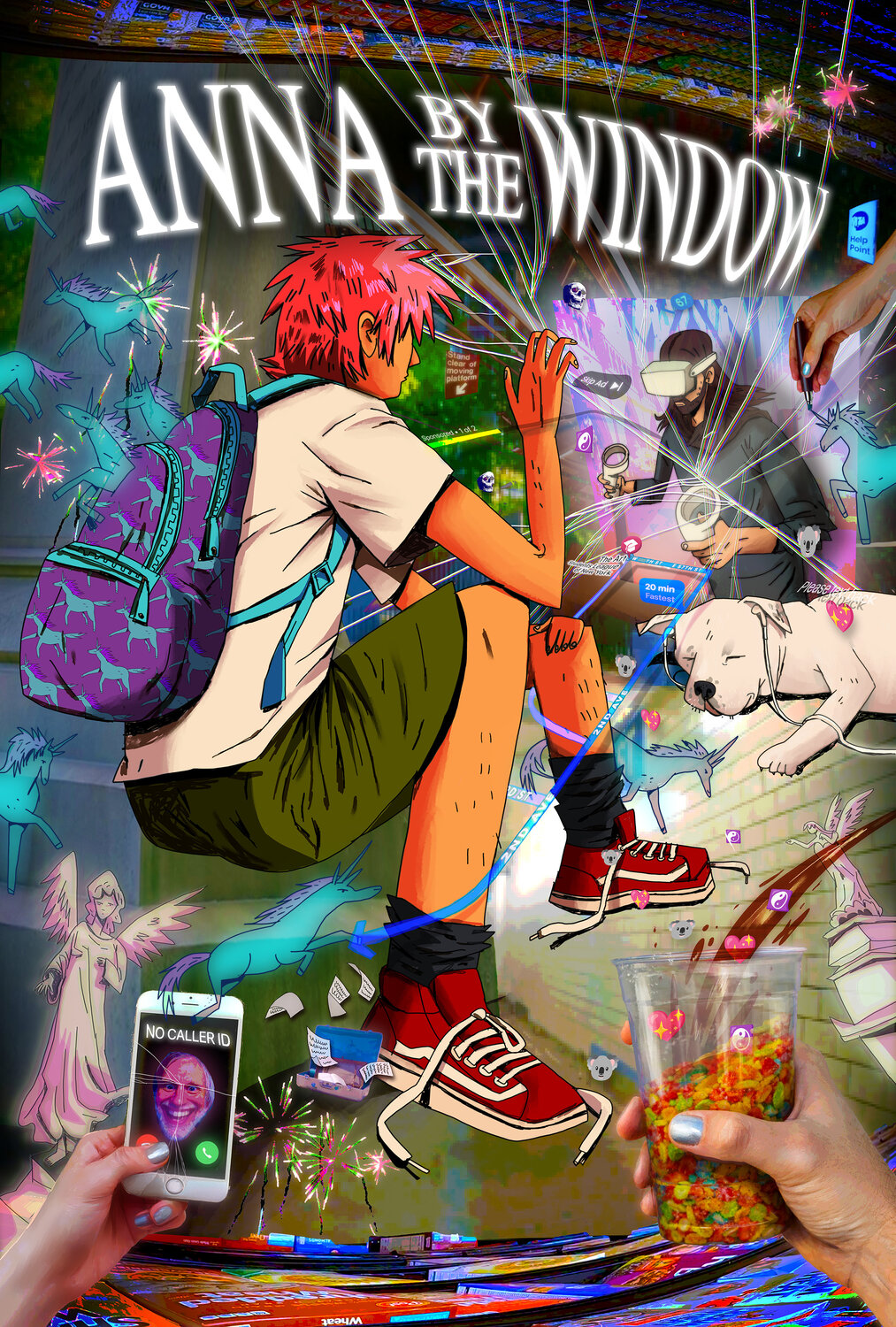
- The American animator Victoria Vincent did the poster for a live-action movie, Anna by the Window, screening in Los Angeles soon. (Also, Vincent made her own hybrid live-action and animated short, Lifewasters, last year.)
- At MIPCOM in France, a report discussed the fall of film and TV production for kids. Among other causes: competition from YouTube and games, plus streaming audiences’ overwhelming preference for old work over new.
- The Canada-based artist Nishant Jain (a longtime friend of the newsletter) passed the crowdfunding goal on his new book project, with 26 days to go.
- In Vietnam, the trailer for The Naked World, a GenAI film, received a lot of pushback on social media.
- In its coverage of Durban FilmMart in South Africa, Variety looked into the growth of African animation. The next step: building “a sustainable infrastructure” that allows current animation talent to bloom.
- The Puffin Rock movie, by Ireland’s Cartoon Saloon, was screened for children in Gaza.
- Finally, we looked into the career of Karen Aqua, and her excellent animation for Sesame Street.
3. Last word
Thanks for reading today’s issue! Hope you’ve enjoyed. As usual, we’re closing out with some personal thoughts:
John: I love to study directing in animation. And Isao Takahata was a great theorist on that topic — his writing about it always expands my mind. So, reading an article on Takahata’s craft by Idris Kellermann Williams (published over the summer in Mechademia) was a high point of my week. It shows how Takahata’s ideas evolved between the ‘80s and ‘90s, as he left behind immersive realism for a more cerebral, distanced style in Only Yesterday. Idris is a contact of ours and we’ve admired his work for a while, but he’s outdone himself here. I recommend his new piece to anyone who wants to dig deeply into the techniques of this master filmmaker.
Jules: While researching for an art project, I’ve been looking at a lot of work by artists who aren’t (at least from my understanding) considered canonical right now. Many of them, even if they don’t have the qualities of artists like Michelangelo or Jan van Eyck, have special qualities of their own. The art canon is always being revised: Vermeer only became widely known as great many, many years after his time. Painters, writers and composers are always being reevaluated based on the tastes and priorities of the current moment. But, as long as their work still exists, its impact can’t truly disappear. Who’s to say that the down-to-earth, realist paintings of Giacomo Ceruti, or the wild, wind-blown images of the Ebbo Gospels, for example, won’t become better known again someday?
Until next time!
From Ota’s interview in the book 漫画映画漂流記 (Manga eiga hyoryu-ki). This book was our main source today. It also includes interviews with Yoichi Kotabe, Hiroshi Ikeda, Osamu Kasai, Kyoko Yamashita and Norio Hikone that were invaluable to this article.
From a 1968 write-up by Okuyama collected at the back of Reiko Okuyama: Legendary Animator – Her Animated Drawings, an incredible book from recent years. We also looked at (and quoted) other essays and interviews in it, and a few of the biographical details.
See Okuyama’s section of The People Who Built Japanese Animation: New Edition, used several times.
Kotabe mentioned Okuyama’s interest in jazz in this interview (part 2, part 3).
From the interview with Okuyama and Kotabe in Japanese Animated Films: A Complete View from Their Birth to Spirited Away and Beyond, used several times.
This is Okuyama’s write-up on A Midsummer Night’s Dream in Best 150 World and Japanese Animation Films.
These films were confirmed as screening at the studio in Kanoh’s book The King and the Mockingbird: The Origin of Studio Ghibli (王と鳥―スタジオジブリの原点).
From the intro to The Visual Expression of Horus.
See this interview.
Kotabe confirmed Okuyama’s credit in his interview for the booklet in the Little Prince Blu-ray box set.
The author of Manga eiga hyoryu-ki makes this argument on page 98.
From Kotabe’s Iwata Asks interview.
Today’s lead story is a revised reprint of an article that first ran in our newsletter, behind the paywall, on February 29, 2024.

 点赞
 收藏
 点踩
 分享