In a Second Robotics Contract, Nyobolt Will Power Agility’s Latest Humanoid

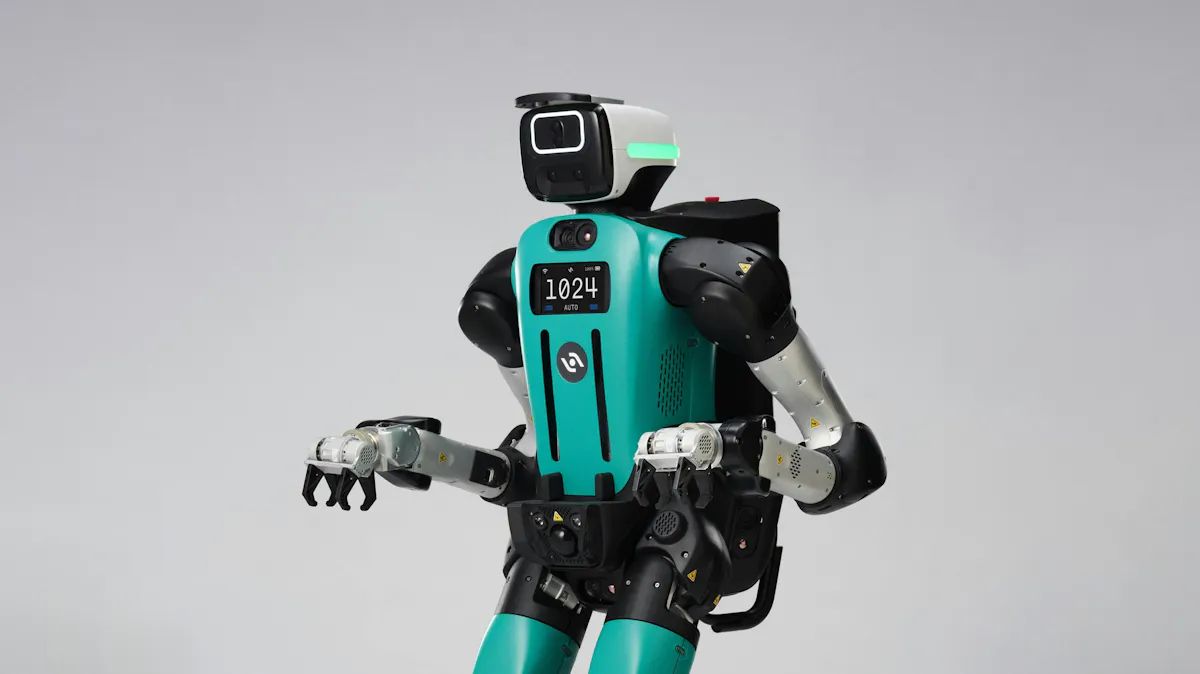
In the latest bullish sign for the previously troubled battery industry, Agility Robotics said it would power the latest version of its humanoid robot, Digit, with next-generation batteries manufactured by Nyobolt.
The Agility-Nyobolt deal, which comes ahead of Agility’s planned public debut next month, is dramatic validation for the next-gen battery industry. Agility will deploy Nyobolt batteries in an estimated 7,000 humanoid robots over the next three years.
The battery industry has struggled for four years, thanks to sluggish growth in the U.S. electric vehicle market—on which most of the battery startups had banked as a customer.
In recent months, however, several battery startups have won their first commercial revenue with sales to military drone makers, including for use in Ukraine.
Now, the Agility deal moves the next-gen battery makers squarely to the glamorous center of the action—to humanoid robots, which have attracted much fawning attention from investors and consumers.
Oregon-based Agility is one of the three or four leading makers of humanoid robots, along with Boston Dynamics, Tesla and Apptronik.
For Agility, upgrades to Digit, including the Nyobolt battery, are an attempt to make it much more commercially practical. Agility said it designed the latest version of its humanoid, Digit 5, specifically to work safely next to humans. But the Nyobolt batteries are another advantage, allowing the model to recharge in just 9 minutes, meaning a single robot will be able to work 20 hours a day in 90-minute bursts, Agility co-founder Jonathan Hurst told me.
That will be an enormous improvement over current conventional batteries, which work for two hours and then need an hour to recharge. Agility said it expects to use the Nyobolt batteries starting the first half of next year in robots for customers including Toyota Canada, GXO Logistics and Schaeffler Group, a German manufacturing company.
The deal gives Nyobolt a second robotics deployment. Its first are deployed in nonhumanoid robots: As we have reported, Nyobolt batteries power small nonhumanoid wheeled robots that move boxes around Walmart distribution centers in the U.S. The robots are made by Symbotic, a Massachusetts startup 40% owned by Walmart. In May, Symbotic helped finance Nyobolt by leading a $59 million Series C funding round in the startup at a $936 million valuation.
Nyobolt appears to have sealed the Agility deal the same way it did with Symbotic: by promising that Digit, powered by Nyobolt’s batteries, would have very little downtime for charging and massive amounts of uptime.
Agility has described long recharge times as a longtime constraint on the deployment of humanoid robots in factories, warehouses and other commercial uses. In the four hours a typical robot is charging during an eight-hour shift, a factory will need a spare robot to take its place. The factory will have to own or lease approximately twice as many robots as it technically needs so half can work while the other half charge.
To solve this charging problem, Agility also considered another widely discussed option, Hurst said: A system in which fresh batteries would be swapped into Digit when its installed ones were exhausted. He abandoned that idea, however, in part because it would require an inventory of spare batteries; in addition, pulling batteries in and out of the humanoids on a regular basis could damage the robot.
Nyobolt’s batteries almost eliminate the need for spare robots or extra batteries, Hurst said. To be specific, the ratio becomes one spare robot to 10 working robots. With an 11th robot, he said, one robot in a grouping of 10 can be pulled out to charge for 9 minutes, then put back into service while another begins to charge. “You need 11 robots to have 10 robots working, 24 hours a day,” he said.
Nyobolt CEO Sai Shivareddy told me that the battery can technically charge in 3 minutes. The lightning-quick charge reflects a striking advance in graphite anodes first achieved in China.
Earlier this year, China’s BYD and its battery-making rival, Contemporary Amperex Technology Ltd., both announced anode breakthroughs that enabled their batteries to recharge to around 80% of capacity in about 5 minutes.
Their announcements were almost unbelievable: Since the start of the lithium-ion age in the 1990s, the industry’s assumption has been that you could not charge a battery faster than in 20 or 30 minutes because the graphite anode couldn’t absorb the lithium shuttling to and fro in the battery more quickly than that. The lithium would accumulate and gum up the anode at higher speeds.
But a CATL scientist told me on a visit to China in April that the company had figured out how to engineer the graphite particles to accommodate the much faster charging.
Shivareddy said much the same thing. He declined to detail precisely what Nyobolt had done to the graphite but said one of the keys was using small particles.
“We don’t like to talk about what actually works when something’s working well,” Shivareddy said. “We want to keep that as quiet as possible.”
Noteworthy
California-based battery developer Enovix got its first big order—a deal for 100,000 battery packs. Executive chair T.J. Rodgers told me the customer would not permit him to disclose its name. Enovix will fulfill the order in the first six months of next year. The company is known for a silicon-anode battery encased in a stainless steel cage, but Rodgers said the drone deal involves a silicon carbon anode in a conventional battery architecture.
When Tesla unveiled its preposterous upgrade of the Roadster last week, most attention was focused on the cold thrusters that made it fly. But there were also an undisclosed number of large cylindrical batteries in the car. Behind all that razzmatazz were rows of its pioneering 4680 battery, which the company said could recharge to 80% of capacity in 10 minutes. Tesla disclosed no details about the vehicle’s battery capacity.
Recommended Newsletter
Start your day with Applied AI, the newsletter that uncovers how leading businesses are leveraging AI to automate tasks. for free to get it delivered straight to your inbox twice a week.
Upcoming Events
Tuesday, November 10 — The Long Road to an IPO
The Information’s Dakin Campbell will host a panel discussion on the evolving landscape of public listings and exit opportunities during SF Tech Week, sponsored by NYSE (more details).
Steve LeVine is editor of The Electric. Previously, he worked at Axios, Quartz and Medium, and before that The Wall Street Journal and The New York Times. He is the author of The Powerhouse: America, China and the Great Battery War, and is on Twitter @stevelevine

 点赞
 收藏
 点踩
 分享