Neocloud Shakeout Looms, and Nvidia Has a Lot to Lose


How many young AI cloud providers can the market, and Nvidia, support?
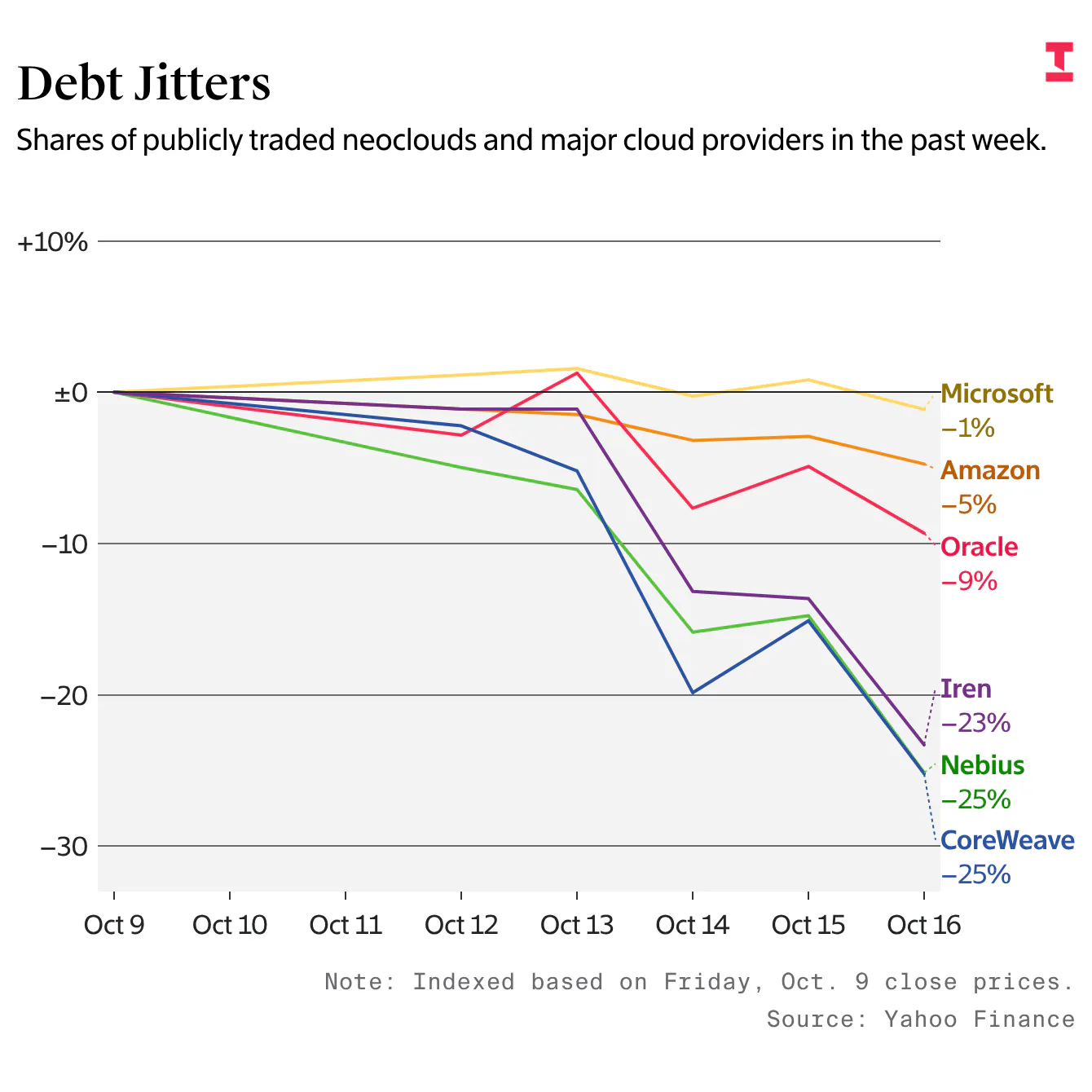
That’s one of the big questions after a week in which investors worried about the data center buildout and the risks that its unproven participants, known as neoclouds, are taking. Those risks include loading up on debt (CoreWeave) or trying to go public without much of a track record (Firmus and Nscale). Firmus abruptly pulled its public offering last week while shares of CoreWeave and its smaller rivals fell around 20%. The concerns even hit bigger AI cloud providers like Oracle.
Data center and neocloud executives told me there’s a limit to the number of AI cloud providers that can exist, even if Nvidia provides many of them with investment or backstops.
Two of the executives said that in a few years, only seven to 10 neoclouds will remain, compared to the hundreds that are trying to get up and running right now. Several of these executives say consolidation, which is usually a feature of any maturing market, is inevitable.
But not all neocloud failures would be equal. A cloud that mainly leases its data centers, like CoreWeave, could fail without derailing the buildout because its sites could more easily find new tenants. A cloud that mainly builds its own facilities, like Nebius, IREN or Nscale, would be a different story even more worrying to Nvidia.
Cost pressures might contribute to consolidation. Each neocloud needs massive revenue growth to be able to pay down debt it’s borrowing to buy primarily Nvidia servers. At the same time, increased competition—and not much differentiation between the clouds’ server-rental offerings—could pressure clouds to lower prices, though prices have actually risen a bunch this year due to scarcity.
“ We'll definitely see consolidation,” said David Driggers, CEO of Cirrascale, one of the earliest neoclouds that has rented out Nvidia cloud servers for more than a decade.
As the market starts to separate winners from losers, Driggers said deeper-pocketed firms like asset management giants as well as big telecom and fiber companies could certainly “pick up a neocloud here, a neocloud there.” As expected, he believes Cirrascale will be among the remaining winners; it’s generating free cash flows and more than $200 million in annual revenue, he said.
Another executive at a small neocloud thinks consolidation might begin by late next year, and that bigger neoclouds like CoreWeave and Nebius could be acquirers. (CoreWeave would need to make a serious dent in its debt obligations before investors allow it to make such a move!)
Some market analysts are also doubtful of the possibility of a thriving ecosystem of hundreds of neoclouds, and they doubt that all the data center projects being announced left and right will actually happen. Gartner predicts that 80% of independent neoclouds will “cease independent operations” by 2030; Bernstein analysts estimate that only 35% of the data center capacity that has been announced in North America will ever get built, Bloomberg reported.
Nvidia, which effectively created the neocloud market, hopes to prove the skeptics wrong by providing additional equity investments, chip allocations, credit support and customer leads to the neoclouds. Of late, a team at Nvidia—led by CEO Jensen Huang’s son-in-law Nico Caprez and longtime vice president Raj Mirpuri—has even begun helping neoclouds find sites with available power, which are hard to come by because it takes a long time to either source independent power or get connected to the electric grid, executives at Nvidia and the neoclouds tell me. Nvidia also has signed $20 billion worth of its own data center leases, which it says it intends to pass on to neoclouds and other chip customers down the line, as of the July quarter.
Neocloud executives say their counterparts at Nvidia remain positive in meetings and haven't yet suggested brand-new types of financial arrangements to remedy the market jitters. However, Nvidia has already modified the way it provides credit support to some firms that must raise capital for new facilities. Some bigger neoclouds passed on Nvidia’s initial credit-support offer, which it made in exchange for a share of the neoclouds’ future revenues. Nvidia is now offering shorter-term, credit-support agreements in exchange for a smaller cut of revenues, according to one of those executives with knowledge of the shift.
Given the tweaks Nvidia made to its credit support program, it would likely move fast to aid neoclouds if the capital markets get materially worse.
Nvidia’s Needs
Neoclouds are so important to Nvidia because the biggest Nvidia customers are trying to make their own server chips to reduce their reliance on Nvidia’s. This summer, Nvidia even changed the way it reports its revenue in a way that further highlights neoclouds. It now breaks out revenue into two buckets: so-called hyperscalers (very large customers such as major cloud providers Microsoft, Google, Oracle and Amazon, and presumably Meta Platforms as well) and everyone else—primarily AI clouds and other enterprises and industrial firms that buy chips.
The everyone-else category that includes neoclouds amounted to $40 billion, or 45% of Nvidia’s data center revenue in the July quarter. That number more than doubled from a year prior, Nvidia reported, and people familiar with Nvidia’s thinking said it’s continuing to trend upward. (It’s worth noting that there’s a lag between the revenue Nvidia generates from the neoclouds and the revenue the neoclouds themselves are booking from cloud customers.)
Last week, Huang attempted to calm down the market about CoreWeave’s debt concerns. At an event in Stockholm, he said CoreWeave wouldn’t require a further credit backstop from Nvidia. Nvidia has already agreed to rent back its GPUs from CoreWeave if for some reason CoreWeave can’t rent them out to other customers. (As of September 2025, when CoreWeave last disclosed the agreement, that capacity was worth $6.3 billion in rental revenue to CoreWeave.)
Huang’s comments appeared to soothe some investors’ concerns, but they won’t change the critics’ long term prognostications about the rest of the field. CoreWeave CEO Michael Intrator told employees in a memo last week that the market woes are the result of other much smaller rivals such as Firmus, Lambda and Nscale that are “trying to raise enormous amounts of capital without the execution, revenue, scale, or software solutions that CoreWeave delivers to its customers,” Bloomberg reported.

Intrator is right that not all neoclouds are alike, though not necessarily in the way he means. CoreWeave primarily leases its facilities, whereas Nebius, IREN and Nscale are also building theirs. If CoreWeave went away (and we aren’t saying it will), the facilities it plans to lease could find new tenants. But capital troubles at the builders could stall the buildout itself, and with it Nvidia’s sales, which are limited by how many powered data centers exist to hold its chips.
The lenders backing chips and data centers for neocloud facilities would probably renegotiate terms rather than let a cloud go bankrupt, of course. But if a neocloud does fail due to a lack of financing, whoever is guaranteeing its obligations—in many cases Nvidia, Broadcom, Google or AMD—could end up on the hook, and might step in to run the facility or find another tenant.
One issue that’s dogging the sector right now: too many new data center projects seem speculative. One investor in data center power believes Anthropic has deliberately over-committed to more data center lease deals than it might actually need, in case some of the sites don’t work out due to equipment, labor or power supply constraints, not to mention local political challenges.
However, if all those projects do get off the ground, there’s a chance the industry is building more capacity than customers really need. One neocloud executive said it was a given that at some point, the supply of compute capacity will exceed demand.

 点赞
 收藏
 点踩
 分享