Why Upstart Banks May Have to Keep Raising Money


The Trump administration has opened the door for entrepreneurs to start new banks in the U.S., many funded by venture capital. But there’s a catch for fast-growing newcomers.
Upstarts like Palmer Luckey’s Erebor Bank, as well as other new entrants like Openreserve and Augustus, will likely have to keep raising money as they grow to maintain the capital cushion they need to satisfy bank regulatory requirements. That’s a contrast to most startups, which use fresh venture money to pay for operating expenses and expand the business.
Regulators require banks to maintain a capital cushion to absorb potential losses and protect depositors. That cushion is typically measured through a minimum tier 1 leverage ratio, which measures a bank’s capital relative to assets including cash, loans and investments. For instance, a bank subject to a 12% minimum tier 1 leverage ratio needs to maintain at least $12 in capital for every $100 in assets.
As a bank attracts more deposits, its assets, such as loans, typically grow too, increasing the amount of capital it needs to meet that minimum ratio. Established banks can build up their capital through their profits, but newer banks that aren’t yet profitable have to rely instead on raising fresh equity from investors.
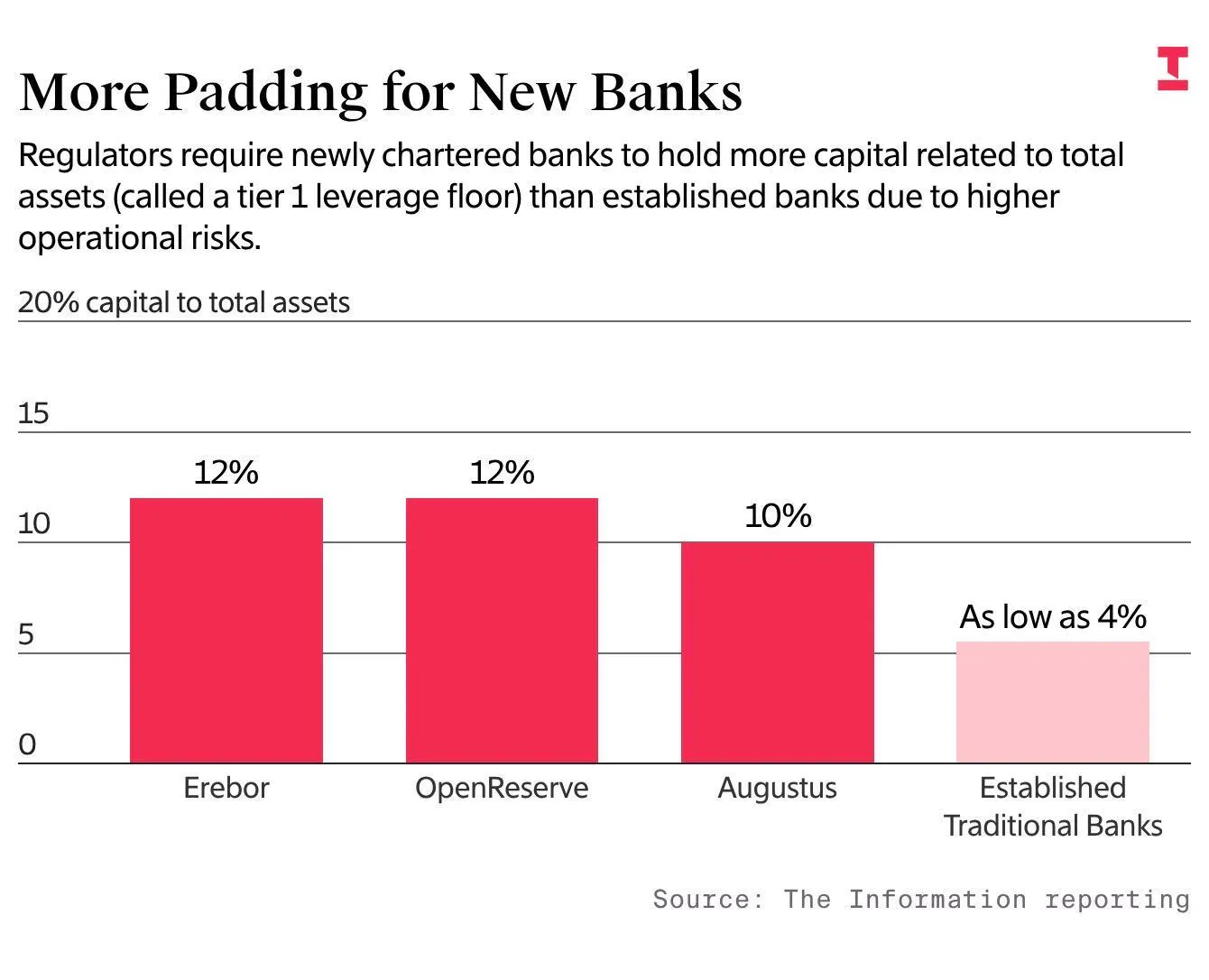
Startup banks have already been raising significant funding to get their businesses off the ground or as deposits grow.
Erebor Bank is set to raise $1.5 billion in a fresh fundraising round at an $8 billion valuation before the investment, after launching with $625 million in committed capital in February. The fundraising comes as the bank has seen its deposits surge to $7 billion as of the end of September, up from $4 billion at the end of the prior quarter.
Meanwhile, Openreserve, an a16z crypto-backed bank that raised $25 million in September, said it expects to announce an additional capital raise to meet its regulatory requirements ahead of its planned opening early next year.
Then there’s Augustus, a startup bank focused on serving fintech companies. It raised $180 million in a Tiger Global Management–led round in July at a $1 billion valuation and expects to open later this year.
Regulators give capital ratios to each bank based on their assessment of the institution’s business plans and risks. Newly created banks typically face tougher capital requirements than established banks. For the first three years of operation, Erebor and Openreserve must each maintain a minimum tier 1 leverage ratio of 12%, while Augustus faces a 10% minimum. Established banks, by comparison, typically have ratios of between 5% and 6%.
“There’s no question that the regulators treat de novo banks—new banks—differently than they do well-established banks,” according to Brian Graham, a partner and co-founder at consulting firm Klaros Group who advises clients on bank charter applications. Graham noted that the extra capital requirements typically go away after a bank has been operating for three years.
The upstart banks are generally pursuing relatively new business models or focusing on sectors big banks typically avoid. Erebor Bank, for example, has gained traction in areas prioritized by the Trump administration, such as defense startups and crypto firms, and is expanding in geographies traditional banks typically avoid, including Venezuela and Syria.
In addition to making minimum capital requirements, the Federal Deposit Insurance Corp.—a banking regulator—imposed an unusual condition on its approval of Erebor for the deposit insurance program. Under a capital-call provision, Erebor’s investors must contribute additional capital if the bank doesn’t meet its minimum capital requirements, according to a filing. The filing didn’t disclose which investors are required to provide the capital backstop.
In the meantime, upstart banks that are looking to drive revenue growth from lending rather than fees will likely need to tap investors to build their capital.
“To the extent the bank’s business model is reliant materially on the balance sheet for revenue and net income, you’re going to need to raise more capital to drive growth,” Klaros’ Graham said.
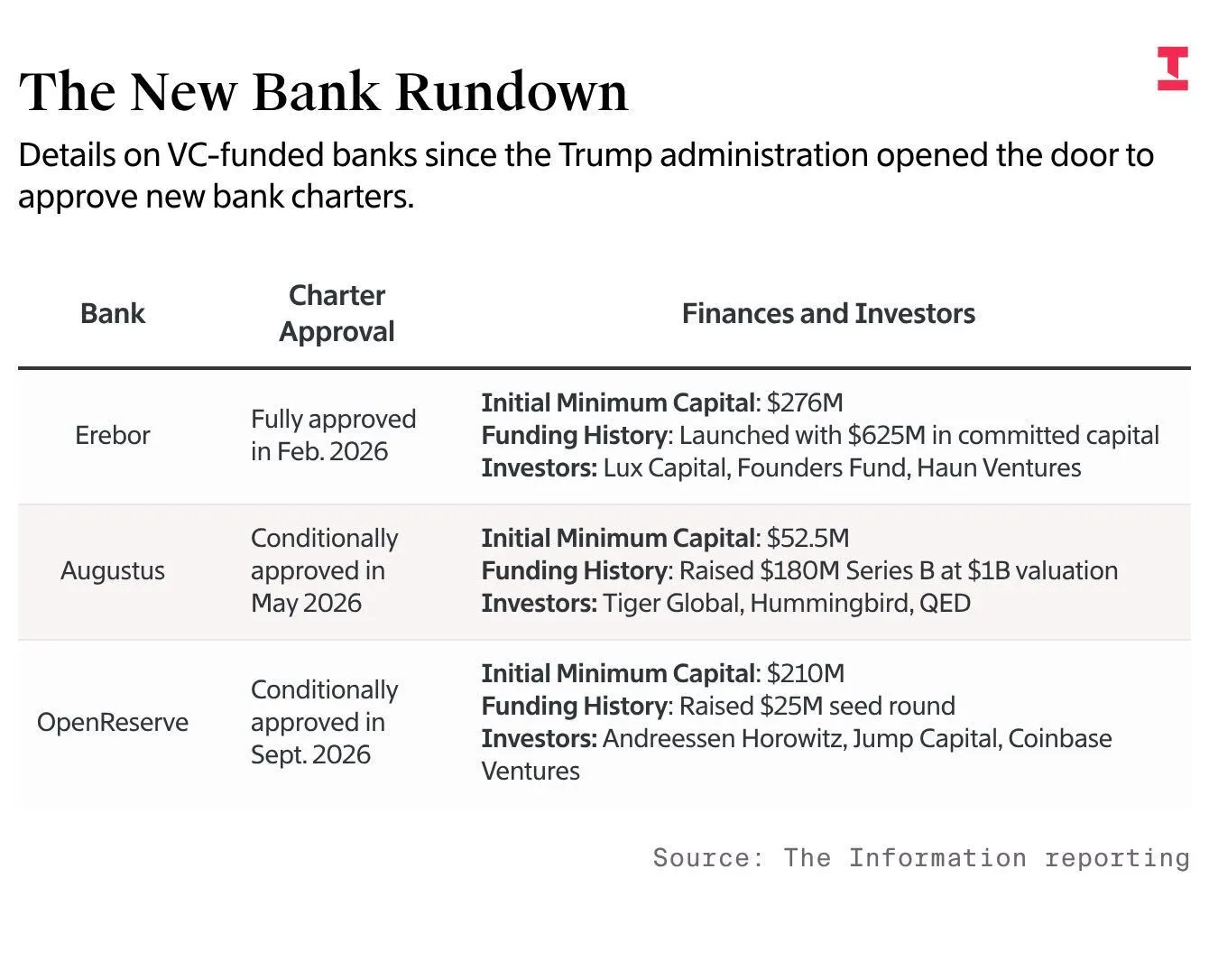
Openreserve, for its part, plans to make loans backed by traditional assets and turn them into digital tokens that can trade on blockchain, potentially providing a new source of loans for investors and lenders in the crypto market. For example, it plans to lend businesses money against their trade receivables, turning those assets into digital tokens to make them easier to trade.
“Our ambition is to be the on-chain GSIB,” referring to a globally systemically important bank, said Dee Choubey, founder and CEO of Openreserve. The bank also plans to issue its own stablecoin and to offer tokenized deposits, digital versions of traditional bank accounts that earn interest. Over time, it aims to provide banking and payment services to other digital banks.
Augustus plans to focus on helping fintech, crypto and remittance companies move money across borders using both traditional banking systems and stablecoins. That will put it in competition with existing banks like United Texas Bank, which has become dominant in processing dollar payments for overseas crypto exchanges.
“Whenever someone outside the U.S. touches the dollar through a local bank or local fintech, that always has to be facilitated by a U.S. nationally chartered clearing bank, so we provide that service,” said Augustus CEO Ferdinand Dabitz. In Europe, the bank already counts crypto exchange Kraken among its clients.
Augustus is less focused on activities like lending, however, and has a lower ratio than the other two. The company has raised significantly more than its initial capital requirement, which could lessen the need for more fundraising in the near term. “We are less focused on the credit side as other market participants. We think the clearing side is really where we shine,” Dabitz said.

 点赞
 收藏
 点踩
 分享