Notes on Group Theory

This is what I have learned studying basic group theory. The ordering of the subjects might have a few oddities, but it's what makes the most sense to me. There are some of the definitions where the motivating reasons weren't properly explained in any of the textbooks I read, and I had to work them out myself; in the best case this post's justifications will be more intuitive, and in the worst case they'll be incorrect nonsense. The main textbook I followed was Álgebra Exemplar (Exemplary Algebra) by Sérgio Martins and Eduardo Tengan.
What is Symmetry?
Group theory is the study of symmetry.
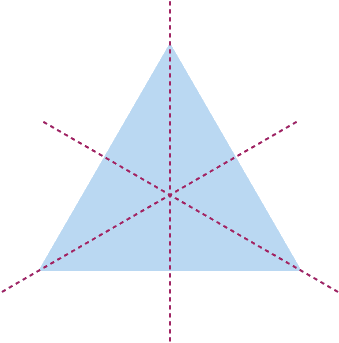
A symmetry is usually defined as a transformation that leaves something unchanged. For example, the symmetries of this equilateral triangle are the (linear) transformations that take the triangle to itself. These are the rotations by clockwise or counterclockwise, reflections about the axes shown above, and (trivially) the identity transformation.
We can be a bit more precise than "a function that leaves something unchanged". You have probably heard of the notion of an isomorphism, a bijection between two sets that respects some kind of structure. If there's an isomorphism between two sets, they are "the same" (isomorphic) regarding that structure, so that anything we can say about one transfers directly over to the other.
For example, in linear algebra, the structure of a vector space is set by the operations of vector addition and scalar multiplication. This means an isomorphism of vectors spaces is a bijection that preserves these operations: an invertible linear transformation.
A symmetry is an isomorphism from a set into itself. Symmetries let you see different perspectives from which you can look at the same structure, the degrees of freedom in its presence, the different possible implementations of its interface.
The symmetry maps of a vector space are the invertible linear transformations from the space to itself. We can pin down each vector in a vector space by introducing a basis; a symmetry map can be seen as a change of basis.
Groups and Subgroups
A group is an abstract representation of the set of an object's symmetries. The set of the triangle's 6 symmetry transformations is a group, called (for "dihedral group"). The set of all invertible linear maps from a vector space to itself is another group, called (for "general linear group").
Let's start by asking, if is a set and is the set of its symmetries, what properties should satisfy? Here are a few:
- Isomorphisms are invertible, and their inverses should also be isomorphisms, because their whole point is that you can go back and forth between representations without losing information. So for any symmetry , its inverse should also be in .
- Obviously if you don't do anything this preserves the structure, so the identity map, such that for all , should be a symmetry; we'll require that .
- If two operations and both preserve a structure, then applying first and then should not disturb it. This means the composition of all symmetries should also be in .
The definition of a group will be abstract, so that a single group can simultaneously represent the symmetry structure of many different sets. So a group is just a set , the identity and inverses are members of , and composition is a binary operation , with no explicit reference to another set whose symmetries represents.
We then need to guarantee that only the sets that can represent a set of symmetries will count as groups, by imposing axioms on and the operation . The following axioms are obviously always true when the operation is composition, and turn out to be enough:
- Identity: composing with the identity does nothing, or there is an such that for all .
- Inverses: applying a function then its inverse will put each element back where it started, or for every there is a such that .
- Associativity: if you compose together the application of then then , it doesn't matter whether you first combine with or with , or for all .
So a group is any set with a binary operation that satisfies those axioms. We'll write the group operation as a product for short, so we write as , and repeated times as . An easy induction proof shows that , so we can also write these as .
Note that the group operation doesn't have to be commutative, because neither does composition: in general. Some specific groups are commutative; they are often called abelian groups.
As a first result, we can prove that for a , the function that multiplies by on the left, where , is a bijection. It is surjective, because for any , is ; and injective, because if then , and and by the same token , so .
The function that multiplies by on the right is also a bijection; the proof is analogous to the proof above. One consequence of these results is that we can "cancel out" multiplication by , so if then , and if then .
In our axioms, we only required that some identity and inverses exist. Using cancellation, we can prove that they are unique, meaning that if something acts like the identity, then it is the identity, and if something acts like an inverse it is that inverse. If , then , and the s cancel out to ; and if , then , and the s cancel out to .
The triangle's symmetries are invertible linear transformations of the plane, so they are a subset of the group containing all such transformations, . A subgroup of a group is a subset of that is a group (under the same operation). An equivalent condition is that be any subset of that is closed under multiplication and taking inverses, so if then and .
A subgroup is a specialization of its group, the symmetries that are left when you add new structure to your object and so diminish its redundancy. For instance, suppose you have a vector space , whose symmetry group is , but you want to use an inner product in it . Then you'll need to restrict its symmetries to only the subgroup of that respects the inner product, not changing lengths or angles: the orthogonal transformations .
Examples
Let's look closer at the product in the triangle's symmetries . If we name the counterclockwise rotation , then is the other rotation and is the identity . If we name the reflection about the vertical axis , then , and multiplying by a rotation gives you another reflection. So the group's elements can be written as . This group is not commutative, for example . It's a nice exercise to write down the 6x6 multiplication table.
The identity and rotations form a subgroup of , ². The identity and one of the reflections will also form a subgroup. There are also two "trivial" subgroups, itself and the set with only the identity ; any group must have at least these subgroups. The group with only the identity is called the trivial group.
If you count the elements of each of 's subgroups, you'll get 1, 2, 3 or 6. It is not a coincidence that these are the multiples of 6; we'll prove all subgroups must divide the side of their group.
Generalizing, -sided polygons for any have their own symmetry groups , with the identity, rotations and reflections. There is also a group , with the identity, a 180° rotation and two reflections, which is the symmetries of the "2-gon", a line segment, or alternatively the symmetries of a non-square rectangle. If you square any of 's elements you get the identity, and multiplying two of the non-identity elements yields the third.
Now, suppose a set has no structure at all. In that case, all bijections will preserve the structure. The set of every self-bijection is written . This is known as the permutation group of , because its elements are the possible reorderings of 's elements. If is finite, has elements.
A vector space such as forms a group under vector addition. Its elements correspond to translations of n-dimensional Euclidean space. We usually represent Euclidean space by itself, fixing a point to be the origin; the difference between Euclidean space and is that Euclidean space should be symmetric under translation. This means you can only do vector operations on displacements between two Euclidean points, not on the points themselves, because the displacements are the same vector no matter where you put the origin, so they're invariant under translation of the space.
The integers , reals and complex numbers also make groups under addition which can represent translation. If you take out zero, the real numbers and complex numbers also form groups under multiplication. These multiplication groups can represent scaling transformations in a vector space.
If you have two groups and , we can treat their Cartesian product as a group with operation . This is called the groups' direct product. It is the symmetries of the product if can be applied to as its symmetries, and can be independently be applied to as its symmetries.
The integers modulo are a group under addition. Two numbers are "equal" modulo if they have the same remainder after dividing by . This means the only numbers are the set , and addition "wraps around", so for example 5+5 mod 7 is 10-7=3. This is how we add hours: 10 hours after 10 am is 8 pm, because 10+10 mod 12 is 8. The group of integers modulo is written , for reasons that will be explained later.
Homomorphisms and Actions
The notion of a "structure-preserving function" can also be applied to the groups themselves. A homomorphism between two groups and is a function such that for all .
Homomorphisms preserve the structure of the product operation: they take the product in to the product in . It's easy to show they must also preserve identity and inverses: and . A homomorphism between and embeds , or a substructure of , into a subgroup of , its image .
The kernel of , , is the set of members of that are taken to the identity in . It is a subgroup of , since if , then , and , so it's closed under multiplication and inversion.
The kernel measures how injective the homomorphism is: for a fixed element , if and only . Since multiplication by is a bijection in , every with corresponds to exactly one member of . In particular, if is finite, the same number of members of goes to each member of the image. In particularer, is injective if and only if is the trivial group .
If a homomorphism is a bijection, it's easy to prove its inverse is also a homomorphism. Because of this, we can define a group isomorphism to be a bijective homomorphism. If two groups are isomorphic, they're considered "the same". The set of isomorphisms from a group to itself form another group, 's own "symmetry group", called the automorphism group .
Using the concept of homomorphisms, we can go back to our original notion of using groups to encode the symmetries of objects. An action of a group on a set is defined as a homomorphism , where is the group of bijections from to itself.
An action usually defines "the symmetries of " as , the embedding of . Of course, it's only an embedding of the entire group when is injective. Otherwise, has redundancies and we can represent 's symmetries by some other group that is actually isomorphic to . When is indeed injective, the action is called faithful.
Since we look at the action as a description of how we see , not just any function, we'll treat it as another binary operation, writing as a product , letting be inferred from context. The conditions for some arbitrary binary operation to be a group action are:
- , for all , . (This is the condition for being an homomorphism.)
- for all . (This ensures that the members of do act as bijections, rather then, say, taking every member of to the same place.)
Examples
For any groups and , there is a trivial homomorphism where for all . Its kernel is all of and its image is the trivial group . This also means a group has a trivial action on any set , where for all , .
The set of complex numbers with absolute value 1, are a subgroup of under multiplication. Multiplying a complex number by rotates it by counterclockwise in the complex plane. This gives us a homomorphism from to the set of linear transformations of the plane, , which takes to the matrix
This is also an action of on the plane . Rotations are orthogonal linear transformations, so the image of is a subgroup of .
Since , the determinant is a homomorphism from to the reals under multiplication . Its kernel is the set of matrices of determinant one, called (for "special linear group").
Fix a . The mapping defined by is a homomorphism from under addition to . The image of is called the cyclic subgroup generated by . If for some positive , then so the cyclic subgroup is isomorphic to the integers modulo , . If there is no such , this means is trivial and so is injective, so its image (the cyclic subgroup) is isomorphic to .
For example, let be rotation in the group of symmetries of the square. Then the cyclic subgroup generated by is the group of rotational symmetries of the square . This subgroup is isomorphic to the integers modulo 4, , where each corresponds to . Using the correspondence between the rotations of the plane and the unit-length complex numbers, we see this group is also isomorphic to the set under multiplication.
The group also has four elements, but is not isomorphic to these groups, because all of its elements squared go to the identity, and in 1+1 is not 0. is actually isomorphic to the direct product . This group's elements are , and the operation is vector addition except 1+1 in each direction wraps around back to 0.
Suppose there's a bijection between two sets and . Then there is an isomorphism between the permutation groups and , defined by . So there is, up to isomorphism, only one permutation group for sets of size . Our canonical permutation group will be , defined as the permutations of the -element set , but which can act faithfully on any -element set.
The equilateral triangle's symmetries take the triangle's vertices to other vertices, which is an action of on the set of vertices. This action is a homomorphism from to (a group isomorphic to) . Since only the identity leaves all three vertices fixed, the homomorphism is injective (the action is faithful), and so since both and have 6 elements it is bijective; is isomorphic to .
As we said, the reals under multiplication can represent scaling transformations on a real vector space . This is an action of on , defined as . The action's image is the set of scaled identity matrices . The complex numbers act analogously on complex vector spaces.
A group can act on itself, by left multiplication: have be just . This action takes to the left multiplication bijection we defined earlier. Note that in general, is not a member of , what we called the symmetries of : for that you'd need , and is not when . Each group element acts as a bijection, but not as a self-isomorphism by the usual definition.
Orbits and Stabilizer Subgroups
Suppose a group acts on a set . The orbit of a point is the set of points that goes to after being multiplied by each member of , the set .
For example, the orbit of a nonzero point in under the group of rotations of the plane is a circle around the origin, the "orbit" the point would take if it started rotating around it. As another example, we mentioned takes each of the equilateral triangle's vertices to other vertices, so the orbit of any of the triangle's vertices under is the set of all three vertices.
Now, consider the binary relation " is in 's orbit ". This relation turns out to be an equivalence relation. The relation is:
- Reflexive: , so is in its own orbit.
- Symmetric: if , then .
- Transitive: if and , then .
This means the set can be partitioned up into disjoint orbits, so that each belongs to one and only one orbit. The set of orbits of under is written .
If the set consists of only one orbit, the action is called transitive; this the requirement that for any there is a such that . By definition, applying the members of to gets you everywhere in its orbit and nowhere else, so 's action on the set can be decomposed into separate actions on each of the orbits, and each of those actions is transitive.
Consider the set of group members that take to itself. If and , then also, and . So this set is a subgroup of , called the stabilizer subgroup (or the isotropy subgroup) . For example, in a triangle being acted on by , a vertex's stabilizer subgroup contains the identity and the reflection whose axis passes through that vertex.
If the stabilizer subgroup of all elements is the trivial group , the action is called free; this is the requirement that for all , , we have unless . Note that this is not the same as the action being faithful, but a much stronger condition: for an arbitrary group member different from , the action being faithful means can't take every member of to itself, but it being free means can't take any member of to itself.
If we hold fixed and see the product as a function from to , the action being transitive means this function is surjective for all ; the action being free means it is injective for all . For example, when a group acts on itself by left multiplication , and right multiplication by is a bijection, which means this action is both free and transitive.
Suppose the group is finite. If , then if and only if . Since multiplying by is a bijection in , it's also a bijection between and the set of elements of that take to . This means that for each element of the orbit , there are exactly the same amount of group members that take to .
Since there are total group members, each of which takes to some other element, the total number of elements in 's orbit must be . This is the orbit-stabilizer theorem. It implies that within an orbit, all the elements' stabilizer subgroups must be the same size (though they aren't necessarily the same subgroup).
Action on Functions
This is also an example, but it's important so I gave it its own subsection. Suppose a group has an action on a set , and an action on another set . We want to look at how elements of act on the space of functions .
The correct "view of under the transformation " should behave like , but on elements that are themselves being "viewed under ". That means if takes to , then should take to . So we have
If this is true for every , then , or
That will be our ; it's easy to show this is always an action.
For example, if is a matrix and/or linear transformation, and is represented by the change of basis matrix in and by the matrix in , then is . If and are the same space, the action is , the well-known "change of basis formula" in linear algebra.
The actions of each element of a group on a set are themselves functions, from to . If we make act on the representation of another group element, , then is , so takes to another member of the group, . This gives us another action of a group on itself, called conjugation, where . With this action, unlike with left multiplication, group elements do act as members of the self-isomorphism group : . The action's orbits are called the conjugacy classes of the group .
If the group acts on the set , sometimes an element is "symmetric" by itself, meaning every element of keeps it where it is. This is saying that its orbit is , or that its stabilizer subgroup is all of . For example, a group of linear transformations (such as our friend ) always takes the origin to itself, so under such a group, the origin satisfies this property.
This property is more useful when the "symmetric" element is a function, so the function can represent a "feature" of a set that is symmetric, while maybe some other features of the set do change under the group transformations. If a function is symmetric in this way, meaning for all , the function is called a -morphism. An equivalent condition is that , or that commutes with the elements of .
For example, in quantum mechanics, the Hamiltonian is a linear operator that represents a system's time evolution; if a system's Hamiltonian is a -morphism the system's time evolution is symmetric under . (If is continuous, this gives you a conserved quantity by Noether's theorem.)
Cosets and Quotients
Let be a subgroup of , and let act on by left multiplication, so . This action partitions into orbits, the sets . These sets are called the right cosets of .
This action is free, as we know if we must have . If is finite, by the orbit-stabilizer theorem this means all right cosets must have the same size . Since each element of must appear in exactly one orbit, by counting all the elements we can conclude that , where is the set of right cosets.
This result is called Lagrange's theorem. It means that any subgroup of a finite group must have a size that divides the size of . For example, as we mentioned, the 6-element group has subgroups of size 1, 2, 3 and 6.
As an application, suppose a group has a prime size . Since every subgroup of needs to have size 1 or , 's only subgroups must be and itself. Now if we pick any non-identity element , the cyclic subgroup generated by (aka the set of the powers of ) has at least two elements ( and ). This means it can't be , so it must be equal to . Therefore is isomorphic to the group of integers modulo , . So up to isomorphism, is the only group of prime size !
also has left cosets , which form a different partition and have essentially the same properties. For example, all the left cosets also have size so Lagrange's theorem also applies to them. We'll mostly only need one kind of coset, so we'll use only the right cosets and sometimes call them "the cosets" for short.
Now, consider an arbitrary homomorphism . We saw that for any , if and only if . That is true if and only if for some , which is the same as saying is in the coset .by this function is well-defined
So if we define the function by , then this function is well-defined (because if then ) and injective (because if then ). The function is a version of with the redundancy "cut out".
Next we'll define an operation to turn the set of cosets into a group, which will mean is actually an isomorphism between and the image . This will tell us what substructure of gets embedded into by a non-injective homomorphism: it is the quotient group .
We want to define a binary group operation on , a set of subsets of . The most obvious way to "multiply" two subsets of would be to multiply together every pair of members, giving us . This will turn out to work.
Let's try "multiplying" two cosets of a kernel, . Each member of this product can be written as , where are arbitrary members of . If we apply to this element, we get
So this element is in the coset . Since that's true for every member of the product, the product is a subset of . But the members of can be written for some , which is equal to , so they are all also members of the product . So the coset is a subset of the product. This means they are equal, .
This relationship shows the product of two members of is another member of , and also makes it easy to show this product also obeys the group axioms by "translating" 's own axioms. So is a group, called the quotient group of by . It's also easy to show is a homomorphism with this product.
Since it is injective, is an isomorphism between and . What we've shown is that every homomorphism can be "decomposed", into the trivial morphism that takes the subgroup to the trivial group, and an isomorphism that takes the quotient group to its image . This is the analog in group theory of the rank-nullity theorem in linear algebra.
Now that we know the cosets of a kernel can become a quotient group, we'd like to find out which other subgroups can make quotient groups . The crucial property is , or for some .
We can cancel out the s and rearrange to turn this equation into . Since by choosing we can make be any member of (and nothing outside of it), this is true if and only if . This needs to be true for arbitrary , so can make a quotient group if and only if for any . But this is true only if, conjugating both sides by , for all . So it's equivalent to the condition that for all . Another equivalent condition is for all , meaning the subgroup's right cosets are the same as its left cosets.
A subgroup that satisfies this condition is called a normal subgroup. So if a subgroup is normal, it makes a quotient group . We also showed the kernel of any homomorphism is always normal. The converse, that any normal subgroup is the kernel of some homomorphism, is also true: just take the projection where . Since the identity in is itself, the kernel is .
For example: in , the subgroup with one reflection is not normal because ², but the rotation subgroup is normal. In fact, every subgroup of with half the size of is normal, because the cosets (left or right) must be and , so the left and right cosets are the same.
As another example: is commutative, so all its subgroups are normal. For each positive , the set of its multiples, , are a subgroup. In fact, it can be shown these are the only subgroups. Two integers are in the same coset of if their difference is a multiple of , meaning if and only if they're equal modulo . So the members of the quotient group are the equivalence classes of equal numbers modulo . So is indeed the integers modulo under addition.
Previously we found that the cyclic subgroups are isomorphic either to or to for some . We now see this is just a special case of our theorem: these groups are the image of the homomorphisms with , and so must be isomorphic to a quotient group of .
Semidirect Products
We have shown a group can be "factored" into a normal subgroup and a quotient group . If we're given the normal subgroup and quotient, how can we reconstruct using as little additional information as possible?
Suppose that has another subgroup, , which has exactly one element in each coset of . For example, this is true of with the normal subgroup , if we pick . Then must be isomorphic to , because the projection with is a homomorphism that, when restricted to , becomes a bijection.
Since there is exactly one per coset of , each member of can be written as for , in exactly one way, meaning the product function is a bijection between and . So if we can find a group operation in such that this is a homomorphism, the resulting group will be isomorphic to .
If the product is , what we need is . We know that is in the same coset of as , so . We can then write , and rearrange to get . As is normal we can confirm this is indeed a member of .
So the product is , where the dot indicates acting on by conjugation. It turns out different actions of on can give different groups , so we can't reconstruct from only the information in and , we also need to know how to conjugate members of by members of .
Which actions of on work "like conjugation"? We know that conjugation acts as a member of , so for any conjugation . It turns out this condition is necessary and sufficient; using it we can prove our product satisfies the group axioms, and if the axioms are satisfied the condition must hold. The proof is not difficult, but I'm omitting it for length.
So given two groups , and an action of on such that , we define the semidirect product as the set with the product operation . The identity is and the inverses are .
and are natural subgroups of isomorphic to and , and they satisfy the properties we wanted and to satisfy in : is normal, has exactly one element in each of its cosets, and conjugating by gives , so the action is equivalent to conjugation of the elements of by the elements of .
For example, if we take to be the trivial action, then so we just get the direct product . As another example, we already know we can recompose using the normal rotation subgroup and an identity+reflection subgroup. These subgroups are isomorphic to and respectively. The action turns out to be , , so the product is for and .
With this action we have . But with the trivial action is the direct product , which is actually isomorphic to and not to . So and are an example of two groups whose semidirect product may be different depending on the choice of action.
At the start of this section we assumed has a subgroup with one element in each coset of the normal subgroup . If this isn't true of , it can't be written as a semidirect product , because the product always has a subgroup like that, namely . So this is not quite a full solution to our original problem of reconstructing based on and .
For example, has a normal subgroup , and also. But there is no subgroup with one element in each of the cosets and , so there is no semidirect product isomorphic to .
There does exist a different construction, called the wreath product , which has subgroups isomorphic to every possible group with normal subgroup isomorphic to and quotient isomorphic to . This group has a whopping elements, so it's usually infeasible to, say, search through its subgroups to find . Also it's more complicated and I don't fully understand it. But I thought I should mention it exists anyway.
- A third of a full turn, or radians, where .
- In group theory we usually call the identity , for the German word for identity.
- so it obviously holds for , and , which is , which is . Since the inverse is unique (as we prove in three paragraphs), is the inverse of , .
- Sometimes people even write the action without the dot, as just , but I'll keep the dot to distinguish it from the group product.
- If there's no positive satisfying this there's also no negative , because if then , so the only integer taken to the identity is the identity 0.
- It's a homomorphism because , and the and cancel each other out to give . It's bijective because the map inverts it.
- If you use von Neumann's definition for the naturals, this is just our original notation applied to the sets .
- If we only want to act on one of the sets, it can always just act on the other by the trivial action.
- I'm being a bit evil with notation here since is usually the set of left cosets, and the set of right cosets is ; however, is in fact also the usual notation for the set of orbits, which happen to be the right cosets with this action. If we wanted the left cosets we could use a weird action like , or define "left vs right actions", but in this post I'll just ignore convention and use for the set of right cosets.
- If a subgroup of is nontrivial, it must have a smallest positive member . Then it must contain all multiples of , and if it contained a non-multiple, it could be written as for , and then would be in the subgroup, contradicting the fact that is the smallest negative member. So the subgroup is the set of multiples of , .
- You can show it's isomorphic to

 点赞
点赞 收藏
收藏 点踩
点踩 分享
分享