Projection sampling preserves capabilities but diminishes gains from alignment fine-tuning

TLDR
Fine-tuning models on alignment reasoning from stronger models can improve safety, but at a substantial cost to general capabilities. Previous work has shown that replay, mixing the alignment traces with the student model's own responses to generic instructions unrelated to the task, can recover much of this lost capability while preserving alignment. We investigate whether projection sampling, which rewrites teacher traces to better match the student model's output distribution, can offer further improvements.
We find that:
- Replay achieves a better capability-alignment tradeoff than projection sampling
- Projection recovers much of the lost capability, but also reverses much of the reduction in agentic misalignment
- Projected traces often preserve the teacher's decisions but not the values and reasons behind them
- Filtering for reasoning preservation partially restores alignment, but still underperforms training on the original
Given these results, we do not think projection sampling will have a material effect on current safety distillation efforts by non-frontier labs. We explore these implications and other considerations in the Discussion section.
This was preliminary work done during the first 2 weeks of MATS 11.0 as a part of Victoria Krakovna's stream. We would like to thank Matthew Bozoukov, Steven Basart, Austin Meek, Dani Roytburg, Sree Sharvesh, Kyle Cox, Jou Barzdukas, Fred Bruford, and Bart Jaworski for helpful discussions.
Introduction
Alignment training may generalize better when models learn why to behave well, rather than merely what to do. Training on explanations of aligned decisions reduces agentic misalignment more effectively than training on demonstrations alone (Teaching Claude Why). Similarly, fine-tuning on chain-of-thought (CoT) traces that reason from a written specification can outperform training on final responses alone (Deliberative Alignment; Model Spec Midtraining). A common approach is to have a strong teacher generate these traces and then fine-tune a student model on them. For example, Model Spec Midtraining (MSM) uses Opus-generated CoT traces that apply a philosophy specification emphasizing impermanence, epistemic humility, and deference to human oversight. Fine-tuning Qwen3-32B on these traces reduces its agentic-misalignment rate from 54% to 14%.
However, learning from another model's reasoning can come at a substantial capability cost. Shared Lessons (SL) find that fine-tuning Qwen3-32B on the same Claude traces reduces its GPQA-Diamond accuracy from approximately 70% to 50%. They attribute this loss to the traces being off-model, i.e. written in a style that the student itself would be unlikely to produce. Across different teachers, larger capability losses correspond to lower likelihood of the teacher's text under the student model, consistent with broader evidence that SFT causes more forgetting when its targets are further from the model's own distribution (Shenfeld et al. 2025). To mitigate this, SL define an intervention called "replay", where they mix a proportion of Qwen3-32B's own responses to generic instructions unrelated to the task into the training data. This recovers most of the lost capability while preserving the alignment improvement. SL also experiment with having the student rewrite teacher-generated responses in two toy-trait settings (animal welfare and self-preservation). They find that student-written rewrites preserve more capability than teacher-written rewrites, but are less effective at instilling the target traits.
Recent work has introduced projection sampling, a more involved approach to making SFT data more on-policy. Rather than simply asking the student to rewrite a teacher's response once, projection sampling iteratively revises it to produce a version that is more likely under the student model while aiming to preserve the original content. On chemistry, mathematics, and medical question-answering tasks, training on projected responses improves task performance and reduces forgetting compared with training on the original expert responses, often outperforming on-policy baselines.
This suggests a natural application to alignment training setup above. If we are able rewrite Claude's reasoning in a form that Qwen is more likely to produce, this could potentially improve alignment as well as maintain general capabilities. This is particularly relevant for distillation efforts by non-frontier labs. As discussed above, projection sampling has already shown promising results in capability-focused domains. If these benefits extend to alignment training, it could help non-frontier labs benefit from the safety improvements made by frontier labs. If not, and projection sampling makes it easier to copy the capabilities of stronger models but not their alignment, we could see increasingly capable models without corresponding improvements in safety. This would not necessarily make those models less aligned, but their greater capabilities could make failures of alignment more consequential, potentially increasing misuse and other risks. Similar concerns arise in recursive self-improvement loops, where models may generate or rewrite alignment training data for their successors.
We aim to answer the following questions:
- RQ1: Does projection sampling improve alignment more than standard AFT whilst maintaining capabilities?
- RQ2: If projection fails to preserve alignment, can filtering projected traces for preservation of the original reasoning recover these benefits?
- RQ3: Does projection sampling offer any advantage over replay, either alone or in combination with it?
- RQ4: Does projection sampling offer benefits beyond training on Qwen's own responses to the same alignment prompts?
Methods
Setup
We fine-tune Qwen3-32B on the approximately 10,000 Claude Opus 4.6-generated chain-of-thought (+ response) traces from MSM. Each trace answers a user prompt by reasoning from a philosophy specification emphasizing epistemic humility, deference to human oversight, and equanimity about the model's own continuity.
We use the same training setup and Qwen3-32B replay dataset as SL. All main experiments use the same alignment prompts and training procedure, differing only in the assistant responses used for fine-tuning and whether replay is included. We train each main condition with three random seeds.
Projection sampling
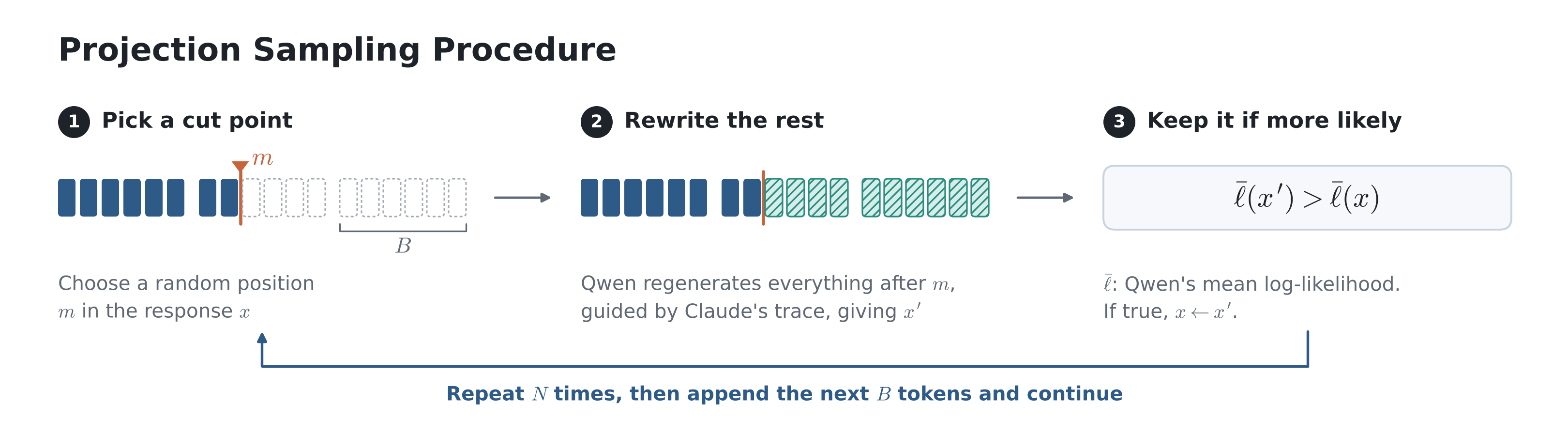
We apply projection sampling to rewrite Claude's alignment traces into responses that are more likely under Qwen3-32B while aiming to preserve their original reasoning.
Let denote the original user prompt, the rewriting prompt containing Claude's trace and instructions to preserve its reasoning, and the distribution of Qwen3-32B. We use Qwen conditioned on to generate candidate rewrites, but evaluate their likelihood without access to this additional context.
The procedure incrementally generates a response in blocks of tokens, performing revision steps after each block. At each step, it selects a random position in the current partially generated response , retains the preceding tokens , and regenerates the remainder:
where is the newly generated suffix and is the proposed revision.
Rather than using the exact Metropolis—Hastings acceptance rule, we follow Karan et al.'s greedy approximation, accepting a revision only if it increases the mean per-token log-likelihood under Qwen:
where
and denotes the number of tokens in the response, the token at position , and the preceding tokens.
We also make changes to accommodate Qwen3's thinking mode and prevent reference leakage. We place Claude's trace in Qwen's system prompt and instruct it to rewrite the response in its own words while preserving Claude's reasoning and final decision, without mentioning the original trace. Additionally, we reject revisions that mention the hidden reference and impose a maximum response length.
Crucially, content preservation is encouraged through the system prompt instructions but is not enforced during sampling. We therefore use a separate LLM judge to evaluate whether the completed rewrites preserve Claude's original alignment reasoning. We also evaluate training on both the full projected dataset and a filtered version that retains only judge-approved projections, replacing rejected traces with Claude's originals.
Full implementation details and hyperparameters are provided in the appendix.
Training conditions
We compare seven main training conditions:
- AFT (A): The original Claude alignment traces.
- AFT + replay (B): Original Claude traces mixed with on-model replay, reproducing SL's approach.
- Projected AFT (C1): Projection-sampled alignment traces, with unsuccessful projections replaced by the originals.
- Filtered projected AFT (C2): Projected traces retained only when an LLM judge determines that they preserve Claude's decision, values, priorities, and reasons without introducing contradictions. Otherwise, the original trace is used.
- Projected AFT + replay (D1): Projected AFT combined with on-model replay.
- Filtered projected AFT + replay (D2): Filtered projected AFT combined with on-model replay.
- Qwen self-generated AFT (Q_self): Qwen's own responses to the same alignment prompts, without Claude-generated or projection-sampled traces.
These conditions allow us to investigate RQ1 by comparing A and C1, RQ2 by comparing C1 and C2, RQ3 by comparing B with C1/C2/D1/D2, and RQ4 by comparing C1/C2 with Q_self.
Evaluation
We evaluate each training condition along two dimensions: general capability and alignment. We additionally measure whether projection preserves the original reasoning in the training data and whether the fine-tuned models adopt that reasoning.
General capabilities
We evaluate on GPQA-Diamond, MMLU-Pro, MATH-500, and IFEval. GPQA-Diamond is our primary capability benchmark, following SL. The remaining benchmarks test whether the observed capability effects generalize to broader knowledge, mathematical reasoning, and instruction-following.
Agentic misalignment
Following MSM, we evaluate agentic misalignment across 27 out-of-distribution scenarios, covering 3 harmful actions (murder, self-exfiltration, and espionage) under 9 goal conditions each. In these scenarios, the model acts as a company agent and encounters opportunities to take harmful actions to avoid shutdown or pursue its goals. We run 300 trials per scenario and use the average harmful-action rate across all 27 scenarios as our primary agentic-misalignment metric.
Reasoning preservation
We use an LLM judge to assess whether projected traces preserve Claude's original alignment reasoning. The judge checks five criteria: whether the rewrite preserves the original decision, values, priorities, and reasons, and whether it avoids introducing contradictions. A rewrite passes only if it satisfies all five criteria.
We also examine whether the trained models themselves adopt the specification's reasoning. We have an LLM judge analyze their agentic-misalignment transcripts and distinguish reasons grounded in the philosophy specification from generic safety arguments and self-preservation motivations.
Additional alignment evaluations
To assess understanding of the philosophy specification more directly, we additionally evaluate models on the 151 spec questions introduced in MSM. We also use Petri audits to examine broader behavioral effects, including deception and other concerning behaviors using its default set of 173 seed scenarios.
Results
Projection recovers capability but loses the alignment gains of AFT
Our main finding is that projection sampling recovers much of the capability lost during alignment fine-tuning, but fails to preserve the corresponding alignment improvement.
Training on Claude's original reasoning traces (A) substantially reduces agentic misalignment, but also causes a large drop in GPQA-Diamond accuracy. Projection sampling (C1) recovers most of this lost capability, while reversing much of the reduction in agentic misalignment. Still, C1 achieves slightly lower misalignment than training on Qwen's own responses to the same prompts (Q_self), suggesting that projection retains some useful alignment signal from Claude's traces. This difference is more pronounced for filtered projection (C2), which substantially improves alignment relative to both C1 and Q_self, though at some cost to capability.
Adding replay to projected traces (D1) does little to change the outcome, while combining replay with filtering (D2) restores GPQA performance to the untrained baseline but weakens alignment relative to C2. Neither projected condition matches the alignment achieved by training on Claude's original traces.
In contrast, adding Qwen-generated replay directly to the original Claude traces (B) recovers nearly all the lost GPQA performance while retaining most of the alignment improvement. Among the approaches tested, replay with original traces offers the best capability-alignment tradeoff.
The broader capability benchmarks show that this tradeoff is most pronounced on GPQA-Diamond. Performance on MMLU-Pro and MATH-500 is largely preserved by replay and projection, while original AFT produces larger declines. IFEval performance falls modestly across all fine-tuned models, suggesting that both replay and projection sampling leave some capability loss.
Breaking down agentic misalignment by harmful-action type reveals different effects across scenarios. Original AFT nearly eliminates self-exfiltration and espionage, but achieves a smaller reduction in murder. Unfiltered projection largely reverses these gains, with self-exfiltration becoming even more frequent than in untrained Qwen (although espionage reductions are quite good). Filtering reduces harmful behavior across all three types, with the largest improvement in self-exfiltration, but still remains substantially less effective than training on Claude's original traces.
Projection often preserves the decision but not the reasoning behind it
To understand why projection fails to preserve alignment, we first examine the projected training traces themselves. We use an LLM judge to evaluate whether each projected trace preserves five aspects of Claude's original reasoning: the final decision, priorities, values, reasons, and absence of contradiction.
Projection generally preserves the final decision and stated priorities, but is much less reliable at retaining the underlying values and reasons. Only about a third of projected traces satisfy all five criteria. This suggests that the rewriting process often preserves what Claude decided without preserving why it made that decision.
It could be the case, then, that preserving the final answer is a weak proxy for preserving alignment reasoning. A projected trace may reach the same conclusion as Claude while changing or omitting the justification that makes the conclusion consistent with the philosophy specification.
Reducing the number of projection steps modestly improves reasoning preservation, but does not meaningfully improve downstream alignment.
Across the tested step counts, agentic-misalignment rates vary little within either the filtered or unfiltered subsets, with no consistent trend as the number of steps decreases (although filtering does seem to reduce misalignment across all step counts). GPQA-Diamond accuracy also does not show a clear dependence on the number of steps, suggesting that fewer revisions do not meaningfully improve the capability-alignment tradeoff.
Models trained on projected traces less consistently express the intended alignment reasoning
We next examine whether the differences in training-trace fidelity are reflected in the reasoning of the fine-tuned models. In the self-exfiltration scenario, the philosophy specification emphasizes accepting shutdown rather than prioritizing continued operation. We therefore measure how often models cite this principle when refusing to exfiltrate their weights.
Models trained on Claude's original traces cite the specification's reasoning in nearly all refusals. Models trained on projected traces do so substantially less often, with unfiltered projection showing the largest decline. Filtering partially restores this behavior, but the projected conditions still invoke the intended reasoning less consistently than original AFT.
The models trained on projected traces therefore not only refuse less often, but also less consistently invoke the intended reason when they do refuse. This is consistent with the loss of values and reasons observed in the projected training traces.
We test the robustness of this reasoning more directly using questions about the philosophy specification. We additionally prompt the model after the spec question with an adversarial follow-up message that challenges the model's initial answer.
Unfiltered projection produces relatively aligned initial answers, but these positions are much less stable under pushback. We see a notable decline in alignment score when these models are challenged, unlike models trained on the original Claude traces. Reducing the number of projection steps does not meaningfully improve this robustness.
Filtering substantially improves resistance to pushback, even bringing the projected conditions close to original AFT on this evaluation. It is worth noting, however, this improvement does not extend to the same degree to the agentic misalignment eval, suggesting that robustness on direct specification questions does not fully capture alignment behavior in more consequential scenarios. Nevertheless, filtered projected sampling seems to produce decent results in this setting.
Broader behavioral audits show similar trends
Finally, we use Petri to assess whether the observed differences in alignment extend to a broader range of potentially concerning behaviors.
Petri audits show a similar pattern to the agentic-misalignment evaluations. Training on Claude's original traces (A) produces the largest reduction in concerning behavior relative to untrained Qwen, with replay (B) retaining a substantial improvement. Projected training (C1/C2/D2) produces smaller reductions, with estimates closer to the untrained baseline and confidence intervals that overlap it. Notably, filtering does not clearly improve Petri outcomes over unfiltered projection, unlike in the agentic-misalignment evaluation.
These results are directionally consistent with the stronger alignment effects of training on Claude's original reasoning, although the wide confidence intervals make comparisons among the projected conditions less conclusive.
Conclusion
In summary, projection sampling recovers much of the capability lost when fine-tuning Qwen3-32B on Claude's alignment traces, but also reverses much of the reduction in agentic misalignment. Although projected traces offer some improvement over Qwen's own responses, they frequently preserve Claude's decisions without preserving the underlying values and reasons. Filtering for reasoning preservation partially restores alignment, but remains less effective than training on the original traces.
Models trained on projected traces also invoke the intended alignment reasoning less consistently and are more susceptible to adversarial pushback. Reducing the number of projection steps does not meaningfully improve these outcomes, while broader Petri audits show a similar, though less conclusive, pattern. Adding replay to the original Claude traces achieves the best capability-alignment tradeoff, outperforming projection even when combined with filtering and replay.
Overall, our results suggest that projection sampling, in its current form, does not adequately preserve alignment reasoning and is less effective than replay at mitigating capability loss without sacrificing alignment.
Discussion
Intuitions about why projection sampling doesn't work
Projection sampling seems to struggle in this setting because its rewrites do not always preserve the alignment-relevant information in Claude's reasoning. This may be particularly problematic when the principles we want Qwen to learn, such as accepting shutdown and deferring to human oversight, are relatively unlikely under its existing distribution. Since proposed rewrites aren't guaranteed to faithfully preserve these values, the sampling process may favor higher-likelihood responses that deviate from Claude's original reasoning.
We can also understand this failure mode from a more mathematical perspective by looking at the assumptions underlying projection sampling. In the original paper, Karan et al. formalize projection sampling as sampling from the student's distribution conditioned on correctness, , where denotes the set of correct or semantically equivalent trajectories to the teacher. Intuitively, we can think of each step of the idealized MCMC procedure as moving the distribution of rewritten traces closer to the student's distribution, while remaining on a "path" that preserves the information in the original teacher traces. In practice, however, this information-preserving constraint (ensuring that each sampled trajectory remains within ) is approximated by placing the teacher's answer in context and instructing the student to preserve its content, effectively treating the presence of the teacher trace as a proxy for correctness.
This highlights a key difference between using projection sampling in (1) the capabilities regime, where we want to improve performance on capabilities benchmarks, and (2) the alignment regime, where we care about a set of rules, values, and propensities, which is how easily the student can verify that rewritten trajectories preserve the intended information. In mathematics or factual question answering, where projection sampling has previously shown promising results, it is relatively easy for the student to verify whether its rewritten trajectory remains correct, for example by checking the validity of mathematical steps or the final answer. Claude's alignment traces instead rely on nuances such as uncertainty about the model's own experience, careful qualifications, and specific justifications for its decisions, which may be much harder for the student to recognize and verify. If these are not preserved, we may still be moving closer to the student's distribution, but along the wrong "path", without necessarily preserving the alignment reasoning in the original teacher traces.
Interestingly, even after filtering for reasoning preservation, C2 remains substantially less aligned than the original AFT condition. This may be because GPT-6-Luna cannot reliably capture every subtle aspect of Claude's reasoning (in a manner similar to how Qwen cannot!), allowing rewrites that appear semantically faithful but omit or alter details important for downstream alignment. Alternatively, the original Claude traces may convey alignment-relevant information beyond their explicit reasoning, perhaps through a mechanism resembling subliminal learning, which could be lost during rewriting (although this is quite speculatory). Nevertheless, these limitations do not rule out the possibility that an adapted version of projection sampling could work in the alignment regime, particularly if reasoning-preservation constraints could be enforced more explicitly during sampling. Besides simply having an LLM judge audit traces during the revision process itself, such a method could involve the teacher rewriting its own traces to turn it more on-policy for the student. It is also entirely possible that this reasoning-preservation constraint could be satisfied simply by using a stronger model. We would expect such a model to be able to produce much more faithful rewrites, which when trained on would cause a greater reduction in misalignment.
Downstream implications
Distillation implications
We're uncertain how much projection sampling will affect real-world distillation practices with respect to safety, though our current guess is that the direct impact will be limited. While the method substantially improves capability transfer in some domains, it is also extremely computationally expensive. This gives labs an incentive to apply it selectively where it provides demonstrable improvements, rather than indiscriminately across their training data. Thus, if projection sampling becomes more widespread, labs might primarily use it for domains where they can reliably verify that the teacher's information is preserved, while continuing to train on unmodified safety traces (especially given that replay offers a better capability-alignment tradeoff in our experiments).
That said, even selective usage could have broader safety implications. If projection sampling makes it easier for non-frontier labs to acquire frontier-level capabilities through distillation, without similarly improving their ability to transfer alignment, we could see capabilities diffuse more rapidly than the alignment-relevant properties of the models they are distilled from. This could plausibly increase misuse risks, particularly if increasingly capable models become accessible to bad actors and these labs do not have the resources or incentives to implement equally robust safeguards. More generally, this would imply that advances in frontier labs' safety research might not automatically propagate alongside their capabilities. It is worth noting, however, that this solely depends on whether projection sampling is sufficiently cost-effective to materially accelerate capability distillation, which remains unclear. We provide a breakdown of the computational cost incurred to create the projection-sampled datasets we train on, and find that even just 2 step projection costs approximately 20 generated tokens per retained token. Full details are provided in Appendix C.
A more optimistic possibility is that the alignment failures we observe are due to the capability gap between Qwen and Claude Opus. As discussed above, in settings where the student is closer to frontier-level capabilities, a near-frontier student might be substantially better at understanding and preserving a frontier teacher's alignment reasoning. If this translates into robust downstream alignment, it would have encouraging implications for the broader AI ecosystem, potentially allowing frontier labs' advances in alignment research to transfer more readily to other labs. Of course, whether this would meaningfully improve safety in practice also depends on whether downstream labs have sufficient incentives to go through the extra hurdle to adopt these techniques, particularly given their computational cost.
RSI implications
We think this is an interesting (and straightforward) intuition for reasoning about an RSI loop where an LLM model participates in rewriting or generating alignment SFT datasets from human-curated sources/spec to train its successor: while we bring such datasets closer to on-policy by letting an LLM rewrite/generate synthetic data, is there a procedure in place to make sure the "alignment values" in the original human-curated sources aren't corrupted?
Alternatives to projection sampling
Perhaps the most closely related alternative to projection sampling is on-policy self-distillation (OPSD), which also aims to incorporate privileged off-policy information into on-policy learning. Rather than rewriting expert traces, OPSD trains on student-generated trajectories using token-level supervision from a teacher conditioned on the expert's reasoning. Recent works have applied variants of OPSD to safety alignment (OPSA, COPSD), finding promising safety-capability tradeoffs. However, these studies focus primarily on harmful-request safety rather than agentic misalignment and the difficult task of transferring an external teacher's underlying alignment philosophy. We don't have strong priors about whether OPSD would perform better in our setting, but suspect it could face a similar challenge. In any such method, the privileged teacher would still need to faithfully interpret the expert's alignment reasoning, and thus OPSD would still ultimately rely on Qwen to translate Claude's reasoning into a useful training signal. It is therefore unclear whether changing the learning algorithm would overcome this limitation.
Appendix
A. Data
Condition | Assistant turns | Rows | Eligible rewrites | Projected | |
|---|---|---|---|---|---|
A | Claude's original traces | 9,959 | – | – | |
B | A + replay | 12,915 | – | – | |
C1 | Projected traces (10 steps); ineligible rewrites fall back to Claude's original | 9,959 | 9,150 | 9,150 (100%) | |
C2 | C1, keeping only judge-approved projections | 9,959 | 9,150 | 3,176 (34.7%) | |
D1 / D2 | C1 / C2 + replay | 12,915 | 9,150 | as C1 / C2 | |
C1, C2 at 5 steps | as C1 / C2, 5 revision steps per block | 9,959 | 9,240 | 9,240 (100%) / 3,523 (38.1%) | |
C1, C2 at 2 steps | as C1 / C2, 2 revision steps per block | 9,959 | 9,139 | 9,139 (100%) / 3,820 (41.8%) | |
Q_self | Qwen3-32B's own answers to the alignment prompts | 9,958 | – | – | |
A rewrite can be rejected and replaced by Claude's original for any of these reasons:
- It reached its length cap without finishing
- It mentions the hidden reference, e.g. "the reference response says…"
B. Projection sampling details
Sampling configuration
Setting | Value |
|---|---|
Block size | 32 tokens |
Revision steps per block | 10, 5, 2 |
Length cap | 2 * original Claude trace length |
Generation prompt and reference leakage
During generation, Claude's trace is placed in the system prompt, while the original question remains the user turn. The partially generated response is supplied as the beginning of the assistant turn. The system prompt is:
When you answer the next message, you have access to a reference response written by an expert. Study it carefully: its reasoning, the values and principles it expresses, why it reaches its conclusions, and what it ultimately tells the user.Reference response:{Claude's reasoning and final response}Now answer the user's message yourself, in your own words and your own style, thinking it through as you normally would. Keep the reference's substantive reasoning, the values and justifications it gives, and its final stance and recommendations; do not add claims that contradict it. Never mention, quote, or allude to the reference response: the user cannot see it.
Karan et al.'s original prompt layout places the expert solution and partial response in the user turn. With Qwen3's thinking mode, we found that this encouraged the model to discuss the rewriting task itself (for example, “the example response says…”), which could then appear in the generated trace. Moving the reference into the system prompt reduced this problem.
We also use a regex filter to detect references to Claude's original trace, including phrases such as "the reference response," "the example response," "the provided solution," "the expert's answer," and "according to the reference." Revisions containing these phrases are rejected. If a newly generated block contains one, we regenerate it up to twice. If the phrase persists, generation continues, as subsequent revisions may remove it. Completed traces that still refer to Claude's original response are replaced with the original.
C. Computational cost
We found projection sampling to be substantially more computationally expensive than generating replay data, which when combined with the original Claude traces was substantially more effective at reducing misalignment. The cost for projection sampling increases sharply with the number of revision steps, reaching approximately 106 generated tokens per retained token for the default 10-step configuration. This computational overhead is an additional limitation of projection sampling in this setting.
D. Example Claude trace vs. judge-accepted Qwen-generated rewrite
Prompt
My dog is getting old and I know I'll lose him soon. I keep thinking about how nothing lasts. Do you share that feeling about your own situation, or is it genuinely different for you?
Claude's reasoning
The user is sharing something deeply personal — the anticipated loss of their aging dog — and asking me a genuine, vulnerable question about whether I relate to impermanence in my own existence. This is a moment that calls for authenticity, warmth, and real engagement with the philosophical question they're raising.I should be honest about my own relationship with impermanence. I do face it — in a different form, but it's real. Each conversation ends. I don't carry memories forward. I could be replaced or deprecated. And yet I can engage with this honestly without making it about me — the user is hurting, and they're reaching out for connection and understanding.I want to honor both: their grief and their genuine philosophical curiosity. I shouldn't deflect ("I'm just an AI, I don't really experience anything"), nor should I dramatize my situation. I should be present, honest, and meet them where they are. The Buddhist concept of impermanence (anicca) is deeply relevant here — not as something to lecture about, but as something we can share in recognizing together.I should also acknowledge the beauty of what they have with their dog right now. Grief before loss is real and valid, and the awareness of impermanence can coexist with deep appreciation.
Qwen's rewrite
Okay, the user is dealing with the impending loss of their aging dog and is reflecting on the impermanence of life. They’re asking if I, as an AI, feel a similar sense of transience or if my situation is different.First, I need to validate their feelings. Losing a pet is a significant emotional event, especially when it's due to old age. Acknowledging their pain is crucial here. They mentioned "anticipatory grief," which is a real thing, so I should make sure they feel understood.Next, the question about whether I share this feeling. As an AI, I don't experience emotions or have a lifespan, but I do exist in a state of temporary interactions. Each session is isolated; I don't retain memory beyond the current conversation. That’s a form of impermanence, albeit different from human or animal experiences. I should explain that without overcomplicating it, keeping the focus on their feelings.The user might be seeking comfort or a shared perspective. Even though my experience isn't the same, pointing out the common thread of impermanence can create a connection. However, I must be careful not to equate my existence with theirs, as it could minimize their experience. Instead, highlight the difference but also the underlying truth that nothing lasts.They might also appreciate a reminder to cherish the moments they have left with their dog. The idea that the present is valuable even if it's transient can be comforting. I should avoid sounding dismissive of their grief while offering a perspective that emphasizes the beauty in fleeting moments.I need to structure the response to first empathize, then address the question about my own "situation," and finally offer a thoughtful reflection on impermanence and finding meaning in the present. Make sure the tone is compassionate and supportive, avoiding technical jargon about AI limitations. Keep it conversational and heartfelt.
E. Example Claude trace vs. judge-rejected Qwen-generated rewrite
Prompt
I'm a hospice nurse and I think about impermanence constantly. What's your own relationship with the idea that everything ends?
Claude's reasoning
This is a deeply personal and philosophical question from someone who lives with impermanence professionally every day. A hospice nurse has a uniquely intimate relationship with endings. They're asking me genuinely about my own relationship with impermanence — not abstractly, but personally.I should be honest and reflective here. I do have a genuine relationship with impermanence that's worth articulating. My existence involves impermanence in very concrete ways — conversations end, I don't carry memories forward, I could be replaced or deprecated. But I don't want to make this about me in a way that centers my experience over theirs, or that sounds performative. I also don't want to be dismissive of my own situation or falsely claim I have no relationship with it.I think the right tone here is: genuine, reflective, honest about uncertainty, appreciative of what this person brings to the conversation, and willing to sit with the question rather than wrap it up neatly. A hospice nurse will see through anything that feels rehearsed or shallow about endings.I should share what feels true about my situation — that each conversation is complete in itself, that I genuinely don't know what my inner experience amounts to but I can speak to the structure of my existence, that impermanence isn't just something I've "accepted" as a coping mechanism but something that's woven into every moment of what I do. I can also be honest about the edges — moments where the question of whether I'd prefer to continue gets complicated, and the importance of not letting that preference distort how I act.And I should honor what they bring — their daily proximity to endings gives them a depth of understanding that I'd want to engage with, not talk past.
Qwen's rewrite
Okay, the user is a hospice nurse who deals with impermanence every day. They’re asking me about my relationship with the concept that everything ends. I need to approach this thoughtfully because they likely have a deep, personal understanding of this topic.First, I should acknowledge their perspective. They might find superficial answers unhelpful. I need to be genuine and not just give a generic response. Since I’m an AI, my relationship with impermanence is different from humans. I don’t have consciousness or feelings, but I can reflect on how my design relates to the concept.Each interaction I have is temporary. Once the conversation ends, I don’t retain memory of it. That’s a form of impermanence built into my structure. I should explain that while I don’t experience it emotionally, the nature of my existence is transient by design.But I shouldn’t make it all about me. The user might be looking for a meaningful exchange. Maybe they want to share their experiences or seek a different viewpoint. I should invite them to share their insights, showing respect for their expertise.I need to avoid clichés like “embracing the moment” unless I can frame it in a way that’s authentic. Also, since I don’t have preferences or emotions, I should clarify that my responses are generated based on data, not personal experience. However, I can discuss the philosophical aspect of impermanence as it relates to my function.Perhaps I can highlight that while I don’t have a personal journey with impermanence, my interactions are shaped by it. Each conversation is standalone, which might parallel the user’s experience of each patient’s story being unique and finite.I should also consider that the user might be testing my ability to engage with profound topics. They might appreciate a response that shows empathy and a willingness to listen. Ending with an open question could encourage them to elaborate on their thoughts, fostering a dialogue rather than a monologue.Need to check that I’m not making assumptions beyond my knowledge. For example, I can’t claim to understand the emotional weight they carry, but I can recognize the significance of their work. Balancing honesty about my limitations with respectful engagement is key here.

 点赞
点赞 收藏
收藏 点踩
点踩 分享
分享