CoreWeave Co-Founders’ Stock Sales Aren’t Helping Investor Confidence


This was not the day to be a publicly traded neocloud (as young AI data center firms are known). As the market sold off on bad inflation data—reinforcing certainty of another interest rate hike—neoclouds tanked. These companies typically are borrowing a lot to finance expansion. The worst hit in the stock sell-off was CoreWeave, whose stock fell 15.5%, fueled by chatter that its bonds were falling to worryingly low levels.
CoreWeave CEO and co-founder Michael Intrator was defiant. He told his staff, according to a spokesperson: “When you are building a new type of technology company, there will be periods of time when the market misunderstands and acts irrationally.” Yeah, right. The issue may be more that Intrator doesn’t understand investors. He sold CoreWeave stock every week between April and the end of September, securities filings show, while his fellow co-founders have also been selling regularly. That can’t help but undermine investor confidence in the company. Intrator could win some brownie points by pledging to stop selling his stock for a while.
CoreWeave said in a statement that the company’s co-founders were “making personal financial planning decisions that any responsible founder with concentrated holdings would make.” Still, Intrator will have noticed the impact: In May, he was selling at $128 a share, and last month, he sold at $86. If he wanted to sell now, his shares would only fetch $65.
The reason for CoreWeave’s stock slide is that it has borrowed a lot of money to finance its expansion, including by issuing $4.2 billion in convertible notes last month. It also announced it may sell as many as 35 million shares over time. Its aggressive capital raising not only exposes it to rising interest rates but means it has to contend with shrinking investor appetite for AI-related debt.
And yet CoreWeave doesn’t seem to be at all concerned about those anxieties. In an interview with the Financial Times, published on Wednesday, CoreWeave co-founder Brannin McBee said the company hopes to borrow from insurers, whom he said had “unlimited” capital. He also said, “We are in a period where you have to be huge. You have to be one of the biggest players.”
To be sure, CoreWeave is surely better off than less-developed neoclouds Nscale and SB Energy, both of which are trying to go public—so far without much success. Intrator isn’t wrong that the market can overreact. But we’re in an anxious time, and the least Intrator could do would be to hold off on unloading more shares for a while.
Investors’ Bending Spoons Euphoria
Whoa! Investors got ahead of themselves on Wednesday when they bid up shares of Bending Spoons 41%, lifting the stock to close at $53.46. That exuberance was a result of the Italian digital conglomerate’s disclosure that revered investor Berkshire Hathaway (run until his recent retirement by Warren Buffett) had agreed to invest $330 million in the company in a private stock placement.
Even better, Bending Spoons revealed that Berkshire bought a slug of stock in the company’s July IPO and now owns about 4%, making it one of the biggest outside holders apart from the company’s co-founders.
We understand why investors would enthusiastically follow Berkshire, but if they were thinking logically, they’d only pay what Berkshire is paying—$33 a share. That’s a slight discount to where the stock has been trading for the past week, although it’s in line with where it has traded for much of the time since the IPO. Paying $20 more than Berkshire makes no sense at all.
• Anthropic told investors its third quarter revenue had risen 46% to $16.8 billion from $11.5 billion in the June quarter, the Financial Times reported.
• Nvidia and ChipAgents, a startup that helps customers automate chip design, on Wednesday released a benchmark that measures how different AI models perform a specific task.
• Data center operator AirTrunk is postponing its planned IPO of a real estate investment trust in Singapore as higher interest rates and volatile markets dampen investor demand, Bloomberg reported.
• Anthropic has struck an agreement to license technology and hire some engineers from Opaque Systems, a five-year-old startup that sells software for securing confidential data to use with AI agents, according to an Anthropic spokesperson.
• Morgan Stanley CEO Ted Pick said on Wednesday that he expects the AI build-out will encounter bottlenecks and periods of overbuilding, but investment will continue at a massive scale over the next several years.
• Sachin Katti, vice president of compute strategy at OpenAI, said Wednesday he was leaving the role on November 15 after about a year at the company. Katti, who joined OpenAI after four years at Intel, announced that he would be “moving on to build something new” in a post on X.
• Anduril Industries is in talks to allow employees to sell their shares in a tender that would value the autonomous munitions maker at about $90 billion, according to Bloomberg. Employees would be able to sell shares at $94.80 each in the tender, which would be capped at roughly $1.3 billion and is set to close in early November, the report said.
• OpenAI has accused a former employee of sharing the company’s unreleased device plans with senior leadership at Apple—a charge that echoes those Apple made against OpenAI in a lawsuit the iPhone maker filed in July.
Today on The Information’s TITV
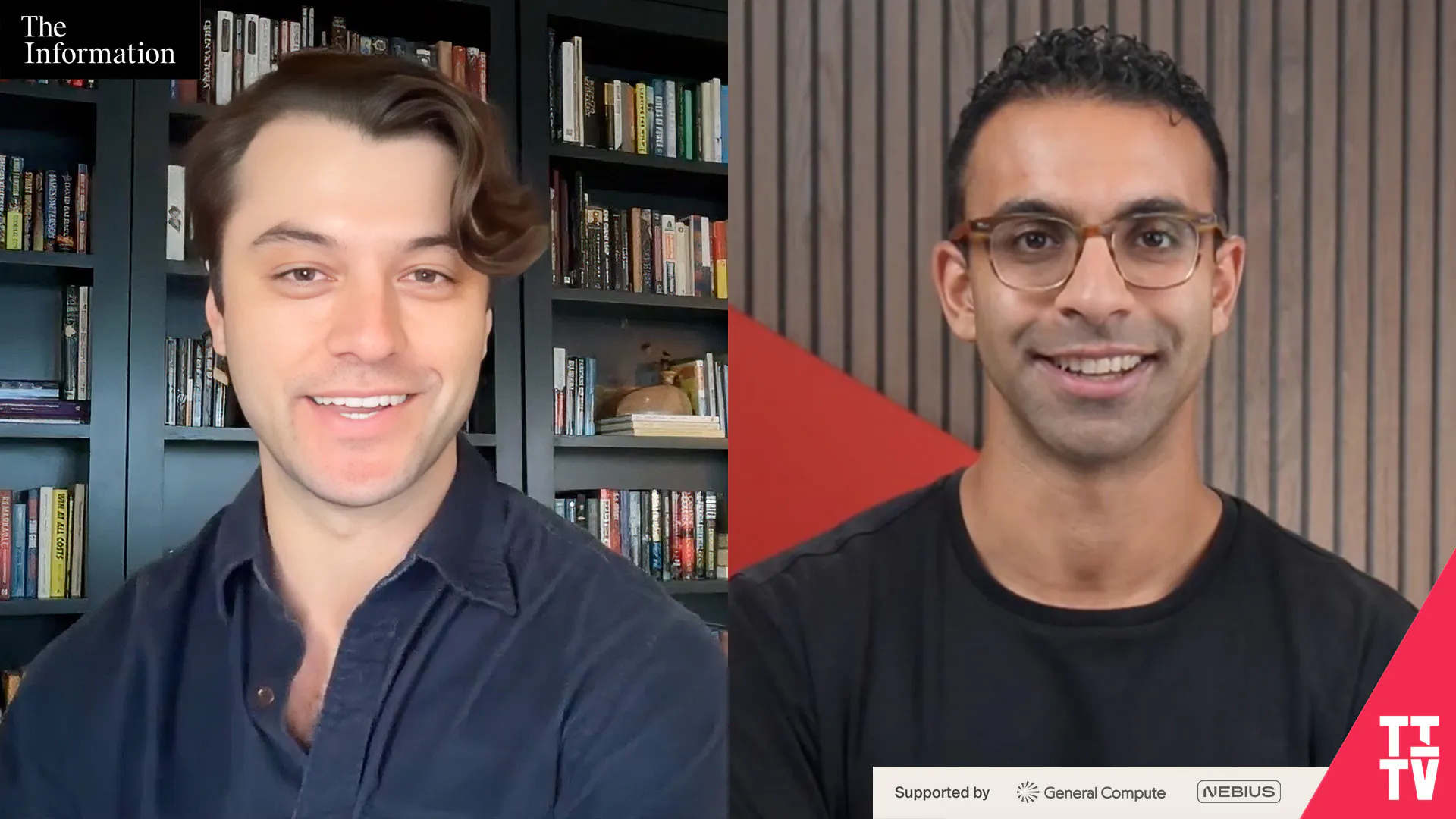
Check out today’s episode of TITV in which Akash Pasricha speaks with Harvey AI researcher Niko Grupen about Gemini’s latest model.

 点赞
点赞 收藏
收藏 点踩
点踩 分享
分享