CoreWeave’s Brazen Dream Crashes Into Reality as Yields Top 15%

For just about any company, it’d be an audacious thing to say: Find a way to get an investment-grade credit rating, and win access to “unlimited” funding.
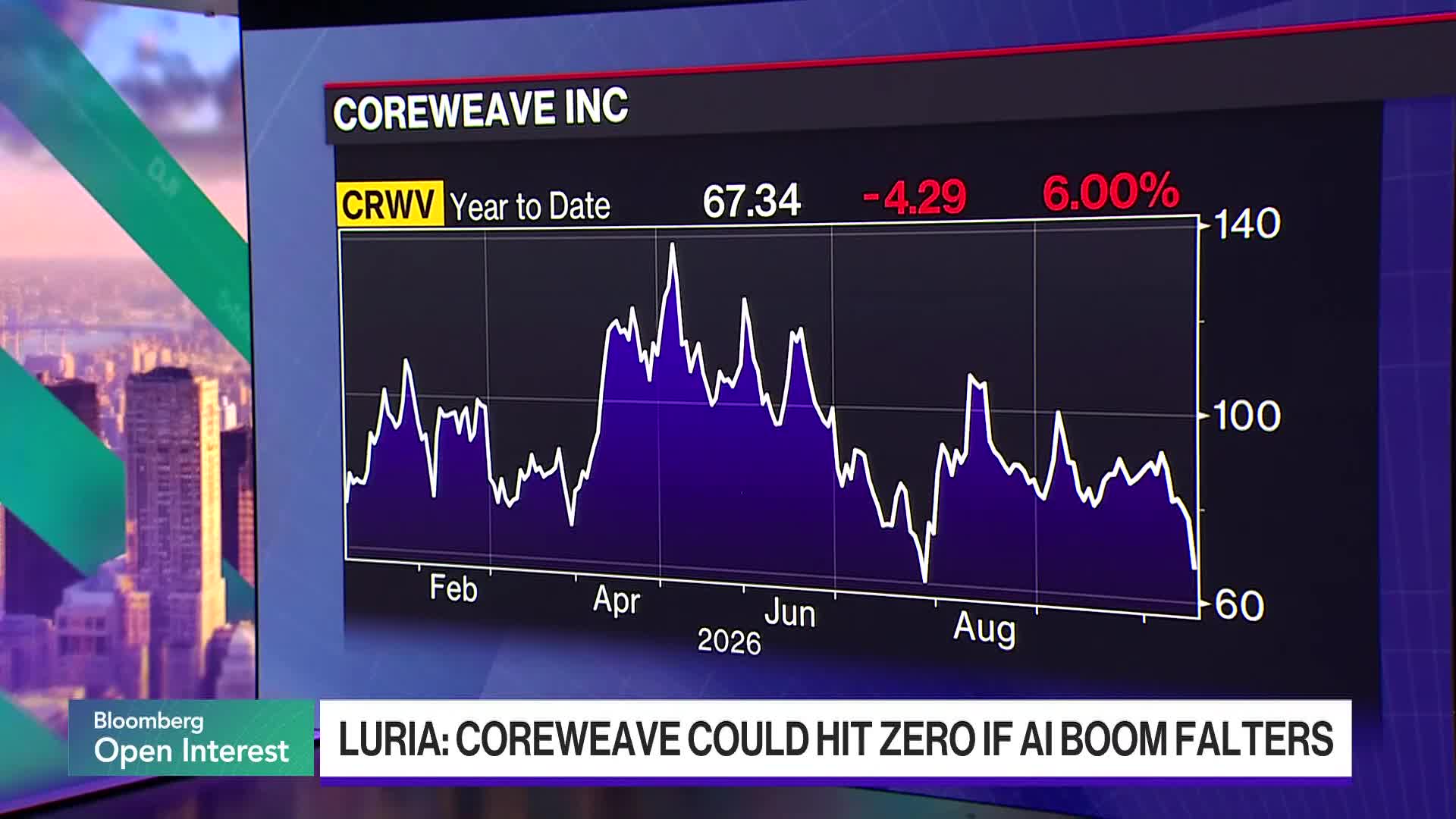
That it came from a co-founder of CoreWeave Inc., just as the AI cloud-computing provider’s existing bonds signal distress and at least one analyst mused about how its stock could go to zero, further sent markets into a tailspin.
CoreWeave shares plunged as much as 17% on Wednesday, the biggest drop since February. Its debt due in 2032, which investors bought at par four months ago, traded at less than 78 cents on the dollar — a precipitous drop that Elon Musk flagged with a “yikes” on his social media platform. Credit-default swaps on the company are pricing in a more than 50% chance of default within the next five years.
While angst around funding artificial intelligence has been building for months, CoreWeave has drawn outsized attention for being an early entrant in the business that has been heavily reliant on the high-yield debt markets to finance its buildout. Worries have seeped into the bonds backing data centers tied to CoreWeave, with at least seven such securities trading lower this week, according to data compiled by Bloomberg.
CoreWeave co-founder Brannin McBee said in an interview with the Financial Times published Wednesday that its goal was to keep winning high-grade ratings for its chip-backed debt — as it did for the first time in March — and eventually the company itself. That would provide access to “all the money in the world that sits in the insurance tranche,” McBee said.
That investment-grade dream is crashing into reality, according to D.A. Davidson analyst Gil Luria, who has previously referred to CoreWeave as “the subprime tranche” of AI. Its bonds now yield 15% — a level that is practically unheard of in the primary market for new debt.
“They’ve run out of the ability to borrow even at 9% — that’s a very concerning factor,” Luria said Wednesday in a Bloomberg TV interview.
“If CoreWeave is borrowing at 9% and the best return they can get off of that is a 5% return, it doesn’t matter how much they scale: They’re destroying value at every turn,” he said. “That’s especially true for the type of neocloud that funds their entire investment based on debt. The more leverage we use to build data centers, the more risk we’re bringing into the system.”
CoreWeave Chief Executive Officer Michael Intrator, in an internal email seen by Bloomberg, said the company’s financial position “more than supports” its debt obligations.
“When you are building a new type of technology company there will be periods of time when the market misunderstands and acts irrationally,” Intrator wrote in the email. “We are confident in our business model, our customers, the extraordinary quality of our execution, and the relentless discipline around the financial engine we have built.”
A representative for CoreWeave confirmed the contents of the email. In an additional statement, the company said its contracted backlog fully supports repaying secured debt and unsecured parent-level obligations without requiring any customer contract renewal or re-leasing collateral.
Read More: CoreWeave’s CEO Blames Rout on Market Acting ‘Irrationally’
Demand Barometer
Livingston, New Jersey-based CoreWeave, which provides AI computing power and services to companies like OpenAI, Microsoft Corp. and Jane Street, has been largely sold out of capacity as the AI boom strained supplies. As the largest public company among so-called neoclouds, the company’s growth has served as a barometer for AI demand and as a proxy for concerns of a slowdown.
CoreWeave has made no secret of its goal to secure a higher credit rating. It said last month in a statement that it has an “objective of migrating its enterprise credit profile toward investment grade.”
But its debt has weakened in recent months, and took another lurch lower this week as stocks in areas like AI chips, equipment and cloud services have been roiled.
Memory chipmakers Samsung Electronics Co., Micron Technology Inc. and SK Hynix Inc. dropped as a Chinese rival announced a technological advance. Applied Materials Inc. shares sank after the chip-equipment maker gave an investor day forecast that was light on specifics. And Broadcom Inc. CEO Hock Tan said in a Monday speech that the AI boom has attracted investors whose strategies resemble those of gamblers, suggesting some have little idea what they are betting on.
Still, to Luria, the sharp repricing of CoreWeave’s debt indicates that markets are starting to pay attention to companies that are taking on leverage compared with those that are positioned for more lasting growth.
That was already partially evident in the company’s effort to borrow in July. It ended up selling leveraged loans at a higher-than-intended interest rate, equating to around $30 million of extra annual interest costs, according to Bloomberg calculations.
Read More: CoreWeave’s Wild Stock Ride Takes Toll on Its Cost to Finance AI
“We are not inflating a bubble as quickly as we could be because the capital markets are going to regulate that, and we’re not going to continue to lend at these rates,” Luria said. “There’s a finite amount of risk capital that’s available to lend to build out data centers, and hopefully that keeps the growth at rates that can sustain through 2030.”
CoreWeave’s bonds were among the worst performers across the junk-debt market on Wednesday, according to Trace pricing data. Two portions of its unsecured debt issued this year, due in 2031 and 2032, now trade below 80 cents, which is widely considered the threshold for when a borrower is financially distressed. The cost of protecting against the company defaulting on its debt in the next five years, meanwhile, is back at a record high.
Some bonds tied to CoreWeave have also weakened, including those for Galaxy Digital Inc. and Core Scientific Inc., data compiled by Bloomberg show. S&P Global Ratings analysts wrote in a July ratings report for the Galaxy Digital bonds that a key expectation was for CoreWeave to meet its lease obligations “for the foreseeable future.”
“Still, given that its customer contracts are shorter than its lease commitments to Galaxy Digital,” they added, “it could be challenging for CoreWeave to honor these lease obligations in an environment where the demand for AI services is lower than expected and the industry is facing excess infrastructure supply relative to demand.”
Even though its bonds are at distressed levels, CoreWeave shares are still up by more than 60% since its initial public offering in March 2025. Its market value currently stands at about $36.5 billion — about the same as Kroger Co., Yum! Brands Inc. and M&T Bank Corp.

 点赞
点赞 收藏
收藏 点踩
点踩 分享
分享