More research needed?

In an earlier post I showed that when AI systems can perform a task, they do it much more cheaply than a human worker. If, as I think is likely, this remains true as we develop AGI, today's stock of compute could run the equivalent of hundreds of millions of AI workers, and billions as the stock grows. Such workers could perform vast amounts of research.
Total academic research
To measure all the research humanity has done, I start from scholarly publishing. OpenAlex indexes almost all scholarly articles, and the journals it flags as core published 3.0 million articles in 2023, up from 82,000 in 1950, growth of about 5% a year:
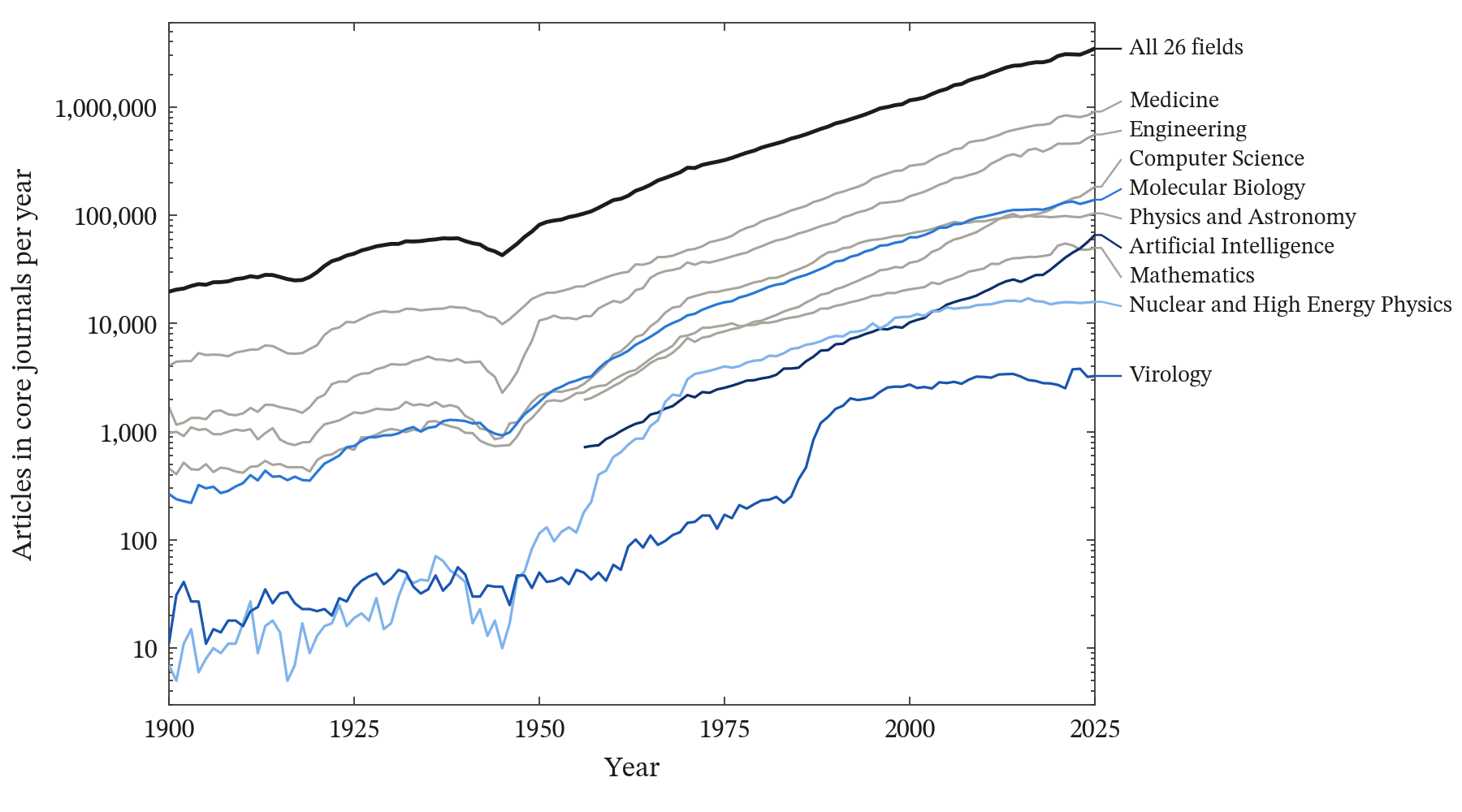
Unfortunately, we don't have comparable data for the total number of researchers. But using US, Japanese, and German counts of academic researchers by field and comparing them to the number of papers published in each field in these countries, we can estimate that every paper published in a year corresponds to between one and four full-time researchers, depending on the field. Here a full-time researcher means a full working year spent on actual research. A professor who only spends a third of their time on research would count as a third of a full-time equivalent. See Appendix A for more details.
Applying these ratios to the world's articles gives about 6 million academic researchers today, and 150 million researcher-years of academic research since 1900, while for major fields and subfields:
| Field | Researchers today (thousands) | Researcher-years since 1900 (millions) |
|---|---|---|
| All academic research | 5800 | 150 |
| Engineering | 1200 | 30 |
| Medicine | 790 | 19 |
| Physics and Astronomy | 160 | 6.0 |
| Computer Science | 290 | 5.7 |
| Mathematics | 150 | 4.4 |
| Molecular Biology | 120 | 3.6 |
| Artificial Intelligence | 95 | 1.6 |
We can get another estimate of total researchers by using national surveys compiled by UNESCO, which cover both academia and industry but are only available from 1996 to 2023. Comparing both estimates:
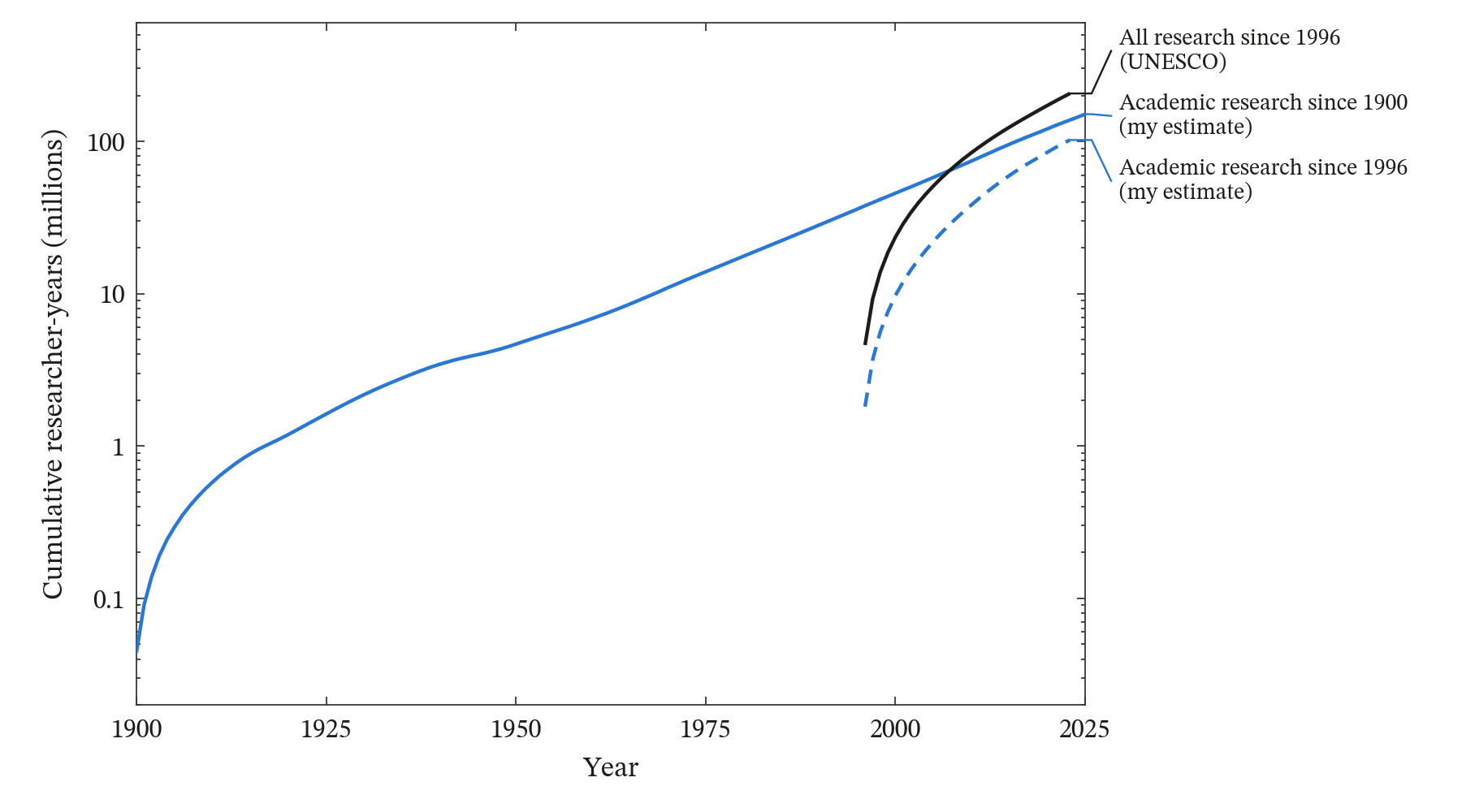
From UNESCO's data we estimate 12 million full-time researchers in 2023, and 206 million researcher-years from 1996 to 2023. This is about twice the 102 million academic researcher-years estimated from OpenAlex for the same years; the difference appears to be almost entirely industrial research, which in the UNESCO data accounts for about 60% of all research. Half of all academic research has been done since 2011, and I expect the same is true of research in general.
In my earlier post, I estimated how much compute AGI would need to replace a human worker, based on what current AI systems use for tasks they can already do. Even at the expensive end of my range, the chips sold by mid-2026 could do the work of about 240 million full-time workers, 20 times all the researchers in the world today. If they all did research, a single year would be 1.6 times all the academic research done since 1900. If chip production keeps growing on its current trend, by 2030 a single year would be about 17 times. Even if only a small fraction of that compute went to research, the output would dwarf OpenAI's recent release of 372 groups of results on open problems in mathematics.
Major research projects
Another way to get a sense of hundreds of millions of AI researchers is to compare them with the major research projects in history. Using Claude Opus 5.5, I counted the researcher-years for 28 landmark projects, from the start of work to the first time the product worked, and the total spending for 21 of them. Appendix B gives the sources.
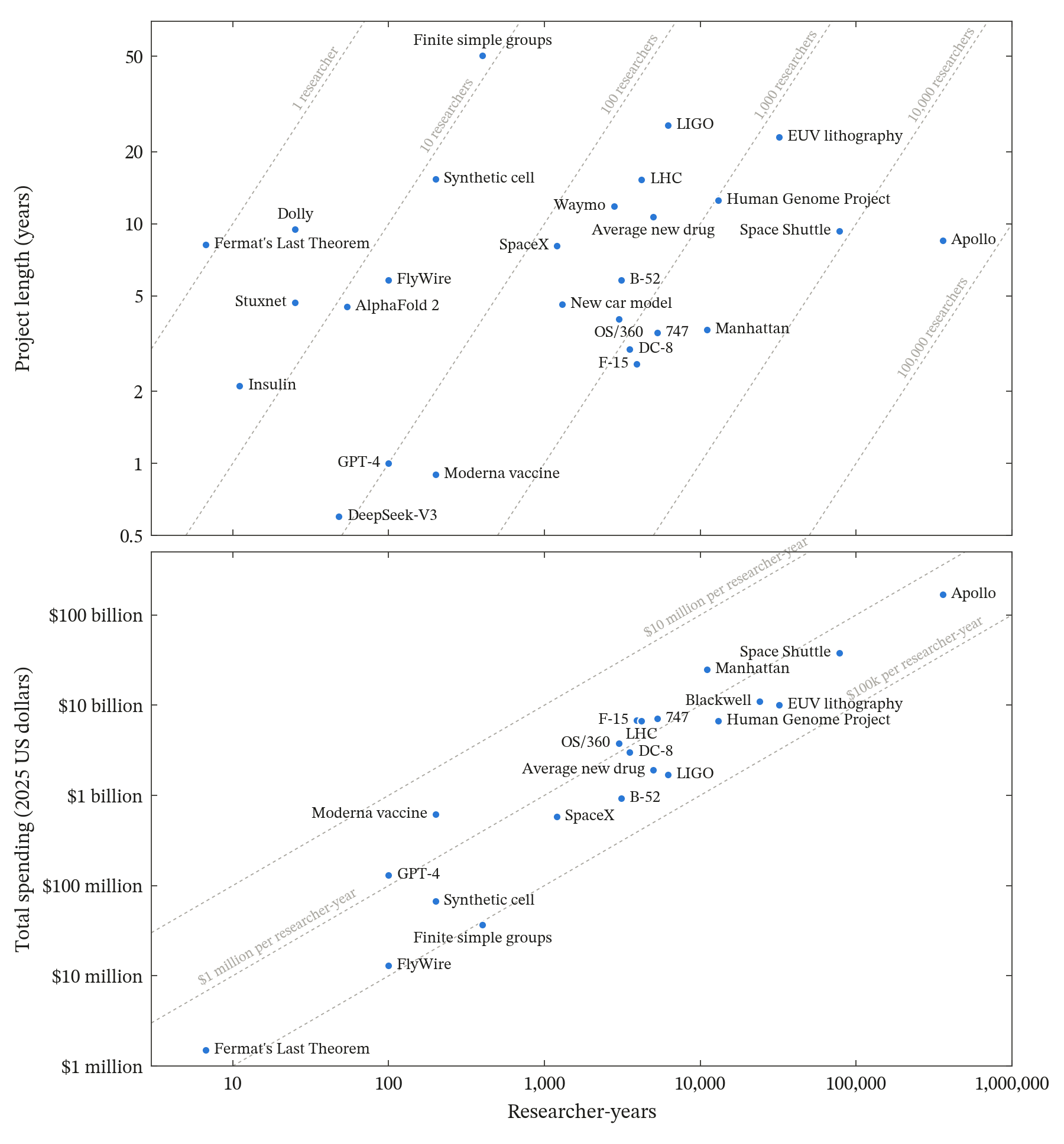
With hundreds of millions of AI researchers operating at the same time, we would have enough intellectual firepower for the equivalent of thousands of Apollo programs, tens of thousands of Manhattan Projects, or hundreds of thousands of new drug programs running in parallel. At historical speeds, these projects take several years to a decade, and the world would be radically transformed by the end of that. In practice we could also trade some of this parallelism for speed. More researchers shorten a project far less than proportionally, but I'd still expect most of these projects could go several times faster.
Of course, projects need more than researchers. They need equipment and facilities, and workers to build and run them. The bottom half of the figure above plots each project's total spending against its researcher-years, with dashed lines marking spending per researcher-year. For most projects, researchers were only a minority of the costs. For these projects, AI research would quickly become bottlenecked on the physical capacity to carry out the necessary plans. As I discuss in my series on the AI industrial explosion, physical production could grow quite fast after AGI, but it would grow much more slowly than the population of AI researchers.
Implications for AGI
Some fields need no physical equipment at all, so they would not hit the physical limits that constrain big engineering projects. Mathematics is the clearest case, along with much of computer science, philosophy, mathematical physics, and theoretical economics. The only limit on these fields is the number of researchers. All the mathematics done since 1900 comes to about 4.4 million researcher-years, which hundreds of millions of AI researchers could match within a few weeks.
Many other fields rely on data from the real world, but a great deal of that data already exists, far more than anyone has had time to study. This includes the troves of genomic data in molecular biology, and historical archives far larger than the relatively small population of historians could ever systematically read through and analyze.
Then there is automating the economy. This needs some integration with the real world, but it doesn't need vast numbers of workers or vast amounts of equipment. Even if AI did this no faster than human engineers would, there would be enough intellectual firepower to automate most jobs over a few years.
A separate question is whether AI would improve itself, which is another plausible use of these AI researchers. Today the frontier labs employ only a few thousand people each, and even very generously there are at most several hundred thousand AI researchers globally. With potentially hundreds of millions of AI researchers entering the field, it is hard to see how AI progress would not greatly speed up. It is less clear whether this would trigger true recursive self-improvement, because it is unclear how far compute bottlenecks would still limit progress. This may be an academic question, since even a one-time jump to hundreds of millions of AI researchers could take us into very scary territory.
All research runs into diminishing returns. It's hard to look at how much more research is done today than in the 1950s and not conclude that ideas are getting harder to find. Any alternative has to postulate a universal, several-orders-of-magnitude decline in research quality. Nevertheless, the increase is so massive that even steep diminishing returns don't change the conclusion that AI would radically accelerate research across all domains. Within a decade we would see an amount of research effort that one might naively have expected to take the entire 21st century.
Appendix A: researchers per article
To convert articles into researchers, I use the three countries that count their academic researchers by field:
- US: NSF's surveys of doctorate holders, college graduates, and graduate students.
- Japan: its national R&D survey.
- Germany: Destatis university staff statistics and R&D counts.
Faculty count at their measured share of time on research. The ratio is measured for nine groups of fields, since national job categories don't match OpenAlex's fields. The central value is the geometric mean of the countries with data, and Environmental Science, which no country counts, takes the article-weighted average of the other groups.
| Group | US | Japan | Germany | Central |
|---|---|---|---|---|
| Mathematics | 3.83 | 2.21 | 3.44 | 3.08 |
| Computer Science | 2.02 | 1.22 | 2.90 | 1.93 |
| Earth and Planetary Sciences | 3.22 | — | 1.15 | 1.93 |
| Physics, chemistry, and materials | 2.32 | 1.16 | 1.69 | 1.66 |
| Life sciences | 0.96 | 1.40 | 0.70 | 0.98 |
| Engineering | 3.18 | 2.50 | 2.38 | 2.67 |
| Social sciences and humanities | 2.59 | 7.31 | 2.83 | 3.77 |
| Applied health | 1.16 | 4.52 | 1.30 | 1.90 |
| Environmental Science | — | — | — | 1.89 |
The ratio is held constant over time. UNESCO's counts show researchers per core article staying between 3.4 and 4.7 from 1996 to 2023.
Appendix B: projects
To estimate how long different research projects took and how much they cost, I used Claude Opus 5.5 to investigate several dozen projects. Good estimates of researcher-years and total spending are often hard to find, and I only included projects where I could find reasonable data. The estimates of total researcher-years and of total spending should be taken as order-of-magnitude estimates only. I would not be surprised if the true values differed by 50% from those reported here.
| Project | Length (years) | Researcher-years | Spending (2025 USD M) | Source |
|---|---|---|---|---|
| Apollo (all NASA manned space flight) | 8.5 | 360000 | 170000 | Van Nimmen, Bruno, and Rosholt (1976); Levine (1982) |
| Space Shuttle (to first flight) | 9.3 | 78000 | 38000 | HAER (n.d.), citing Heppenheimer (2002); Van Nimmen, Bruno, and Rosholt (1976) |
| ASML EUV lithography | 23 | 32000 | 10000 | ASML (2018, 2019, 2022, 2026); LaPedus (2014) |
| NVIDIA Blackwell | — | 24000 | 11000 | CNBC (2024); NVIDIA (2023, 2024) |
| Human Genome Project (public) | 12.5 | 13000 | 6700 | JGI (2000) |
| Manhattan Project | 3.6 | 11000 | 25000 | Manhattan District History (n.d.); Hawkins (1961) |
| LIGO (to first detection) | 25.7 | 6200 | 1700 | INSPIRE (2026); LSC (2014); Vogt (1994); LIGO Laboratory (2007) |
| Boeing 747 (airframe) | 3.5 | 5300 | 7100 | Vincennes Sun-Commercial (1970); Sutter and Spenser (2006) |
| Average new drug | 10.7 | 5000 | 1900 | DiMasi, Grabowski, and Hansen (2016); NSF NCSES (2016) |
| Large Hadron Collider (the machine) | 15.3 | 4200 | 6700 | Roser et al. (2023); Maiani and Bonolis (2017); CERN (2012) |
| McDonnell Douglas F-15 (airframe) | 2.6 | 3900 | 6800 | Hess and Romanoff (1987) |
| Douglas DC-8 (airframe) | 3 | 3500 | 3000 | Interavia (1959) |
| Boeing B-52 (airframe) | 5.8 | 3100 | 930 | Hess and Romanoff (1987) |
| IBM OS/360 | 4 | 3000 | 3800 | Brooks (1975) |
| Waymo | 11.8 | 2800 | — | Markoff (2010); The Information (2020); Crustdata (2026) |
| New car model (automaker only) | 4.6 | 1300 | — | Ellison, Clark, Fujimoto, and Hyun (1995) |
| SpaceX (to Falcon 9) | 8.1 | 1200 | 580 | Space.com (2008) |
| Classification of finite simple groups | 50.3 | 400 | 37 | Solomon (2001); Gorenstein (1979); Aschbacher (2004) |
| First synthetic cell (JCVI-syn1.0) | 15.4 | 200 | 67 | Nature (2011) |
| Moderna COVID-19 vaccine | 0.9 | 200 | 620 | Moderna (2020, 2021); Hoge (2020) |
| GPT-4 | 1 | 100 | 130 | OpenAI (2023) |
| FlyWire fly-brain connectome | 5.8 | 100 | 13 | Dorkenwald et al. (2024) |
| AlphaFold 2 | 4.5 | 54 | — | Jumper et al. (2021) |
| DeepSeek-V3 | 0.6 | 48 | — | DeepSeek-AI (2024) |
| Dolly the sheep | 9.5 | 25 | — | Wilmut et al. (1997); Campbell et al. (1996) |
| Stuxnet | 4.7 | 25 | — | Kushner (2013); McDonald et al. (2013) |
| Recombinant human insulin | 2.1 | 11 | — | Stern (1995); Goeddel et al. (1979) |
| Fermat's Last Theorem (Wiles's proof) | 8.2 | 6.7 | 1.5 | Wiles (1995); Taylor and Wiles (1995); Wikipedia (2026) |
- Computer Science and AI start in 1956, since OpenAlex's assignments of earlier papers to them are mostly misclassified.

 点赞
点赞 收藏
收藏 点踩
点踩 分享
分享