How Data Centers Are Pushing Up US Power Costs


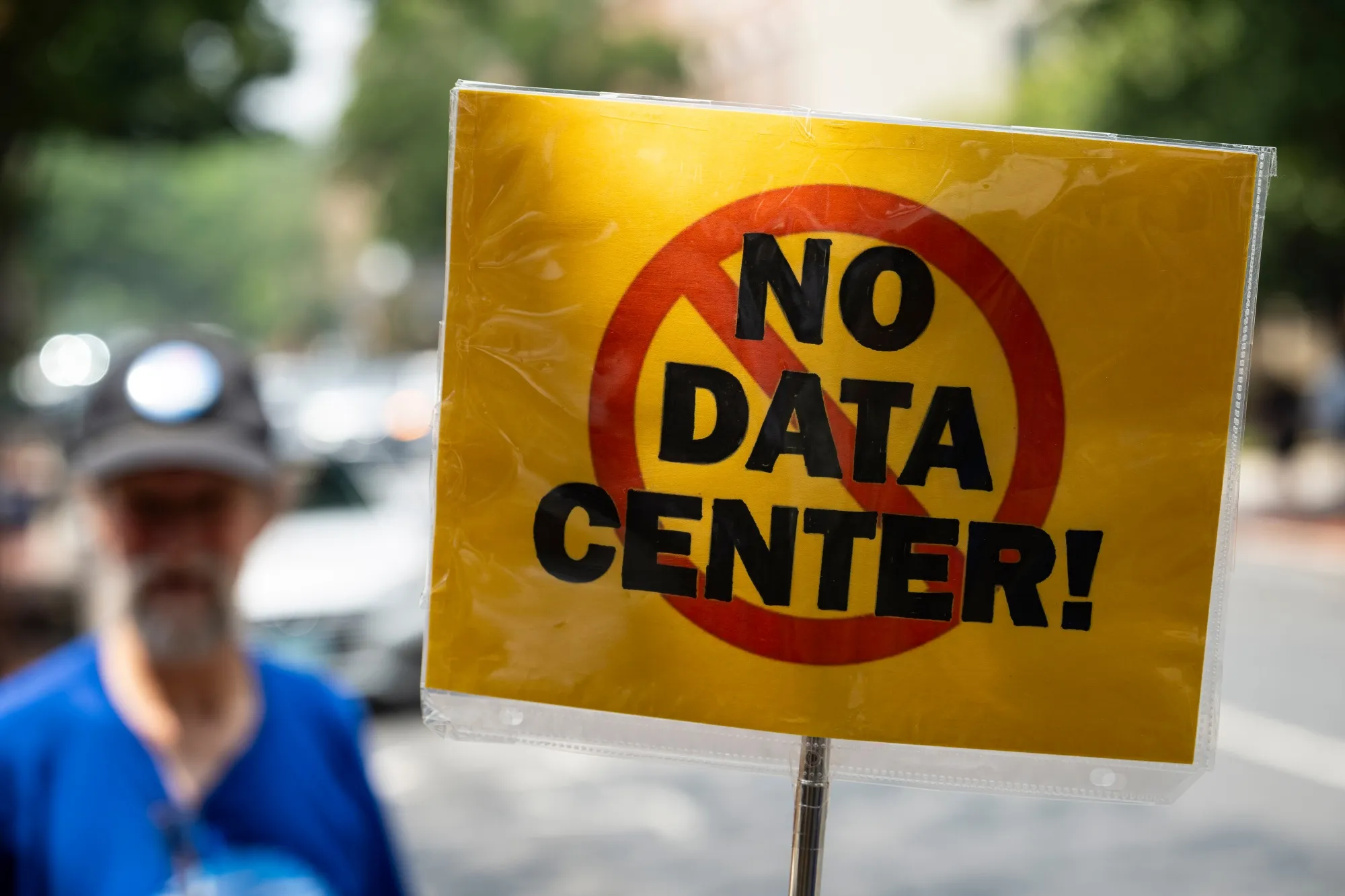
Data centers have become a defining political issue in the run-up to the US midterm elections. The giant, windowless warehouses have drawn fierce backlash across the country as people worry about how much power and water they use, as well as the noise and heat they produce.
Voters squeezed by higher electricity bills have focused their ire on data centers, which can require as much power as a small city to support artificial-intelligence systems. Local opposition blocked or delayed at least 120 projects worth almost $200 billion in the first half of this year, according to research group Data Center Watch.
Those cost-of-living pressures have become a liability for Republicans as they seek to hold on to both chambers of Congress in November. President Donald Trump had promised to slash electricity prices by 50% if he was reelected to the White House.
How much have power prices increased by?
Between January 2025, when Trump took office, and July of this year, the latest date for which data is available, the national monthly average price of electricity for residential users rose by 15% in nominal terms, according to data from the US Energy Information Administration.
Zooming out, power prices have been climbing more rapidly in recent years after a long stretch of relatively small increases. They were nearly 40% higher across the first seven months of 2026 than the same period in 2019.
The picture varies by state over that time frame. The largest jump in residential prices has been in Maine, at around 90%, followed by California and New York at closer to 70%. At the other end of the scale, the increase has been much more modest in Iowa and Nevada, where average prices have risen by less than 15%.
How do data centers contribute to higher electricity costs?
Data centers need vast amounts of power to run thousands of chips and the cooling systems that prevent overheating. A large facility with a 1-gigawatt capacity can use about as much electricity as 800,000 homes, according to the Electric Power Research Institute. As data centers rapidly spring up across the US, BloombergNEF forecasts their share of national electricity consumption could roughly double to 12% by the end of the decade, rising to 20% in 2035.
After many years of stagnant power growth, US grids are grappling with surging demand from data centers and the electrification of the economy. That’s pushing up power prices in some markets as supply comes under pressure. Bloomberg News analysis published in 2025 found that in areas near significant data center activity, monthly wholesale prices were up to 267% higher than in 2020.
The grid wasn’t designed to accommodate the large loads of data centers. Connecting one of these facilities to the system can require hundreds of millions of dollars’ worth of new generation capacity, transmission lines and other infrastructure. Traditionally, the cost of grid upgrades has been recovered from all users, adding to everyone’s bills.
The region covered by grid operator PJM Interconnection LLC — which spans 13 states, including a swath of Northern Virginia known as Data Center Alley — has been a popular location for data centers. In the first seven months of 2026, the wholesale cost of power there rose by 47% year-on-year, to almost $117 per megawatt-hour, according to Monitoring Analytics. The independent market monitor for PJM said that figure would’ve been around $10 lower without the load from data centers. The addition of these facilities has forced the grid operator to pay more for backup capacity to ensure it can meet future peaks in demand.
There are concerns that utilities might end up investing in new grid infrastructure for data centers that don’t ultimately get built — for example, if the appetite for AI is less than expected. The remaining grid customers would still be on the hook for those investments.
Data center developers have also been making “phantom” applications, pitching the same project to multiple utilities to see where they can get the speediest approval for a connection. That makes it difficult to accurately plan for future grid demand.
Many utilities are preparing to meet data centers’ needs by building or contracting new natural gas-fired generation. Overinvestment in gas capacity could raise the power bills of an average US household by up to $118 a year, according to clean energy think tank RMI.
Are there other factors driving up power prices?
“There isn’t a single unified story of what’s going on nationally,” said Severin Borenstein, an economist at University of California, Berkeley, who studies electricity pricing.
Retail electricity prices set by utilities reflect wholesale power costs combined with additional expenses for things such as transmission and distribution. On the West Coast, damage from severe wildfires has driven up consumers’ bills, even if wholesale costs have remained relatively stable, Borenstein said. Beyond funding repairs, utilities are also spending to increase resilience against future extreme weather and climate events. On the East Coast, particularly across PJM, Borenstein said that wholesale price spikes have driven retail electricity pricing higher.
There are some common factors. An increase in gas prices and upgrades to aging grid infrastructure have put upward pressure on electricity costs. “There are portions of the power grid that are 80 years old at this point,” said Ryan Hledik, a principal at consulting firm The Brattle Group. “We need to go out and replace aging equipment and unfortunately we are having to do that right at a time when a lot of that equipment has gotten more expensive.”
Prices for gas turbines and transformers — which change the voltage of electricity for it to be transported efficiently and used safely — have been increasing, while delivery times for these assets now stretch years. The supply crunch for the equipment is partly due to demand being driven by data centers.
Soaring Electric Bills Stoke Voter Fury Ahead of MidtermsBacklash Over Data Centers, Power Costs Tests GOP’s Hold on OhioAI’s Power Surge Is Forcing Total Redesign of Data CentersExplainer: Why the Data Center Backlash Has Republicans on the Back Foot
What’s been the political response?
Courting data center investment, once pitched by politicians as a boon for local economies, has now become a liability for both Republicans and Democrats. According to a Pew Research Center poll conducted in July and August, 60% of Americans wouldn’t be comfortable with a new data center operating in their area, while 50% of respondents said that these facilities are mostly bad for home energy costs.
With the midterms looming, the House of Representatives passed a bipartisan bill in September that requires states to consider a federal standard for large data centers to cover the costs of the new power infrastructure that they need. But the bill stumbled in the Senate, criticized by Democrats as “toothless” because state regulators wouldn’t be forced to adopt the standard.
While Trump has criticized efforts to block new data centers, saying they’re essential for the US to win the AI race with China, he has said that he wants technology firms to foot the bill for their expanding electricity needs. His “Ratepayer Protection Pledge” has been signed by utilities and so-called hyperscalers with the biggest data-center portfolios, including Microsoft Corp., Alphabet Inc.’s Google and Amazon.com Inc. The initiative is non-binding and lacks specifics on how it fits into the complex landscape of how rates are set.
States have been moving faster than the federal government to put guardrails on the data center build-out. In Texas, Governor Greg Abbott, who is up for reelection in November, has effectively paused approvals for new data centers until the state completes a comprehensive audit.
New York Governor Kathy Hochul, who is also running for another term, has imposed a one-year moratorium on new permits for large data centers as the state establishes a framework to review the environmental and energy-cost impacts. More than a dozen other states have introduced or considered similar action, according to the National Conference of State Legislatures.
How are grid operators and utilities responding?
Some utilities have started to propose separate large-load tariffs so that data center developers pay directly for infrastructure upgrades or the procurement of extra generation capacity, or even face minimum billing requirements. Regulators in Ohio ruled last year that new data centers served by the state’s largest electric utility must pay for at least 85% of the energy they say they’ll need, regardless of whether that power ends up being used.
Utilities are also looking to weed out speculative grid connection requests by introducing steep upfront application costs, asking for more collateral and requiring near-perfect credit ratings. Earlier this year, Exelon Corp., which operates in the Mid-Atlantic and Midwest, slashed its forecast for “high probability” data centers in its pipeline by almost 40%.
Grids operators are grappling with how to stave off potential electricity shortages as more data centers come online. PJM has struggled to keep up with the demand growth and is under pressure from the federal energy regulator to rethink its strategy. This comes as consecutive power auctions held by the grid have failed to secure enough supply commitments to ensure reliability in the coming years, leaving it with a shortfall roughly equivalent to the capacity of seven traditional nuclear reactors.
How are data center developers responding?
Tech companies have mounted a charm offensive to try to win over an increasingly skeptical public. They’ve poured millions of dollars into funding local infrastructure, schools and other initiatives. One developer offered $10,000 checks to residents of a Pennsylvania township if its data center is allowed to proceed, the Wall Street Journal reported.
Amazon announced in October that it will invest more than $1 billion over the next five years in communities where it operates data centers. But it also pushed back against the notion that these facilities are to blame for driving up electricity costs. Matt Garman, the chief executive officer of Amazon Web Services, called the idea a “myth” and “convenient scapegoating,” and instead pointed the finger at the nation’s aging grid. He argued that once the grid expansion is completed, consumers could see flat or lower power prices.
More data center developers are looking to produce their own electricity. Some 59 projects with a combined capacity of roughly 90 gigawatts aim to build their own behind-the-meter generation, according to Cleanview. The research firm said this represents more than 25% of planned data center capacity it has tracked in the US.

 点赞
点赞 收藏
收藏 点踩
点踩 分享
分享