US Effort to Combat Iran-Backed Groups Was Disorganized, Audit Finds

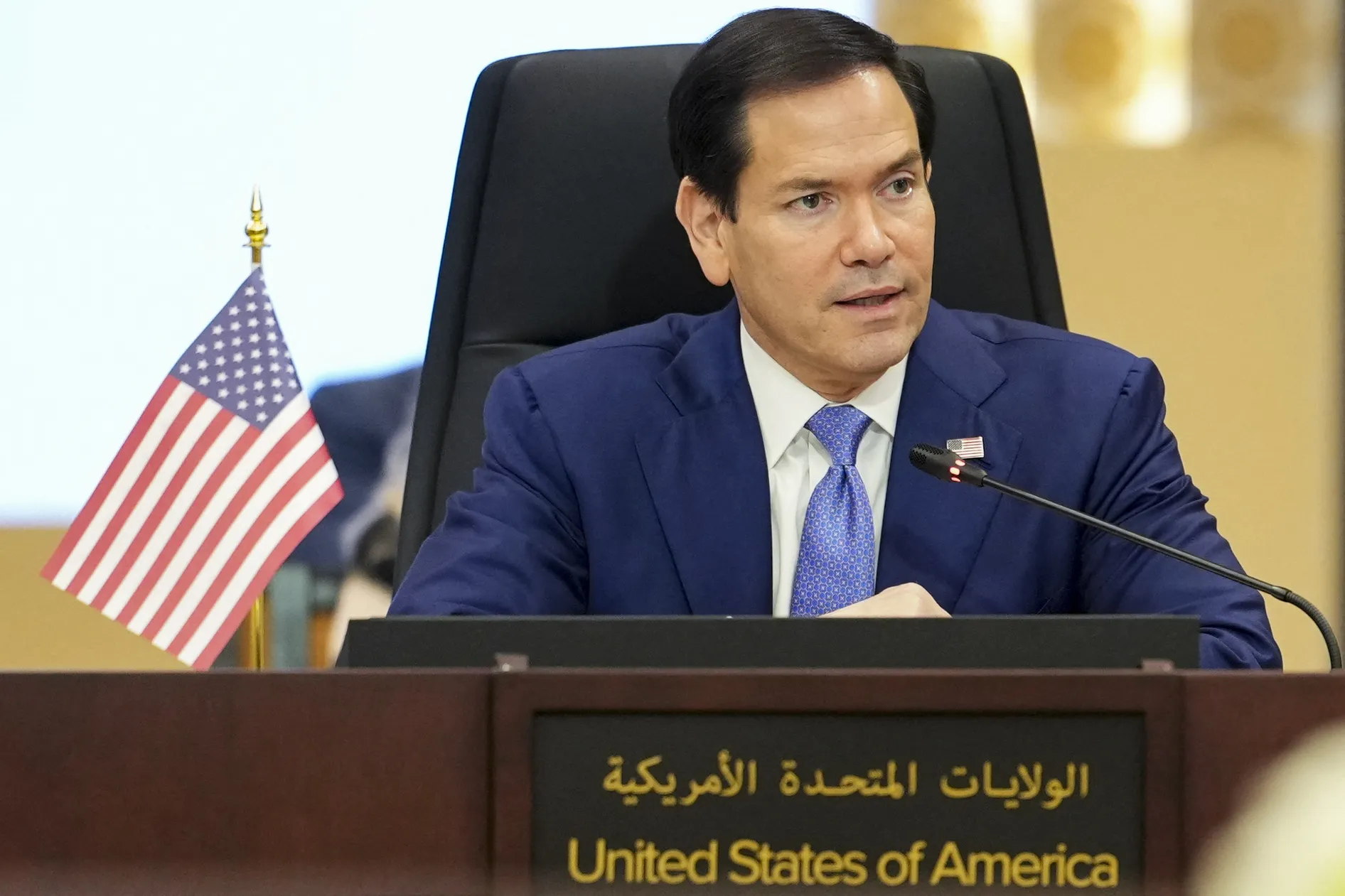
Welcome back to FOIA Files! During the first six months of President Donald Trump’s second term, the State Department acted as one of the enforcers of his “maximum pressure” policy on Iran. Secretary of State Marco Rubio was tasked with targeting Iran-backed militant groups and proxies, such as Hamas, Hezbollah and Yemeni Houthis, through terrorist designations, banking-and-oil sanctions and pressuring other countries that gave them safe haven to cut off their funding. Around that time, the State Department’s Office of Inspector General was close to wrapping up an audit of the agency’s work to combat the Iran-backed groups in the Middle East. In July 2025, the OIG wrote a report about its findings. It was classified SECRET. I requested a copy of it through the Freedom of Information Act. It’s pretty critical. If you’re not already getting FOIA Files in your inbox, sign up here.
Iran-backed groups are nonstate actors that get money, training and weapons from Iran in order to advance Tehran’s interests across the Middle East. The groups have a long history of attacking US personnel and facilities in the region and remain a national security threat, according to the 64-page report, portions of which were redacted.
“The threat is not new. But the Oct. 7, 2023, Hamas attack on Israel brought renewed attention to the reach of Iran-backed groups and the threat they pose in the Middle East and beyond,” the report said.
The OIG’s audit spanned a year, from April 2024 to May 2025, at embassies in Jordan, Lebanon and Israel and in Washington, DC. Auditors interviewed officials from various overseas posts, State Department bureaus, and interagency partners, including the Departments of Defense, Homeland Security, Justice and Treasury.
Despite the federal government investing significant resources into more than 200 State Department programs and interagency initiatives, the agency’s work to counter Iran-backed groups has been deeply disorganized, the audit found.
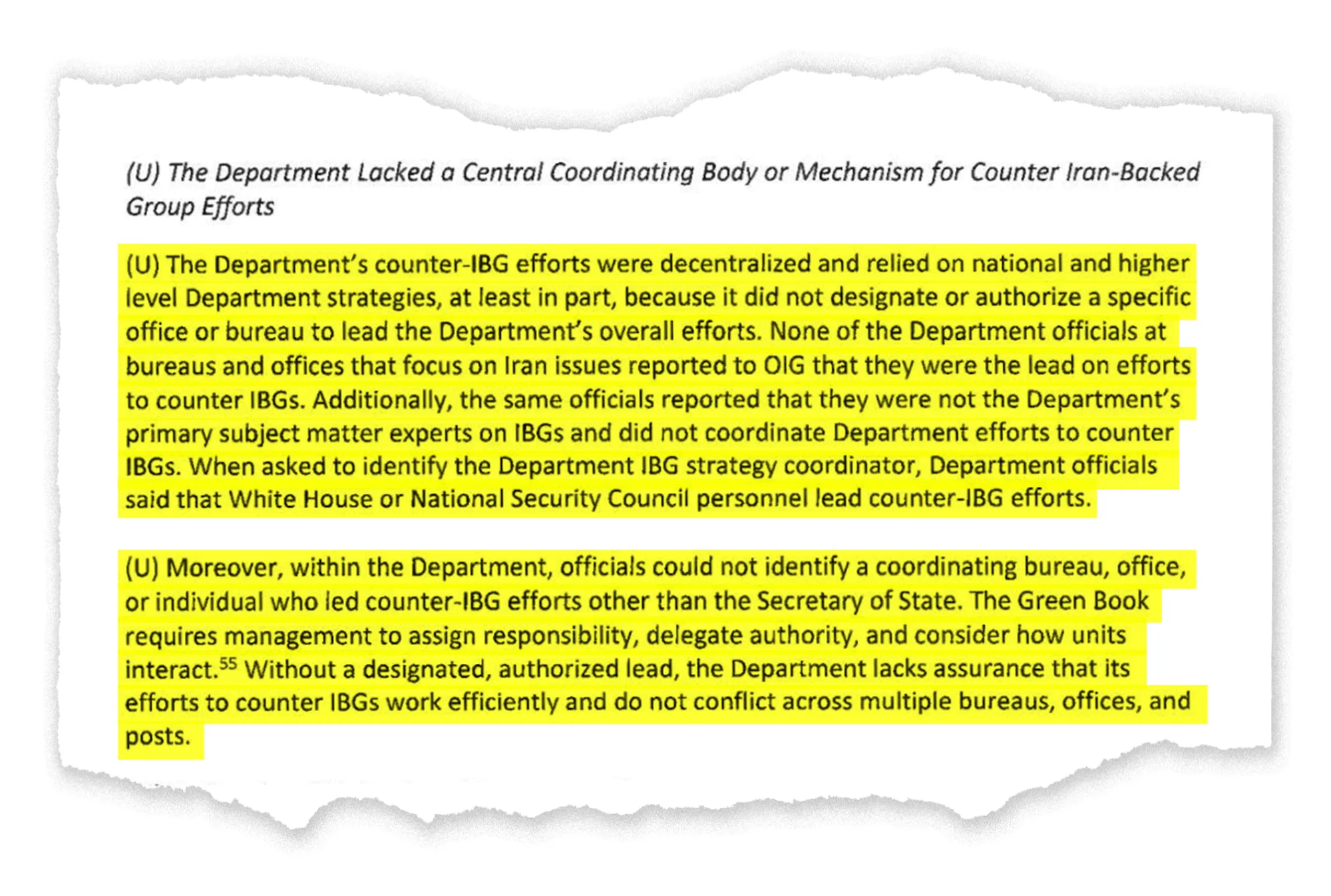
The auditors identified more than 200 programs to counter Iran-backed groups (identified in the report as IBGs). The State Department ran 139 of them spread across 12 bureaus and seven overseas posts. Seven other federal agencies were responsible for the other 75. The work ranged from high-profile military actions, including naval escorts in the Red Sea and airstrikes against Houthi targets in Yemen, to diplomatic pressure, designating certain groups as terrorist organizations, offering rewards for information, training police in Lebanon and spearheading messaging campaigns that targeted Hezbollah and Hamas.
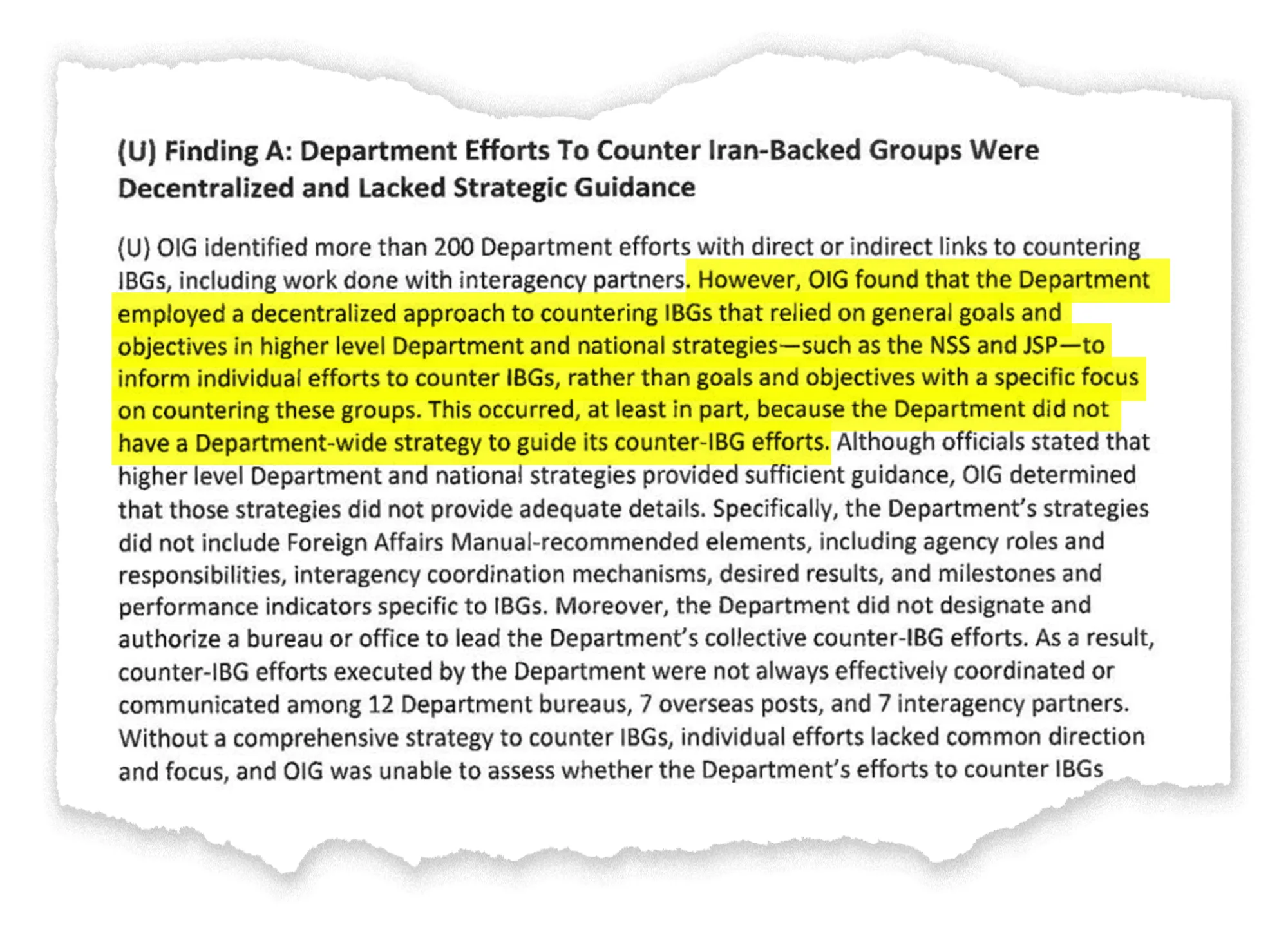
But the audit said those endeavors weren’t always coordinated or discussed with all the different agencies and offices inside of State.
“For example, one Department official stated that the areas of responsibility for counter-lBG efforts were ‘completely overlapping,’ meaning there was very little delineation of work, and multiple stakeholders were always involved,” the report said. “OIG observed a lack of clarity between issues related to Iran and those related to IBGs.”
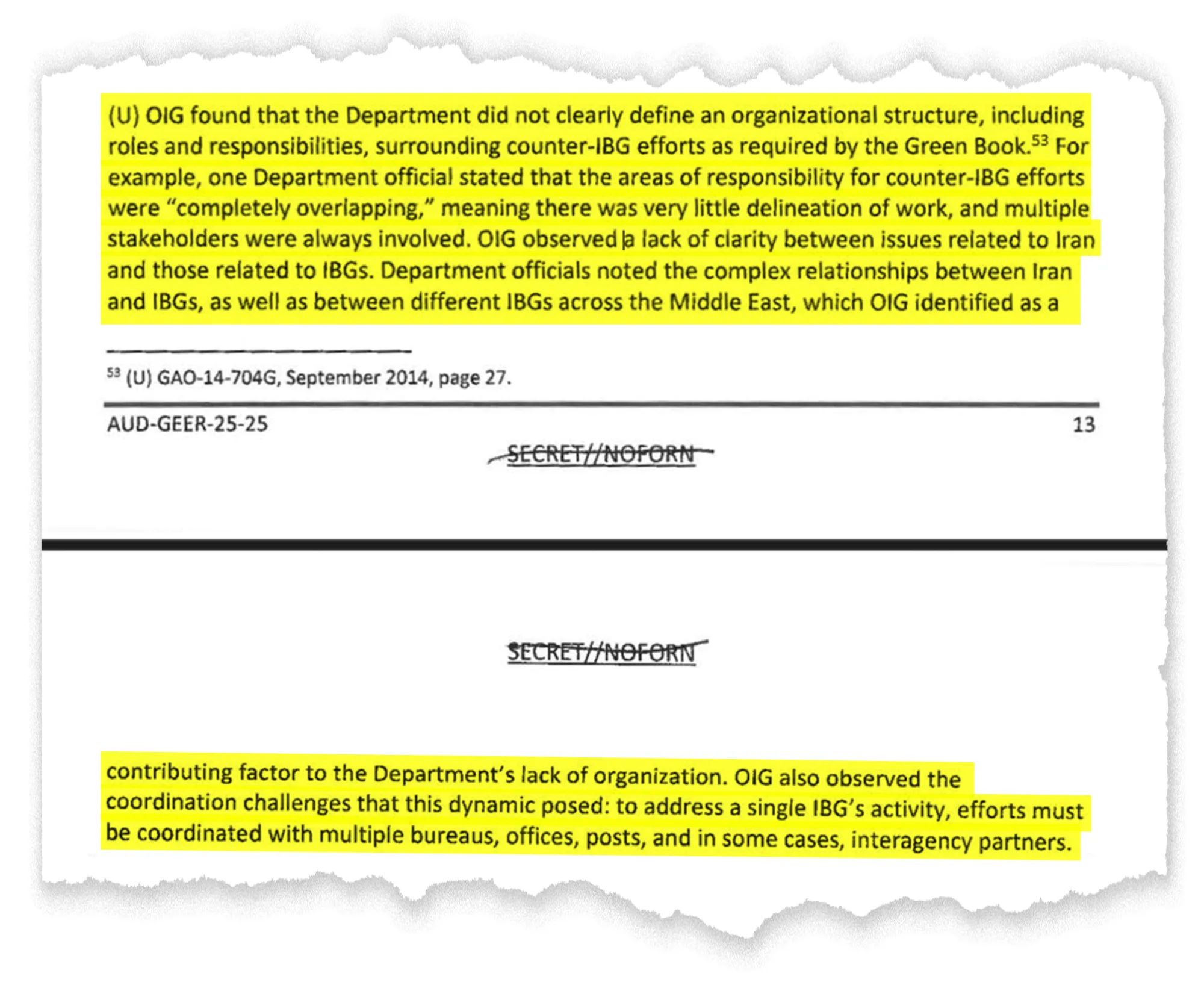
The report mentions the federal government’s “Green Book,” which dictates how federal agencies should manage their operations in a way that ensures employees have the information and tools they need to do their work. But the auditors found that the State Department lacked an organizational structure for coordinating its campaigns against the groups, failed to clearly assign roles and responsibilities, and had no one in charge of overseeing how the department’s various offices worked together. That made it impossible for the auditors to determine whether the State Department’s work was working, the report said.
Reforms
To address the shortcomings, the OIG made two major recommendations to the Undersecretary of Management: The Secretary of State should assign a specific bureau or office to oversee all of the agency’s efforts to counter Iran-backed groups; and the State Department should designate an official to head the initiative and design a plan to be used by all the offices and bureaus to combat the groups.
The report said the State Department agreed with the recommendations and said it designated the Office of Iranian Affairs to serve as the office responsible for coordinating the work across the State Department.
The report also said that the Undersecretary of Management told auditors they believed the agency already had a plan to combat Iran-backed groups pursuant to a Feb. 4, 2025 presidential memo: White House National Security Presidential Memorandum-2. The auditors disagreed.
“Only one action in the memorandum is targeted at countering IBGs,” the report said. “The memorandum does not outline specific goals and objectives for countering IBGs, which are critical to ensure that Department efforts achieve intended results.”
The report said it would close the recommendation when it receives “documentation” proving that the Office of Iranian Affairs established a department-wide strategy to target Iran-backed groups in the Middle East.
A State Department spokesperson did not respond to specific questions about the audit. The spokesperson said the agency “is focused on countering the Iranian regime’s support for terrorism and maintains close coordination with bureaus, overseas missions, and interagency partners on these efforts.”
Since the report was finalized more than a year ago, the State Department has stepped up its campaign against Iran-backed groups in coordination with other agencies. Last month, State and Treasury announced “Operation Economic Outcast,” which focused on action against Hezbollah “and the broader financial networks that sustain Iran’s campaign of regional destabilization.”
Do you have details to disclose about the current state of the FOIA? Or documents you think I should request? Send me an email: jleopold15@bloomberg.net or jasonleopold@protonmail.com. Or send me a secure message on Signal: @JasonLeopold.666.
More From FOIA Files
Pam Bondi’s Secret DOJ Email Address RevealedTrump’s English-Language Order Spurs New Agency Guidelines, Memo RevealsGhislaine Maxwell’s Prison Transfer Application Released
More from Bloomberg
Like FOIA Files? Check out these newsletters:
Washington Edition for following Trump’s second term through the lens of business, markets and the economyCalifornia Edition for a weekly newsletter on one of the world’s biggest economies and its global influenceSoundbite for reporting on podcasting, the music industry and audio trendsCyber Bulletin for coverage of the shadow world of hackers and cyber-espionageGreen Daily for the latest in climate news, zero-emission tech and green finance
Explore all newsletters at Bloomberg.com.

 点赞
点赞 收藏
收藏 点踩
点踩 分享
分享