Apollo "UAP"s explained

On May 8th, the Department of War released a trove of files showing various images, testimonials, audio recordings, and videos capturing what appear to be unexplainable phenomena.
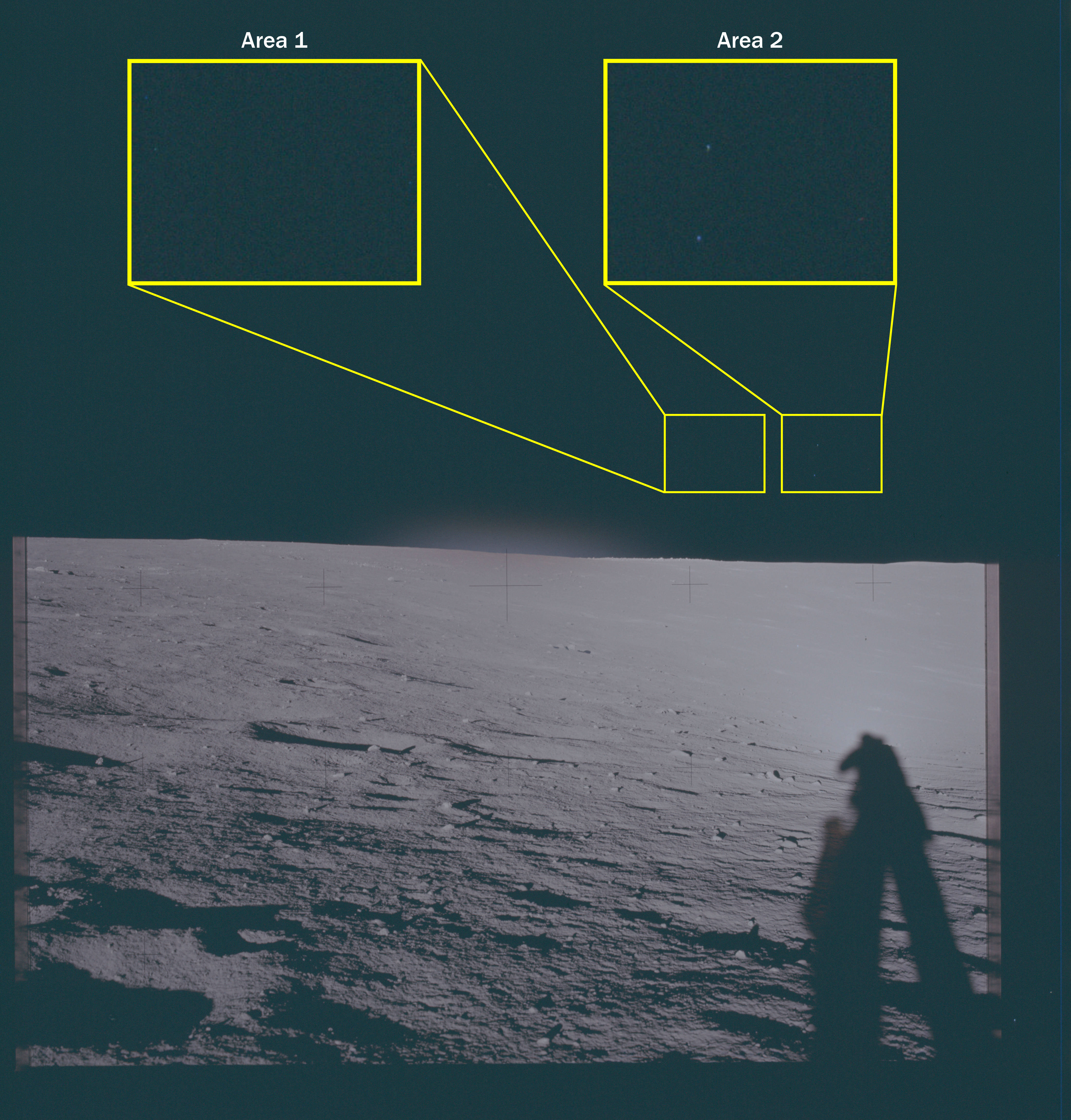
The most striking images are the ones captured on the lunar surface during the Apollo 12 and Apollo 17 missions, and in particular, one image that shows a “streak” of blue particles above the lunar surface.
On the official DoW site, we are provided with a short description of the image:
“This archival photograph depicts the lunar surface as viewed from the landing site of Apollo 12. This image features a highlighted area of interest slightly to the right of the vertical axis of the frame, above the horizon, in which unidentified phenomena are visible.This image has been modified from its original state to assist viewers in identifying specific areas of interest. These highlights are provided for contextual purposes only. Such alterations do not constitute an analytical judgment, investigative conclusion, or factual determination regarding the nature or significance of the subject matter.”
And the attached edited image:
The image provided is of the JPEG format (with lossy compression, which generates further artifacts) and of a small 2.4MB size. It’s titled nasa-uap-vm1-apollo-12–1969 (which is technically incorrect since “Unidentified Aerial Phenomena” would presumably only be found in the atmosphere… not above the lunar surface).
Looking through the publicly available Apollo 12 images we can see that this image is actually titled AS12–46–6842 (46 stands for the magazine number, and 6842 for the specific captured frame). The website ‘March to the Moon’, which scans the original film rolls stored in the Johnson Space Center, allows us to download the original scanned film at a much higher quality (up to 1.3 GB in TIFF format). You can download it here.
Examining the higher-quality version you can immediately spot other “UAP”s. Here are some that I highlighted in the same photo:
Since some of these anomalies can be found outside the captured image (they are homogeneously spread across the image, however they are easier to spot when placed against a black background), it is plausible to infer that no, these lights in the sky aren’t alien crafts nor demons but photographic artifacts likely caused by scratched or otherwise physically disturbed film as can be found in many photos captured using the Kodak Ektachrome film (or any reverse-color film). Just rifling through the Apollo images in high quality can show many artifacts in a similar manner (see appendix).
The Ektachrome color film is notorious for producing blue artifacts when scratched due to the Blue-sensitive layer being the topmost one (see forum discussion and this article). Typical color-negative films, scratched, will produce yellowish artifacts, which we recognize as the typical warm film look. Since Ektachrome film is reverse-film (which directly produces positives without negative images), it typically produces blue artifacts.
“On color film, a very light
scratch on the emulsion generally
appears neutral. But going deeper into
the three color layers, it will project
as most any color depending on the
scratch depth, or even white if all the
emulsion was removed. Scratches are
best detected by visual observation
on projection.”-Kodak’s The Book of Film Care, 2nd Edition 1992, Publication H-23 (page 52)
So very thin scratches (which are the most typical) would produce a blue artifact, somewhat deeper scratches would produce a cyan artifact, and even deeper scratches would produce a white artifact. Notably almost all artifacts captured in the Apollo photos appear to be of one of these colors to varying saturation.
Here's an interactive diagram made by Claude to explain:
I ended up asking the Apollo Image Archive about these artifacts and they confirmed to me that these artifacts are physical aberrations in the film:
You are correct that those are nicks and scratches on the film. The film was set up on a reel system for astronauts and analysts to study the flight film after each mission, and it’s possible (maybe even likely) that those happened at that time. It’s impossible to say for sure at what point in handling the film it happened, though.
I asked about all the different artifacts found in this film reel however, so I’m not sure this answer covers every case
Others have postulated that these artifacts are the result of high energy particles from cosmic-rays or solar wind, this is partly correct. for the bright dot-like artifacts this seems like a plausible explanation given the artifacts’ morphologies however it is highly improbable that this could explain the repeated ‘streaks’ in AS12–46–6842 (assuming singular particles strike the film homogeneously, the chances of multiple particles striking the film in just the right way to produce what are typical film scratch artifacts are low)
The DoW also provides us with another photo from Apollo 17 with a description that sheds more light on the circumstances of the “disclosure” of these photos:
“As part of the review of historical UAP materials under PURSUE, DOW has opened a case to investigate the accompanying NASA photograph from the Apollo 17 mission, taken December 1972. The image contains three “dots” in a triangular formation in the lower right quadrant of the lunar sky that is clearly visible upon magnification of the image. While this photo has been previously released and discussed by keen observers, there is no consensus about the nature of the anomaly. New preliminary US government analysis suggests the image feature is potentially the result of a physical object in the scene. Additionally, as part of this investigation, the government has obtained the original film from the Apollo 17 mission and the results of the full NASA and DOW analysis will be released when completed.”
Here, the DoW states that this photo (as all other “disclosed” in this release) has actually already been in the public domain and has been discussed. This image is actually AS17–147–22470, and has also been scanned by ‘March to the Moon’ in much higher quality. Again, we have what seem to be very clear blue scratch artifacts, as this is still Kodak Ektachrome film. Here is another UFO visible in the image, of an even larger size!
The only problem with this other, bigger artifact is that it’s outside the frame of the actual image. This seems to be another scratch artifact from the Ektachrome film. However the US government claims that:
“New preliminary US government analysis suggests the image feature is potentially the result of a physical object in the scene”
It’s unclear to me what possible analysis could indicate this artifact is the result of a “physical object” given that it’s clearly a film scratch artifact, but maybe the Aliens were the ones who scratched the film themselves?
I’ll leave explaining the rest of the unexplainable phenomena as an exercise for the reader.
Appendix
Here are the rest of the Apollo images, their corresponding title, a higher quality version (sourced from ‘March to the Moon’), and highlighted artifacts elsewhere in the image:
- Due to removing the yellow dye layer (opposite of blue) first, a scratch could not produce a red artifact by removing dye alone (the same argument holds for standard photographic paper, with the layer order reversed), yet images: AS12-46-6843, AS12-46-6848, AS12-46-6849 seem to show a slight reddish tinge to the outside of the artifacts. This could be due to the digital scanning process (Leica DSW700 scanner used by ‘March to the Moon’) although this seems highly unlikely particularly in AS12-46-6849 which has distinct “patches” of color:
however red scratches could still be possible if a torn flake of the top (yellow and magenta) layers lands over a spot the scratch cut clean through (see the diagram above). Nevertheless even if we accept the claim that red scratches are impossible given that even seemingly partly red artifacts are visible outside the captured image these are almost certainly still physical film aberrations of some kind. - The fact that the newly provided images are of a compressed low quality JPEG form when much higher quality versions have been publicly available for years seems rather amateurish at best and potentially suspect at worst.
“…Whereas previous Administrations have failed to be transparent on this subject, with these new Documents and Videos, the people can decide for themselves, “WHAT THE HELL IS GOING ON?” Have Fun and Enjoy! President DONALD J. TRUMP”-trump’s truth social tweet
Given the lack of context, image quality, non-standardized and unclear naming conventions (VMx? 65_HS1–834228961_62-HQ-83894_Section_2?), limited data (without the actual telemetry and sensor display which would help explain these phenomena), the disclosure of solved phenomena (Astronaut’s eye), this release seems antithetical to the goal of “the people can decide for themselves, “WHAT THE HELL IS GOING ON?””.

 点赞
点赞 收藏
收藏 点踩
点踩 分享
分享