Raising $2 Billion to Turn Idle EV Charging Stations Into Power for the AI Boom

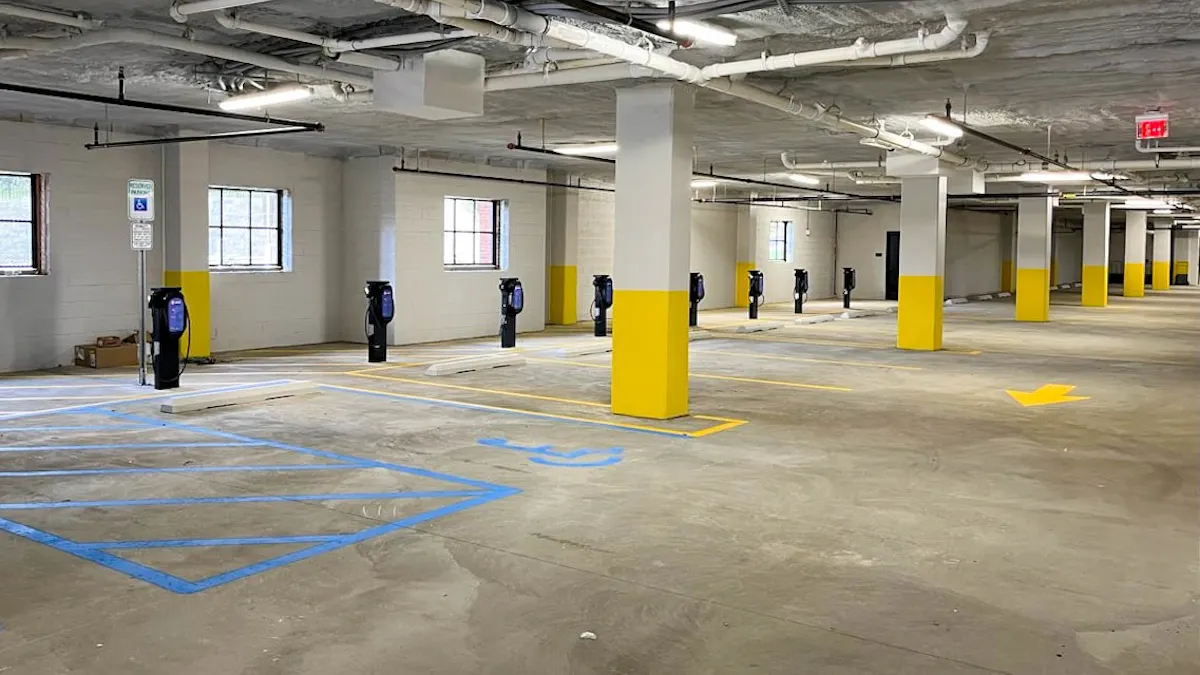
Here’s a new approach to powering AI computing capacity—using electric vehicle charging stations. That’s an idea being pursued by EV charging startup Xeal, which hopes to raise some $2 billion in debt financing over the next 18 months to back the idea.
New York-based Xeal manages a network of thousands of EV charging stations, mostly in luxury apartment complexes and upscale retail and office buildings in about 500 cities across the U.S. and Canada.
Xeal CEO Nikhil Bharadwaj says the company’s charging stations are in use less than 10% of the time on average, although its utility contracts give it the right to charge cars 24 hours a day. That typically leaves Xeal with a humongous store of idle electricity—enough to power around 130,000 homes or 110,000 Nvidia AI chips around the clock.
So the company is launching a service that will use that electricity to power AI chips. In December, Xeal will begin installing Nvidia AI server racks, housed within custom-made protective metal containers the size of a single parking space, next to chargers located in Chicago, Houston and Dallas parking garages. The power behind the chargers will instantly juice the racks, which will each contain roughly 48 Nvidia AI chips.
Bharadwaj said Xeal had contracts with compute customers for 100 of these containers. He declined to name the customers. But over the next 18 months, the company aims to raise around $2 billion to manufacture and deploy 1,000 of the containers, he said. Those containers will each house a single GPU rack, adding up to about 50,000 GPUs and 60 megawatts of total power capacity.
The company has previously raised $54 million in two funding rounds, most recently a $40 million Series B round in 2022. Bharadwaj said Xeal would seek relatively low-interest asset-backed loans and project finance debt totaling about $2 billion to finance the expansion. He argued that the company should be able to qualify for such funding because it had managed to build its large network of charging stations using just the $54 million in venture funds.
Xeal’s plans reflect the creative lengths to which companies even far-flung from AI are scrambling to make money from meeting soaring demand for power in the unprecedented AI data center boom.
As my colleagues have reported, however, it is becoming more difficult for some AI project developers to raise funds, and there is no guarantee that Xeal will manage to raise the investment it is seeking even if its initial GPU containers perform well.
Xeal’s advantage is its novel access to the grid. That’s attractive to AI data center developers who often face multiyear waits for grid connections and have turned to natural gas turbines and nuclear power, though those alternatives also face long delays. Batteries can serve as backup power, but can’t run a whole data center for more than a few hours before needing to be recharged.
“We are bringing inference and compute online in a matter of weeks versus waiting years,” Bharadwaj said. “Capital is just going to be the gas we pour on the fire here to help build a sustainable form of computing.”
Bharadwaj co-founded Xeal in 2019. It sells the chargers to building owners, who can often pay off the cost in five years if EVs are using them regularly, he said.
But EVs have been slow to sell in the U.S. for a number of reasons, including their cost. This has left Xeal’s charging stations unused 92% of the time on average. As a consequence, many building owners are reluctant to add chargers. “There‘s always this chicken and egg problem where real estate customers are like, ‘Hey, I don’t know if I have EV drivers living here. I'm not sure I can install a couple chargers or more,’" Bharadwaj said.
The AI boom changes that calculation. Bharadwaj said he calls the owners of buildings using Xeal chargers and offers to pay them a rental fee to allow Xeal to install just one of the GPU containers in their garage. “How would you like your payback to be 2½ years instead of five,” he tells them. “No capex to you, no opex. I'll pay for all the power bills.”
Demand for computing capacity is so high, he said, that it justifies adding new charging stations. Xeal currently has 200 MW of power across its installations and is adding capacity at a clip of 10 MW every quarter, he said.
“You can now underwrite EV charging projects across the country without federal subsidies, without utility incentives,” he said. “The industry can stand on its own feet because the compute generates income from the same infrastructure that is already deployed.”
Steve LeVine is editor of The Electric. Previously, he worked at Axios, Quartz and Medium, and before that The Wall Street Journal and The New York Times. He is the author of The Powerhouse: America, China and the Great Battery War, and is on Twitter @stevelevine

 点赞
点赞 收藏
收藏 点踩
点踩 分享
分享