Turning cheese whey into value: a sustainable substrate for probiotic biomass production

Authors: Eider Fernandez & Igor Baroja-Careaga, Esneki Zentroa (Leartiker S.COOP)
Probiotics are part of a rapidly expanding field of research. They are live microorganisms that, when administered in adequate amounts, may confer health benefits. Among the most extensively studied probiotics, some species of Lactobacillus and Bifidobacterium have been associated with the maintenance of gut microbiota balance and with several physiological functions. Producing these microorganisms usually requires nutrient-rich culture media. But what if such bacteria could be obtained from a food by-product nowadays regarded as waste? This question formed the starting point of a study carried out by Esneki Dairy Centre – Leartiker to assess the potential of cheese whey as a substrate for producing microbial biomass enriched in microorganisms with probiotic potential.
The challenge of cheese whey
Cheesemaking inevitably generates substantial amounts of whey: a yellowish liquid released from the curd that still carries lactose, soluble proteins, minerals and other valuable compounds. In fact, whey can represent around 85% of the original milk volume used in cheese production.
Despite this nutritional richness, whey remains a difficult stream to manage for many artisanal dairies. This is particularly true in the Basque Country, where many cheesemaking farms are small, family-run businesses located in rural areas. Its highly perishable nature means that whey must be preserved or processed soon after production, making storage, collection and transport especially challenging when volumes are small and geographically dispersed.
Moreover, uncontrolled whey discharge results in a high organic load that can affect aquatic ecosystems. Paradoxically, the same nutrients that make cheese whey a potential pollutant are also what give it considerable biotechnological value.
A natural culture medium
From a microbiological standpoint, cheese whey is not merely a residual stream, but a naturally nutrient-rich matrix. Its lactose content, together with soluble proteins, minerals and other available compounds, provides a favourable environment for the growth of lactic acid bacteria, widely used microorganisms in fermented foods and increasingly explored for their probiotic potential.
The working hypothesis was simple: by steering whey fermentation under controlled conditions, it could be possible to recover a biomass enriched in microorganisms of interest, while at the same time increasing the stability and value of the by-product itself.
To explore this possibility, several fermentation strategies were tested using whey generated during the production of blue cheese from pasteurised cow’s milk. The study compared three different approaches:
- Fermentation of previously pasteurised whey (Protocol 1).
- Fermentation of whey after a deproteinisation step (Protocol 2).
- Direct fermentation of raw whey, without any prior treatment (Protocol 3).
Two different blends of commercial microorganisms, inspired by the naturally diverse microbial communities found in kefir, were also evaluated. These included; Choozit Kefir DV LYO 1000L (Danisco) (starter culture A) and Ferlac Kefir Type C (Abiasa) (starter culture B). Additionally, unfermented whey (that is, whey to which no starter cultures were added and which was not subjected to fermentation) from each protocol was analysed as a control sample. Controlled fermentation processes were carried out under monitored conditions. Throughout the fermentation, key parameters were monitored, including temperature (25 ± 1 °C), incubation time (16 ± 1 h for starter culture A and 21 ± 1 h for starter culture B) and pH evolution, with fermentation being considered complete once the pH fell below 4,6. These measurements allowed the identification of the conditions that most effectively supported the growth and enrichment of the target microbial populations.
Exploring the microbiome through metagenomics
However, assessing the success of a fermentation process requires more than simply determining how many microorganisms grow. It is also essential to identify which species are present and how the microbial community changes over time.
Traditional culture-based microbiological methods remain fundamental tools for quantifying and isolating viable microorganisms. Yet they have important limitations when complex microbial communities need to be characterised, as they only detect microorganisms able to grow under the selected culture conditions. As a result, part of the microbial diversity present in the sample may remain undetected. To obtain a more comprehensive view of the microbial community, the study incorporated high-throughput amplicon sequencing, an approach that enables the direct analysis of DNA present in a sample and the identification of microorganisms regardless of their ability to grow under laboratory conditions.
Bacterial communities were characterised by amplifying the V4 region of the 16S rRNA gene, one of the most widely used markers in bacterial diversity studies. Fungal and yeast communities were analysed through the ITS region — the Internal Transcribed Spacer — which is considered the standard marker for fungal diversity studies.
Sequencing was performed using Illumina technology, generating approximately 100,000 reads per sample for bacteria and around 40,000 reads for fungi and yeasts. These sequences were then compared against specialised databases to determine the identity of the microorganisms present and estimate their relative abundance.
Before interpreting the results, sequencing depth was assessed using rarefaction curves. These curves showed a clear trend towards saturation, indicating that most of the microbial diversity present in the samples had been adequately captured.
Which protocol worked best?
High-throughput amplicon sequencing revealed clear differences among the fermentation strategies tested.
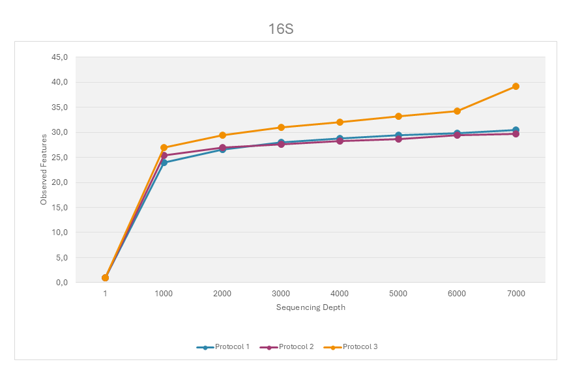
Fermentations carried out using raw whey (Protocol 3) maintained a more diverse bacterial community than those in which the whey had first been subjected to thermal treatment (Protocol 1 and Protocol 2), as can be seen in Figure 1, as can be seen in Figure 1, the number of observed microbial taxa increases with sequencing depth. This suggests that the partial preservation of the native microbiota originating from the cheesemaking process may play an important role in shaping the fermentation outcome.
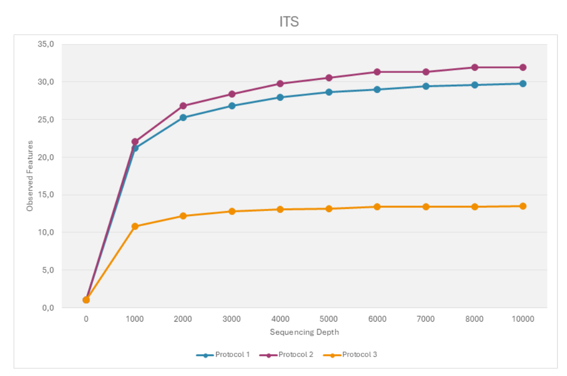
In contrast, the diversity of moulds and yeasts decreased. This trend may be related to the origin of the whey, which was obtained from blue cheese production, where specific mould (Penicillium roquefoti) species are deliberately enriched during manufacture. The competitive advantage of these dominant fungi appears to favour the development of a more specialised microbial community, reducing the abundance and diversity of other microbial populations present in the whey (Figure 2).
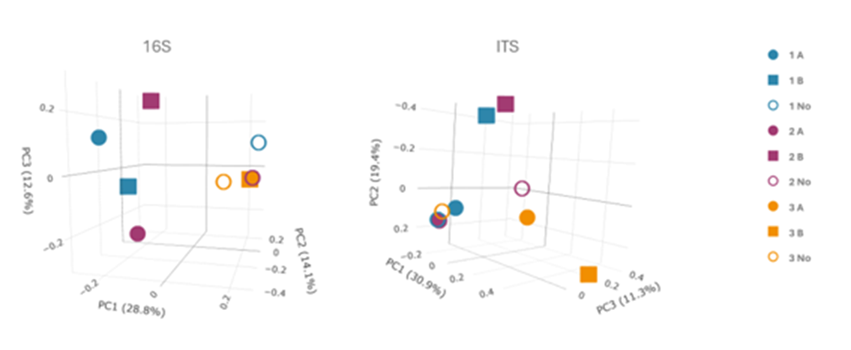
Principal coordinates analysis (PCoA) based on Jaccard distances (Figure 3) showed a clear separation among the different fermentation protocols, indicating that each strategy gave rise to distinct microbial communities. In parallel, the relative abundance of profiles (Figure 4) made it possible to visualise how particular species increased or decreased depending on the conditions applied.
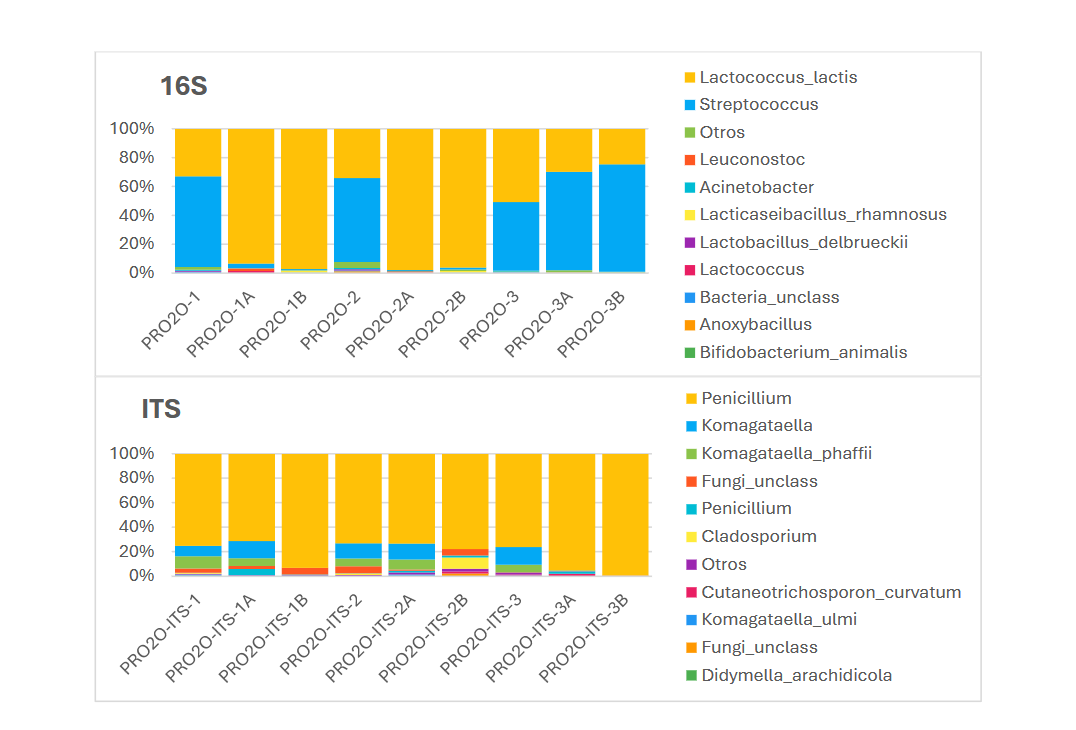
Amplicon sequencing also enabled the identification of the dominant microorganisms during the process. In most samples, Lactococcus lactis was particularly abundant. This result was expected, as this bacterium was included in the commercial starts cultures used and is widely employed in dairy fermentations. However, some fermentation conditions, particularly those involving starter culture B, also favoured the development of species such as Lacticaseibacillus rhamnosus and Bifidobacterium animalis, wich were also present in the commercial starter culture. These microorganisms are frequently associated with probiotic applications,,.
To identify the most suitable protocol for producing a fermented whey enriched in microorganisms with probiotic potential, both microbial abundance (including aerobic mesophilic bacteria, yeasts and moulds) and the diversity of the resulting microbial communities were evaluated. The highest microbial counts were obtained in whey samples produced using Protocol 3, which was based on raw whey, and fermented with starter culture B. (Average counts of 8.2 log CFU/mL were obtained with starter culture A, and average counts of 8.5 log CFU/mL with starter culture B).
Furthermore, as mentioned previously, the highest levels of microbial diversity were observed in the samples produced using Protocol 3, where fermentation was carried out directly on raw whey without prior heat treatment.
Overall, the results pointed to the most effective strategy also being the simplest from a technological perspective: the direct fermentation of raw whey, without prior thermal treatment using starter culture B. This approach maintained high microbial diversity while reducing energy requirements and simplifying the overall process.
An opportunity for the circular economy
Beyond the microbiological results, the broader relevance of this work lies in showing that the role of whey within the cheesemaking chain can be reconsidered.
Rather than being treated as a waste stream associated with management costs, whey can be viewed as a raw material capable of supporting valuable biotechnological processes. Controlled fermentation not only helps stabilise whey but also makes it possible to harness the nutrients it still contains to generate added-value microbial biomass.
Such strategies are closely aligned with the principles of the circular bioeconomy, in which by-products are no longer seen as the end of a production chain, but as the starting point for another. In a context where sustainability and efficient resource use are increasingly important, initiatives of this kind show how microbiology and omics technologies can help turn an environmental challenge into an opportunity for innovation.
The PRO2O project (grant agreement No. 00003-BIO2022-48) was funded through the 2022 Bioeconomy Innovation Projects funding programme of the Basque Government’s Department of Economic Development, Sustainability and Environment.
References
Guarner F, Requena T, Marcos A. Consensus statements from the Workshop “Probiotics and Health: Scientific evidence”. Nutr Hosp. 2010 Sep-Oct;25(5):700-4. PMID: 21336423.
Martin, A. J. M., Serebrinsky-Duek, K., Riquelme, E., Saa, P., & Garrido, D. (2023). Microbial interactions and the homeostasis of the gut microbiome: the role of Bifidobacterium. Microbiome Research Reports, 2. https://doi.org/10.20517/mrr.2023.10
González Siso, M. I. (1996). The biotechnological utilization of cheese whey: A review. Bioresource Technology, 57(1), 1–11. https://doi.org/10.1016/0960-8524(96)00036-3
Esneki Zentroa – Leartiker (2022). “El sector quesero en Euskadi 2021”. Available at: El-sector-quesero-en-Euskadi.pdf
Figueroa Pires, A., garcía Marnotes, N., Díaz Rubio, O., Cobos García, A., Dias Pereira, C. (2021). Dairy by-products: A review on the valorization of whey and second cheese whey. Foods, 10: 1067
Neethu, M., Bunt, C., Hussain, M., 2015. Comparison of Microbiological and Probiotic Characteristics of Lactobacilli Isolates from Daity FOod Products and Animal Rumen Contens Microorganims 3, 198-212.
Rama, G.R., Kuhn, D., Beux, S., aciel, M.J., Volken de Souz, C.F., 2019. Potential apllications of dairy why for the production of lactic acid bacteira cultures. Int Dairy J.
Rodriguez-Palacios, 1., Staemplfli, H.R., Duffield, T., Weese, J.S., 009. Isolation of bovine intestinal Lactobacillus plantarum and Pediococcus acidilactici with inhibitory activity against Escherichia coli O157 and F5. J. Appl. Mcrobiol. 106, 393-401
The BRTA is a consortium that remains a step ahead of future socio-economic challenges worldwide and in the Basque Autonomous Community; it addresses them through research and technological development, thus projecting itself internationally. The BRTA centres collaborate to generate knowledge and transfer it to Basque society and industry so as to make them more innovative and competitive. The BRTA is an alliance of 17 R&D centres and cooperative research centres with the support of the Basque Government, the SPRI and the Chartered Provincial Councils of Araba, Bizkaia and Gipuzkoa.
The post Turning cheese whey into value: a sustainable substrate for probiotic biomass production appeared first on Mapping Ignorance.

 点赞
点赞 收藏
收藏 点踩
点踩 分享
分享