The Reserve Bank of India Faces a Classic Central-Bank Trilemma

I’m Anup Roy , an economics and government reporter in Mumbai. Today we’re looking at India’s interest-rate conundrum. Send us feedback and tips to ecodaily@bloomberg.net . And if you aren’t yet signed up to receive this newsletter, you can do so here .
Top Stories
Iran has stepped up attacks on tankers in the Strait of Hormuz as oil shipments approach prewar levels.The IMF chief said AI, energy and debt will dominate next week’s annual meetings, and require urgent action from governments.The European Union is preparing so-called safeguard measures that would limit imports of Chinese hybrid vehicles.
India’s Impossible Trinity
Several big emerging-market central banks have already joined their developed-world peers in tightening policy, and now the Reserve Bank of India has finally bitten the bullet too.
On Wednesday the RBI raised its benchmark rate for the first time in nearly four years, by a quarter point. It cited broadening inflation, though price pressures are hardly alarming yet. Something else may also be at work, even if the RBI is unlikely to acknowledge it: Global forces are increasingly narrowing its room to set policy independently.
Here’s why: The RBI does not have an exchange-rate mandate, unlike some regional peers such as Indonesia. Rather than use interest rates primarily to defend the rupee, it turned to India’s roughly 35 million-strong diaspora to gin up some foreign-currency deposits.
The response was overwhelming. Banks mobilized some $133 billion, far exceeding expectations. The inflows helped lift India’s foreign-exchange reserves to about $786 billion, giving the RBI substantial ammunition to support the rupee.
But the laws of economics are difficult to escape.
By seeking to limit currency volatility while remaining open to global capital flows, the RBI finds its room for rate-setting increasingly constrained. It is a real-time version of what economists label the “Impossible Trinity” or the trilemma. The idea is that a central bank can pursue only two of three goals: a stable exchange rate, free capital flows and an independent monetary policy.
After the Fed raised rates last month and US bond yields spiked, foreign investors accelerated sales of Indian assets. Ten-year US Treasuries yield about 5.3%, compared with roughly 7.2% on equivalent Indian bonds. That represents a spread close to a multidecade low, sharply reducing the extra return investors get for taking rupee-denominated emerging-market risk.
Oil above $100 a barrel has added to the pressure, increasing India’s demand for dollars. Persistent foreign selling has pushed the rupee back toward its record low near 97 per dollar despite RBI intervention.
And that is where the trilemma bites. The RBI still retains monetary-policy independence, but with US rates rising, capital leaving and the rupee under pressure, its room to diverge from global monetary conditions is narrowing.
After Wednesday’s rate hike, the RBI nodded at the “monetary policy tightening by major central banks” as well as the surge in developed-economy bond yields. It listed both among the contributors to “nervous and fragile” sentiment on global markets.
The upshot is that India’s monetary policy is being shaped not just by domestic inflation and growth but increasingly by external pressures — and central bankers in the emerging world’s second-biggest economy are running short of room to maneuver.
The Best of Bloomberg Economics
Coming up: the Federal Reserve will release minutes of its last meeting, while Peru is set to hike, and Poland may keep borrowing costs steady.The Bank of France governor said the country’s bond situation is complicated and serious, but doesn’t warrant intervention from Frankfurt.Real wages in Japan climbed for an eighth month, the longest streak in a decade, helped by the government’s inflation-relief packageRussia’s military spending is on track to hit a record this year after Vladimir Putin added almost $60 billion to outlays set out in the budget.Farmers around the world are struggling with the spike in diesel prices, which threatens harvests and could trigger a wave of food inflation.President Donald Trump’s trade war is letting Canadian Prime Minister Mark Carney push an industrial agenda that was once divisive.
Need-to-Know Research
Tariffs have left US consumers dealing with more elevated prices on consumer goods, imported and domestic, even as their impact of inflation fades, according to a recent New York Fedstudy.
The research finds a 10% increase in import and producer prices due to tariffs raises consumer retail prices by 5.6%. Roughly two thirds of this effect come directly, by raising the price of imported consumer goods, and within a month of the levy being imposed.
But one third comes indirectly, either because domestic producers face higher prices for imported parts and materials, or because they now have incentives to increase their prices. This indirect impact for goods made in the US has made the overall effect of the 2025-2026 tariffs last longer, taking six to twelve months to move through the supply chain.
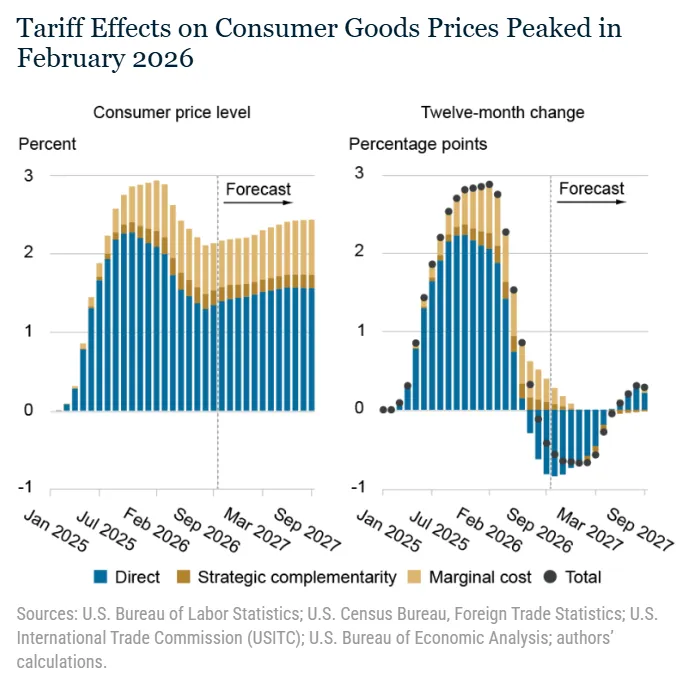
Overall, the effect of tariffs peaked last February and should fall to around zero by August, write the researchers Mary Amiti, Sebastian Heise, and David E. Weinstein. Still, “tariffs have left consumer goods price levels higher, while their effect on inflation fades,” they added.
More from Bloomberg
Enjoy Economics Daily?
Read more economic stories
Plus, here are some newsletters we think you might like
Fault Lines, Bloomberg Economics’ daily geoeconomics newsletter, delivers a midday check on how geopolitical tectonic shifts are shaping the global economy and marketsSupply Lines for daily insights into supply chains and global tradeBusiness of Food for a weekly look at how the world feeds itself in a changing economy and climate, from farming to supply chains to consumer trendsBalance of Power for the latest in politics from around the globeExplore all newsletters at Bloomberg.com

 点赞
点赞 收藏
收藏 点踩
点踩 分享
分享