El Niño Is Bringing Kelvin Waves to California. Here's What To Know

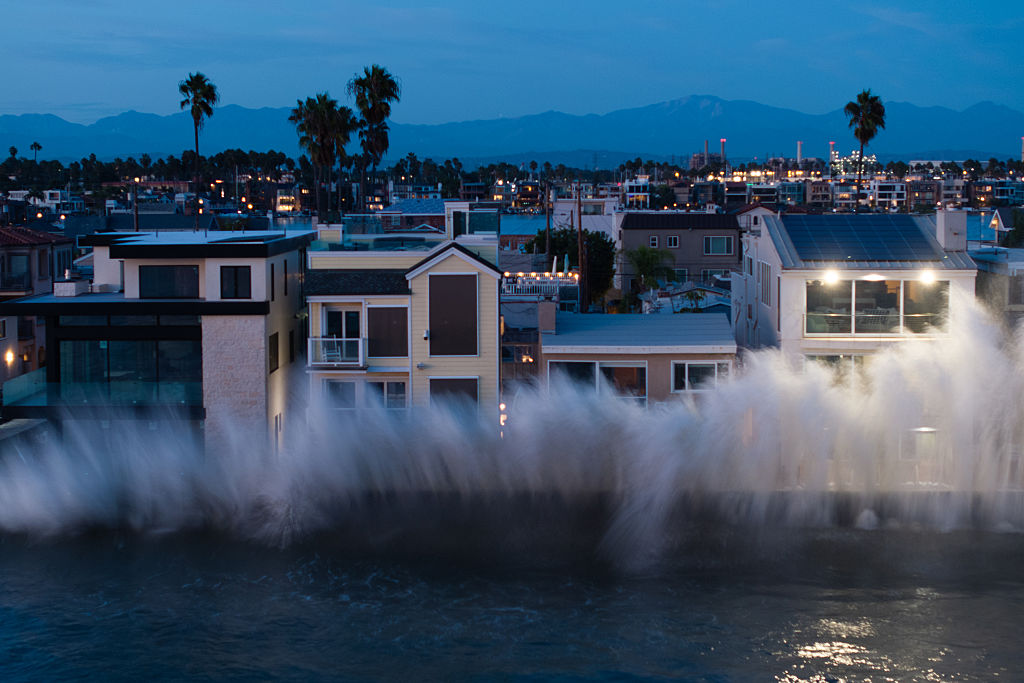
A large pulse of wave energy generated by El Niño conditions, known as a Kelvin wave, is expected to travel up the West Coast, raising sea levels and increasing the risk of coastal erosion for beachfront towns.
As a result, the West Coast can expect to see sea levels begin to rise by up to 1 ft. this month—and scientists say that the phenomenon can create dangerous conditions for humans, and place deadly stress on marine wildlife as it travels up the coastline.
Read more: Why California Just Declared a State of Emergency Due to El Niño
What is a Kelvin wave?
Kelvin waves are named after the Scottish engineer, mathematician, and physicist who identified the phenomenon, William Thomson, also known as Lord Kelvin. They are not like the typical waves you see crashing into the beach. They’re planetary waves—large, slow-moving masses of water that can span thousands of miles. Warm water slowly moves along the equator, towards South, Central and North America and can raise sea level for months.
On the surface, their impact might not be particularly noticeable. “It pushes the warm water down deeper and produces a ridge in the ocean itself,” says Paul Roundy, professor of atmospheric science at University at Albany. That causes sea levels to rise, he says. “You would not see anything different, but the sea level would be just a few centimeters higher than it would normally be.”
While it might not sound like much, coupled with other factors, it can have a major impact on coastlines. “[If] you add that sea level change to the normal tides or strong tide, and then potentially add a storm on top of it, which El Niño intensifies, then it can start to have a meaningful effect on changing the beach erosion and flooding at the coast,” says Roundy.
When was the last Kelvin wave?
This season has already brought a few Kelvin waves to the West Coast. “We've already had probably three or four of them up along the west coast of North America so far,” says Roundy.
A number of coastal California towns, including Malibu, Laguna Beach, and Long Beach, have already seen significant coastal erosion this year—due to a number of factors, including El Niño and Pacific hurricanes. At the end of September, California Governor Gavin Newsom declared a state of emergency to help prepare the state for potential El Niño impacts.
The last strong El Niño event, which took place from 2015-2016, had five Kelvin waves.
On the other hand, the 2022-2023 El Niño, did not produce strong Kelvin waves. That’s because a number of other weather events—including weak westerly winds—did not produce the kind of conditions meant to form them.
How are Kelvin waves linked to El Niño?
Kelvin waves commonly occur during El Niño years, when trade winds that normally push warm surface water toward the western Pacific weaken or change directions, moving warm water east and initiating a Kelvin wave.
There’s a lot of scientific debate about how climate change is impacting El Niño events. However, global temperatures trend higher during El Niño years, as warm water adds heat into the atmosphere. That, coupled with already record breaking global temperatures due to human caused climate change, has scientists predicting that 2027 is likely to be the world's hottest year on record.

 点赞
点赞 收藏
收藏 点踩
点踩 分享
分享