Why the SaaSpocalypse Isn’t Over For Workday


AI doesn’t seem likely to completely replace enterprise apps like Workday, which companies use to store key information about employees and financial transactions. But it is putting potential constraints on their growth.
Already, some Workday customers are using so-called AI agents from Anthropic, Microsoft and other providers to pull data from Workday so they can analyze employment records or trends, for example, meaning the customers themselves don’t have to visit the app. And many companies that pay for access to Workday’s own AI tools, which sit on top of its core HR and finance databases, aren’t regularly using them, according to interviews with five consultants and partners that work with more than 2,000 Workday customers.
That could make it hard for Workday to charge customers for its AI down the line, according to some of these consultants.
In one example, NinjaOne, an IT software firm with more than 2,000 employees, has prioritized using Anthropic’s software to develop AI agents that can pull data from traditional software apps including Workday and Salesforce to generate reports related to HR and sales, according to Joel Carusone, NinjaOne’s senior vice president of data and AI. While Carusone is open to testing proprietary AI products from software providers such as Workday, NinjaOne is choosy.
“We don’t necessarily need to use the in-app AI for a particular [enterprise app] provider we’re working with ‘cause we can get access to all of the stuff” by asking NinjaOne’s own AI agents to get them, he said.
Workday points to other companies that say its AI tools are useful, and its executives say greater adoption of those tools will eventually drive revenue. But the relatively slow start to its AI ambitions mirrors the initial struggles of many other traditional software firms like Salesforce to boost growth by selling AI. While earlier fears that AI would help customers to completely ditch traditional apps, a view known as the “Saaspocalpyse,” have dissipated, these apps still face the challenge of proving they won’t become “dumb” infrastructure that customers treat as just a database or system of record—apps that store critical information enterprises trust to be accurate.
“The system of record is not at risk of being skipped. A payroll still has to run, be filed and be audited,” said Raphaëlle D’Ornano, a strategic adviser to investment firms and software companies. That’s one reason Workday’s shares, like those of Salesforce, have recovered somewhat in recent months.
What remains at risk, she said, is the “layer above the record,” meaning the work that companies do with the data.
The odds of Workday turning into an AI-sales powerhouse are about the same as the odds that it will slowly lose relevance as customers use AI to tap the data its apps store, according to D’Ornano’s proprietary “framework” for evaluating software companies in the AI era.
“The question is, is a human going to access your app or an [AI] agent?” she said.
Other companies are hesitating to purchase AI from traditional software providers like Workday because of rising costs, and because some businesses that are spending more on AI from the likes of Anthropic are looking to curb or cut spending elsewhere in their software budget. Workday and other traditional app firms are increasingly charging for new AI based on how much customers use it, rather than as part of subscriptions, driving up costs, the consultants say.
And many companies are also wary of using any AI at all for HR and finance tasks that involve sensitive business data, fearing mistakes that would be costly, these people say.
To lure customers to its AI, Workday is offering incentives, such as free credits to use the tools to track and fix payroll issues or to compile records for auditors. Some major customers are being offered a free year of Sana Enterprise, a Workday product that helps them use AI agents for automating HR, finance and IT tasks and can automate work in other business apps the customer pays for, such as Jira, Salesforce and ServiceNow.
“We are laser-focused on adoption, adoption, adoption,” said Gabe Monroy, Workday’s chief technology officer “And if we stay focused on that, I have no doubt that the monetization is going to come, but it’s gotta come through great products, and that is our laser focus right now.”
At one consulting firm that works with more than 400 Workday customers primarily located in North America, roughly half signed new agreements that included access to Workday’s AI features that charge based on usage. But only between 10% and 20% of customers are actively using Workday’s AI, such as a recruiting agent that helps talent teams find and book interviews with job candidates, an executive at the consulting firm said. Some customers that did use the AI were surprised by how high their bills were and have asked the consultant to help them pull back spending, the executive said.
None of the 400-plus customers are using Workday’s Sana Enterprise, one of the company’s big AI bets, which launched in March. The problem is, Microsoft, Salesforce, ServiceNow and many other traditional app makers are selling similar products.
Like NinjaOne, security software provider Druva chose to develop its own AI tools to tap its data in Workday to generate reports about employee performance or recruiting, said CEO Jaspreet Singh.
“We didn’t find [Workday’s] in-platform agents that useful,” he said. Plus, Druva, which spends more than $10 million annually on software, already pays for pricey AI tools from database provider Snowflake.
“It’s just not productive for us to go into multiple platforms and each platform have [sic] their own agents,” he said.
Erecting a Toll Booth
Even if customers use their own AI agents to access Workday, it still plans to get a piece of the action. Similar to Salesforce and other systems of record, Workday says it will charge customers for using external AI providers like Anthropic or Microsoft to access and change data stored in its apps. But it’s too soon to tell whether such tolls will become major moneymakers.
As evidence of Workday’s challenge, D’Ornano pointed to Microsoft’s Copilot AI, which Microsoft customers can use to access HR data in Workday. The Microsoft tool means customers don’t need to visit Workday themselves—nor do they need Workday’s own AI tools.
And while Workday will eventually charge customers for tapping data this way, it doesn’t appear to have pricing power at the moment: Workday waived so-called overage charges from May this year through February next year, meaning enterprises can go above the limits of their subscription plans when it comes to accessing Workday through application programming interfaces—like with Microsoft’s Copilot tool.
In that scenario, “Workday is called, not visited, and the toll is waived,” D’Ornano said.
Workday said the grace period aims to give customers time to plan for future charges.
While earlier fears that AI would help customers to completely ditch traditional apps, a view known as the “Saaspocalpyse,” have dissipated, these apps still face the challenge of proving they won’t become “dumb” infrastructure that customers treat as just a database.
Workday has plenty of customer testimonials praising its AI. For example, software firm FlexGen said Workday’s AI helped it avoid paying $35 million in tariffs by reviewing its contracts and identifying exposure to import taxes, while Chipotle said it used Workday’s AI to reduce the time it took to hire new employees by 75%. A chain of water park resorts, Great Wolf Lodge, said it saved $700,000 annually from using Workday AI to automate 90% of its hiring process.
And the number of customers using its proprietary AI agents grew 35% from the previous quarter to 5,500 of its roughly 11,500 total customers in the July quarter. The company didn’t specify how many of these customers are paying fees to use the agents versus using free credits or credits included in subscriptions.
But while Workday said in August that its AI agent products and Sana were on pace to generate $600 million a year in revenues, up three times from a year earlier, the software firm’s growth overall has been steadily decelerating over the past few years to 12.8% in the July quarter. That growth rate is not very fast, given it is only about 2 percentage points higher than that of Salesforce, which generates four times as much revenue as Workday.
Wall Street analysts expect Workday’s revenue growth to slow further in the next couple of quarters, to 9.7% in the upcoming January 2027 quarter, according to Koyfin.
Reuters’ report in August that private equity firm Silver Lake had considered taking Workday private spurred excitement among investors looking for relief from its lagging share price. A deal could offer Workday, which has a $45 billion market capitalization, a chance to boost its AI product growth without public scrutiny.
CEO Aneel Bhusri has been tight-lipped about the potential take-private transaction. In a recent message to Workday employees, he neither confirmed nor denied reports of the deal, saying only “we don’t comment on rumors or speculation, and we’re not going to start now.”
Voting Power
Workday was founded in 2005 by David Duffield and Bhusri. They collectively hold 69% voting power in the company and have said they structured it that way after Oracle acquired the prior company they worked at, PeopleSoft, in a particularly brutal hostile takeover.
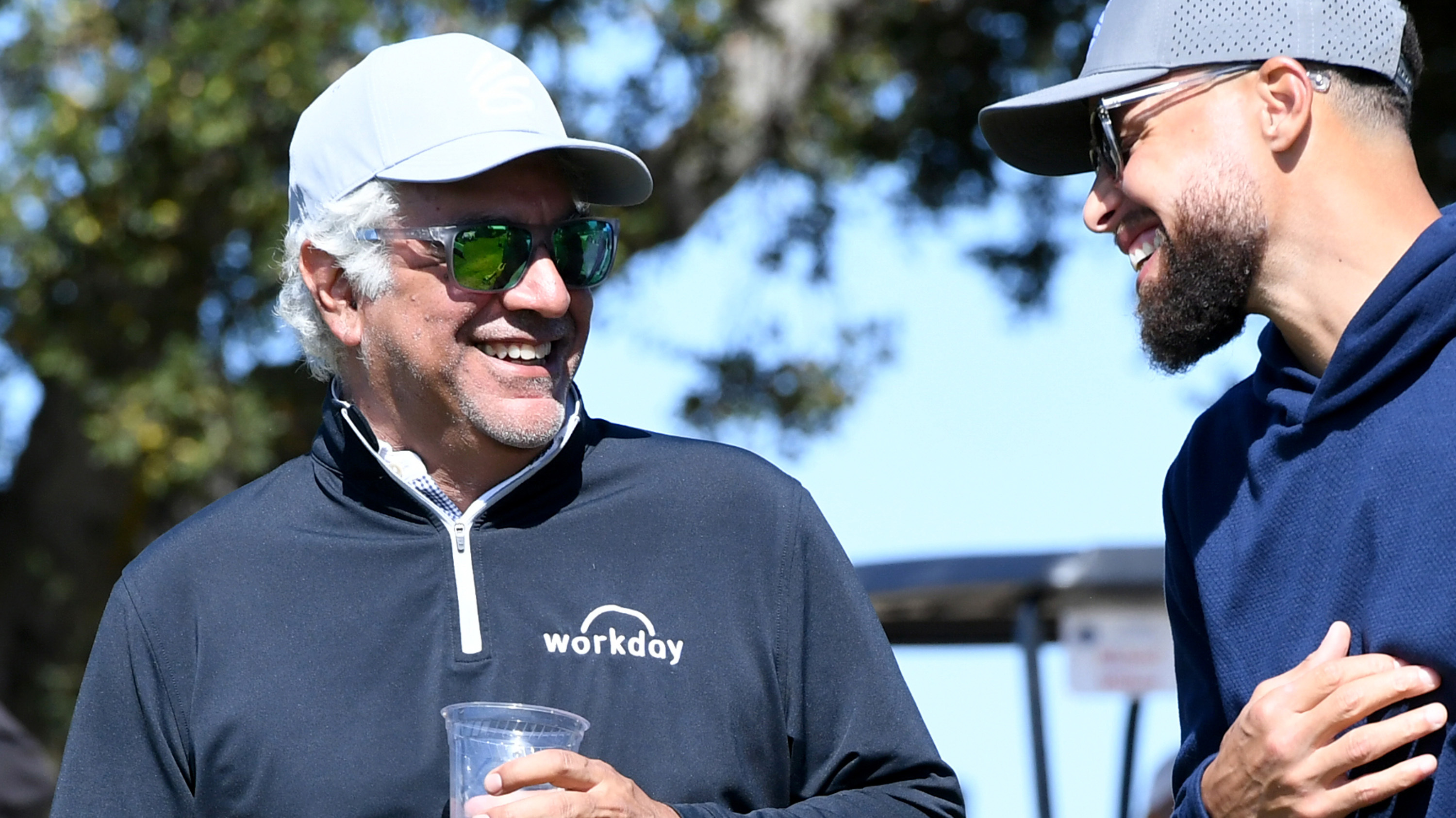
Workday went public in 2012 in a wildly successful initial public offering that signified the golden age of enterprise software built for the cloud era.
Today, Workday’s HR software is deeply entrenched in large companies, governments, universities and healthcare systems, though customers have long complained about its clunky user interface. Even Anthropic and OpenAI are both Workday customers.
Its competitors include bigger firms such as SAP and Oracle and smaller rivals Rippling, Dayforce and Paylocity.
Workday has long charged customers based on the number of people they employ. But like those peers and others, Workday last year introduced usage-based pricing for its AI products, and it acquired and hired talent to help it launch Sana and other products. Its recent hirings from Google include Monroy, the CTO; Chief Marketing Officer Sarah Kennedy Ellis, and Yasmeen Ahmad, senior vice president of its data cloud.
Sensitive Data
Ahmad said she was interested in moving from Google, where she worked as an executive of a team building AI data management software, to Workday because of the opportunity to develop AI for highly regulated enterprises that are wary of using major AI model providers.
“Nobody wants [Google’s] Gemini Enterprise or an Anthropic or an OpenAI to have access to their business data,” said Ahmad. (An OpenAI spokesperson said OpenAI is introducing new ways for customers to use its models without the company seeing the information they share with the AI as well as the answers it produces.)
The problem is that many of those customers are averse to using any AI at all for their sensitive HR and financial data.
“There’s a lot of anxiety around [AI and] sensitive data,” said Phill Pearson, a vice president at Kainos, a consulting firm that works with more than 400 Workday customers, which he describes as being “conservative” when it comes to AI.
While some rivals and consultants have said Workday was slow to launch AI features, that may be a reflection of its software baggage. The company’s software is written in a proprietary coding language, XpressO, which today’s AI coding tools struggle to work with. Monroy, who joined the company last year, has led an effort to make XpressO more accessible to the latest AI tools so his engineers can use them to develop new features.
‘Founder Mode Energy’
“The systems that I inherited weren’t necessarily designed for that next generation of generative AI out of the box,” he said. Now, he said, “the pace of engineering velocity that you’re going to see out of Workday is going to be surprising to people.”
At a time when many software employees are worried over layoffs and sinking share prices, the return of Bhusri as Workday CEO in February after a two-year break has helped energize employees, Monroy said. Workday laid off about 400 employees in February and announced layoffs affecting another 500 staffers, or 2.5% of its workforce, late last month.
“Founder mode energy is a real thing,” said Monroy, and pointed to the special attention Bhusri has paid to teams that historically flew under the radar. For example, Bhusri was supposed to attend a town hall for Workday’s software infrastructure team for 20 minutes and instead stayed a whole hour to answer questions from employees about its AI strategy.

 点赞
点赞 收藏
收藏 点踩
点踩 分享
分享