Comparing AI Policy Courses

A personal opinion comparing courses from BlueDot Impact, Lens Academy, Vista Institute for AI Policy, and the Center for AI and Digital Policy.
This post is for the curious minds with a lifelong commitment to learning. It’s meant to help you choose which courses suit your particular needs. Maybe you don’t have to choose at all- you can accidentally undertake a self-directed degree in AI Policy like meeee!
Why take these courses?
- You’re looking to upskill or pivot to working on tech policy, AI safety, or AI governance.
- You’re interested in a structured learning environment with accountability.
- You’d benefit from remote networking opportunities with your cohort.
- You are self-disciplined & self-motivated to complete required readings.
- You have 2-5 spare hours per week to dedicate to continuing your education.
Each course below is free, but requires an application and acceptance into the program. I can personally vouch that having a course like this on your resume is a clear signal to hiring managers when applying to roles in AI Safety. Successful completion earns you a shiny digital certificate for your LinkedIn, contacts in the field, and context for your next Substack post ;)
BlueDot Impact AGI Strategy & Frontier AI Governance Courses
Start here! These courses are a must for anyone interested in AI Safety. Great for beginners, pivots, and career transition folks. Participants must apply, be accepted, and complete the AGI Strategy course before being eligible for the Technical, Bio or Governance courses. If you’re not accepted, you can also take these as a self-paced online course without the certificate.
Time Commitment: 25 hours for AGI Strategy. 40 hours for Frontier AI Governance. Available as an intensive (5-6 days), or part-time (5-6 weeks).
Pros:
- Lots of updated/interesting readings from leading voices across industry, academia and policy.
- Some of the AGI Strategy course articles are available in audio form so you can learn on the go.
- Cohorts of less than 10 students per facilitator.
- Very engaged participants.
- You may have spent a lot of time reading other people’s analysis of breaking news from Silicon Valley. These courses will teach you how to analyze a frontier model’s system card or a lab’s technical report end-to-end and form your own opinions. It includes practical exercises like conducting research, systems mapping, and writing a policy memo.
- Gain access to a super active Slack community with an open opportunities channel. Become eligible for Rapid Grants and Career Transition Funding- although a note that these are very competitive.
Cons:
- Utility of the live class discussions really depends on your cohort and facilitator, so switch early if it’s not a good fit.
Pro-tip: To get the most out of the Frontier AI Governance course, don’t take the course as an intensive, take it part-time. Read these blogs from the team at BlueDot Impact to see if you’re a good fit: https://blog.bluedot.org/p/is-the-frontier-ai-governance-course &
https://blog.bluedot.org/p/is-the-agi-strategy-course-right-for-you.
Lens Academy’s Compute Verification Course
Intermediate-level, deep dive, technical governance course on what verification mechanisms it would take for adversarial countries to trust/verify each other’s AI commitments under a multinational AI agreement. Would recommend for mid-career level & above folks who already have some technical or policy background expertise on this topic.
Time Commitment: 25 hours over 5 days or 5 weeks.
Pros:
- Their dedicated AI study guide companion “Lens Coach” is actually quite useful and provides immediate feedback on answers to HW questions with suggestions on how to strengthen your writing and arguments. This immediately verifies your grasp of the concepts and learning progress (although I still think learning by teaching others, and talking about these topics with your network is the best path forward).
- Gain access to their active Discord chat and networking with your cohort.
- A lot more writing than the BlueDot courses, and it’s not optional. Great if you want to improve your research and writing abilities to communicate these topics to policymakers and learn to defend your own position.
Cons:
- This was the hardest course on this list due to its academic nature and amount of writing & reading homework. It is a condensed version of University of Chicago’s XLab curriculum, split into two parts/courses.
- The estimated durations per module seem off, as each part took me much longer than the indicated time (and I’m a fast reader!)
- I was part of the first cohort taking this course so there were some technical tweaks and lack of clarity on the readings and discussion prompts along the way that I suspect will be fixed by the time you consider taking this course. The Lens Academy team is excellent, super-responsive, and literally troubleshoots technical issues the same day.
Pro-tip: Highly recommend taking this over 5 weeks instead of the 5 day intensive due to the density and length of the material.
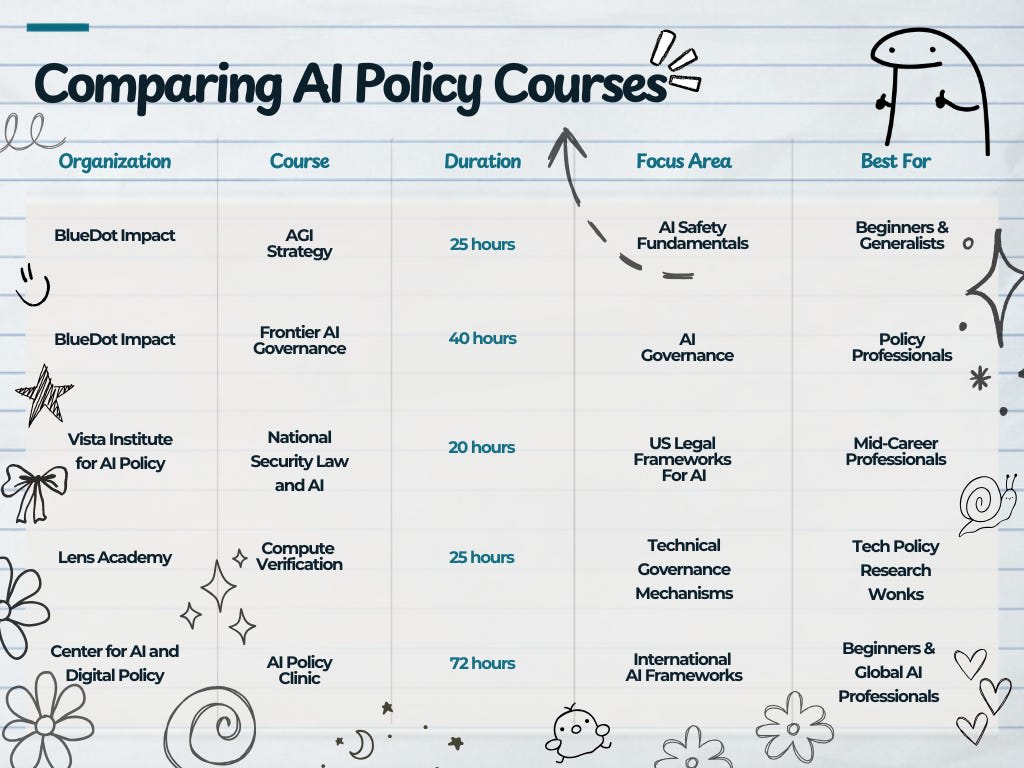
Vista Institute for AI Policy - National Security Law & AI Course
Speaker series with accompanying readings. Focused on the legal basis underlying AI governance approaches in national security applications. Best for mid-career professionals, practitioners, or people in career transition. Workload is very manageable alongside full-time work. Shattered my assumptions from BlueDot’s governance course by introducing legal contexts that restrict potential policy pathways. Lots of Lawfare, think tank, and academic paper readings. You don’t have to be a lawyer to apply. Also not limited to applications from people based in the US- but probably most useful for US policy experts. They have an ‘AI Agents and the Law’ class which also may be of interest.
Time Commitment: 20 hours. 1-2hrs of daily weekday meetings over 2.5 weeks.
Pros:
- Interesting, high-level speakers with up-to-date presentation content tailored for practitioners.
- No hand holding, jump into the technical and legal details right away.
- This course was easier compared to the rest. As long as you show up to the sessions, there’s no required writing or homework during the course.
Cons:
- Lots of reading, but limited discussion of the readings, so they’re effectively optional- there’s no accountability if you don’t finish them.
- There’s no community building amongst the cohort of ~60 students. Most people remain off camera so there’s less engagement with your cohort in sessions and no asynchronous communications channel. Most of the networking happened on LinkedIn and separately scheduled one-on-ones. You get out of it what you put in.
- Communication channels with the course leads and resolution of technical difficulties with Google Meet & Classroom were delayed and could be improved.
Pro-tip: Take BlueDot first, Vista builds on what you learned.
Center for AI and Digital Policy’s AI Policy Clinic
I recently started this three-month program, which meets twice a week to analyze current AI regulatory frameworks and undertake research on national AI policies to prepare “future leaders in the AI policy field skills in policy analysis, research, evaluation, team management, and policy formation.” It’s a global cohort with Research Group members from ~130 countries focused on international policy frameworks from the EU, UN, OECD, and UNESCO. The Fall 2026 cohort admitted 390 participants, about a ~50% acceptance rate, so less exclusive than the other programs.
Including it here so people know it’s an option. I’ll update this post and will report back on pros and cons after the conclusion of the program in November 2026.
Questions about any of the courses?
Any AI Policy courses I missed that you would recommend?

 点赞
点赞 收藏
收藏 点踩
点踩 分享
分享