BofA Sees the End of ‘Easy Money’ Made From the AI-Spending Trade

Investors are likely to find it increasingly hard to make “easy money” by betting on outsized returns from artificial intelligence-linked capital expenditures compared with consumer-driven spending, according to strategists at Bank of America Corp.
The combination of abundant AI-related spending and shrinking discretionary spending, with the latter spurred by white-collar job losses, is already baked into investment positions, strategists led by Savita Subramanian wrote in a Monday note. Going forward, “alpha from buying AI capex beneficiaries and selling white-collar consumption themes may be harder fought,” she said.
“We think it‘s time to selectively pivot, as it is dangerous to underestimate the appetite of US consumers and capex strength may be more priced in than not,” Subramanian said.
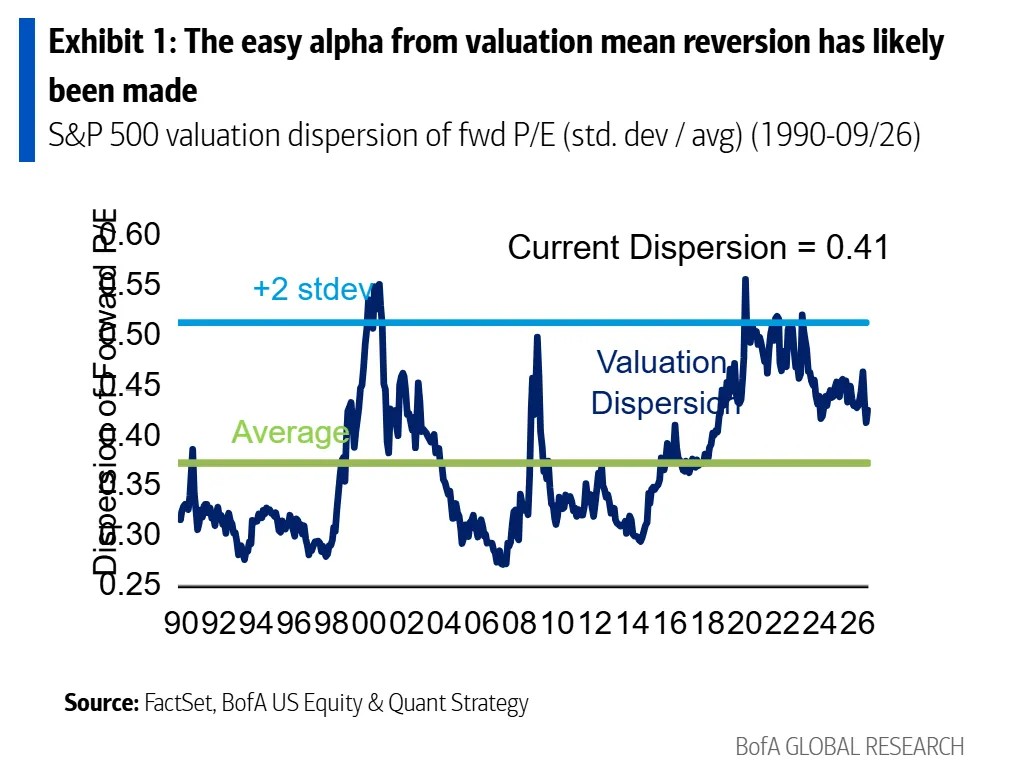
An analysis of long-only active funds shows positioning in sectors referred to as “AI disruptees” — information-technology services, consumer finance and software — sits near record lows, Subramanian added. Meanwhile, positioning in industrial stocks is near record highs relative to consumer discretionary stocks.
Fund managers are most overweight electronic equipment, instruments and components, according to BofA.
Last week, BofA said that investors might want to “get bulled up” as the distribution of market risks had shifted to the upside along with strong consumer spending and healthy balance sheets.
With high-paying jobs among AI disruptees increasingly at risk, Subramanian now sees “a continued trade down amid white collar professionals from wants to needs.” The trend is evident in positioning in staples stocks versus discretionary stocks, she said.
Consumer staples and discretionary stocks are underperforming the broader S&P 500 Index in the past 12 months. However, the S&P 500 Consumer Staples Index has climbed 4.6% in the period, while a gauge of the consumer discretionary stocks has fallen 3.3%. Athletic apparel companies Lululemon Athletica Inc. and Nike Inc., for instance, are both down about 50% in the past year.
Read More: Big Tech Needs to Justify AI Spending as Investors Dump Stocks
Subramanian said the current positioning is “justified,” as a likely shift to capex from consumption had been a core investment thesis for this year. In a November year-ahead outlook, BofA strategists had favored “capex over consumption,” with AI-linked spending likely to remain the “ballast.”

 点赞
点赞 收藏
收藏 点踩
点踩 分享
分享