‘Wallace and Gromit,’ 90% Alone
Welcome! This is another Sunday edition of the Animation Obsessive newsletter. Here’s the plan for today:
- 1. Nick Park’s time on A Grand Day Out.
- 2. An ambitious education project.
- 3. Animation newsbits.
- 4. The last word.
With that, let’s go!
1. In the attic
The shape of animation changed in November 1989.
It happened in Bristol. Nick Park, an animator, had just finished two films with a stop-motion outfit named Aardman. For the premieres, he took both to the local Bristol Animation Festival. Their titles: Creature Comforts and A Grand Day Out.
Park’s screenings went well, but there wasn’t an explosion of media coverage. The wide world didn’t yet know what he’d achieved. One magazine report did sum up A Grand Day Out, though, as a “marvelous Lancastrian model animation about a Cheese Monthly reader and his dog Gromit going to the moon by rocket.”
Park had plugged away at that film across most of the ‘80s. “I always dreamed of this moment when Wallace and Gromit would come into the world,” he said later. Even so, when it went up for an Oscar, he was shocked. “I didn’t even realize you could be nominated … for short animated films,” he recalled.
Ultimately, Creature Comforts was the Academy’s pick. But A Grand Day Out, despite its “more low key success,” took the BAFTA and began something enormous.
During Park’s years on the first Wallace and Gromit film, it would’ve been hard to foresee the scale of its influence. He wanted to quit many times. A Grand Day Out was his way-too-ambitious graduation project, and he didn’t have the luxury of a full team. As he explained, “I did probably 90% of it myself.”
Park was an unknown before that Bristol festival. Now, suddenly, his stuff was catching the notice of his idols Terry Gilliam and Ray Harryhausen. “I’ve never seen claymation so smooth!” the latter told him. Once Park’s work aired on Channel 4 in 1990, pretty much everybody else fell in love with it, too.
Although he was a latecomer to Aardman, the “Nick Park look” took over the studio so thoroughly that its earlier films with other approaches (Babylon, Sales Pitch and so on) often go unmentioned today. “I take no credit for his talent. He came to us fully fledged,” said Peter Lord, Aardman’s co-founder.
Park had been formed by a lifetime of practice and study — and especially by his lonely proving ground, A Grand Day Out. In his words:
Wallace and Gromit have had quite a large impact. They’re the first characters I’ve really put my heart into, that I really have started to have a kind of relationship with, really. I mean, they gave me my style, really. The eyes close together, the wide mouth, the very exaggerated mouth movements and Gromit’s kind of looks, frowning, all his expression coming out of his eyes, it all started off with Wallace and Gromit.
A Grand Day Out began in 1982, while Park was a student at the National Film and Television School. “I needed a couple of characters for my graduation film, so I went back to my old sketchbook,” he noted. Originally, Gromit was a cat and Wallace had a mustache. Park’s main idea was a journey to the moon via a basement rocket; Wallace’s love of cheese was invented as the excuse.
Park asked for help as he could. “The very first script, I worked on with a friend I shared digs with in Sheffield called Steve Rushton. He was into writing kids’ books,” he said. Over time, animators Alison Snowden and David Fine made some props, and a technician at the school built the rocket’s light-up console. Meanwhile, Park got a giant lump of Plasticine for free from its manufacturer, and actors Peter Sallis and Peter Hawkins voiced his characters as a favor.
Still, the budget allocated to A Grand Day Out limited Park’s ability to hire people. The film became mainly his thing, and it evolved naturally in his hands.
Gromit turned into a dog really early on, since Park found dogs easier to model. And the character’s dialogue was cut due to animation difficulties in the first week of the shoot. “That’s when I realized I could do everything with the eyes. Gromit was suddenly born. He didn’t need a mouth. He became a very introvert and very intelligent dog,” Park remembered.
You can see Park’s development on screen just in Wallace’s design. The character initially had a “very small” mouth. While animating Sallis’s pronunciation of cheese, though, Park thought to give Wallace a “coathanger mouth” wider than his head. Different versions of his design remain scattered in the final film.
Even if A Grand Day Out wasn’t well planned, Park’s work was obviously special. That much was clear to Aardman’s David Sproxton and Peter Lord when they visited his school, relatively early in production. Here’s Sproxton:
I remember he was doing the cellar set: the construction of the rocket sequence. He hadn’t actually shot much more than that. … Certainly when we met him at the film school, there was something about what he was trying to do which was actually a bit different. You could immediately see that. It was an ambitious project: there was something about the way he was using the Plasticine and the sets and things that he’d built which was actually very charming, but it also showed a real endeavor which you didn’t often see. So we definitely kept in touch with him for two or three years.
Park had been taking shape as an artist long before that Lord–Sproxton visit. A Grand Day Out was partly riffed, but his riffing was grounded in something.
As a child, he’d created 8 mm animations with a camera from his parents, who encouraged him. Around 12 or 13, he did experiments like Rat and the Beanstalk and Walter Goes Fishing (both linked to watch). A bit later, in 1975, his short Archie’s Concrete Nightmare aired on television. In ‘77, Movie Maker made note of the film Bird by one Nicholas Park of Preston — he’d sent it in.
“That’s how I spent my time. While my mates were out playing with their bikes,” Park said, “I was in the attic.”
In those years, he pulled from the cartoons and stop-motion shows on television (Roobarb, Clangers, Noggin the Nog, Morph), and Monty Python, and Ray Harryhausen movies, and the comics in The Beano, and The Do-It-Yourself Film Animation Show. “Influences were to be found everywhere,” he said.
When Park’s father pushed him to pursue filmmaking in college, he did — first at Sheffield Art School, then at NFTS. He devoured the subject. “I really enjoyed the history of film and studying directors like Orson Welles and Hitchcock,” Park said. He learned about lighting and storyboarding, and German Expressionist film, and (crucially) avant-garde animation.
Asked about his preference for stop motion, Park once explained:
I think it’s because I’d been brought up on a diet of children’s 3D animation. I wanted to take what I’d seen and apply what I’d learned from filmmaking, in terms of lighting and using the camera, a lot more inventively. I wanted to do something different from the usual puppet animation which was made for children. I suppose I was more interested in the Eastern European style: [Władysław] Starewicz, [Jiří] Trnka, [Jan] Švankmajer. It was only when I got to the NFTS that I became aware of all these figures and of what a range there was in the world of animation.
That was the foundation of A Grand Day Out. Park drew from his many references (including Jules Verne and Hergé’s Explorers on the Moon) and then applied these filmmaking techniques that fascinated him. “I could use the cameras the same way Hitchcock did, or Orson Welles. I was making a live-action film, but on a small scale,” he felt.
Here’s Park on the moment when Wallace’s completed rocket appears:
This shot is one of those things which really encapsulated the kind of vision of the film. What I was trying for was something in model animation that had kind of a feature film feel to it, which is very much complemented by the music at that point. Just the scale and the kind of slow camera moves. I think it came from watching Close Encounters and that kind of thing — you know, the way Spielberg always had, like, this tiny drift on the camera. … And it stopped it from becoming a kind of static, kind of puppet-y, kind of TV animation.
Park had great ideas and was strikingly good at claymation, which he handled in the old way. “[T]here was no video assist [so] you didn’t know what the results were gonna be until a week later when you got the film back,” he noted.
But he was still in a tough situation with A Grand Day Out — despite all he was picking up. “At one point, I even had a guy come in and do the lighting and camera. He couldn’t stick around for too long, so I learned everything I could from him,” Park said. “In the end, it was pretty much a one-man show.”
Which was too much. Like he recalled:
I thought it would be a ten-minute film, and it would take me six months to make. … In fact, I remember the script for A Grand Day Out was about 20 pages long, and on about page 3 it says, “There now follows a sequence where Wallace and Gromit build a rocket.” It was just a paragraph. I started on that paragraph, and a year and a half later, I actually finished the sequence!
Because he couldn’t graduate from NFTS until his film was done, he was stuck. By 1985, the project was in a state of crisis. According to Lord and Sproxton:
... well over four years had elapsed since Nick entered the school, so his three-year student grant had long run out. Worse, he had only completed a grand total of seven minutes of A Grand Day Out — rather less than a third of its eventual length. He passionately wanted to complete it, but it was arduous, lonely work in a small studio, and each day he was commuting 25 miles by bus from his tiny flat in Cricklewood to the film school.
Lord and Sproxton had hired Park over the summers of ‘83 and ‘84. In ‘85, they put him on salary. He agreed because they allowed him to continue A Grand Day Out at Aardman, in his spare hours, through an agreement with the school.
Park’s project was given a small workspace behind a curtain, and he kept going back there, as he could, to chip away at it. He got some help (“I could grab someone to light a scene or make some models”), but he remained mostly alone on A Grand Day Out. And several more years passed that way.
At the Bristol screening in 1989, where A Grand Day Out and his Creature Comforts premiered, Park emerged to the public. “Apart from the amateur film I’d had on the BBC as a child, that was my first taste of fame,” he said. Things changed very fast — within two years, Park was a star of British animation.
He’d pretty easily jumped into Creature Comforts, a short-turnaround project with a “proper crew,” after all he’d learned on A Grand Day Out. “I went from unknown student to a director with two films,” he noted. From there, he began The Wrong Trousers (1993) and the rest of his long career. He was ready.
Park seemed to appear from nowhere, preformed. But that wasn’t really the case: he’d grown into this artist during those years of work off to the side, during hours that most simply weren’t there to see.
2. Animation news
2.1: A new old way to learn
Recently, the producer Lexie Chu told Animation Magazine something interesting. She’s trying to “stop separating learning animation from actually making animation.” It isn’t a radical idea: at one time in this medium, it was standard to learn on the job. In 2026, though, those words were a bit refreshing to read.
Through Chu’s program Asians in Animation, she’s creating a system that brings to mind so many studios from the past, where mentors guided whole teams of newer artists. Its latest learning film, Unboxed (watch), was a virtual production that involved 104 crewmembers and 14 experienced industry people.
We emailed this week with folks from both groups. One was Katelyn Park, a 2025 graduate from the Rochester Institute of Technology. Unboxed was in production for a month last year, and she joined toward the end as an animator and compositor. She told us:
… I had only ever composited on my personal shorts, nothing to this scale of shot number and crew size! [It] offered me an extremely valuable lesson. In animation, it is possible to “over animate.” Some of my character performances have been weakened by my getting lost in details, adding too many elements without the sense of a strong foundation. You can look at compositing in the same way.Before the program, I composited as if I was working off of a blank canvas with no direction. But it was through the weekly review meetings where I learned that, when working on a large production, it’s more important to prioritize the fundamentals of a shot and follow the guides that were built during pre-production. Then any fancier lighting or FX can be played with after.
She glowed about her time on Unboxed, a project that was “more about showing up, communicating and making new friends” than just grinding out assets. And she’s come back for this year’s new Asians in Animation film. “It’s been an absolute blast and I’ve learned even more!” she wrote.
Among the mentors, we heard from Clara Chan, a visual effects supervisor on KPop Demon Hunters. “I have been a big fan of AiA for many years because they have done a lot of great work for the community,” she explained. At Sony, Chan had already gone through this type of program and “found it tremendously beneficial.” So, she had every reason to help with Unboxed.
As she put it:
The project was super well organized and well planned. … For my part, as one of the story mentors, I met with the team a couple times last summer and they pitched their ideas to me. I then gave them some feedback on the script and they improved upon it. …They were all very passionate about the project and very creative. They received feedback very well and were able to turn around changes quickly. … I just asked a lot of clarifying questions about the script, hoping they would help the team to really find the emotional core of the story. I think that’s always the most important thing — to solidify the story before starting production.
In many countries, this kind of education isn’t the given that it used to be. Unboxed brought it to people in America, Canada and Indonesia, and we’ll be excited to see where Asians in Animation takes the idea from here.
2.2: Newsbits
- During the recent liquidation of Phil Tippett’s studio in America, a collection of old internal DVDs and CD-ROMs wound up in the hands of an archivist. They’re full of rare material, and now on the Internet Archive.
- The first episode of Electro Andes, from Argentina, hit YouTube today.
- In South Africa, artist Kabelo Maaka spoke about her experiences as the head of an animation studio, and the ever-shifting focus of the money people. “If you go by the whims of buyers and executives, you will not finish anything,” she said.
- In Germany, Joe May put together a concept teaser for a film based on Haruki Murakami’s Kafka on the Shore.
- In America, Skydance now has a frightening amount of control over Hollywood, and is already reshaping the industry.
- The indie series Catus Magus, created by the artist Yaron Farkash in America, has followed up its viral success on Instagram with a crowdfunding campaign for new episodes.
- Kiri and Lou Go Raaa! (the claymation feature from New Zealand) will open in Britain later this month.
- Meanwhile, following its victory at Annecy this summer, The Violinist is set for Spanish theaters in November.
- In Britain, the next edition of the Manchester Animation Festival is coming up, and its slate has been revealed.
- Finally, we looked into Katsuhiro Otomo’s beginnings in animation, as a character designer.
3. Last word
That’s today’s issue! Thanks for reading. We’re wrapping up with comments from the two of us, connected to this week’s themes:
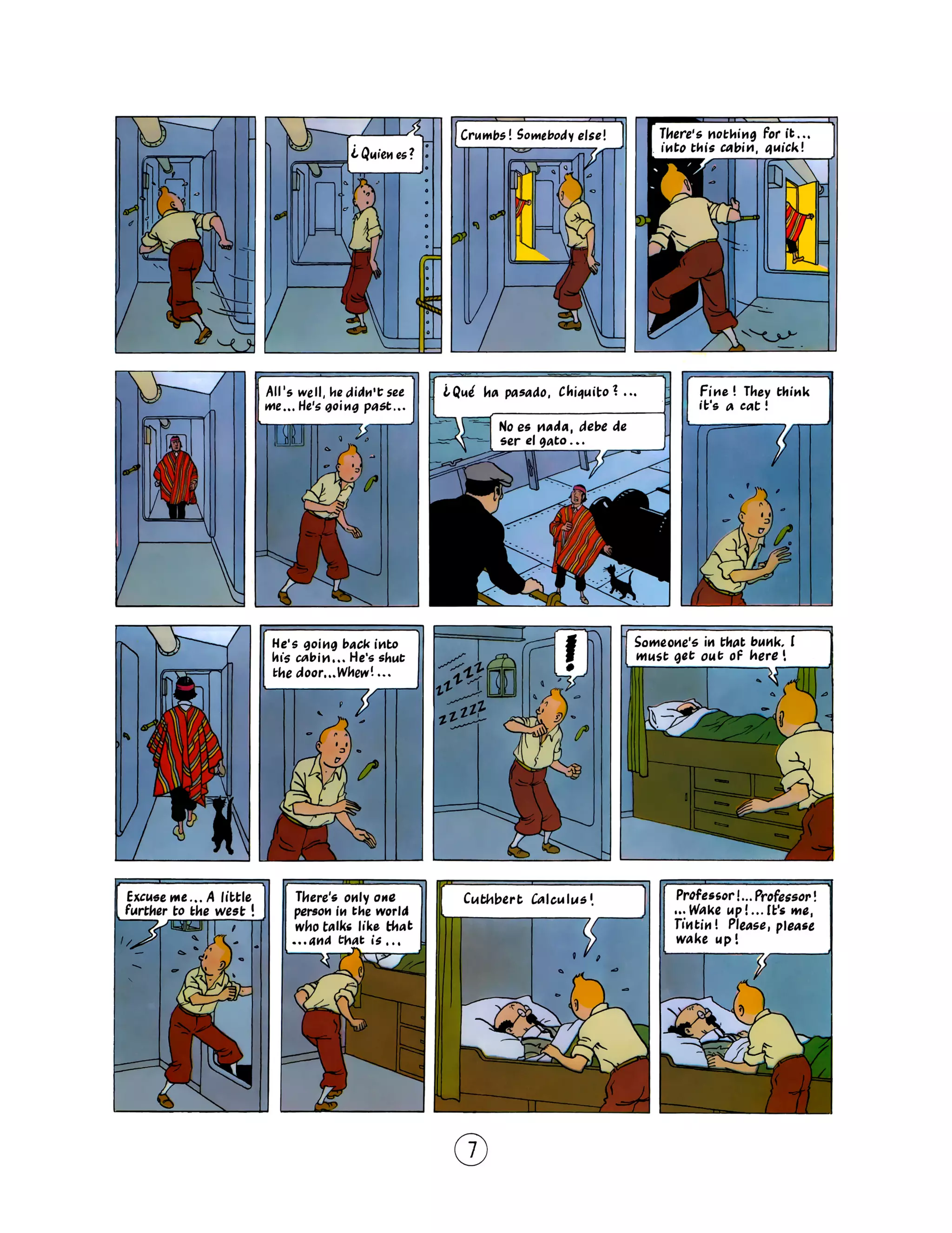
Jules: Strangely enough, something that really developed my understanding of and love for filmmaking was a comic: The Adventures of Tintin by Hergé. I’d never noticed it while reading Tintin growing up, but, revisiting the series later, I started to realize that Hergé handled his panels like he was shooting scenes with a movie camera. He zooms, he pans and tracks, he uses sustained two shots for dialogue scenes. One of his foundational techniques, which allows him to achieve these other effects, is the way he holds shots across multiple panels. He’ll also frequently set up a camera angle, cut away and then return to it. All these things give a sense of continuity and weight to the events. Understanding this helped me understand how the Ghibli directors created similar effects using similar methods!
John: I decided in my mid-teens to become a writer. And, early on, I learned a lesson that I still apply daily. I have to take a step back, regularly, and read from the top. It’s easy to get bogged down in a single sentence or paragraph. But, if I scroll up to the first line and go over a piece with a reader’s perspective in mind, it tends to untangle things. A broken flow or a missing thematic link sticks out, and I get a feel for how to continue what I’m writing. That process takes patience, for sure, but I view it non-judgmentally: this is just the search for a solution that conveys what I need to convey. (Plus, if I’m not reading what I write, it’s hard to ask other people to do so!) It’s helped me more than I can describe — even this afterword was written the same way.
Until next time!
See Animator (here and here) and Projections 5 — used a lot.
From Films and Filming (“Single Frame Trickery,” February 1990).
See On Animation: The Director's Perspective (Volume 1), one of our main sources.
See Animation 101.
The quote comes from Directing for Animation.
See The Guardian (September 18, 2005), used a couple of times. The “Nick Park look” comes up in Creating Creature Comforts, page 103.
See Inside The Wrong Trousers, used a few times.
These paragraphs about the origins of A Grand Day Out draw on Imagi-Movies (Summer 1994), Creating 3-D Animation, the Fort Worth Star-Telegram (October 2, 2005), The Guardian, The Telegraph, The World of Wallace & Gromit and the audio commentary track from the Wallace & Gromit: The Complete Collection Blu-ray. Many of these were used multiple times today.
See Your Animation Time and Movie Maker (July 1977).
From the foregoing sources and the book A Grand Success! (used several times in this last leg of the article).

 点赞
点赞 收藏
收藏 点踩
点踩 分享
分享