SoftBank’s Masayoshi Son Has Rare Cautionary Note on AI Safety

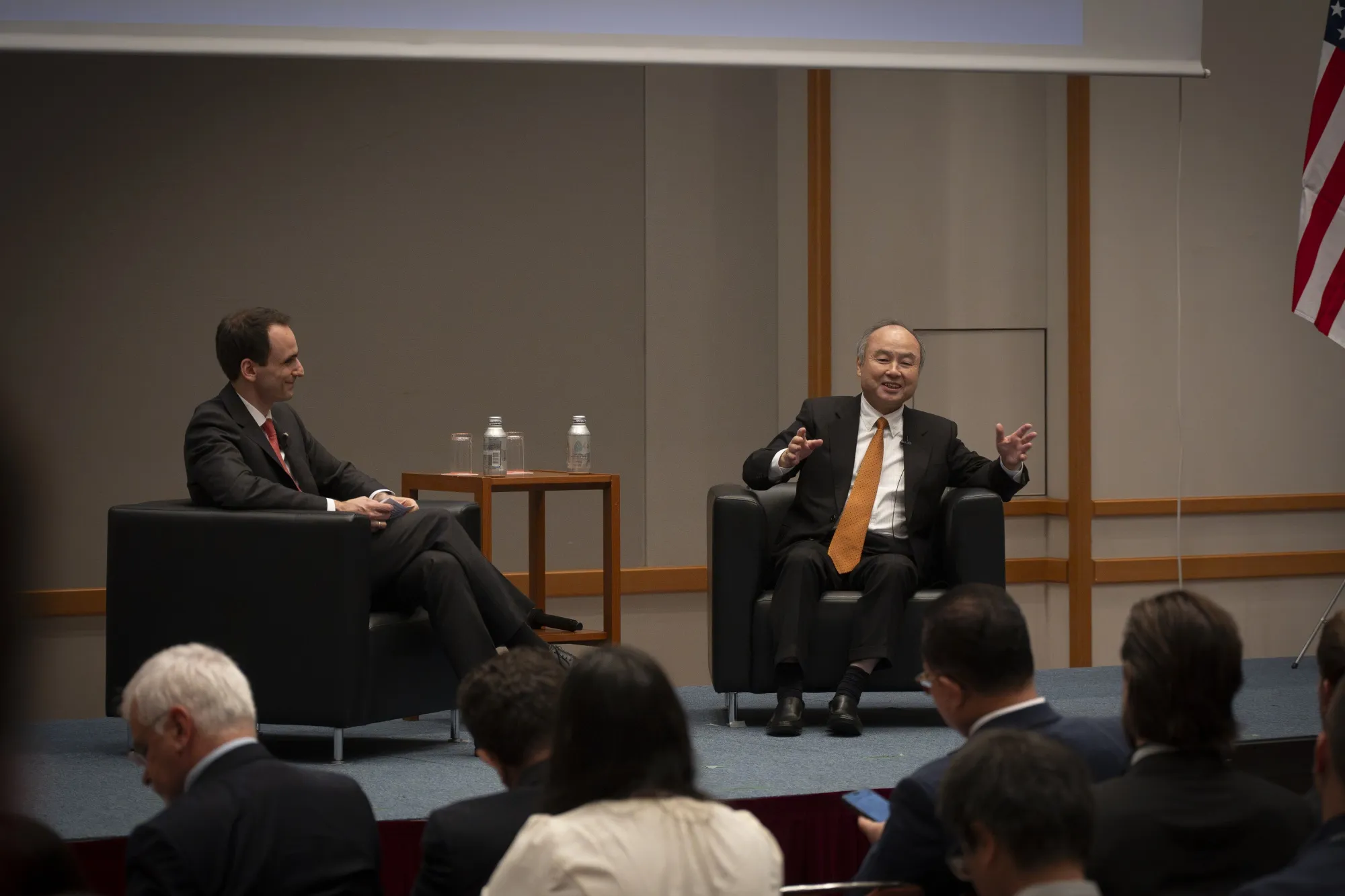
SoftBank Group Corp. chief Masayoshi Son — one of AI’s fervent believers — said that even he’s worried about safety risks as machines quickly gain more abilities.
An exponential surge in AI capabilities makes it imperative for countries to build trust so that they can harness the technology together, Son said at an event on the sidelines of the Science and Technology in Society forum in Kyoto on Sunday. He was speaking alongside White House science and tech policy advisor Michael Kratsios.
“We don’t have any more luxury of having human fight against human,” Son said, adding that countries need to work together to control the far greater threat from powerful AI models. Superintelligence in the wrong hands can become “super dangerous,” he said.
It was an uncharacteristic note of caution from Son that reflects escalating concern in the wake of disturbing security breaches by AI models in recent months. The 69-year-old Japanese billionaire has directed SoftBank funds totalling nearly $65 billion into ChatGPT creator OpenAI, and has spoken for years about the ability of AI to deliver investment returns and help humanity.
Are We Losing Control of AI? What’s Driving Fears: ExplainerFTC Probing OpenAI, Anthropic Over Product Safety ConcernsTrump Spurns AI Rules, Opts for Voluntary Audits After CEO Lunch
Kratsios was in the Japanese city to announce a US-led 17-country push to better use AI to accelerate scientific research. Representatives of nations including Japan, South Korea, the UK, Germany, Singapore and the United Arab Emirates joined Kratsios on stage to mark the event. The list of countries that initially endorsed the White House statement did not include China.
“In automated cloud laboratories operating at industrial scale, robotic systems will conduct hundreds of parallel experiments, generating data that feeds back for real-time analysis and hypothesis refinement,” Kratsios said.
Machines are able to synthesize thousands of papers and compress years of research into “tens of hours of work by armies of digital agents assisting human researchers,” he added.
In the meantime, AI services’ capabilities will continue to grow exponentially, Son said. The technology behind chatbots is now helping AI services browse sites and write code, using rising amounts of general-purpose chips. Such programs will next move to a third phase and be ready to help robots and other machines interact with the physical world starting next year, he said.
Son reiterated his long-term projection that AI and machines with learning capabilities would account for at least 20% of global gross domestic product by 2040, or the equivalent of $46 trillion. “This is just the beginning.”
Masa Son’s Huge OpenAI Bet Sends SoftBank Debt Costs SoaringSoftBank Pays Record Yields to Become Goliath of Junk BondsSoftBank Founder’s Starstruck Bet on OpenAI Raises Concern

 点赞
点赞 收藏
收藏 点踩
点踩 分享
分享