In a Survey of 160 Quantum Firms, 90% Buy From Abroad and About a Quarter Buy From China

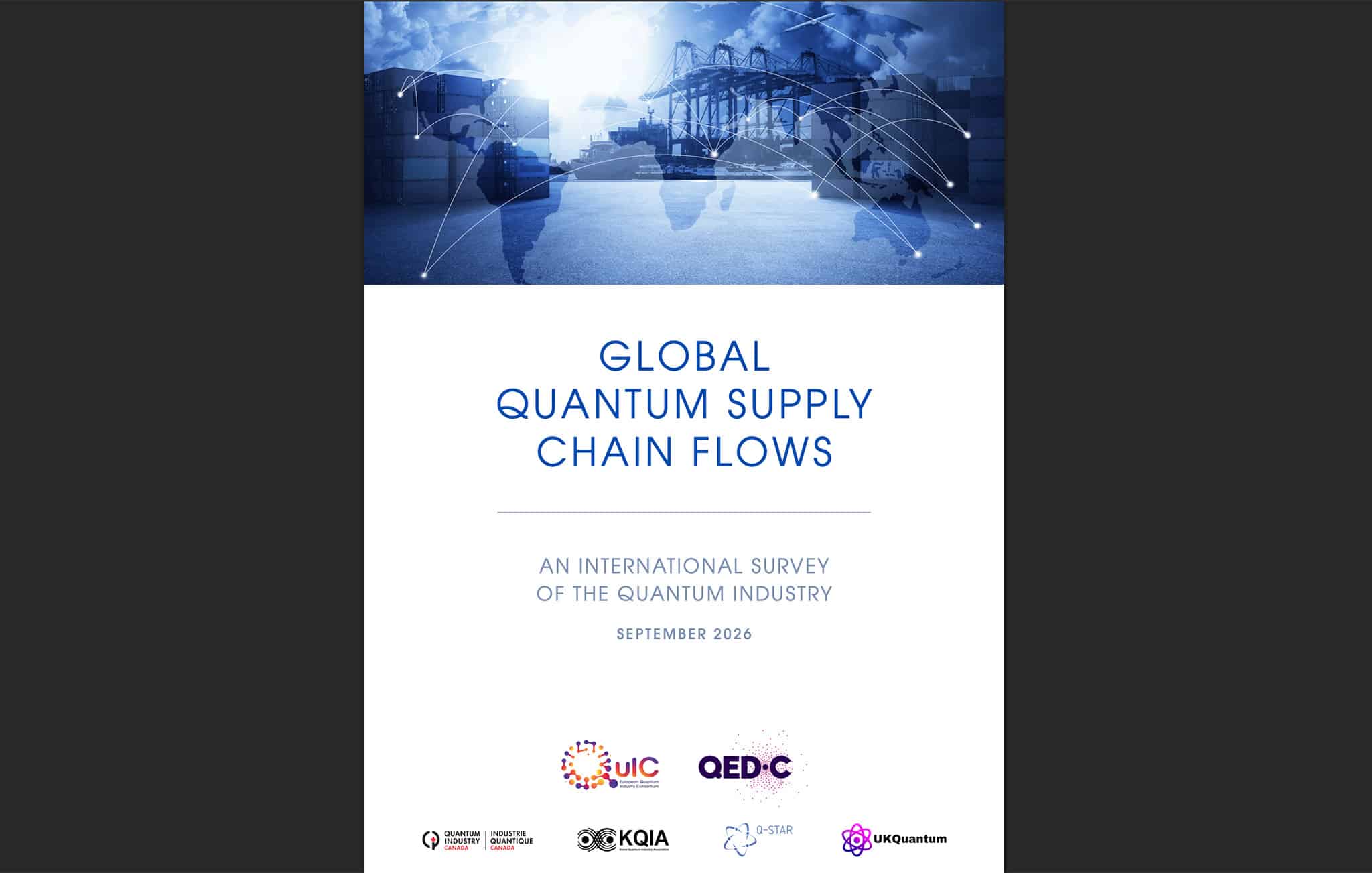
Table of Contents
September 23, 2026 – Ninety percent of the quantum companies in a new survey by six industry associations reported at least one supplier outside their home country and 74% at least one foreign customer, according to Global Quantum Supply Chain Flows, a report released on September 23, 2026.
The Quantum Economic Development Consortium (QED-C) in the United States published the report with the European Quantum Industry Consortium (QuIC), Quantum Industry Canada (QIC), UKQuantum, Japan’s Quantum Strategic Industry Alliance for Revolution (Q-STAR) and the Korea Quantum Industry Association (KQIA). The associations released it as Quantum World Congress opened in College Park, Maryland, and said the aim was to show governments and investors how the industry’s buying and selling crosses national borders.
The 160 companies are headquartered in 15 countries and named suppliers in 36 countries, customers in 49 and manufacturing sites in 25. China ranked sixth among supplier locations, named by 37 respondents, while nine named it as a customer location.
What the Survey Found
Respondents most often named their own country as a supplier and customer location. The United States led both rankings. Germany, the United Kingdom, Canada and Japan completed the top five in each, and the authors wrote that the European Union, counted as a bloc, ranked second only to the United States in both categories.
The median respondent named three countries each for suppliers and customers, and one for manufacturing. The 37 respondents that named China as a supplier location are headquartered in 10 of the 15 countries in the sample, and three respondents reported manufacturing in China.
Companies with one to nine employees reported a median of three countries for both suppliers and customers. Companies with 250 or more employees reported medians of four countries for suppliers, six for customers and two for manufacturing. Companies with 100 to 249 employees reported the lowest medians in the survey, two countries each for suppliers and customers.
The authors compared the 35 respondents that described themselves only as component suppliers with the 36 that described themselves only as systems developers. Component suppliers sold into a median of five countries and bought from three. Systems developers sold into two and bought from four.
The authors attributed the gap to commercial maturity: component makers already sell to other quantum companies, while end-user markets for complete systems are still forming.
Most companies manufacture only in the country where they are headquartered, the authors wrote. Of the 116 respondents that answered the manufacturing question, 45 named the United States as a manufacturing location, 29 Canada and 21 the United Kingdom.
How the Survey Was Run
The associations sent the survey to their members in the United States, Canada, Europe, South Korea, Japan and the United Kingdom in March and April 2026. Companies in India were also surveyed, with Abhishek Purohit, Director of Technology Strategy at QURECA, acting as the study’s India liaison. No Indian association is listed among the publishers.
Qualifying companies buy or sell quantum components or systems. Fabrication and testing providers also qualified, as did companies that sell access to quantum systems as a service, and each respondent had to answer at least one of the three location questions.
The participating associations estimated that the 160 qualifying respondents make up about two-thirds of their members eligible to take part. Of the 160, 146 answered the supplier question. The questions on customers and manufacturing had 133 and 116 respondents. Research organizations were excluded.
By headquarters, 37 respondents are in the United States, 34 in Canada, 25 in the European Union, 25 in South Korea, 17 in the United Kingdom, 12 in India and 10 in Japan. Forty-seven have one to nine employees and 34 have 250 or more. Asked to choose every segment that applied, 109 named quantum computing, 71 communications and networking, 71 sensing and 41 security.
Chinese organizations were not invited, and Quantum Australia, the Australian industry consortium, was unable to take part, so both countries appear in the results only as locations other companies named. Respondents were asked to leave out widely available off-the-shelf parts that are easy to substitute. They did not report the number of suppliers or customers per country, the specific inputs or the volumes traded, and the authors wrote that they kept the survey nonproprietary to get as many responses as possible.
The report is licensed under Creative Commons Attribution-NoDerivatives 4.0.
What the Six Associations Said
The authors wrote that companies benefit from policies that keep markets and preferred suppliers open among “like-minded” countries, and that trade controls should protect critical technologies without slowing innovation or growth.
Celia Merzbacher, Executive Director of QED-C, said the findings show how interconnected the industry already is. She said the International Council of Quantum Industry Associations (ICQIA), which the six publishers belong to, can use them to coordinate across countries while protecting critical technology and keeping companies’ access to trusted suppliers and markets. QED-C, QIC, Q-STAR and QuIC founded ICQIA in January 2023, and the council adopted a new charter and admitted UKQuantum and KQIA at Q-Expo 2026 in Bilbao in May.
Jonathan Legh-Smith, Executive Director of UKQuantum, said every part of the quantum industry, from research and talent to capital and supply chains, crosses borders. He tied the report to the April 2026 communiqué of the Quantum Development Group, whose 13 member governments met in London from March 30 to April 1. They agreed on three priority areas for cooperation, the first covering research security, investment security and supply-chain resilience.
Cécile Perrault, Executive Director of QuIC, said the EU’s second place as a bloc shows how much of the industry already works with European companies. She noted that the countries the industry buys from and the ones it sells to “are not always the same,” and said Europe should keep that in view as it shapes industrial and trade policy for quantum.
Brad Kim, Vice Chairman of KQIA, said commercialization depends on access to global markets as well as to technology, and that the association wants Korean companies to become trusted suppliers of specialized capabilities in global supply chains. Sean Lee, Acting CEO of QIC, said the study points to a prominent role for Canada’s industry and that a strong Canadian position across these supply chains is necessary for the country’s security and resilience goals. Purohit said emerging quantum economies such as India have an opening to supply specialized capabilities and take a larger part in global value chains.
My Analysis
Nine in ten of these companies buy from abroad and a quarter buy from China. The consortia counted countries, and the question governments need answered for sovereignty planning is which of those purchases a company could not replace.
The six associations have given the governments now writing supply-chain rules, from the European Commission drafting its Quantum Act to the 13 members of the Quantum Development Group, a multinational, firm-level map of the industry’s supplier, customer and manufacturing countries to add to earlier surveys and component studies. It is the broadest map of cross-border quantum trade I have seen. My supply chain series mapped the same industry from the component side, with a separate analysis for each major qubit modality. The consortia came at it from the company side, one country at a time.
Supply chain sovereignty, as I defined it in Quantum Sovereignty, is the ability to procure, produce or credibly substitute every critical component of the quantum stack. In the book I put dependency mapping below the first tier of suppliers at the top of what a resilience program needs. This report is a first-tier map, by country. The consortia designed it to show where the ties run, and they chose not to ask which ties a company couldn’t replace.
What the 90% Figure Measures
The consortia counted a company as having a foreign supplier if it named at least one supplier country other than its own. In their release, the associations described that as reliance on foreign suppliers, a stronger claim than the question supports. A Canadian start-up that buys one laser from Germany counts the same as an integrator that can’t cool a qubit without a refrigerator from Finland. Respondents had already been asked to leave out off-the-shelf parts that are easy to substitute, so the laser counts only if it is a specialist part. The survey had no question on whether a specialist part could be replaced. Respondents didn’t say how many suppliers they have in each country or what they buy there. From the report I can’t tell which foreign supplier a company could drop next quarter and which it couldn’t replace for a year.
Country of origin is also messier than a country count suggests. Bluefors is headquartered in Helsinki and builds dilution refrigerators there, but it also makes its Cryomech-branded cryocoolers in Syracuse, New York, where it began building dilution refrigerators in 2024. An American buyer of a Bluefors system could record it as Finnish or as American, and the report doesn’t say how respondents handled a supplier whose headquarters, contracting entity and factory are in different countries.
Two outlets pushed the headline further. Quantum Computing Report put the 90% in a table row labeled “Foreign Supplier Dependency” and credited the survey with finding heavy reliance on international cryogenics, lasers and control electronics, although respondents reported no input types at all. Quantum Zeitgeist read the 25 manufacturing countries as evidence of “immediate reliance on international sites.” The 25 countries are the combined answers of 116 respondents. The median respondent manufactures in one country, and most do so only at home.
I think the consortia made the right trade for a first edition. In QED-C’s own 2023 framework for tracking the quantum supply chain, developed by SRI with the Air Force Research Laboratory, the authors noted that companies are unwilling to share information about their customers and suppliers. Asking only for countries got the associations answers from about two-thirds of their eligible members.
The consortia also left out research organizations as respondents. Bluefors delivered 18 fully wired cryogenic systems, including a KIDE platform sized for more than 1,000 qubits, to the G-QuAT center that Japan’s National Institute of Advanced Industrial Science and Technology (AIST) opened in May 2025. A sale like that can still appear in the data if the supplier answered and named Japan as a customer country, but AIST’s own dependencies can’t.
How Many Foreign Companies Name Each Country, at Minimum
Canada supplied 34 of the 160 respondents, almost as many as the United States with 37. Seven German companies appear in the report’s supplier-and-customer chart, and three each from France, the Netherlands and Finland. The authors wrote that respondents most often named their own country. A country with many respondents therefore ranks high on home-market answers alone.
I separated foreign from home answers with one subtraction. Subtracting a country’s own respondents from the number of companies that named it gives the minimum number of foreign companies that named it. The result is a minimum because at most every home respondent named its own country. Where the result is negative I show zero. These are floors, and they don’t adjust for anything else about how the sample was drawn. The home counts come from the 152 companies in the report’s supplier-and-customer chart. The other eight answered only the manufacturing question, which is why the United States has 34 respondents in the table and 37 in the full sample.
Source: Global Quantum Supply Chain Flows, page 2; subtraction mine. Home counts are for the 152 companies in the supplier-and-customer chart, which also include four “Other EU” respondents from EU countries the report doesn’t name. Spain, Sweden, Denmark, Belgium, Austria, Ireland and Poland are left out of the table because any of them could be home to one of those four. China, Switzerland, Taiwan, Israel and Australia had no respondents, so every company that named them is foreign.
After the United States, Germany draws the most supplier mentions from foreign companies. At least 55 companies outside Germany named it, more than the total number of companies, home and foreign, that named any other country except the United States. Respondents weren’t asked what they buy there. In my trapped-ion supply chain analysis I found TOPTICA’s lasers in almost every trapped-ion system. I also found Infineon, the German chipmaker, fabricating ion traps for most trapped-ion builders, but it does that work at its fab in Villach, Austria, so an Infineon trap could be recorded under either country.
The Netherlands and Finland show the same pattern at smaller scale. At least 21 foreign companies named the Netherlands as a supplier location and at least 20 named Finland, the home of Bluefors, whose dilution refrigerators are the bottleneck I identified in my superconducting supply chain analysis. The three Dutch respondents made 30 customer-country selections between them and the three Finnish respondents 22. Switzerland, Taiwan and Israel had no respondents at all and were still named as supplier locations by 17, 17 and 12 companies.
Canada’s position changes most. In the report’s rankings Canada is fourth as a supplier location and second as a customer location, and QIC’s Sean Lee read the study as showing a prominent role for Canada’s industry. Take out the 33 Canadian respondents in the chart and the number of foreign companies that named Canada as a supplier could be as low as 17, the count Switzerland and Taiwan reach with no respondents. Part of Canada’s showing reflects how many Canadian companies answered. Canada’s industry is real, and with this sample I can’t put a firmer number on how many foreign companies buy from it.
South Korea and India are the reverse case. Korea has 23 respondents in the chart, two more than the 21 companies that named it as a supplier location. India has 12, one more than the 11 that named it, so the subtraction gives a floor of zero for both. The flow chart does show thin bands into both supplier nodes from respondents in other countries, including the United States. The report doesn’t publish the counts behind them. KQIA’s Brad Kim and QURECA’s Abhishek Purohit both described becoming suppliers to global supply chains as the aim, and those counts would show how far Korean and Indian suppliers have got.
Perrault is right that the buying and selling countries differ. France was named as a customer location by 39 respondents and as a supplier location by 28. The pairs for Italy are 26 and 7, for Spain 18 and 3, and for Australia 18 and 8. China (37 as a supplier, 9 as a customer), Taiwan (17 and 6), Germany (62 and 44) and Finland (23 and 16) are named more often as suppliers. Respondents reported no trade values. Each number is a company count from one of two different question samples and covers components and complete systems alike.
China as Supplier to 37 Respondents and Customer to 9
No Chinese company was invited, so China appears in the report only through its trading partners’ answers. Thirty-seven of the 146 companies that answered the supplier question named China as a supplier location (25%), and they are headquartered in 10 of the 15 countries. Nine named it as a customer location, and three manufacture there.
Export controls are one plausible reason for the small customer count, though the survey can’t measure their effect. The count also lacks the home-market answers Chinese companies would have given. Since September 2024, the Commerce Department’s Bureau of Industry and Security (BIS) has required licenses worldwide for specified quantum computers and components such as cryogenic cooling systems and cryo-CMOS circuits, with applications for China reviewed under a presumption of denial. The EU adopted similar controls in September 2025, in force across the Union since November 15, and BIS added 22 Chinese quantum institutes and companies to its Entity List in May 2024. I laid out how these controls fit together in my export-controls analysis.
Those controls govern exports. They don’t apply to what companies in those countries buy from China, and a quarter of these respondents buy there. The consortia didn’t ask what they buy. Prineha Narang of UCLA and Joshua Levine of the Foundation for American Innovation listed candidates in War on the Rocks last October: photonic quantum systems use erbium and ytterbium in optical components, and China handles about 90% of rare-earth processing overall. They also wrote that Sumitomo Metal Mining in Japan and CASTECH in China dominate lithium niobate wafer production. They put China’s share of the market for high-quality lithium niobate crystal boules at 60–70%.
China has already put licensing on some of these materials. Its April 2025 licensing requirement on seven medium and heavy rare earths still applies. On October 9, 2025, the Ministry of Commerce added holmium, erbium, thulium, europium and ytterbium, covering crystal, optical-fiber and magnetic-refrigeration materials that contain them. A separate notice, No. 61, reached foreign-made rare-earth magnets, sputtering targets and the parts and assemblies that contain them when Chinese-origin rare earths make up 0.1% or more of their value. On November 7, 2025, Beijing suspended that package until November 10, 2026.
On September 23, the day the consortia released their report, Treasury Secretary Scott Bessent said the U.S.-China trade truce would run to January 10, 2027, which CNBC reported as keeping rare earths flowing. I haven’t found a Ministry of Commerce notice that extends the rare-earth suspension itself past November 10.
The quantities involved are small. Narang and Levine put the rare-earth volumes quantum systems need in kilograms a year, and in my trapped-ion analysis I described the atomic sources as commodity chemicals, which on price and scarcity they are. Ytterbium is the qubit species in IonQ’s Forte systems. Small volumes don’t take an item out of a licensing requirement, though. What decides it is whether the item falls within the controlled descriptions.
In Quantum Sovereignty I used Henry Farrell and Abraham Newman’s term, weaponized interdependence, for the way a state that controls a node in a network can turn it into leverage. This report is the first count I have seen of how many quantum companies in the participating countries buy from a country that has already put licensing on rare earths and announced it for two that quantum systems use.
Which Countries Count as Like-Minded
The consortia ask for open access to markets and suppliers among like-minded countries without naming them. The three official lists closest to that idea do different jobs (a diplomatic forum, an EU licensing shortcut and a U.S. license exception), and none of them was written to define “like-minded” for industry. They also don’t match:
- The Quantum Development Group has 13 members: the United States, Australia, Canada, Denmark, Finland, France, Germany, Japan, the Netherlands, South Korea, Sweden, Switzerland and the United Kingdom. India, Italy and Spain are not among them.
- The EU’s general export authorization EU001, which covers the new EU quantum entries, lets exporters ship most controlled items without an individual license to the United States, Australia, Canada, Iceland, Japan, New Zealand, Norway, Switzerland and Liechtenstein, and the United Kingdom. South Korea and India are not on it.
- BIS keeps an item-by-item list for its License Exception IEC, last updated in December 2024. For quantum computers (ECCN 4A906) it covers Australia, Canada, Denmark, Finland, France, Germany, Italy, Japan, the Netherlands, New Zealand, Norway, Slovenia, Spain and the United Kingdom. For cryogenic cooling systems (3A904) it is shorter: Finland, Germany, Italy, the Netherlands, Norway and the United Kingdom. South Korea and India appear in neither row, and Switzerland and Sweden, both Quantum Development Group members, are missing from both.
Thirty-seven of the 160 respondents are headquartered in South Korea or India. Korea is a customer location for 33 respondents and India for 23. For the items the new EU controls cover, an EU exporter can ship to Switzerland under EU001 but needs a separate authorization to ship the same item to a Korean integrator. The Quantum Development Group, cited in UKQuantum’s statement, includes Australia and Switzerland, which had no respondents in the sample. It leaves out India, which had 12.
Japan and South Korea fell out over a supply chain in 2019. On July 1 that year, Japan’s trade ministry announced that from July 4 Japanese exporters would need an individual license for each shipment of fluorinated polyimide, photoresist or hydrogen fluoride to South Korea. In August, Japan dropped Korea from its list of trusted trading partners. Japan produced about 90% of the world’s fluorinated polyimide and photoresist and 70% of its hydrogen fluoride, according to the Korean government. Korea’s chip and display makers had few ready alternatives. Tokyo cited Korea’s handling of strategic exports, and Seoul saw the measures as retaliation for its Supreme Court’s 2018 rulings on wartime forced labor. The restrictions lasted 44 months, until March 2023, and Korea’s white-list status returned in July 2023.
Japan and South Korea are both Quantum Development Group members today, and Q-STAR and KQIA, their industry associations, co-published this report. Preferential export treatment between close partners is a political decision that governments can withdraw for reasons unrelated to technology, which is why in Quantum Sovereignty I warned against treating the allied control bloc as a guarantee of supply.
Built at Home From Parts Bought Abroad
On the supplier and manufacturing questions, the median company buys from three countries and manufactures in one. Most companies manufacture only where they are headquartered. Systems developers, the companies that assemble complete machines, buy from more countries than component makers, a median of four against three. They sell into fewer, two against five.
That is the structure of an integration industry. Specialist component makers export to builders in many countries. The builders assemble at home and, for now, sell into two countries at the median. The authors explain the same numbers by commercial maturity, and the two readings fit together.
In Quantum Systems Integration I describe a superconducting quantum computer as six layers that can be sourced independently: the processor, the cryogenic environment, control electronics, wiring and I/O, calibration software and HPC integration. That is the Quantum Open Architecture model. In the book I argue that sovereignty in this model comes from the ability to integrate. A country that can assemble and run a machine from several allies’ parts has more room to change a supplier, as long as an alternative part exists and it keeps the interfaces, software access and test capacity to qualify it. A country that bought a closed turnkey system has one supplier relationship to lose.
IBM follows the pattern too. IBM plans Starling, a fault-tolerant machine with 200 logical qubits, for 2029 in Poughkeepsie, New York, and it built Quantum System Two around the first KIDE cryogenic platform, which Bluefors shipped from Finland in spring 2023. A company as vertically integrated as IBM still buys its cryogenic platform abroad.
I can’t separate open-architecture integrators from vertically integrated vendors in the report’s categories. The two comparison groups are small, 35 and 36 companies, and the survey mixes computing with sensing, networking and security companies. The direction is consistent with the modular model: parts cross borders, and assembly mostly stays at home.
What the Next Edition Should Measure
QED-C has asked the dependency question before. In a 2022 survey that Hyperion Research ran for QED-C among 47 mostly American companies, nearly 60% expected a supply disruption within three years, most often from access to raw materials or to manufacturing and assembly equipment. Asked how long it would take to find an alternate supplier for their single most critical chokepoint, respondents most often answered more than a year, followed by nine months to a year. Those respondents also rated stricter export controls as very detrimental and showed little concern about market access. The samples differ, but four years and two rounds of allied controls later, the six associations lead their message with market access.
If the consortia put the substitution question to the multinational sample and tied each answer to a supplier country, governments would get the chokepoint map they are asking for. The European Commission’s call for evidence on its Quantum Act floated an EU-level monitoring and resilience framework that would run systematic supply-chain analysis and identify chokepoints, according to Covington’s summary. According to an event account published by The Quantum Insider, the Commission’s representative at a European Parliament event on September 3, DG CNECT Deputy Director-General Thomas Skordas, said the Commission hopes to present the Act by the end of this year, and the account noted it could slip into 2027.
My recommendation for the second edition is to keep the country map and add a dependency layer. Three questions would add that layer without asking any company to name its suppliers:
- For each foreign supplier country, is there an input you could not replace with an already qualified alternative within 12 months?
- Does the supplier’s government require an export license to ship that input to you?
- Which second-tier inputs do you know you depend on? The obvious ones are FPGAs in control electronics, helium-3 inside dilution refrigerators and enriched silicon-28 for spin qubits.
The sample needs two changes as well: research organizations, reported as a separate group so buyers like AIST count in their own right, and companies from Australia, Switzerland, Israel and Taiwan, all four of which already appear as supplier locations. The consortia could also publish the anonymized matrix behind the flow chart, with a count for every pair of headquarters and partner countries. That would replace my subtraction with actual counts and let EU readers separate ties inside the Union from dependence outside it.
Component-level maps already exist. QED-C’s 2023 framework was built to answer which components depend on a single supplier. Global Quantum Intelligence reported in 2024 that it had mapped 744 suppliers in 36 countries across 60 component types and classified the components by criticality. The Center for a New American Security’s March 2026 report sorts U.S. vulnerabilities into foreign dependence, insufficient domestic capacity, and performance and scalability gaps, input by input, and my own build guide maps the dependencies modality by modality. A firm-level survey with the substitution question would connect those maps to the companies exposed to each risk.
The consortia published their map on the day Washington announced a two-month extension of the truce under which China suspended its ytterbium and erbium licensing. A quarter of the companies on that map buy from China. In the second edition, the consortia can find out which of them could keep building if that suspension ends.
The post appeared first on PostQuantum - Quantum Computing, Quantum Security, PQC.

 点赞
点赞 收藏
收藏 点踩
点踩 分享
分享