U.S. small-scale solar adds 1.6 GW in Q2

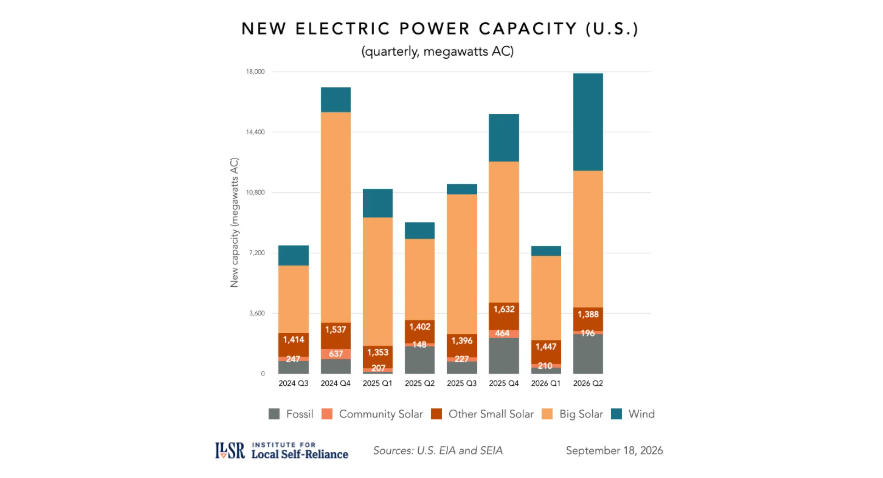
The U.S. distributed solar market added almost 1.6 GW of new capacity in the second quarter of 2026, maintaining a steady buildout rate across behind the meter installations. According to the latest quarterly Big Impact of Small Solar report published by the Institute for Local Self-Reliance (ILSR), total solar power accounted for 55% of all new electric generating capacity added to the national grid in Q2 when combining large-scale and small-scale assets.
While solar retained its position as the primary source of new U.S. electricity capacity, its relative market share contracted compared to prior quarters. ILSR data indicates this dilution was driven by a sharp rise in fossil power coming online, with Q2 recording higher thermal capacity additions than any single quarter over the past two years.
Despite the headwinds created by conventional generation additions and broader market adjustments, small-scale systems continue to offer a reliable buffer for national clean energy additions. The quarter’s 1.6 GW contribution highlights the segment’s relative insulation from transmission queue bottlenecks that continue to delay multi-hundred-megawatt utility projects.
Energy storage pairing accelerates
A key factor supporting small-scale solar resilience is the rapid co-location of battery energy storage systems (BESS). Behind the meter storage deployments reached a notable threshold in Q2 2026, with over 2.5 GWh of distributed storage capacity added across residential, commercial, and community sites.
Industry analysts attribute this growth in battery integration to evolving net metering policy frameworks, which increasingly reward self-consumption and load shifting over direct grid exports. By pairing solar with local energy storage, distributed resources are providing critical grid balancing services and mitigating local distribution network congestion.
As utility-scale interconnection delays persist, the consistent deployment of small solar and distributed storage assets highlights the expanding role of decentralized generation in meeting rising national power demand.
The post appeared first on pv magazine Global.

 点赞
点赞 收藏
收藏 点踩
点踩 分享
分享