Germany could generate over 600,000 tonnes of PV module waste by 2030

A recent study by the Fraunhofer Center for Silicon Photovoltaics (Fraunhofer CSP), commissioned by the German Mineral Resources Agency (DERA), has examined the raw material and recycling potential of photovoltaic modules installed in Germany.
By the end of 2023, the modules installed in Germany represented a total material stock of around 5.35 million metric tons. This included approximately 3.85 million tons of glass, 663,000 tons of aluminum, 208,000 tons of silicon, 53,500 tons of copper and 3,900 tons of silver.
The materials contained in the modules represent considerable economic value, particularly aluminum and silver. According to the study, their potential material value amounts to €4.8 billion ($5.4 billion). Silver is particularly significant for the PV industry: In 2023, the sector accounted for 19.3% of global silver production.
Recycling depends on module technology
The recoverability of individual raw materials depends on the module technology and the recycling process used.
For crystalline silicon modules, Germany already has established recycling processes on an industrial scale. Glass, aluminum and copper can be recovered from discarded modules, while silver can be separated through additional refining processes.
Silicon, which accounts for a significant share of the value of some module components, is generally not recovered at present. Plastics are typically thermally treated. According to the study, current processes achieve a material recycling rate of around 85% and an overall recovery rate of more than 95%.
The study also examines thin-film modules. Cadmium telluride (CdTe) modules contain cadmium and tellurium, while CIGS modules contain indium, gallium and selenium. However, the quantities of these materials installed in Germany are comparatively small because thin-film technologies account for a much smaller share of the market than crystalline silicon modules.
Actual return volumes difficult to estimate
More than 600,000 tons of PV module waste could be generated by 2030. However, the volumes that will actually reach recycling companies, and when they will arrive, remain difficult to predict.
According to the study, the recorded volume of end-of-life modules declined between 2022 and 2024, contrary to expectations. The researchers cite several possible reasons, including the export of used modules.
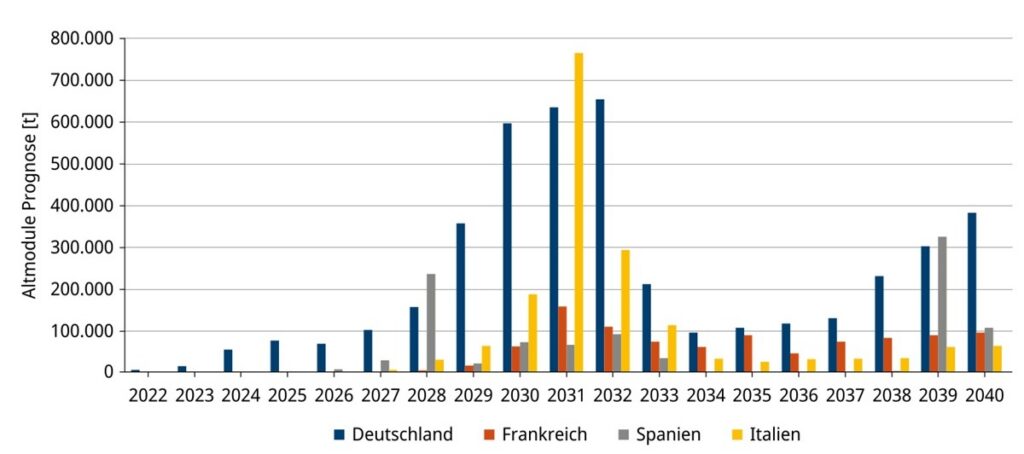
This creates a significant gap between available recycling capacity and actual return volumes. In 2024, more than 50,000 tonnes of recycling capacity was already available for crystalline silicon modules, while only around 9,300 tonnes of decommissioned modules underwent initial processing. The study projects that recycling capacity will reach approximately 64,000 tonnes in 2026 and 75,000 tonnes by the end of 2027.
The authors therefore recommend aligning further capacity expansion with actual return volumes to avoid temporary overcapacity. Based on a modeled expansion pathway, the study estimates that annual recycling capacity of 300,000 tonnes could be sufficient by 2040. Temporary peaks in return volumes could be managed through measures such as the interim storage of decommissioned modules.
The post appeared first on pv magazine Global.

 点赞
点赞 收藏
收藏 点踩
点踩 分享
分享