Small Talk with Emiliano Bonilla, CEO and Co-Founder of Synnax

What is Small Talk?
Small Talk is our short Q&A with founders from the JetBrains Startup Program. They answer a handful of questions in their own words about what they’re building, why they started, and what they’ve figured out along the way. No pitch, no polish – just a two-minute read to meet the person behind the product.
This time, we sat down with Emiliano Bonilla, CEO and Co-Founder of Synnax, the software behind rocket engine testing. He talked us through launches gone wrong, building a programming language from scratch, and why he won’t leave his IDE.
Emiliano Bonilla, CEO and Co-Founder of Synnax
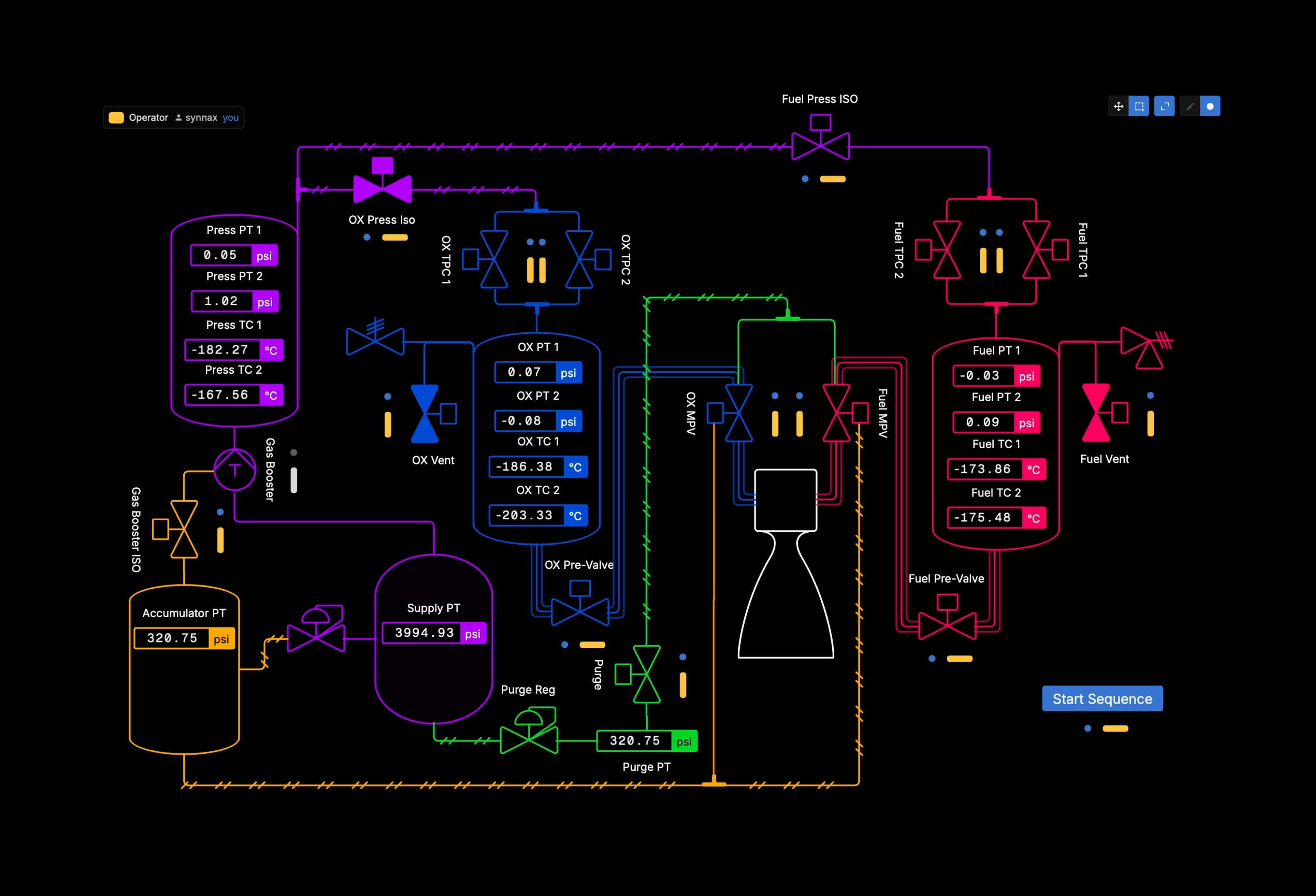
Synnax is a software platform for controlling hardware and capturing, organizing, and reviewing the data it generates in real time. Built for high-stakes environments like rocket engine testing, it replaces the spreadsheets and unstructured file dumps the industry has long relied on. It also includes Arc, a purpose-built real-time programming language. The company is extending its technology from aerospace into fields such as cryogenic control for quantum computing, oil and gas, and manufacturing.
TL;DR
- Synnax is a mission-control and data platform for teams testing and operating hardware, replacing the Excel sheets and 20-terabyte file dumps aerospace still runs on.
- The team built its own real-time language, Arc, in about six months, after Excel and Python both fell short.
- Emiliano’s team works in JetBrains IDEs (GoLand, CLion, and PyCharm) with Claude Code alongside, and is taking Synnax beyond rockets into quantum computing, oil and gas, and manufacturing.
You built software before Synnax. What was it?
I built aerospace ground software. When you watch a NASA launch and see all the screens people are staring at, that’s what I built in industry, and it’s what we build at Synnax now. I was at a rocket startup in Texas, Firefly Aerospace, through their first two orbital launches. They’re the fifth private company in history to reach orbit.
So why start Synnax?
Because the industry runs on tools built in the 80s. We mostly do rocket engine testing – you put an engine on a stand, wire up hundreds of sensors, and collect huge amounts of data. The old software dumps it into unorganized files, drives with 20 or 30 terabytes named only by date and time. Teams make bad calls because they can’t review it fast enough. I’ve seen things blow up. I’ve seen millions of dollars lost. Synnax tightens the loop between collecting data and acting on it.
What’s the hardest part of building software this mission-critical?
Balancing speed against quality when a small mistake can destroy a multi-million-dollar system. If a normal app goes down for a few minutes, it’s survivable. If Synnax misses a timing requirement by a few milliseconds, that can be the end of a customer’s hardware. I stand right behind the engineers at a test site while they run it, and it’s always nerve-wracking.
You built your own programming language, Arc. Why take that on?
Because existing resources weren’t a good fit. Excel can’t handle complex logic or state machines, and Python isn’t fast or safe enough for real-time control of engines. We resisted building our own language until it was unavoidable, then did it in about six months. It’s simpler than Python on purpose, and the developer experience is a night and day difference. A real editor flags a typo in two milliseconds, whereas using Excel would’ve meant carrying files between machines on a USB stick just to find an error.
You build all this in JetBrains IDEs. Why those over other editors?
The debuggers, mostly. You point at any target, press play, and it just works, with none of the configuration wrangling I used to do. We’re in GoLand, CLion, and PyCharm, with Claude alongside, and I like reviewing Claude’s output right inside the IDE. The merge conflict tool is far better than what I used before, and saving a file in our big codebase is basically instant.
Where does Synnax go from here?
Aerospace is still our bread and butter, but we’re expanding. One of the interesting segments is cryogenic control for quantum computers. Beyond that, oil and gas, and manufacturing, where I’d love to be running the control for an entire production line. The potential market is huge, so we pick our segments one at a time instead of trying to do everything at once. On the Arc side, the big thing we’re building is automated data review. A human can only review so much in real time, so we want anomaly detection in the loop to flag and correct things automatically.
Last one. What actually makes a tool win?
It’s rarely one big thing. You win through the accumulation of a lot of small things that make someone’s day a little better. That’s how we think about our own product, and it’s the same reason I stick with the tools I do.
Read the full case study here.
JetBrains Startup Program FAQ
Q: Do I qualify?
A: You qualify if your company is privately owned, established within the last five years, and has a website or other discoverable online presence.
Q: Where do I apply?
A: You can apply here.
Q: What is the timeline for the JetBrains Startup Program application process?
A: After you apply, our team will review your application within 48 hours. If you meet the criteria, you will receive an acceptance email, followed by a quote for the products. If you’re not accepted, our team will get in touch and share our reasoning. An application may be unsuccessful either due to missing information (e.g., a document or website) or because you do not meet our eligibility requirements (e.g., your business is more than five years old).
Q: What products are included in the terms “IDE subscription”, “AI subscription”, and “team or learning tool subscription”?
A: A variety of products are available through IDE subscriptions, including IDEs as well as .NET and Visual Studio tools. “Team tool subscription” refers to team tools, including TeamCity, YouTrack, Datalore, Qodana, and our learning tool (JetBrains Academy).

 点赞
点赞 收藏
收藏 点踩
点踩 分享
分享