Japan Has No Space for Solar Farms Apart From Old Golf Courses

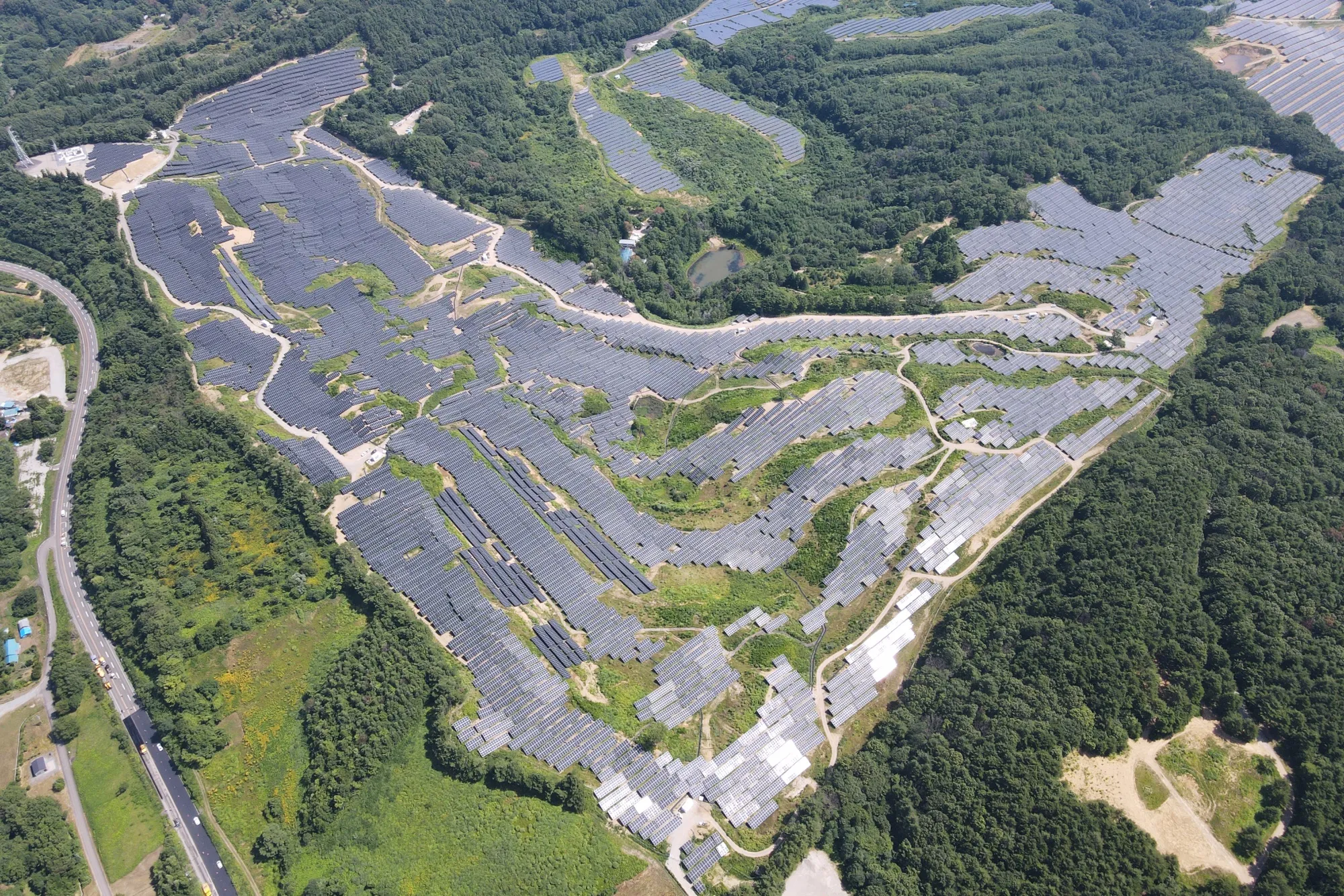
The perfectly manicured fairways at Minohara Country Club wind through the forested hills of Gunma Prefecture about two hours from downtown Tokyo. In a few years, they’ll disappear under row-upon-row of solar panels.
In one of the world’s most densely populated and mountainous countries, developers are running out of sites big enough to host major solar projects. Golf courses, which multiplied in Japan during the boom years of the 1980s, are some of the last tracts of open land available.
“No one wants to do mega solar projects anymore. I really don’t think there’s any space,” said Daisuke Toya, representative director of Kamisato Kensetsu Ltd., a construction and real estate company that develops solar facilities and bought the 27-hole course in 2025. “The most we could do is buy up the golf course to use the land.”
The result is that a relic of Japan’s economic bubble is playing an unlikely role in the country’s energy transition. For the past decade, defunct golf courses have been vital to solar growth. About 9% of Japan’s utility-scale solar capacity is on former golf courses, according to an analysis of a BloombergNEF data that includes arrays with capacity of 0.9 megawatts or greater.
Some of the country’s biggest projects — known as ‘mega solar,’ as projects are larger than a megawatt — have been built on former fairways, including Japan’s largest in Okayama prefecture in western Honshu.
Japan embraced solar power after the 2011 Fukushima nuclear disaster resulted in the closure of its 54 nuclear reactors, which used to supply around a third of its electricity. The government introduced generous subsidies — known as a feed-in tariff — that guaranteed the purchase of renewable power at a price that was economical for developers.
After an initial boom in installations that peaked in 2015, the buildout slowed and Japan gradually lowered the benefits of the feed-in tariff. This deceleration is posing a problem for the government, which is targeting solar supplying as much as 29% of electricity by 2040 — nearly triple the current proportion — and wants to get to net zero a decade later.
As well as the dwindling subsidies, mega solar projects have faced increasing opposition from communities concerned about deforestation, landslides and changes to landscapes. Prime Minister Sanae Takaichi has also been vocal in her opposition to such developments.
The biggest issue facing developers is just finding a place to build, according to Andrew Chapman, an associate professor at Kyushu University, who estimates that using all the land technically suitable for solar and wind could produce 14 times Japan’s annual electricity generation. The country has the space, but that isn’t translating into actual construction, he said.
Mega-solar farms need good sunlight, access to the power grid and to be a reasonable distance from residential areas. Many golf courses tick those boxes.
“If you can snap up a cheap golf course, which is nice and flat, gentle slopes, not mountainous, it’s probably cheap land,” Chapman said. “So it makes a lot of sense, especially if they’re going into regional areas.”
Japan has plenty of courses thanks to a construction boom four decades ago, when resorts and golf became a symbol of corporate wealth and leisure during the country’s economic heyday. But the game’s popularity has faded over the last few decades, particularly in rural areas with declining populations.
The Minohara Country Club typifies this trend. The fee for a day of unlimited play at the course is just ¥5,000 ($31.87) – far cheaper than in the US or Singapore — yet it still barely attracts any customers.
“This establishment is losing money,” Kamisato Kensetsu’s Toya said. The course loses more than ¥2 million a year, he said. The developer bought the site with a plan to cover it with 152 megawatts of solar panels — one of the biggest projects planned for the country.
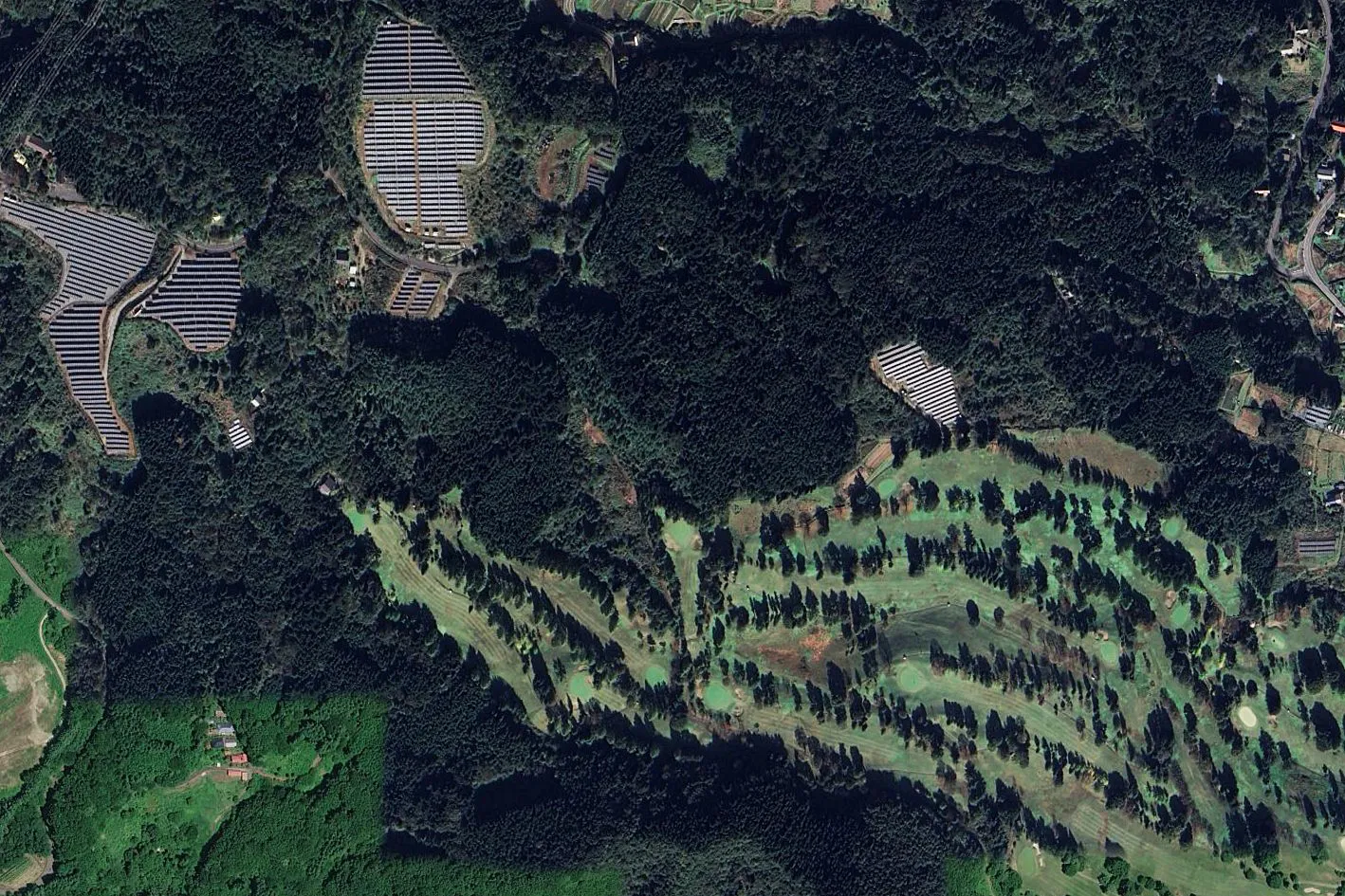
As Kamisato Kensetsu works through the lengthy process of preparing the site for solar development, it’s keeping the course open and has actually taken over day-to-day operations. Environmental assessments and other planning alone can take as long as four years. The company aims to close the country club in 2030, when construction of the solar project is due to begin.
Read More: Solar Rises to 10% of Japan Power Generation in 2025, Ember Says
At least 1 gigawatt of solar projects either announced or under construction are located on Japanese golf courses — roughly 10% of the current pipeline, according to Bloomberg calculations.
EDP SA, which recently commissioned a solar project on a defunct course in Fukushima prefecture, says such sites can accommodate large-scale developments while limiting disruption to natural landscapes. “We see golf course sites as an opportunity to make effective use of available land while minimising the need for large-scale cutting of trees, which is one of the most sensitive issues associated with solar project development,” the company said in an emailed statement.
Still, golf courses aren’t an unlimited resource, and developers are already thinking about alternative sites when they run out.
Renova Inc., one of Japan’s largest independent renewable-energy developers, has shifted toward smaller solar installations on abandoned farmland. The government is also betting on next-generation perovskite solar cells that could eventually be installed on rooftops, walls and other surfaces unsuitable for conventional panels. But widespread commercialization is still some way off.
For now at least, golf courses are offering the best path forward for bigger solar projects in Japan.
“When you look at what land is actually left, I think golf courses may be one of the only options,” Kamisato Kensetsu’s Toya said. “We feel that we have to do what we can for the country. We’ve decided that solar is the right direction.”

 点赞
点赞 收藏
收藏 点踩
点踩 分享
分享