Runner’s Murder in South Africa Reignites Push to Stop Femicide

Liz Ramhlola was jogging with another woman early one morning on a road bordered by vacant plots when a car slowed down beside them. The men inside opened the windows, then began jeering and arguing amongst themselves about how to “take their summer bodies.” The 37-year-old feared that she and her friend would be abducted, or worse. Eventually, the men drove away.
“I was thinking that the minute they open the door, ‘I’m just going to start screaming, but who is going to hear?’” recalled Ramhlola, a mother of two. “It was one of the scariest moments of my life.”
The incident has been weighing on her more over the past two months as the bodies of nine women — including Elizabeth Moselakgomo, a fellow runner who was also a mother in her late 30s — were found in various states of decay in Ekurhuleni, east of Johannesburg. Some of them were partially naked and had been brutalized. Ramhlola’s new crew now staggers its starts, with faster runners leaving first so that they can loop back and check on those behind them. They wear high visibility vests, carry torches and pepper spray.
Women in South Africa, a country with some of the highest levels of gender-based violence in the world, are used to making such calculations. They share their locations. They avoid walking alone. They turn down jobs that require travel before dawn or after dark. And, they pay for private cars rather than use public transport. As anger rises in the wake of the murders, more people are asking why the country’s 32 million women and girls should have to carry so much responsibility for their own safety.
Whether the crimes are connected or not, they serve as a “painful reminder” of how much the society needs to change, according to Keitumetse Moutloatse, founder of the Black Women Caucus campaign group. “Violence has become deeply normalized,” she said. “There’s no cohesion in our families. There’s no cohesion in our communities, in our schools, in society at large.”
By failing to deliver basic services, both President Cyril Ramaphosa’s government and coalitions at a local level are creating space for crime to flourish, said Susan Booysen of the Mapungubwe Institute for Strategic Reflection and Visiting Professor at the Wits School of Governance. “Every moment of this tragedy reinforces that there is a government — in various forms whether national or local — that is basically out of control, that has not been doing what is required, which is to keep the environment safe,” she said. “We see this with bad roads, overgrowth, rubbish dumps, street lighting that is not operational.”
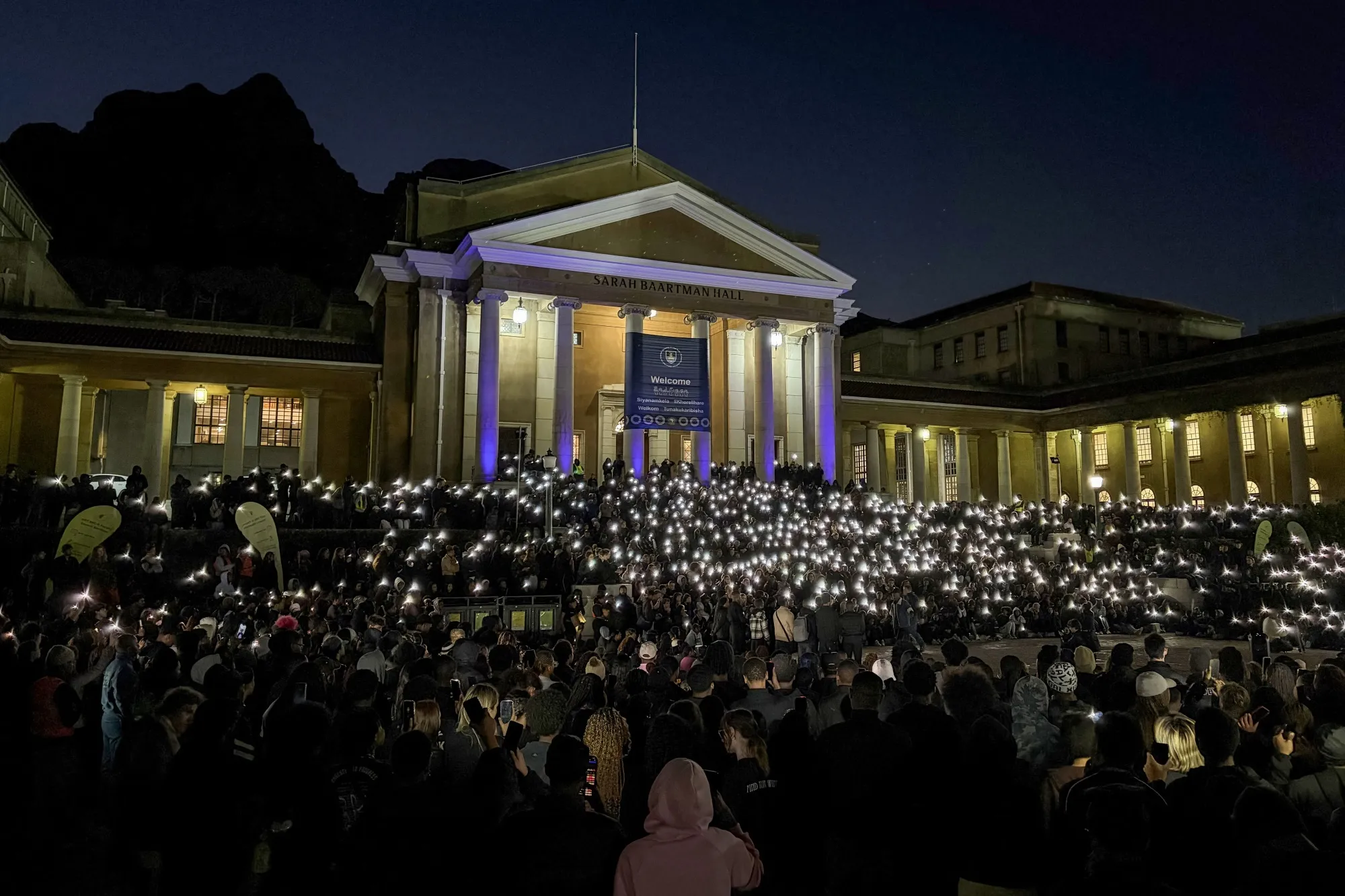
Candle lit vigils attended by thousands of people have been held in several cities, including Cape Town. Protests have taken place outside police stations. Runners have held special events, and are raising money for Moselakgomo’s 8-year-old daughter.
South Africa has been here before.
Every year over the past two decades, at least one woman’s murder has triggered a national outcry. In 2025, Ramaphosa declared femicide — gender-related killings of women and girls — a national disaster. In 2020, his administration introduced the National Strategic Plan on Gender-based Violence and Femicide to try to break the cycle by strengthening the state response through specialist police units, courts and prosecutors, and allocating 21 billion rand ($1.2 billion) over five years to the effort.
Even so, six women a day were murdered in the country between April and June this year, according to crime statistics. Another 1,052 survived attempted murder during the same period while police recorded 9,201 rapes. And, although most women are killed by intimate partners, the rate is growing for violence from strangers. The United Nations Office on Drugs and Crime shows that female homicide in South Africa rose to 4,003 in 2023 from 2,639 in 2016.
It is the government’s “duty and responsibility” to ensure the safety of women, Ramaphosa said on Monday. “The women of South Africa deserve to be protected,” he said. “They deserve to walk in the street at any time of the day and feel safe.”
On Thursday, he said he would address the nation on the matter in the coming days.
Kempton Park
It’s not possible to determine with any certainty where exactly South Africa ranks globally for femicide, as governments define, record and measure such killings differently. UNODC data show that the country’s female homicide rate was 12.2 per 100,000 women in 2022, around six times the global average. Other nations that have recorded high levels of overall violence and murder also have high female homicide rates, including Guyana, Haiti, Jamaica and Honduras.
Comparison of conviction and prosecution rates is difficult, too. South Africa’s National Prosecuting Authority reported a 91.7% conviction rate for femicide prosecutions from 2023 to 2024, but that represents 511 convictions from just 557 cases brought forward that reached a verdict, suggesting that the majority of incidents never even make it that far.
For Malaika Mazibuko, a candidate attorney, the “heightened level of action” shown by police after the Ekurhuleni murders should be common practice. “We need law enforcement that takes these crimes seriously,” she said. “When people are reporting matters at police stations, is sufficient time being given to investigations are statements taken down properly?”
She said that South Africa’s barrage of socio-economic challenges contribute to its crime, disregard for the law and to the erosion of community cohesion. Early interventions need to address root causes, including high levels of poverty — around 40% of the population, or about 23.2 million people, lives in poverty — and inequality, which both re-enforce patriarchal power dynamics. “These are the sociological factors which must be taken into account,” Mazibuko said. “If you can find a way to do that you can influence men to go in a different direction.”
Moselakgomo left her home in Kempton Park for her afternoon run on Sept. 9, sharing details about where she was going and when she expected to return with her daughter, Khumo, who called relatives when her mother wasn’t back by 18:30. They contacted the police. Fellow runners, including Ramhlola — who said “I could literally see myself in her story” — joined the search to find her, circulating her photograph and route online and putting up missing-person posters.
Four days later, Moselakgomo’s family identified her body at a mortuary. She was 38.

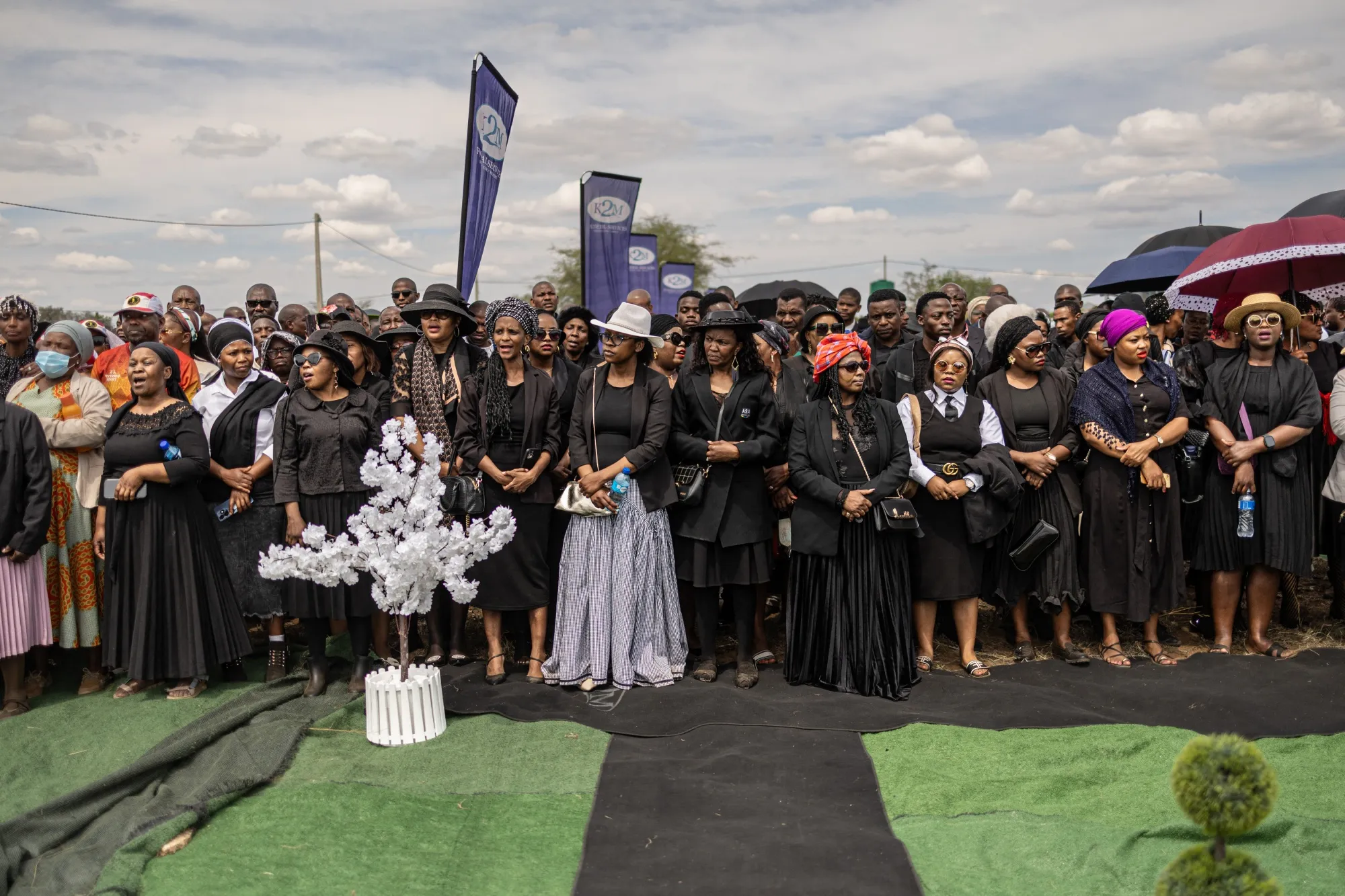
“It is quiet without your voice,” said Khumo, flanked by schoolmates in uniform, at her funeral. “When I feel sad and miss you, I will look up to the sky and imagine you are watching me.”
Her mother’s killing has become the most visible case in the widening investigation in Ekurhuleni, which police have described as complex. Three suspects have been apprehended in relation to one of the murders.
Braving an early morning chill on Sept. 18, a day after the ninth body — that of Jabulile Ntimba — was discovered, demonstrators gathered outside the police station in Kempton Park, a sprawling suburb, near Or Tambo International Airport that includes industrial zones and detached houses behind walls and gates, alongside denser housing and less affluent areas.
Dressed in black, the small crowd sang songs and called on police to find the killer, or killers. They want officers to be more present in their communities. And — since the money allocated under the National Strategic Plan has not been ring-fenced and there is no coordinating structure accounting for the use of the funds — they want the government to set aside 12 billion rand ($739 million) for extra nurses, social workers, police and gender-based violence initiatives, such as shelters for survivors.
The price of not doing anything is even higher, according to Shared Value Initiative, a global platform for leaders seeking to solve societal challenges, which added together the combined cost of medical care for victims, human capital loss and judicial costs, and came up to a conservative estimate of around 36 billion rand a year.
“Captain, please leave no stone unturned,” said Steve Letsike, deputy minister in the Presidency for Women, Youth and Persons with Disabilities, who was among the protesters that day outside the Kempton police station.
Letsike added that boys should be raised to understand consent. “Men, the issue of violence is pointing at you, women die in your hands.”
When Municipal elections are held on Nov. 4, the state of services in local councils will be under the spotlight. A majority of them are bordering on financial ruin and suffering governance crises, especially in urban centers, where coalitions are often reconfigured for political reasons, resulting in the spontaneous change of leaders.
Moutloatse, the Black Women Caucus founder, was drawn to activism when she was 17, after Anene Booysen — a girl the same age as her at the time — was gang-raped, mutilated, and left for dead at a construction site. She bought black ribbons, sold them and donated the proceeds to a women’s shelter.
At Johannesburg’s Wits University, she was leading student protests calling for free education when her childhood friend, Karabo Mokoena, was killed by her boyfriend. He dumped her body in a bin, transported it to another location and set it alight. Days after the burial, Moutlase invited women to gather to “reflect” on what was happening. The movement expanded into poor, neglected communities in townships and informal settlements.
Now aged 31, Moutloatse, said that the recent killings have vindicated ongoing calls from civil society for the government to take a more coordinated approach to gender-based violence. She said South Africa needs solutions to what she believes is mass trauma at a community level, and she wants a more responsive justice system, a sensitized police force and active communities that speak out when abuse happens, because “Femicide is the last stage of the violence.”

 点赞
点赞 收藏
收藏 点踩
点踩 分享
分享