The Political Rivalry That Defines Brazil

Welcome back to The Forecast from Bloomberg Weekend, where we help you think about the future — from next week to next decade.
This weekend we’re focused on global politics:
Brazil’s upcoming election is all about succession (or lack thereof)Predictions: Bad news for gyms, baked goods and beer, plus a new place to play golfCharted: The US and China’s combined share of GDP is about to peak What are the chances… election odds in Brazil, the US and IsraelOptimism corner: The UN is in trouble, but the students of Model UN still believe in diplomacy
But before we get there, let’s check in on a few of our Forecast obsessions:
Still wondering about the next big computing device? Meta unveiled several new products this week: VR glasses (the metaverse is not dead!), audio-only smart glasses, and a handheld AI device that “looks like a Tamagotchi — the digital pet from the ’90s.” Maybe they’re not sure what’s next either.The Australian government said this week that OpenAI’s models had “infiltrated” one of its websites. You don’t have to believe AI is akin to the human mind to worry that we don’t have adequate control over it right now.Two new polls capture America’s AI pessimism: In most countries, positive feelings about AI outweigh negative ones, says Gallup, but the US is an outlier. Pew finds Americans in both parties are souring on data centers. But on AI in general, Republicans are growing less worried, possibly due to the Trump administration’s endorsement.
Brazil Can’t Shake Lula and Bolsonaro
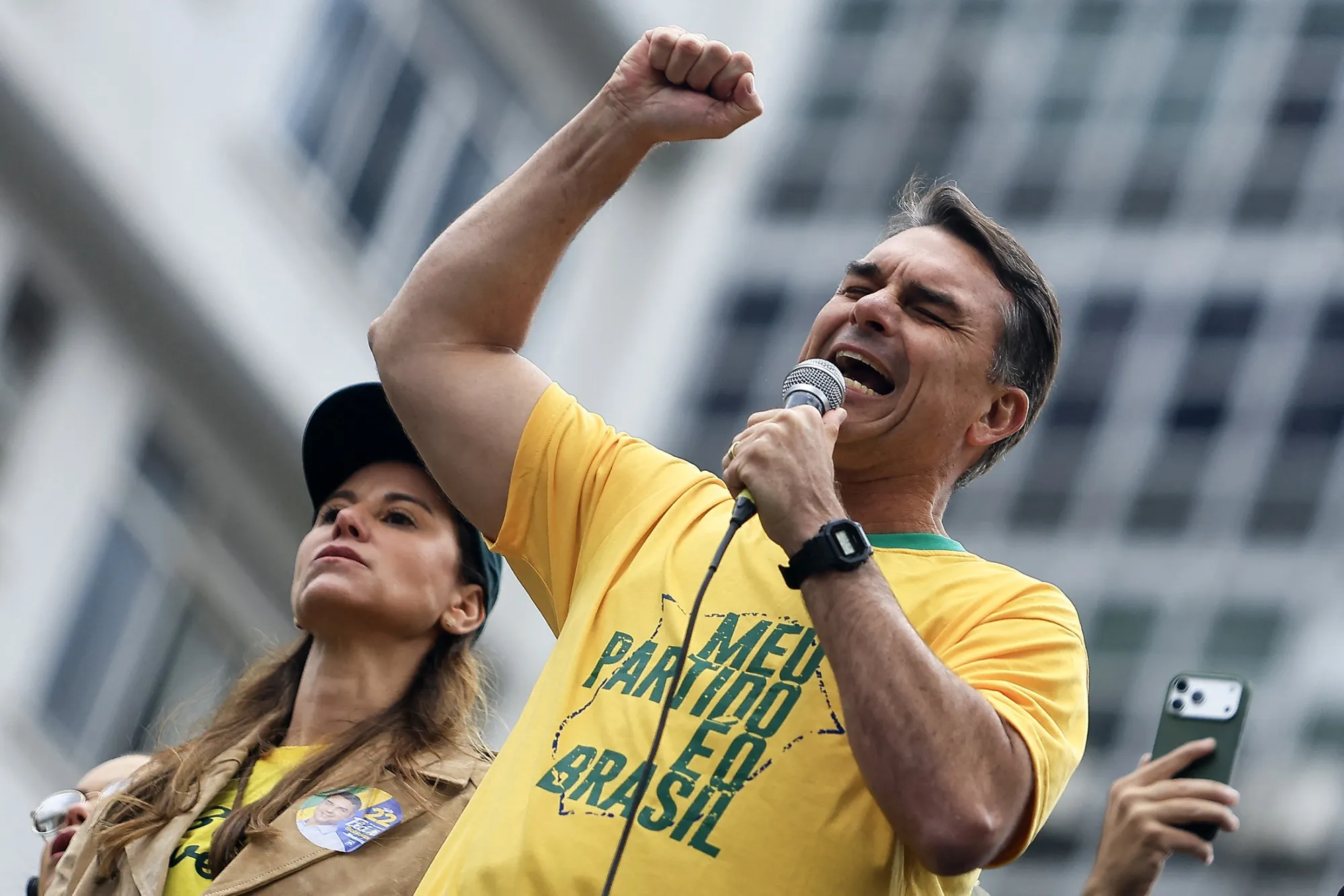
Brazil heads to the polls on Oct. 4 for another presidential election, and once again faces a dilemma its political system has failed to resolve. President Luiz Inácio Lula da Silva, 80, is seeking a fourth term, 16 years after he first left office; his predecessor Jair Bolsonaro is in prison, but Bolsonaro’s eldest son, Flávio, is running in his place.
Their rivalry was already on display on the first day of 2023, when Lula climbed the ramp of Brazil’s presidential palace to begin his third term. Bolsonaro had left for Florida rather than attend the inauguration, so a group of ordinary Brazilians joined Lula to place the presidential sash over his shoulder — a carefully staged image of democratic renewal.
A week later, the monumental square in front of the palace became the backdrop for a very different spectacle. A crowd draped in Brazil’s green and yellow stormed Congress, the Supreme Court and the palace, smashing windows and furniture and slashing paintings as rioters sought to create the chaos they hoped would prompt the military to overturn the election and return Bolsonaro to power.
The two scenes captured the opposing forces that have shaped Brazilian politics for years. Through impeachment, imprisonment, scandal, political resurrection and an assault on democratic institutions, Brazil has proved remarkably unable to move beyond the two figures at its center. Lula created a party meant to outlast him, only to find himself indispensable to it. Bolsonaro built a movement around himself and his family, ensuring that even his absence would leave another Bolsonaro in his place.
Brazil still hasn’t figured out how to leave the age of Lula and Bolsonaro behind. Nor is it clear whether Lula’s left and Bolsonaro’s right can outlive the men who made them.
— Walter Brandimarte, Bloomberg News
Brazil Can’t Escape the Age of Lula and BolsonaroOne is seeking a fourth term, the other is in prison. Yet neither Brazil’s left nor its right has figured out how to move beyond the men who remade them.
Predictions
Higher yields will force a new era of disciplined capital: “A higher cost of money could be exactly the medicine that capitalism needs by forcing companies to spend on projects that have a real chance of generating a return.” — John Authers, Bloomberg Opinion
The US “office bust” is only going to get worse. “One of the scariest headlines is that office CMBS delinquencies are higher than after 2008,” said Dan McNamara, chief investment officer of Polpo Capital Management, a hedge fund that often takes short positions on CMBS. “And it’s going to go higher as we face more maturities.” — Miranda Davis, John Gittelsohn, Natalie Wong, and Scott Carpenter, Bloomberg Big Take
AI assistants will be bad news for gyms — and any business that counts on customers forgetting to cancel. “Shares of major banks, insurers and online travel agencies slid on Tuesday as investors fear that tools like Meta Platforms Inc.’s personal AI agent could disrupt businesses that benefit from so-called consumer inertia, the tendency to keep buying something out of habit even when a better alternative exists… Gym chain Planet Fitness Inc. closed 9.5% lower.” — Henry Ren, Bloomberg News
GLP-1s will dent demand for beer and baked goods. Overall food and beverage sales will decrease by 2.9% in the US and Europe, says Bloomberg Intelligence. Sales of fruits, vegetables and bottled water are expected to rise (link for Terminal subscribers only). — Jennifer Bartashus, Bloomberg Intelligence
More companies will build their own AI model, leaning on open-weight models as a starting point, to avoid dependencies and lower computing costs. — Rebecca Torrence and Natasha Mascarenhas, Bloomberg News
Vietnam will become a world-class golf destination. “The nation expects to have about 200 courses by 2030, more than double the current tally, and [accounting] for almost 50% of golf development across Asia… While China’s Communist Party has long viewed golf as “green opium” and banned its members from using public funds to play or join clubs, Vietnam’s Communist government has embraced the sport… [and it] is increasingly popular with Vietnam’s growing middle class.” — John Boudreau and Cao Ban, Bloomberg Weekend+Pursuits
Peak US–China
This week’s big geopolitical story was Chinese president Xi Jinping’s trip to Washington for talks with President Donald Trump. But if the relationship between the world’s two superpowers can seem all-consuming, here’s a data point to consider: We may well be living through the peak of these two countries’ economic power.
Bloomberg Economics recently updated their 30-year forecasts for every economy around the world. The Forecast asked them to break out their predictions for the US and China — and the result is a case for the middle powers, in one chart. Bloomberg Economics projects that the combined US-plus-China share of global GDP will peak in 2028, before declining gradually.
Today, those two countries together account for just over a third of global GDP (adjusted for purchasing power parity). Bloomberg Economics’ forecasts suggest it will never get significantly higher than that, as growth in India, Argentina, Brazil and Nigeria accelerates.
(For Terminal subscribers only, here’s Bloomberg Economics’ 2056 forecast.)
What Are the Chances...
Since we started on the subject of elections, let’s check in on a few prediction markets, starting with the Lula-Bolsonaro race for Brazil’s presidency:
45%: The chance that Lula wins Brazil’s presidential election on Oct. 4 (Kalshi)
60%: The chance that Democrats win majorities in both the House and Senate in November; there’s a further 30% chance that Democrats take the House but not the Senate. (Kalshi)
29%: The chance of Benjamin Netanyahu remaining prime minister of Israel after Israel’s 2026 election; here’s Bloomberg’s explainer on the election, set for Oct. 27. (Kalshi)
Forecasts as of 3 p.m. ET on Friday, Sep. 25, 2026.
Optimism Corner
Not Everyone Is Giving Up on Global Diplomacy
It’s a tough time to be a diplomat: The global economy is fracturing, war is proliferating, great-power rivalry has returned and the US has overhauled its approach to the world. Perhaps unsurprisingly, it was a rough week for the United Nations.
But not everyone is dissuaded. The UN may be struggling, but Model UN — the clubs and conferences where students simulate global diplomacy — are thriving. In fact, participation is growing even as interest in some other political clubs dwindles.
Some of the appeal is the ability to travel. But the clubs are also stoking students’ interest and faith in the power of global diplomacy.
The UN Is in Crisis. Model UN Is Doing Just FineAs the real institution battles shrinking budgets and questions about its relevance, thousands of students are still eager to play diplomat.
Week Ahead
Sunday: The UK Labour Party’s annual conference opens in Liverpool.
Monday: China reports industrial profits; the Asian Infrastructure Investment Bank holds its annual summit in Doha; SpaceX attempts a test flight of its Starship rocket; Paris Fashion Week begins.
Tuesday: The Reserve Bank of Australia will likely raise rates; the US Conference Board publishes its consumer confidence measure, days after the University of Michigan’s index reached its second-lowest recorded level.
Wednesday: The US publishes consumer income and PCE; China publishes business surveys; the Bloomberg Screentime conference begins in Los Angeles.
Thursday: Manufacturing indices published for many parts of the world; Indonesia reports CPI; Tesla is expected to unveil its new Roadster; China’s National Day holiday begins, with markets closed.
Friday: The US publishes its jobs report; the euro zone reports CPI; India’s stock markets are closed for Mahatma Gandhi’s birthday.
Weekend Reads
Seven Big Ideas for Responding to an AI Jobs CrisisThe Trouble With Turning Economics Into FictionQatar Has a Message for the ‘Troublemakers’ and ‘Saboteurs’ Blocking PeaceThe Ultimate Luxury Travel Flex Is Doing Something No One Has Done BeforeThe Great Stuff Transfer Has a $750 Billion Golden Lining
Have a great Sunday and a productive week.
— Walter Frick, Kira Bindrim and Silvia Killingsworth, Bloomberg Weekend; Walter Brandimarte, Bloomberg News
More from Bloomberg
Enjoying The Forecast? Check out these newsletters:
Breaking News Alerts for the biggest stories from around the world.Markets Daily for what’s moving in stocks, bonds, FX and commodities.Morning Briefing Americas for catching up on everything you need to know.
Explore all newsletters at Bloomberg.com.

 点赞
点赞 收藏
收藏 点踩
点踩 分享
分享