Four ECB Scenarios Sketch a Succession Plan for Post-Lagarde Era

A changing of the guard at the European Central Bank helm looks ever likelier to emerge soon, but its choreography remains guesswork.
That much is clear after Isabel Schnabel’s resignation last week set the ball rolling toward the selection of successors for her job running markets, and for those of President Christine Lagarde and Chief Economist Philip Lane.
As horsetrading kicks off between capitals for what Greece’s premier calls “a grand bargain,” the key contenders for the top role remain Spaniard Pablo Hernandez de Cos and his Dutch rival Klaas Knot.
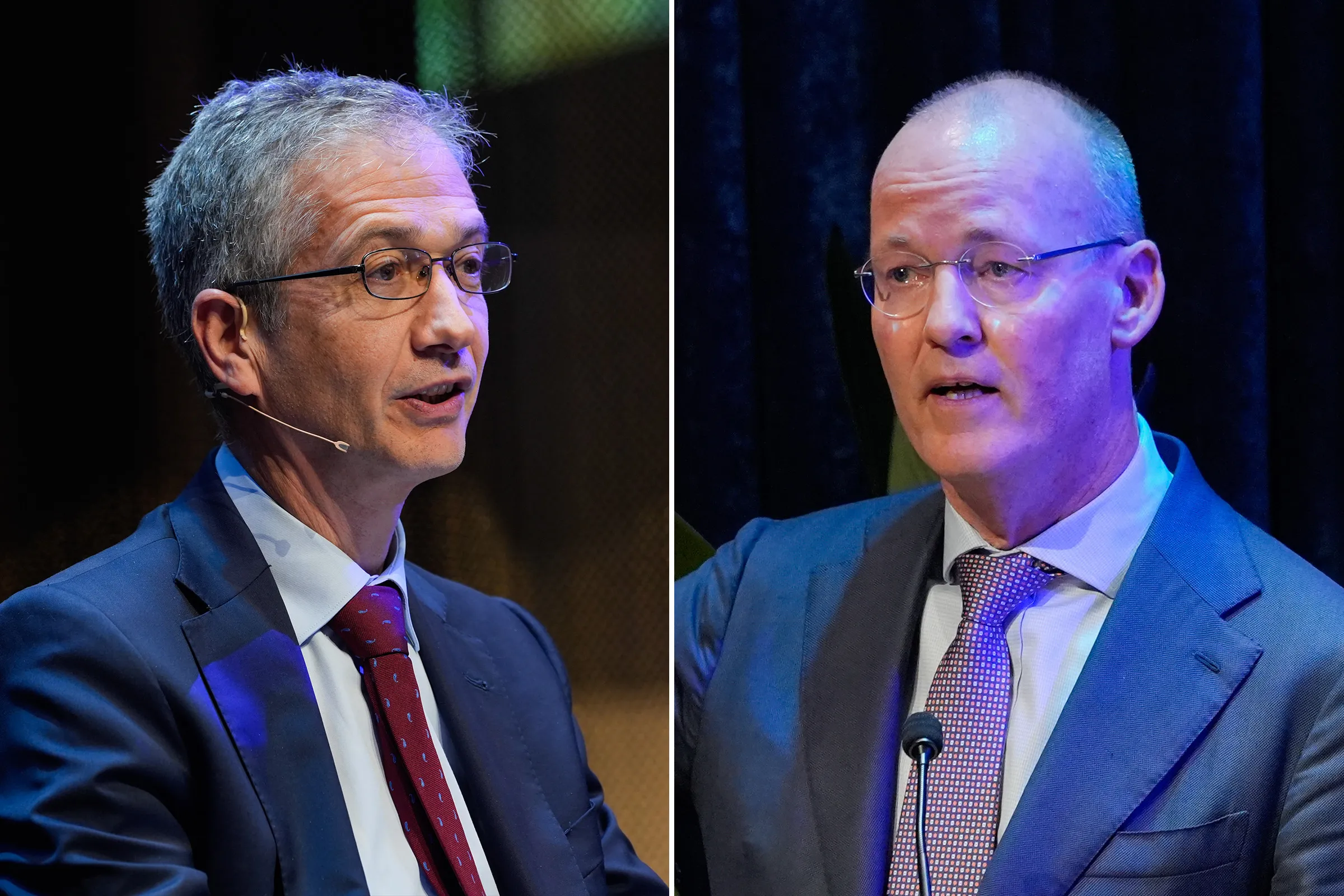
The possibility of another candidate emerging can’t be ruled out, not least given the three-dimensional chess that characterizes European Union decision-making.
Lagarde herself has yet to announce her own much-speculated early departure. But with the race already in full swing, even if the finishing line is hard to make out, here are four scenarios for what could unfold.
They plot out how Knot or de Cos could clinch the presidency, with alternatives in the event of a stalemate.
Whether one transpires or even if another result materializes, three principles stand out: France and Germany must agree, the region’s big countries all need a seat on the six-member board, and at least one of those should be a woman.
Knot, formerly chief of the Dutch central bank, would bring pedigree to the ECB as one of the longest-serving Governing Council members. As one-time chair of the Financial Stability Board, he is also a man with a nose for a crisis at a time when bond turmoil never seems far off.
His past hawkish tendencies may win points with Germany, whose Bundesbank has long burnished that stance. But to make it to the top, Knot would need not only backing from Chancellor Friedrich Merz, but also his help.
That’s because of the French aspect: President Emmanuel Macron is said to want one of his people to clinch Lane’s job, and has good female candidates including former OECD Chief Economist Laurence Boone and Bank of France Deputy Governor Agnes Benassy-Quere.
So Berlin would not only once again pass on the ECB presidency, but also on the chief economist position it covets. Germany might end up replacing Schnabel in the key markets portfolio, which could be pivotal in the event of a crisis, to pave the way for Knot.
Then there’s the Spanish angle. To avoid two Dutch Executive Board members, Frank Elderson would need to resign. That would cede his role, which includes vice chair of the ECB’s banking watchdog, to a candidate proposed by Madrid — potentially a woman.
Opponents to a Knot presidency might argue the Netherlands already had the job once when Wim Duisenberg took charge at the birth of the euro, so it’s someone else’s turn. Long memories of Knot’s tough stance during the Greek debt crisis and a hawkish reputation could hurt his chances too.
De Cos’s credentials are similarly impressive. The general manager of the Bank for International Settlements and a former governor of the Bank of Spain, he would also be the first ECB president to have served there at staff level.
No Spaniard has held the job before, which counts strongly in his favor. This outcome still allows either France or Germany to get the chief economist role too.
Berlin might have a better chance of winning here if countries object to a president and chief economist duo from two highly indebted countries, France and Spain, whose officials have previously had dovish tendencies.
Another bargaining chip for Berlin would be the prospect of Bundesbank chief Joachim Nagel, a former BIS official, succeeding de Cos at its helm.
Merz would need to actually want such an outcome, for instance to clinch a Bundesbank chief more closely aligned with his CDU party.
Knot himself could be a fit for the BIS. But for either him or Nagel to win the job, its governors from outside Europe would have to play ball, with the risk of the region losing the spot.
The prospect of France failing to get the chief economist could be enough on its own to scupper de Cos’s chances, and his prior image as a dove might draw opposition too. With EU governments tending toward the center or right of the spectrum, reluctance to help the socialist premier of Spain, Pedro Sanchez, might also emerge.
Lagarde’s nomination for the ECB by Macron in 2019 came almost out of nowhere during an impasse over several appointments. The same could happen again if a stalemate forces a compromise.
When quizzed, officials at euro-zone finance ministries speaking on condition of anonymity don’t have an easy list of candidates at hand.
One possible tie-breaker, if gender emerges as an issue, would be Sanchez proposing Nadia Calvino instead. The former Spanish finance minister currently leads the European Investment Bank.
David Marsh, chairman of Omfif, suggested this month that former Bank of France Governor Francois Villeroy de Galhau would make a good compromise candidate, though detractors might balk at the prospect of France getting a third ECB presidency when most countries have had none.
Finland’s Governor Olli Rehn, a former European Commissioner who previously tried both for the ECB presidency and its No. 2 spot, might be another option. However, that would force one of the bigger countries to give up their seat on the board.
While the EU mostly manages to cut deals within its membership, some matters such as budgets have previously been far harder to resolve.
If a stalemate persists long enough to last beyond the French presidential elections in April and May, and current front-runner Marine Le Pen then wins, the bloc might enter new territory.
She is EU-skeptic and her indebted country is in the sights of bond investors, so the ECB leadership could plausibly become a bargaining chip at a time of market sensitivity.
While this scenario does allow for a compromise to emerge similar to the above one, it also raises the prospect of a power vacuum at the central bank just when it might need strong leadership.
ECB Jobs Will Be Part of Grand Bargain, Greek Premier SaysLagarde Succession Race at ECB Is Heating Up as Schnabel ExitsKnot Would Be Perfect Fit at ECB for Many Nations, Dutch PM SaysSánchez Backs Spain’s Hernández de Cos to Be Next ECB President

 点赞
点赞 收藏
收藏 点踩
点踩 分享
分享