The AI Bubble Explained

Four huge misconceptions in the AI space, told not very briefly:
First misconception: AI is just doing math. There’s a quote making the rounds about how an algorithm can never gain consciousness because it’s just math describing a thing, and this would be like the formulas for gravity suddenly exerting force on mass. This is a bad take for a few reasons. To start with, we don’t know how consciousness works (or gravity for that matter), but we do know neurons work a lot like logic gates in CPUs. There are voltage differences, inputs and outputs, and emergent properties that are much more complex than its simple components. We know that increasing the number of neurons leads to vast differences in cognitive potential, and increasing the size of LLM training data did something similar. We’ve also gotten to the point where we are performing Turing tests dozens of times a day in our normal lives, asking of everything, “Is this AI?” Math has never made us ask, “is this human or synthetic?” before now. Something much deeper is happening, and dismissing it with quips might feel nice, but it doesn’t describe reality.
Another reason the “it’s just math” dismissal falls flat is that we used to pay humans to do math. These people were known as “computers.” And then we built artificial computers, which not only freed up human labor but empowered the rest of us who are bad at math to do more amazing things. Something similar happened with physical work and the combustion engine / electrification of everything. “It’s just math” doesn’t capture how useful this math is and how it’s transforming work, society, and culture. No one is arguing that we get rid of computers and hire people to do math again, the natural way, or destroy engines and rope people up to wooden wheels the natural way. At least, I hope not.
But the biggest gripe I have with this “it’s just math” meme is that yes, algorithms are math, and all of physics can be expressed in terms of math. Math describes the universe and everything in it. Calling something math isn’t the diss you think it is. Zebras are math. Love is math. Math only seems dry and cold when you don’t understand it. Same for physics and chemistry. These things are pretty much everything. I guess what I’m saying is: don’t build a mental model that requires you to hate everything. :)
Second misconception: AI is going to kill us in ten years. This is rubbish. It cropped up when a researcher who quit Anthropic said there’s a 10% chance AI kills us pretty soon. Look, we’ve been trying to kill ourselves for thousands of years. AI will one day help us get there, but it’s at least fifty years away, if not a hundred. And the way it’ll happen is a human doing more quickly what humans have been trying to do forever. We’re the problem, not AI (more on this later).
Gas was thrown on this fire recently by calls from the head of Anthropic to “slow down AI research.” Sam Altman and Elon Musk chimed in that they agreed. People are combining this with the Anthropic whistleblower and claiming that something bad is happening internally. What that bad thing is is economics. This is something very basic about AI development that everyone should try very hard to understand: The people building these admittedly very useful tools think that at some point the tool will get so useful that it will unleash infinite profits. Which justifies infinite spending.
Well, guess what? They were wrong, and they are all realizing it. The hilarious thing is that they are wrong in two ways that combine into a perfect storm for their bottom end. The first way they’re wrong is that the models aren’t scaling linearly, so they aren’t hitting AGI when they thought they might. Yes, they are making lots of money in revenue, but they are spending more than they’re making. Lots more. The ratio has gotten better for some of these companies, but the AMOUNT they are losing is unsustainable. You can’t burn tens of billions of dollars every year, thinking next year will be the year you make money, and then keep doing that while being wrong.
AI CEOs are suggesting they all take a break because nobody can keep this up, but their religious belief in the singularity makes them terrified that if any competitor keeps going, maybe THAT person will reach the holy grail they’re all after. They’re terrified of going broke but also terrified of not getting there first. They would love nothing more than to profit off inference and tokens for a few years and stop chasing AGI, which could cost a trillion bucks at this rate. But it’s the second thing which is killing them that they are all realizing: and the second thing is open weight models and local inference.
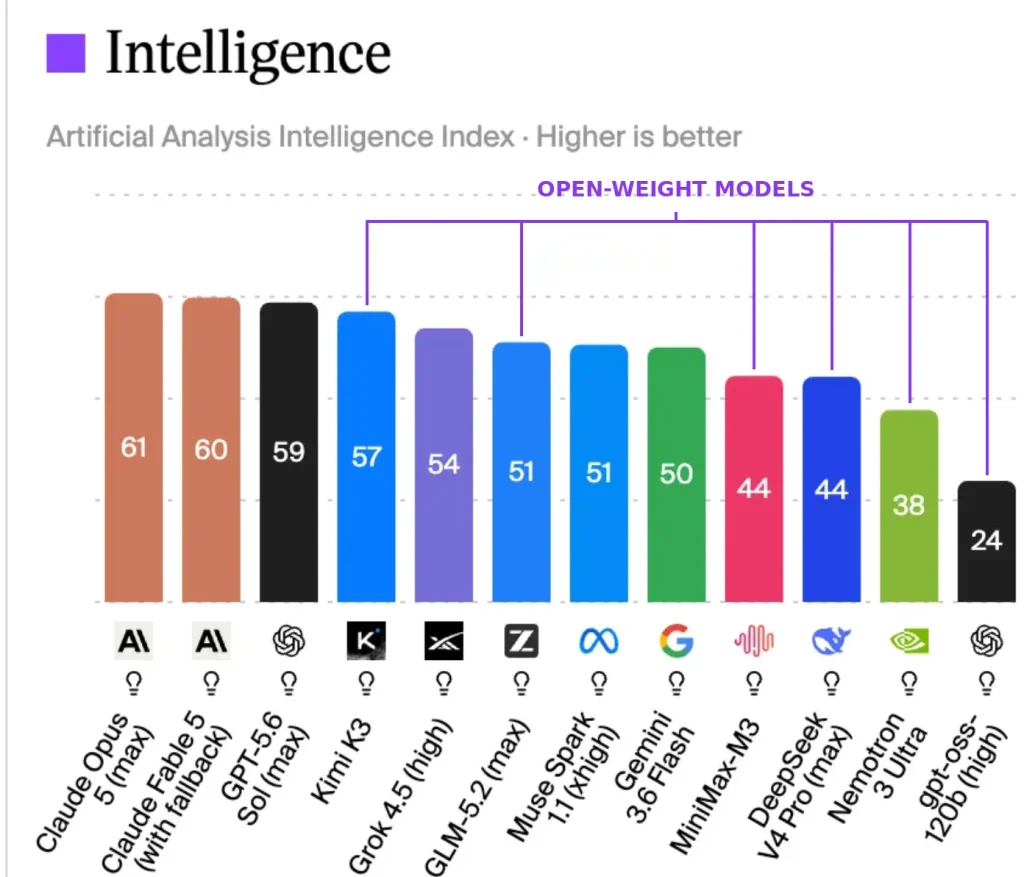
Open weight is the AI version of open source. LLMs use numerical parameters called “weights” and so open weight just means these parameters are published online for anyone to freely use. You can download the entire model, even tweak it to your liking. The big models from major players like ChatGPT, Anthropic, Google, and Meta are known as Frontier models. The problem for the frontier companies is that the open weight models are staying just a few steps behind. Today’s open weight models from Qwen and Deepseek are stronger than the frontier models were a year ago. In fact, open weight models are now lagging frontier models by roughly 4 months, and they cost one fifth as much to run! This graph is a couple of months old, but it gives you an idea of what’s happening:
The poetry in this is that the companies who built their empires on stealing data are going to go broke because someone copies their research. (Since writing my first draft of this blog post weeks ago, a new open weight model called Pixel Canary just came out that is on par with the best frontier models. How long before an open weight model makes a breakthrough that leapfrogs it AHEAD of the big frontier companies? Also since writing the first version of this blog post, THREE leading AI companies have released newer, more powerful frontier models after calling for a pause, so that call for a pause was precisely the nonsense we all thought it was).
The other threat scaring big tech is local inference. There are two main uses for AI data centers. One use is to train the next frontier model. The other use is to deliver responses to customers who are asking the AI a question or to perform a task. This latter use is called inference. And in the last few years, performing inference at home on your own hardware has become more and more viable. To the point that today, a user with a $5,000 to $10,000 home computer, can do almost unlimited AI work with a free open weight model and not send another dime to a frontier AI company. That might sound like a lot of money for hardware, but the token cost for what a home machine can do can run into the hundreds of thousands. You can now do decent inference on a laptop or smartphone for basic tasks. AI companies know this and they are terrified of it. They thought they were building moats with their training data, but they are just greasing the skids for everyone else.
A call to regulate this industry is a call to freeze development because of both of these fears: the fear that a competitor will race ahead and get to AGI first, and a fear that a Chinese open weight model will gobble them up from behind. There’s no clear path to profitability for these companies right now. They’ve known this for at least a year, probably two. They are freaking the fuck out.
Third misconception: AI is a bubble that’s about to pop. No, but close. AI is a financial bubble that’s about to pop (and crater the world economy in the process), but as a technology, AI is here to stay. The financial bubble is actually quite scary. Most AI earnings right now are a circle jerk of passing money from one player to the other until it gets back to where it started. It’s all legit; nothing illegal. But it’s all nonsense, nothing profitable. Nvidia is literally paying for datacenter construction, which means paying other companies to buy their chips. A great website to bookmark and keep an eye on is: isaiprofitable. At the bottom, you’ll see that Nvidia (selling pans, shovels, and blue jeans) is the only company making money. They are using a lot of that money to PAY companies to keep building datacenters. It’s a shell game, and it can’t go on much longer. Investors don’t have the cash, and these companies don’t have the runway. And as stated above, free at-home AI will eat away at their profit margins.
So yes to the financial bubble, and it’s going to lead to a recession (tariffs, trade wars, physical wars, fed manipulation, and general incompetence are exacerbating this). But the AI these companies created is here to stay and it will change your life in ways you can’t even imagine. Avoiding this would be like avoiding computers or smart phones in previous generations, where the new was off-putting and heads were shoved into holes in the ground hoping it would all go away. That would be a choice. But as the technology gets easier to use and the outputs become undeniably better, you will shift how you work. It’s already possible to build a home system that frees you from ever looking in your email inbox ever again. The agent sees the important things and ignores the rest and you never have to think about it. More time reading a book instead of spam. In a year or two, this will be even easier to set up. Eventually, it’ll be the default. No more email management. Unless you want to, of course. Why anyone would is a mystery.
The other side to this is that AI does not need to take over our lives; we don’t need it everywhere; people are already sick of it. If anyone launched a social media platform right now where AI was somehow not allowed (technically this is harder than you might imagine), everyone would flock to it. I don’t want to see a cute cat video and not know if it’s real. I’m sick of getting into the second part of a thread post and realizing it’s all AI-written slop. AI is useful when you need to use it, but it’s not what I’m scrolling to see. We need more of the Amish in our relationship with technology: just because something is possible doesn’t mean we should, and just because something is available doesn’t mean we ought. 90% of what AI is being used for right now could go away, and we’d all be better for it. Figuring out how to filter that in our own lives will be a very difficult challenge to solve, but it needs to happen.
The fourth misconception is that using AI is a betrayal to our human souls. I think both sides of the AI debate get this one wrong. Recently, people burned Stephen King in effigy because he shared an AI generated image. Hank Green was torn to shreds because he was using AI in his research. The idea that creators aren’t allowed to touch anything AI is wild to me. Google search uses AI. Creatives aren’t allowed to Google? They can’t use AI to navigate a foreign city? Or let a car drive for them? Can they use grammar check and spell check? The AI police aren’t doing anyone any favors. We all need to learn some nuance and use these bio-brain of ours. When I see the knee-jerk reaction from anti-AI purists, all I see is an algorithm optimized for anger.
On the other side of this crazy debate are people who think we should give up our souls to AI. Let it do everything! It’ll make all the art and we’ll just consume, consume, consume. Those folks would love to live in the world of WALL-E. Just put them in a wheelchair and shove a slurpee tube in their gullets. AI is useful in the way our phones and laptops are useful. We should only spend a little time with them to be productive in a way that gives us joy or allows us to be creative. The problem with this stance is that it allows gray areas into a debate built on cold reflex. Folks have picked a side (pro or anti AI) and are trying to toe a line that shouldn’t (and probably doesn’t) exist.
We can’t even agree on what “art” is. So it’s no wonder we can’t agree on AI’s relationship with art. But we should at least try. Is fan fiction art? I’ve always argued that it is. It requires creativity, just not as much as someone who does all the things fan fiction does PLUS also creating the underlying world, rules, and major characters. Writing the original usually requires more creativity, but that doesn’t mean fan fiction requires none. And yet it’s been dismissed as “not real writing” in some circles. It’s not that simple. Some fan fiction has more creativity than another person’s original world might. There are levels to everything, and they overlap and get messy.
Another example: An author writes a book from scratch, uses Word’s built-in grammar and spelling checker to clean up mistakes, and then they open up Photoshop to create the cover art. An hour in Photoshop playing with prompts and tweaking outputs, and they get the base image for their cover. They tweak this further and add some text layers, employing a font that someone else created, and is now a free version of a paid font that was famously stolen from another creator (see Arial and Helvetica). The end result is a book they created by themselves just how they envisioned it, but yeah they used Arial, so they supported art theft along the way. Somehow, this is seen as less creative than someone who writes a rough draft and then pays others to do the rest of the work (editing, formatting, cover art). Which hints to me that…
It’s not the creativity that people are angry about, despite the rhetoric. It’s the idea that other trades in the pipeline (cover artists, editors, formatters) aren’t getting paid. It’s a capitalist argument, not a creative argument. Or the anti-AI crowd will claim that these programs stole someone’s art for their training data. But Adobe Firefly, used in the Photoshop example above, was trained on licensed content and open copyright material alone, where stock contributors are compensated and IP is labeled appropriately. You could train a writing LLM just on books in the public domain, and people would still be reflexively angry at the mere existence of AI. It’s an emotional stance rather than a logical one. Again, it’s a capitalist argument, not a creative one.
Say I create a gen-AI cover for my novel using Adobe Firefly. We know for a fact that no artist was stolen from in the creation of this training set. But I’d be willing to wager a lot of money that almost no one in the anti-AI crowd would moderate their reflexive anger at what just happened. They are angry at something, they just don’t know what. They are angry perhaps in the way we deride paint-by-number but celebrate an original oil painting. Or the way we celebrate landscape art but look down on another painting of another bowl of fruit. Or the way we celebrate sculpture but deride someone for their avant garde “found art.” Everyone seems to have their point that art begins to make them angry. It used to be all of impressionism. It used to be anything not religious in subject matter. It used to be abstract art. It used to be a banana peel nailed to a wall. Now it’s AI.
My next project will be graced with a human-created cover from Jason Gurley (check out his work here) Jason did some of the WOOL special editions a while back, and a few other covers for me. The book will also be edited by David Gatewood, who I’ve worked with for years and can be hired here. I work with humans when I can because I enjoy it, not because it’s the only way. When I first started writing, I couldn’t afford to publish any way other than by doing everything myself. Digital photography and Photoshop for covers. My own layouts. Editing done by family and friends. No AI was used, but no one was paid, and let me tell you that it made people very, very angry. If I didn’t hire a professional editor, I was doing it wrong. My covers were crap (they were), and somehow that made my book not worth reading. It was weird. It was illogical. Lots of mean, angry folks. A lot of the same folks I see freaking out today.
Those are the four misconceptions, but I want to add something that’s related to all four, and that’s the ways creativity are going to change despite all the lack of nuance, anger, financial bubbles, false hype, etc. Real things are happening while others are either waiting on a singularity that will never come or burying their heads in the sand:
Ben Affleck has created an AI company for film studios that’s trained on the footage shot on each particular film, using no data from any other film (later sold to Netflix). That training set can then be used to get takes that were missed in the original shoot, obviating the need to reshoot scenes (which sometimes involves rebuilding sets and getting actors off other projects). Reshoots are so difficult and expensive that they are usually not done. And the final product suffers. This is a use case of AI that will become very common, and it doesn’t rely on “stealing” data from anyone. The cast and crew will usually know up-front about this technology and sign off on their likenesses to allow it to be used.
James Cameron has come out and said that AI will cut CGI costs by 50%. His goal, he says, is not about laying people off but accelerating their work so production moves more quickly. Hollywood is slowly changing course on their attitudes toward AI. It won’t be long before most projects use AI in some way (if you include Google searches and lots of AI productivity tools, this is already true). Only going to non-AI films will eventually be a kind of Renaissance LARPing act. Forgoing deodorant and walking around with a turkey leg.
But here’s the thing: I’m all for the hipsters who embrace the analog. Write in long-form! Go back to the oral tradition! See everything you can on Broadway! I support this and do some of it myself. I’m all for the anti-AI crowd doing their thing and will cheer them along. One of my favorite creators right now is a woman who tears the covers off books and replaces them with hand-glued and decorated leather covers. We need this in the world. It will coexist with AI art. All of it will make a big hodgepodge of human endeavor and creativity.
Which leads me to my final and most important thought: The true test in a world changed by AI will be our kindness, not our creativity. I delete posts and replies all the time when they are rude. It’s like picking up a piece of rubbish and putting it in the bin where it belongs. I don’t do this based on viewpoint, but rather intention. Meanness is tossed away. That’s the real human slop. Angry people are going to be angry without really knowing why, and they are going to lash out at others, and it’s a human trait that luckily our AI overlords seem to resist better than we do. Which might lead to this weird dystopian/utopian future, where we have all the true creativity but AI has all the kindness.
The post appeared first on Hugh Howey.

 点赞
点赞 收藏
收藏 点踩
点踩 分享
分享