Textbooks that run
This is a written version of my talk at IndiaFOSS 6.0 in Bengaluru on 26 September 2026. The slides are available as a PDF and a Keynote file.
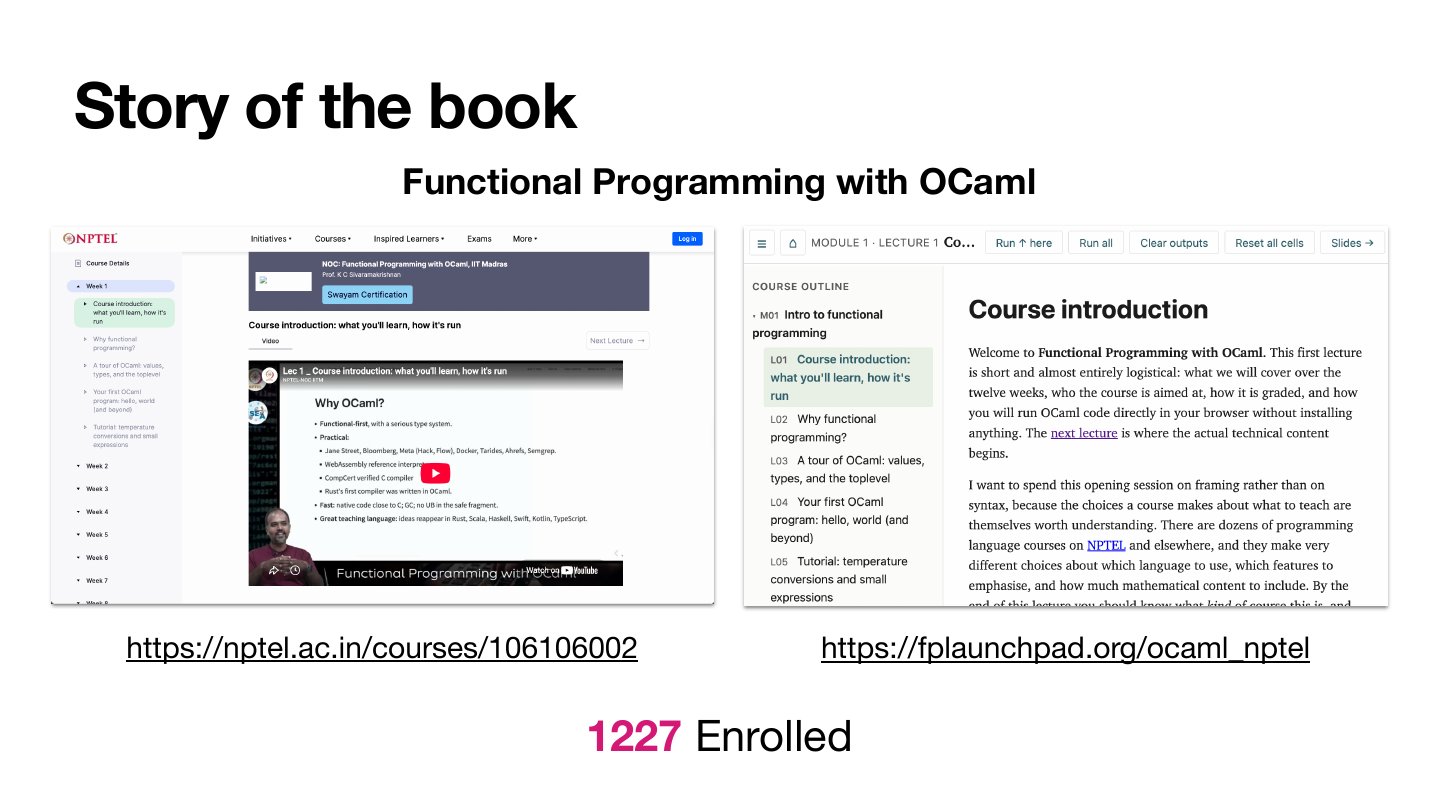
I want to tell you the story of the book I wrote for my NPTEL course, Functional Programming with OCaml. The first run is underway, with 1,227 students enrolled. The book runs in the browser: students can change the examples and execute them right in the page, with nothing to install.
Building it also taught me something about working with coding agents. The agent did well at building the platform. Writing material that a student could learn from took much more work.
A course for learners I will never meet
For those unfamiliar with NPTEL, it is a platform for online courses, primarily from the IITs and IISc. The lecture videos are freely available, including on YouTube. Students can also take a proctored examination for certification, and many colleges and universities recognise NPTEL course credits.
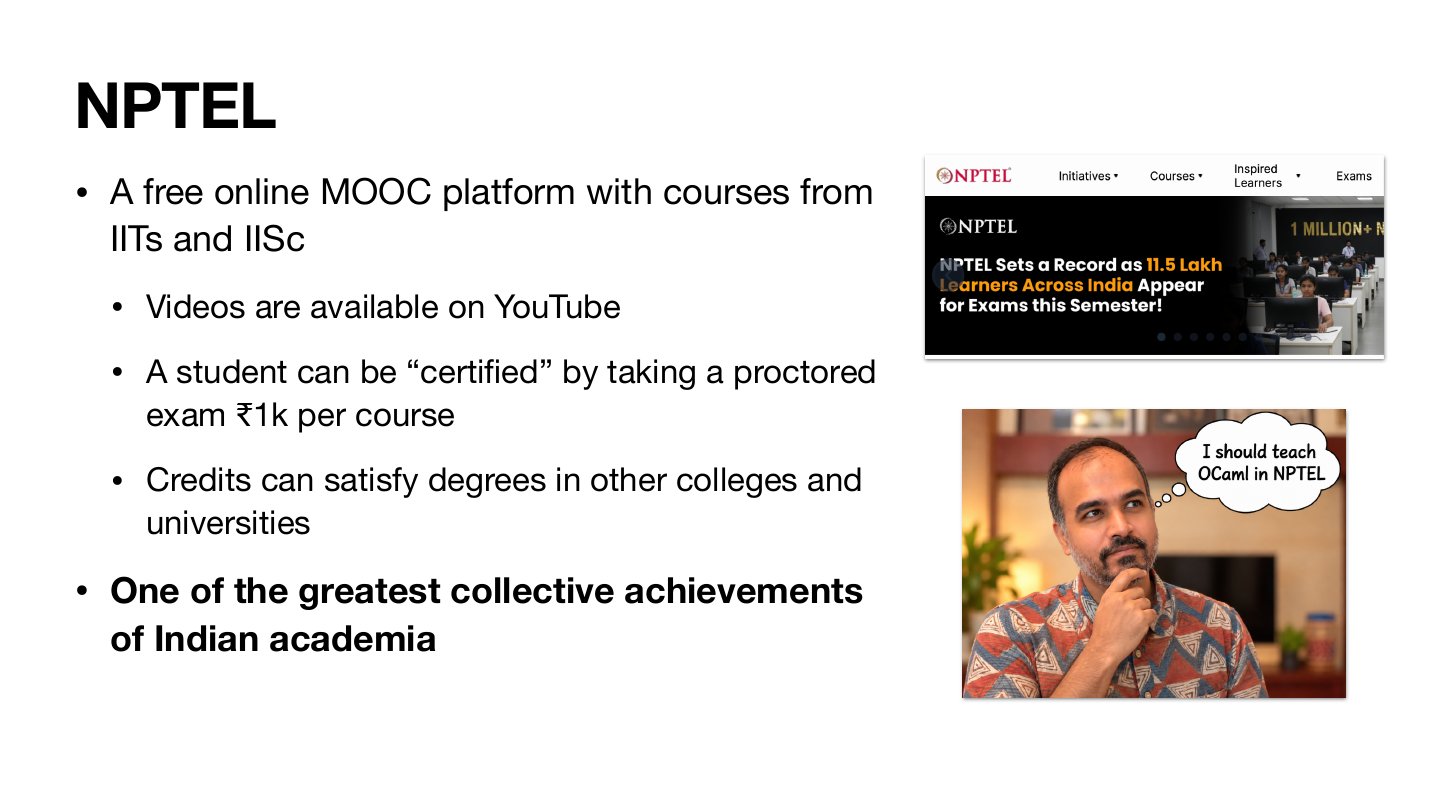
I think NPTEL is one of the greatest collective achievements of Indian academia. There are courses by excellent teachers on foundational subjects. Earlier this year, I noticed that it did not have an OCaml course and decided to teach one.
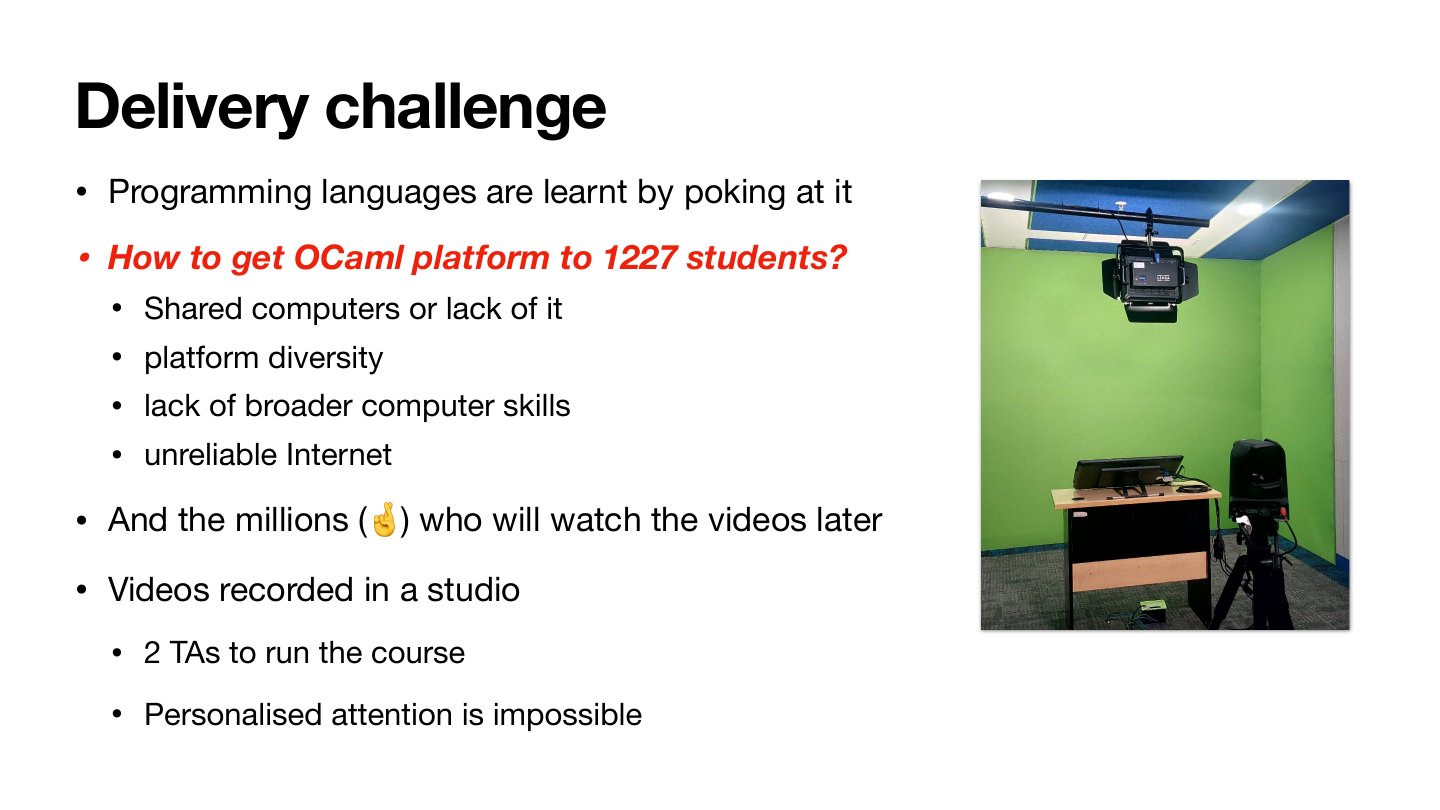
Programming languages are learnt by poking at them. You change a program, run it, and see what happens. How was I going to give 1,227 students a working OCaml environment?
These students are spread across India. Some may share a computer; some may not have one of their own. They use different operating systems, have different levels of familiarity with their machines, and may have unreliable internet. There are also the learners who will watch the videos long after this run of the course has ended.
Recording an NPTEL lecture means sitting in a small studio, speaking into a camera. I have two very good teaching assistants, but I do not get to interact with students as I would in a classroom. We cannot provide individual setup help to everyone.
Who do we not hear from?
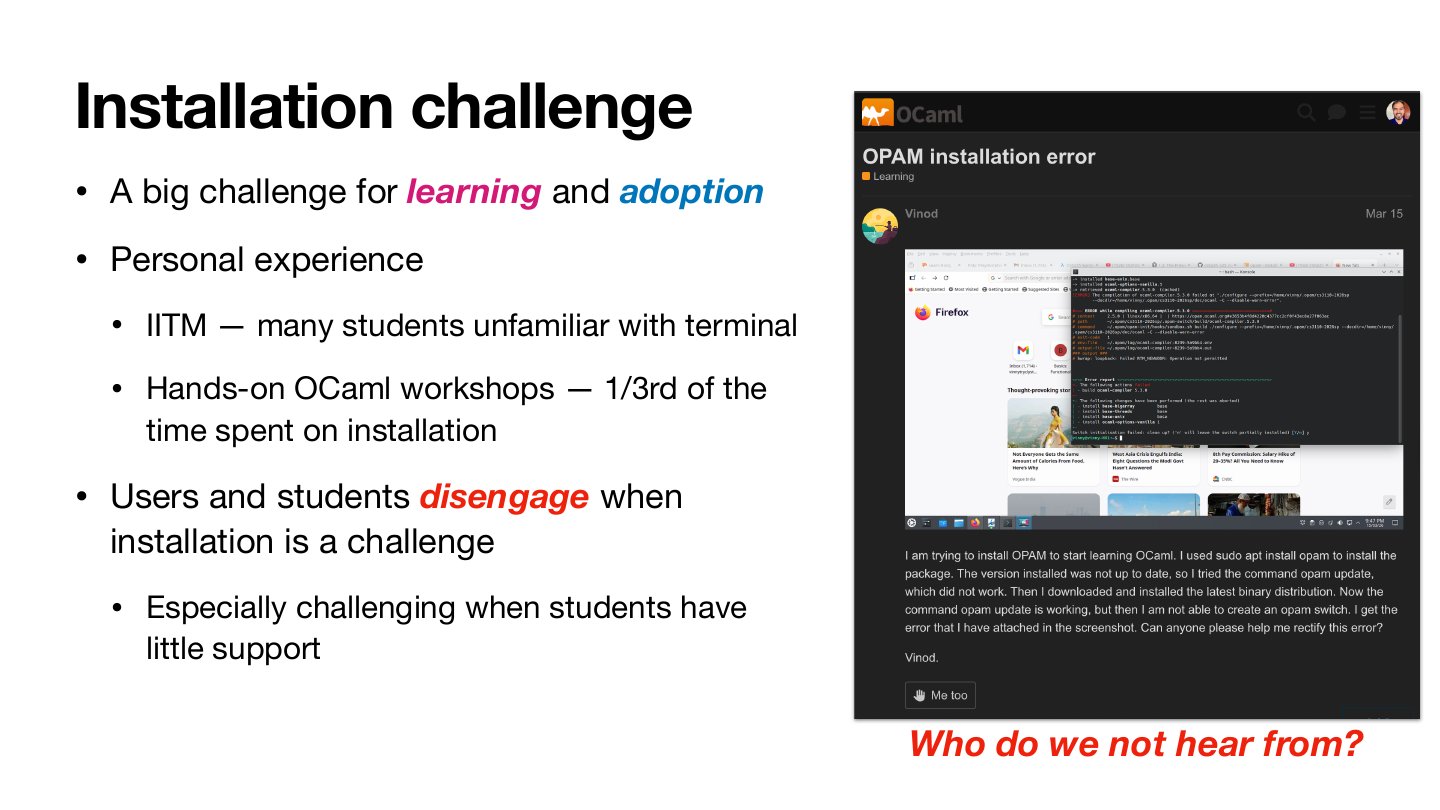
Even at IIT Madras, students arrive in my third-year course without much experience using a terminal. Installing OCaml asks them to use tools they are still learning how to operate. The OCaml Platform has made progress on installation, but there are still gaps.
In the hands-on OCaml workshops I have helped run, we have often spent about a third of the session getting the environment working on people’s machines. In a room, I can walk over and help. A remote learner who gets stuck at the first step may leave. I may never hear from them.
I had tried to address this in earlier courses.
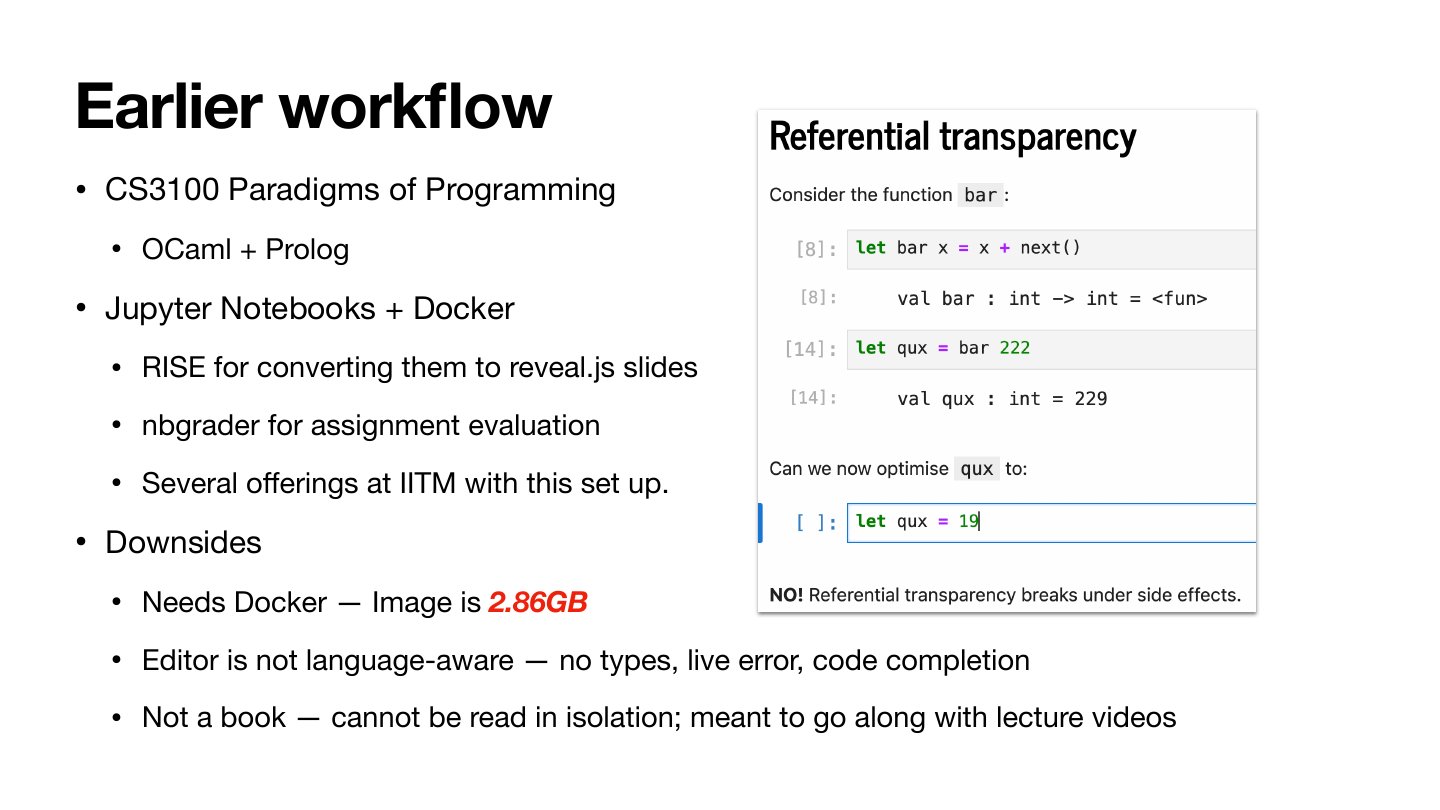
For CS3100, Paradigms of Programming, I taught OCaml and Prolog using Jupyter notebooks in a Docker container. RISE turned the notebooks into reveal.js slides, and nbgrader helped with assignment evaluation. We used this setup for several course offerings, and my colleague continues to use it.
But the student still needed Docker, and the image was about 3 GB. The notebook editor did not have the language support we had come to expect from OCaml editors: types on hover, live errors, and code completion. The notebooks were also lecture material. They did not read as a standalone book.
Zero to OCaml in zero steps
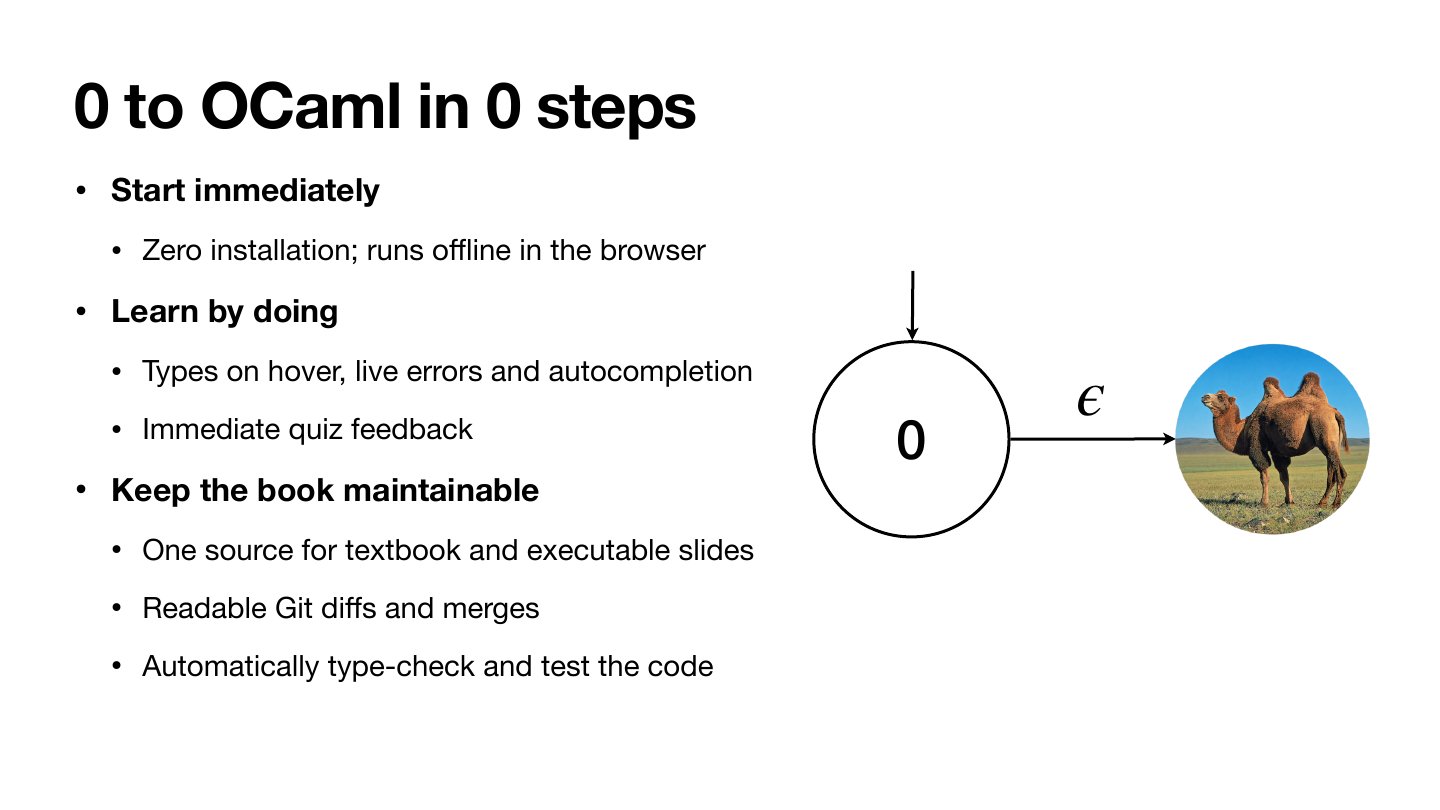
For NPTEL, I wanted students to start immediately. Open a page and run some OCaml. I also wanted a way to use the material offline, so that a learning session would not depend on a reliable connection.
The offline build script packages the book and its runtimes into an archive. Extract it and open index.html in a browser: the chapters, runnable cells, quizzes, and Linux terminal work without a server or internet connection. Online videos and the analytics dashboard still need internet.
The editor should help them as they work: show types, report errors, and offer completions. Quizzes should give immediate feedback, in the same page as the explanation.
On the authoring side, I wanted one source for the textbook and the executable lecture slides. It should produce readable Git diffs, and the build should type-check and test the code examples.
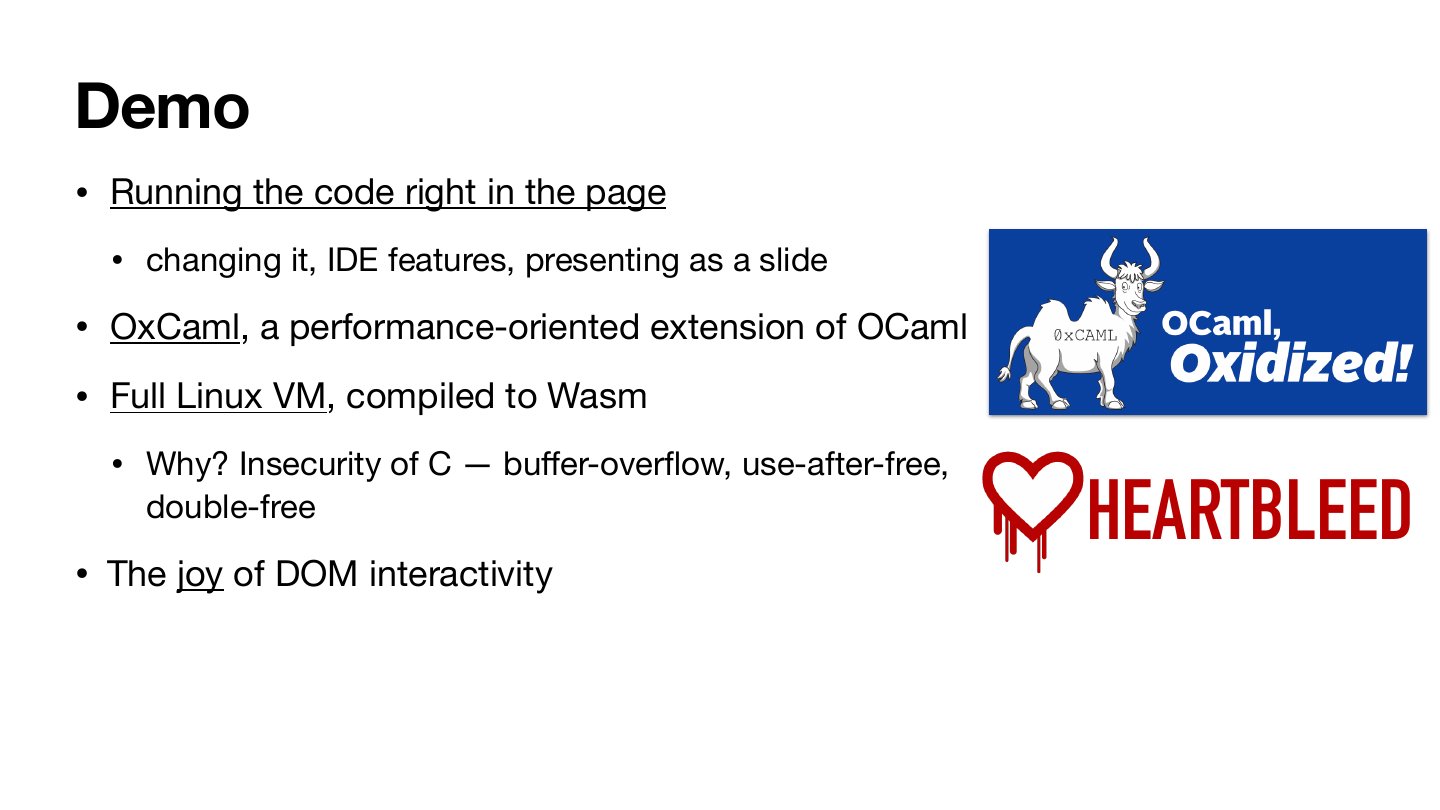
The easiest way to see what this means is to open the course introduction and run an example. Change it and run it again. Hover over an expression to see its type. The lecture can also be presented as slides, with the code still runnable.
The same approach extends to OxCaml, a performance-oriented extension of OCaml. For the systems material, there is a Linux VM in the page. Students can compile C programs and explore buffer overflows, use-after-free, and double-free errors in that environment.
And programs can interact with the page itself. In the OCaml workshop we ran at IndiaFOSS, examples using the Joy graphics library let you change a program and see its effect on a picture.
The tools that make it possible
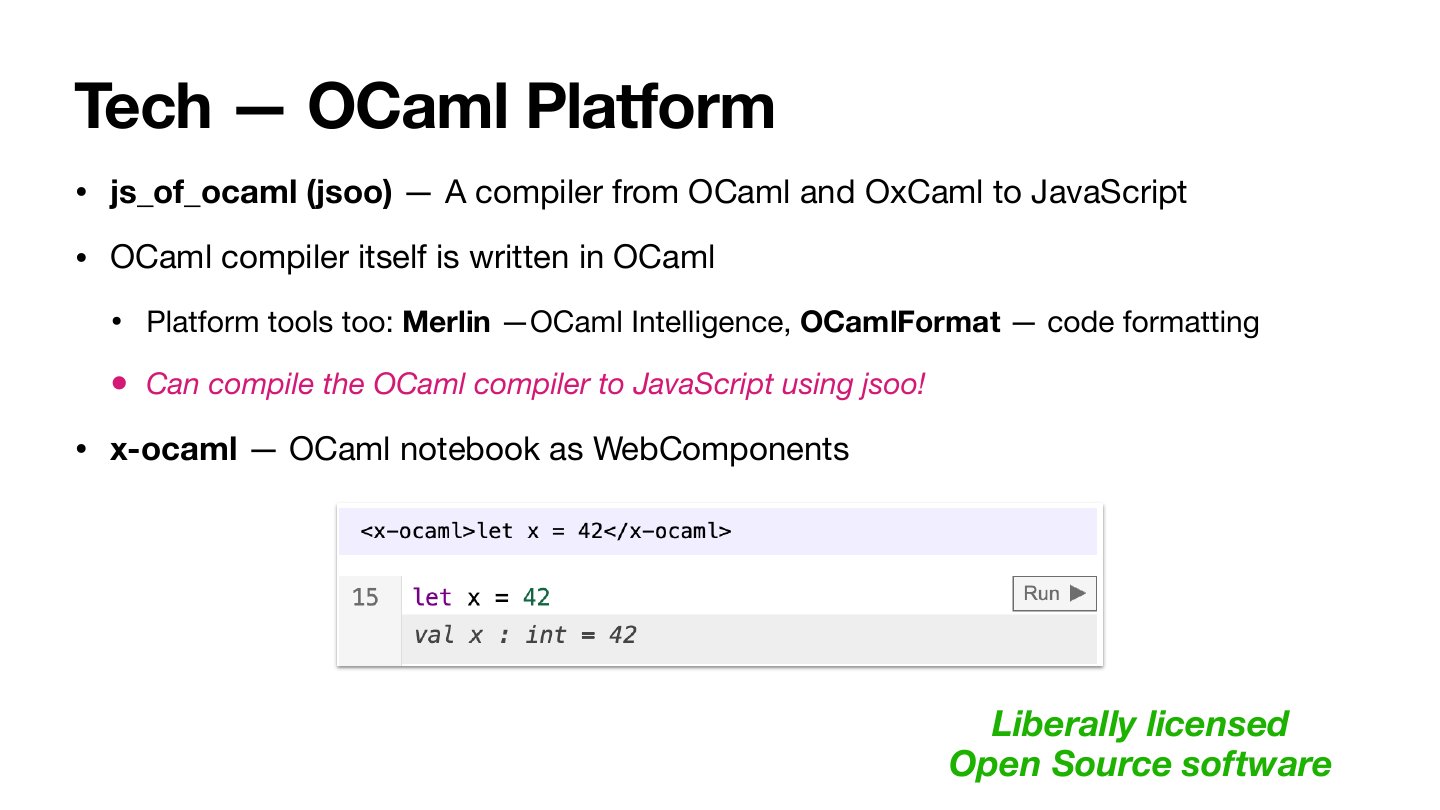
Much of this rests on js_of_ocaml, a compiler from OCaml bytecode to JavaScript. The OCaml compiler is itself written in OCaml. So are Merlin, which provides editor intelligence, and ocamlformat. We can compile those tools to JavaScript too.
Arthur Wendling’s x-ocaml brings these pieces together as a Web Component. Adding an HTML tag gives a page an executable OCaml cell with editor support. The compiler and tools run in the student’s browser.
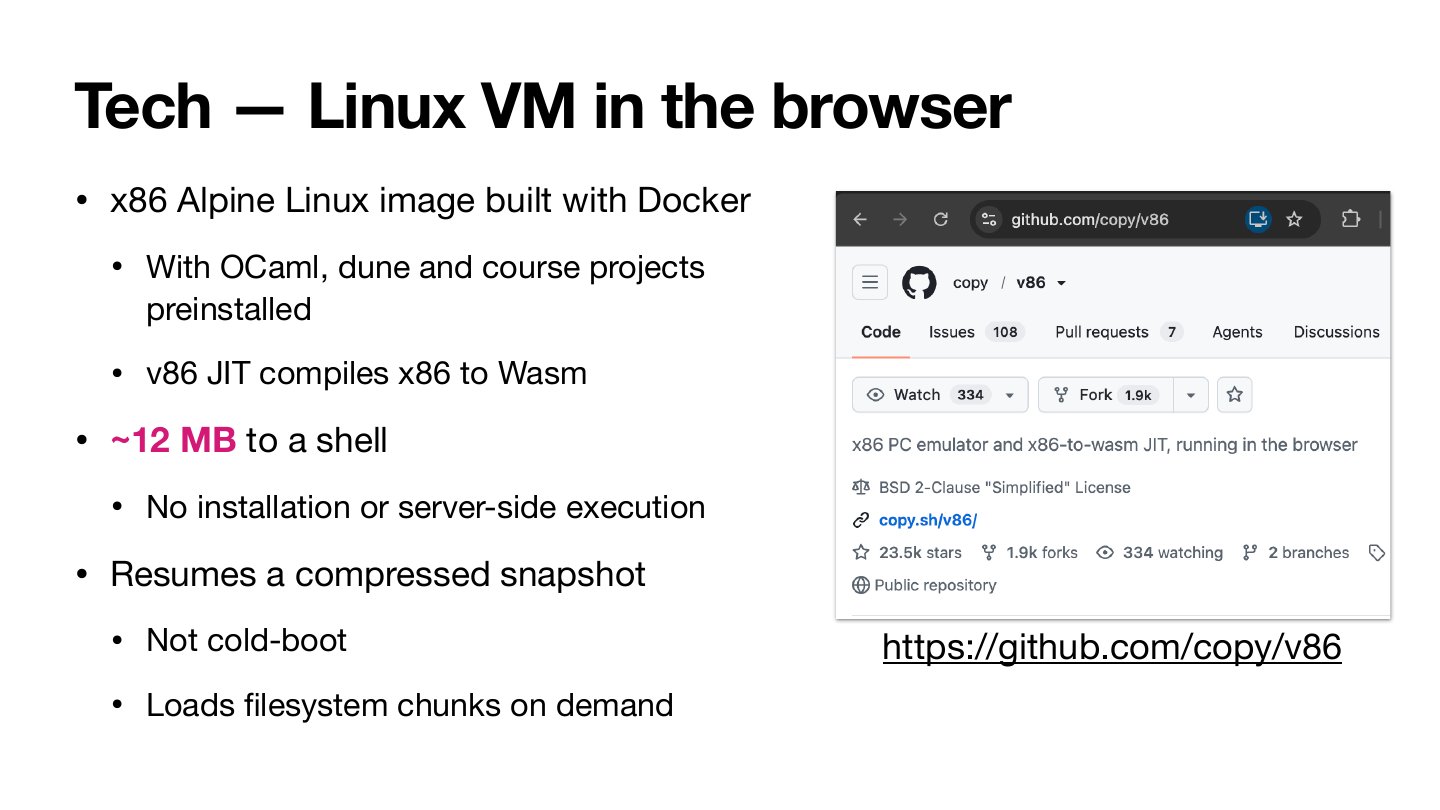
The Linux environment uses v86, which compiles x86 instructions to WebAssembly as it runs. I build an Alpine Linux image with OCaml, dune, and the course projects preinstalled. The student does not need Docker; it is part of how I prepare the image.
Getting to a shell takes about 12 MB of downloads. This is possible because the VM resumes a compressed snapshot instead of performing a cold boot, and fetches filesystem chunks as they are needed. That 12 MB is the initial shell, not the entire course environment. The VM executes locally, with no server running the student’s programs.
Feedback in both directions
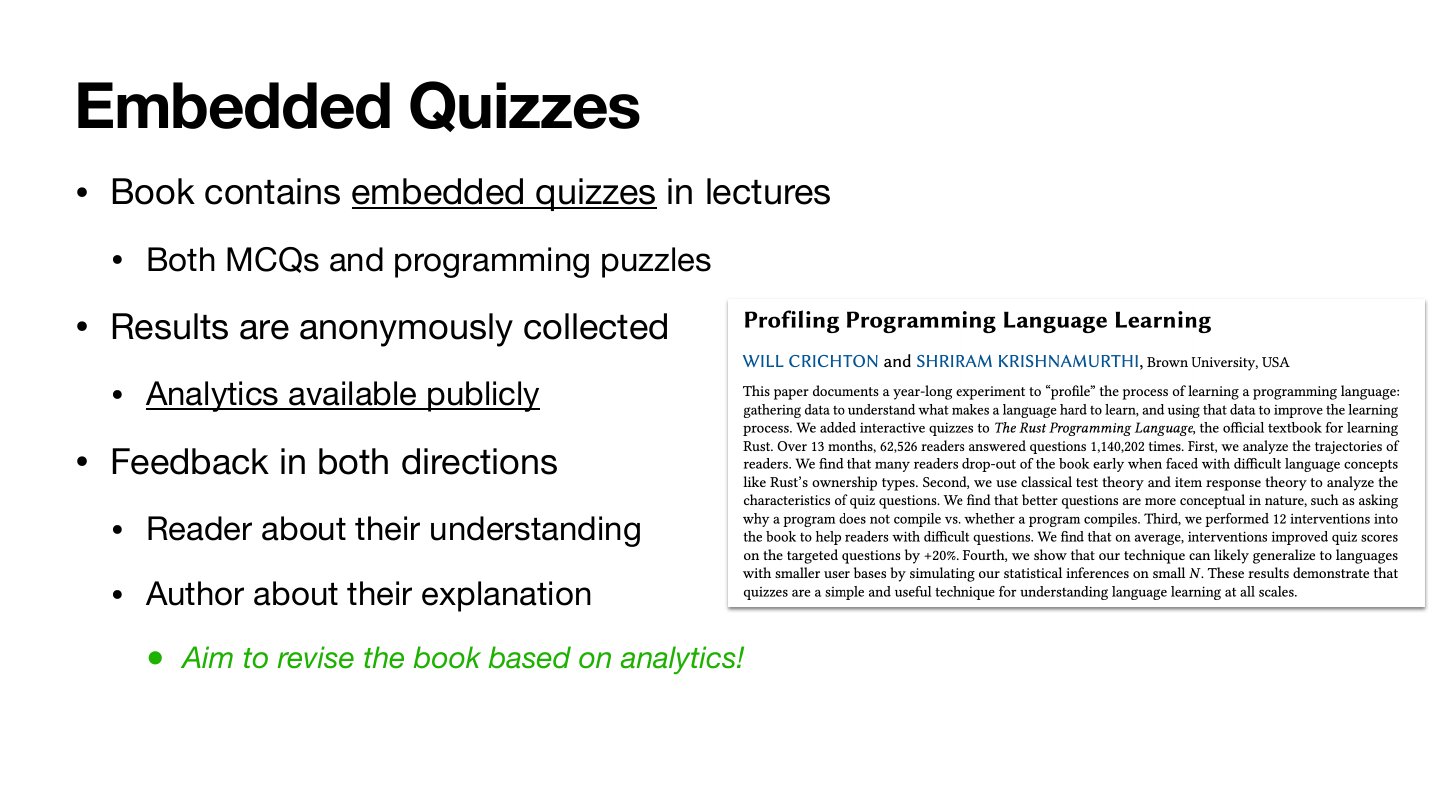
The book has both multiple-choice questions and programming puzzles. A student can test their understanding while reading, and get feedback immediately. For example, the tail-recursion lecture includes a small code challenge with tests.
Anonymous quiz results also feed a public dashboard. The reader gets feedback about their understanding; I get evidence about where my explanations may need work. I plan to use those results to revise the book.
This follows Will Crichton and Shriram Krishnamurthi’s work on the Rust book, described in Profiling Programming Language Learning (OOPSLA 2024). Embedded quizzes helped identify misconceptions and guide changes to the material. Their study was at a much larger scale. My course is still in its first run.
Writing the book and the slides together
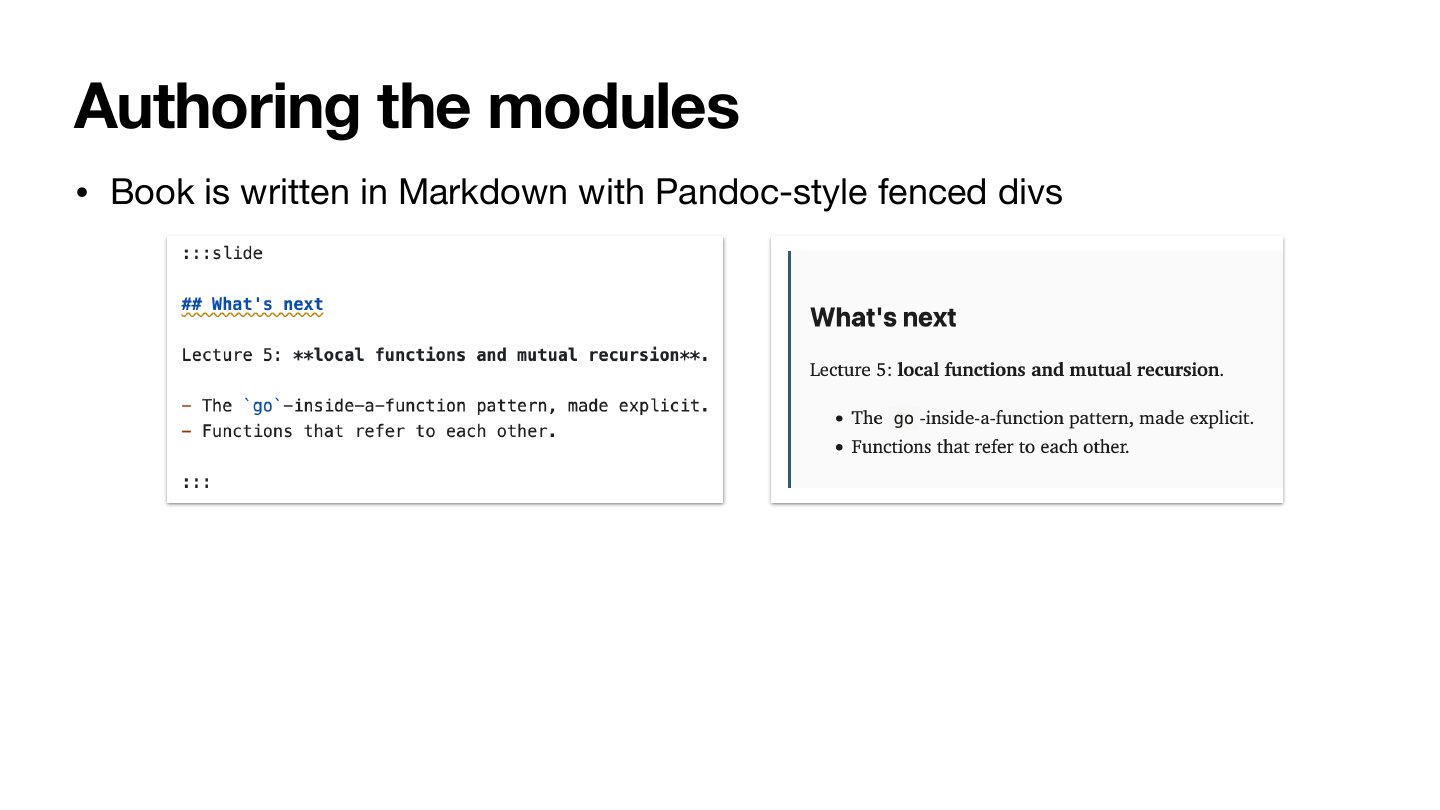
Each lecture is a Markdown file, with Pandoc-style fenced divs to mark slides and other elements. The same file contains the fuller textbook explanation and the material that appears on screen during a lecture.
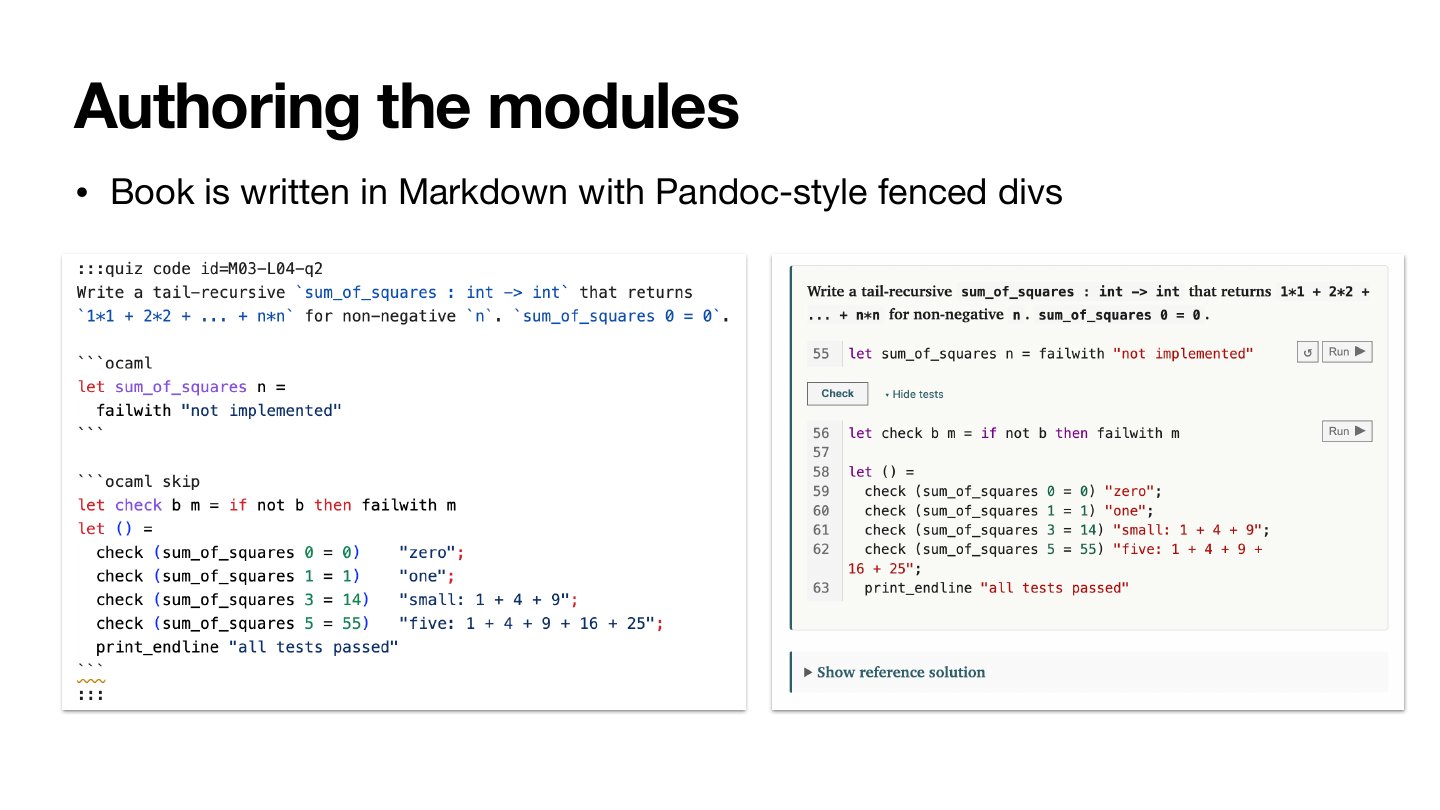
Quizzes are written alongside the prose, with their code, tests, and solutions. The test suite checks them too. It is a relief to be able to change a chapter and have the build check its executable content.
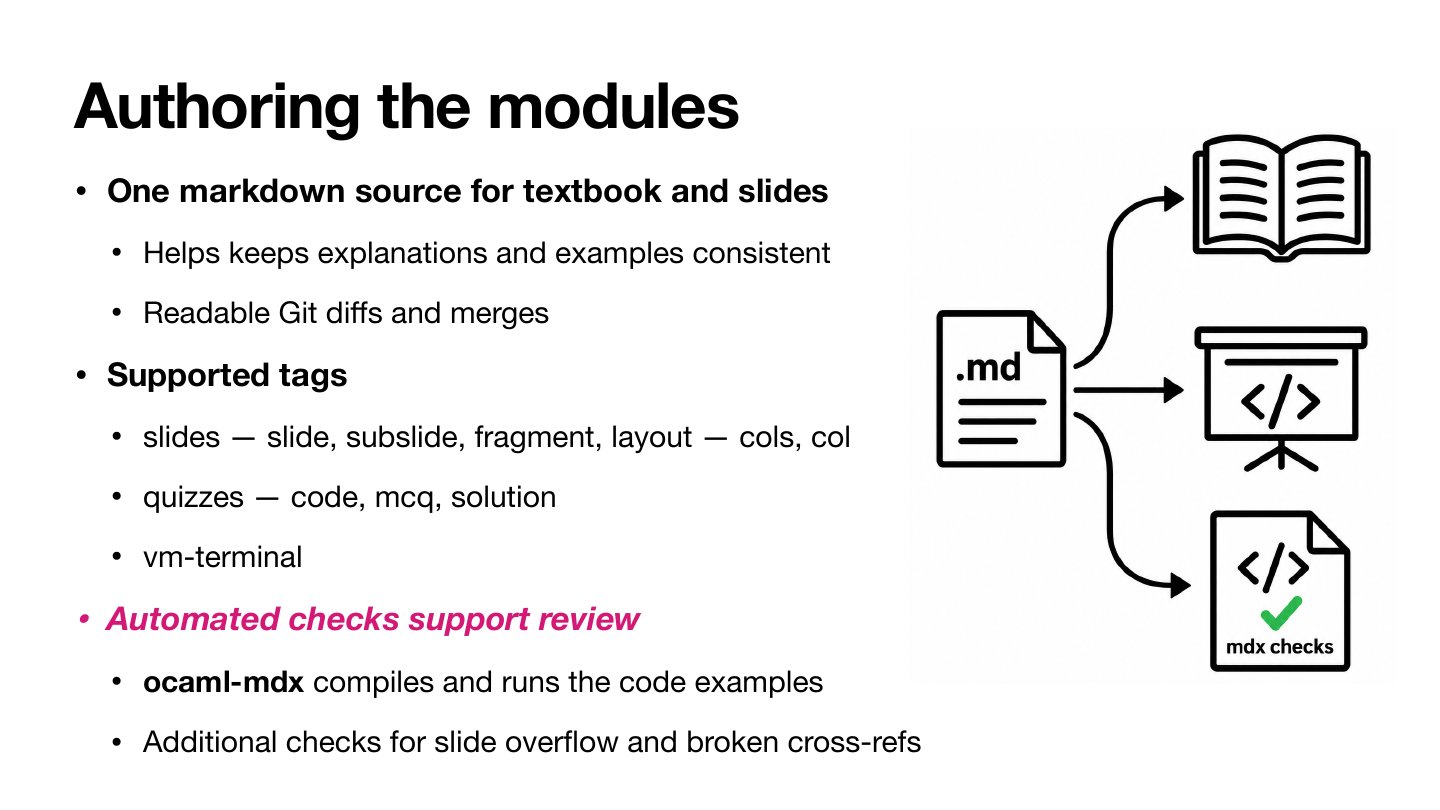
ocaml-mdx compiles and runs the code examples. Other checks catch overflowing slides and broken cross-references. The source stays readable in Git, which helps when reviewing changes across lectures.
Those checks are useful, but they leave another kind of review to do: does the explanation make sense to someone who is learning this for the first time?
Teaching the agent what I had taught
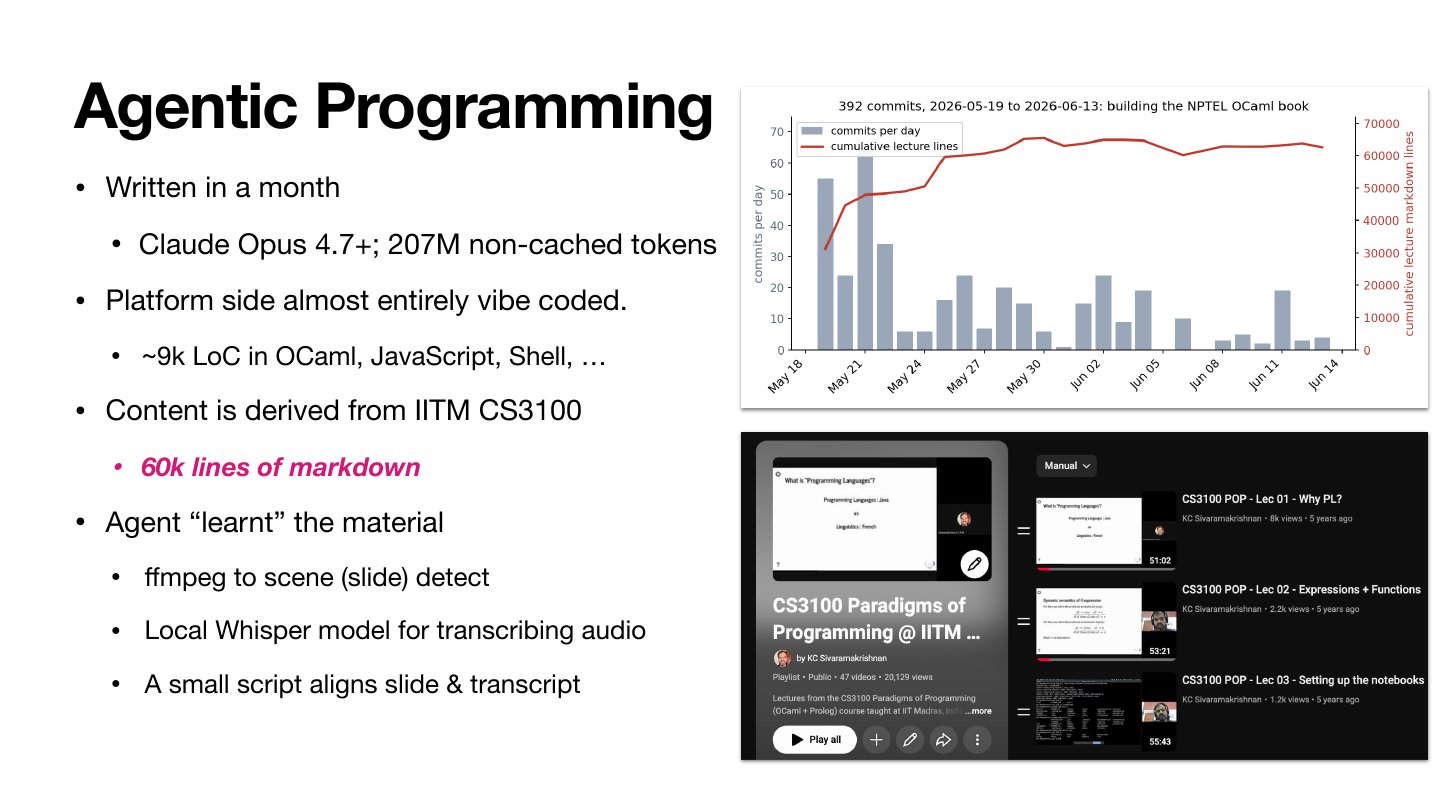
I started writing the book one day before the first recording session. I already had recordings of my CS3100 lectures from teaching during Covid, which gave me material to work from.
I used ffmpeg to detect scene changes and identify slides in those recordings. A local Whisper model transcribed the audio, and a small script aligned each slide with what I had said about it. The agent could then see both the slide and its explanation. That became the basis for the book.
The first draft grew quickly: around 30,000 lines of Markdown on the first day. The book reached roughly 60,000 lines over a month. I primarily used Claude Opus 4.7 during that initial period. The platform was almost entirely built through agentic programming: roughly 9,000 lines of OCaml, JavaScript, shell, and other code.
I have written more about the development and token usage in An O(x)Caml book that runs. Here I want to focus on how differently the platform work and the teaching material went.
A great oracle, a bad teacher
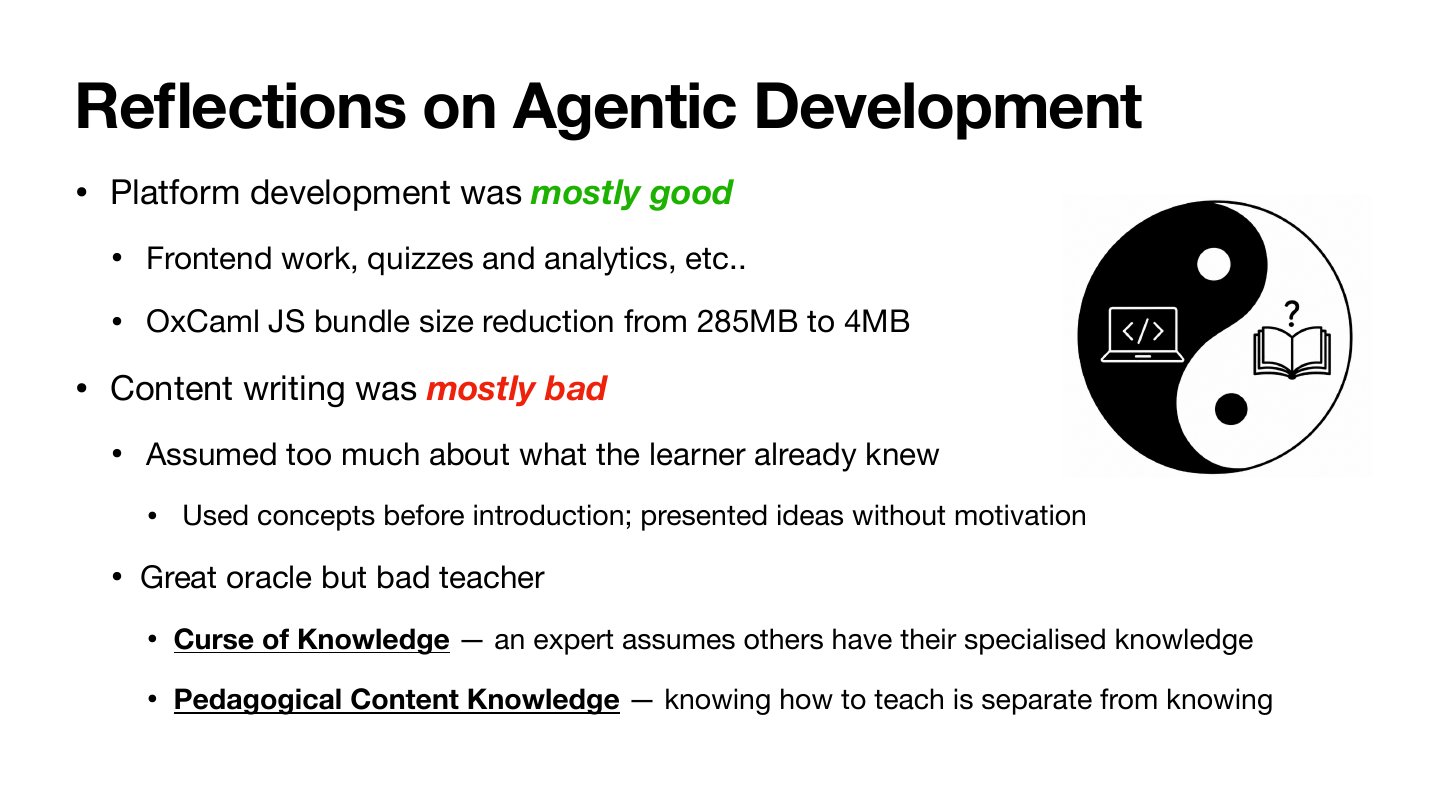
The platform work went mostly well. I had little experience with frontend development or building dashboards, and the agent helped me build those parts. It also helped with narrow compiler problems, including the work to shrink an OxCaml library bundle from 285 MB to 4 MB. That required getting dead-code elimination across library boundaries wired up correctly.
The content writing went much less well.
The agent assumed too much about what the learner already knew. It used concepts before introducing them, jumped between ideas, and presented definitions without first explaining why someone would want them. It could answer my OCaml questions, but that did not make its explanations suitable for a beginner.
This felt familiar. When I first moved from researching a specialised topic to teaching undergraduates, I had to learn to notice all the background knowledge I was assuming. The agent kept making similar mistakes.
Education research has a name for this. Lee Shulman’s account of pedagogical content knowledge describes the knowledge involved in making a subject understandable to others, including useful examples and an understanding of what learners find difficult. Knowing the subject is only part of the job.
A skill for writing chapters
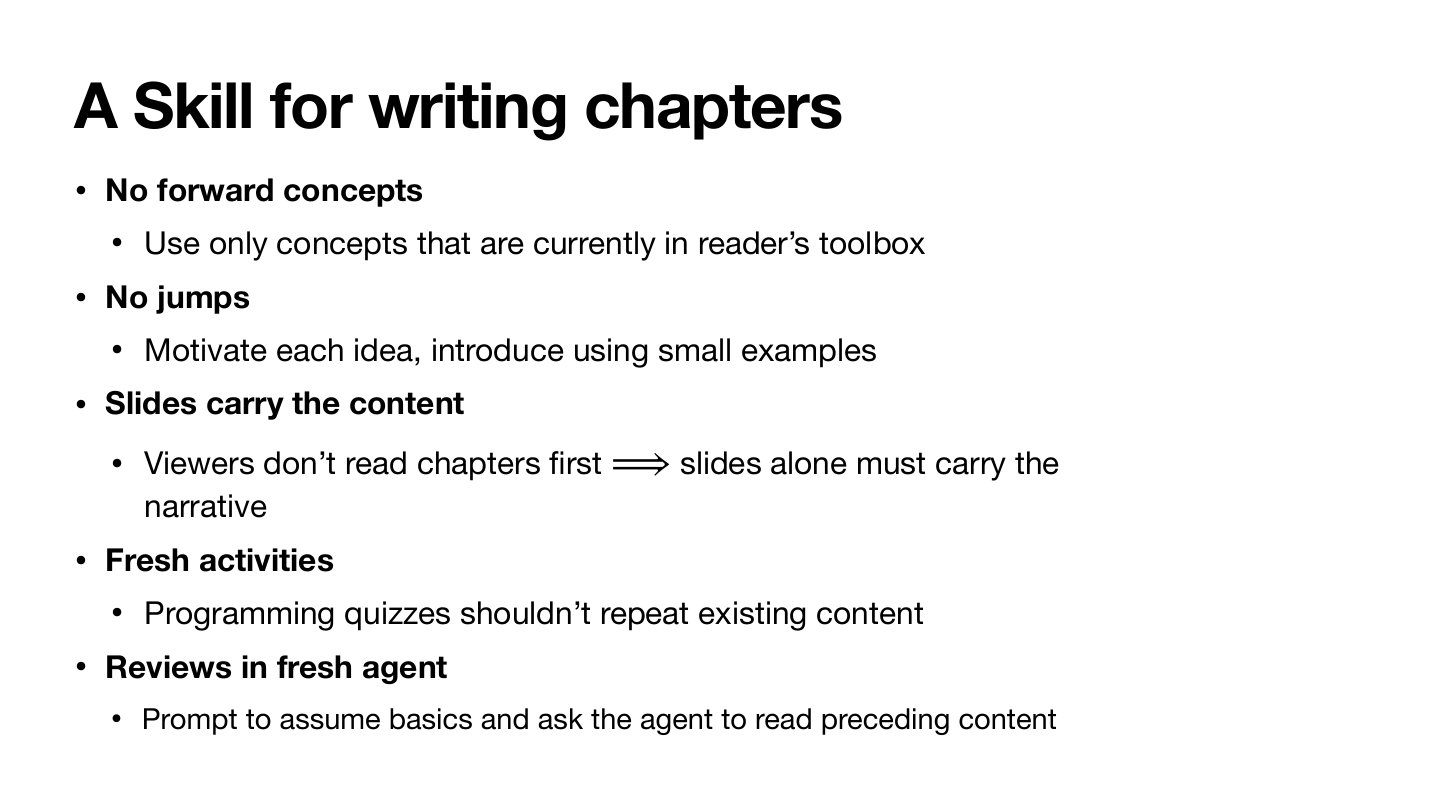
I ended up developing an agent skill: a reusable set of instructions for writing and reviewing chapters. I refined it through reviewing the material.
Use what is in the reader’s toolbox. An explanation can use only concepts the reader has already encountered. A fact being true does not make it appropriate at this point in the course.
Motivate the idea before generalising it. Start with a small example that gives the learner a reason to care. Avoid jumping to an abstraction before they have seen the problem it addresses.
Make the slides carry the narrative. Because the book and slides were written together, the agent often assumed that someone watching a slide had read the surrounding chapter. I expect many students to watch the videos without reading the book first. The slides must make sense in that setting too.
Give the student a fresh activity. The agent sometimes turned a worked example into a quiz by asking the student to reproduce the same code. The exercise needs to give them something new to do with what they have learnt.
Review with a fresh context. It helped to have a fresh agent read the preceding material, assume only the stated basics, and then review a chapter. That reduced the influence of all the extra context accumulated while writing it.
These instructions helped, but I still had to review the material. The tests could check an example’s behaviour. I had to check the assumptions an explanation made about its reader.
After the first run
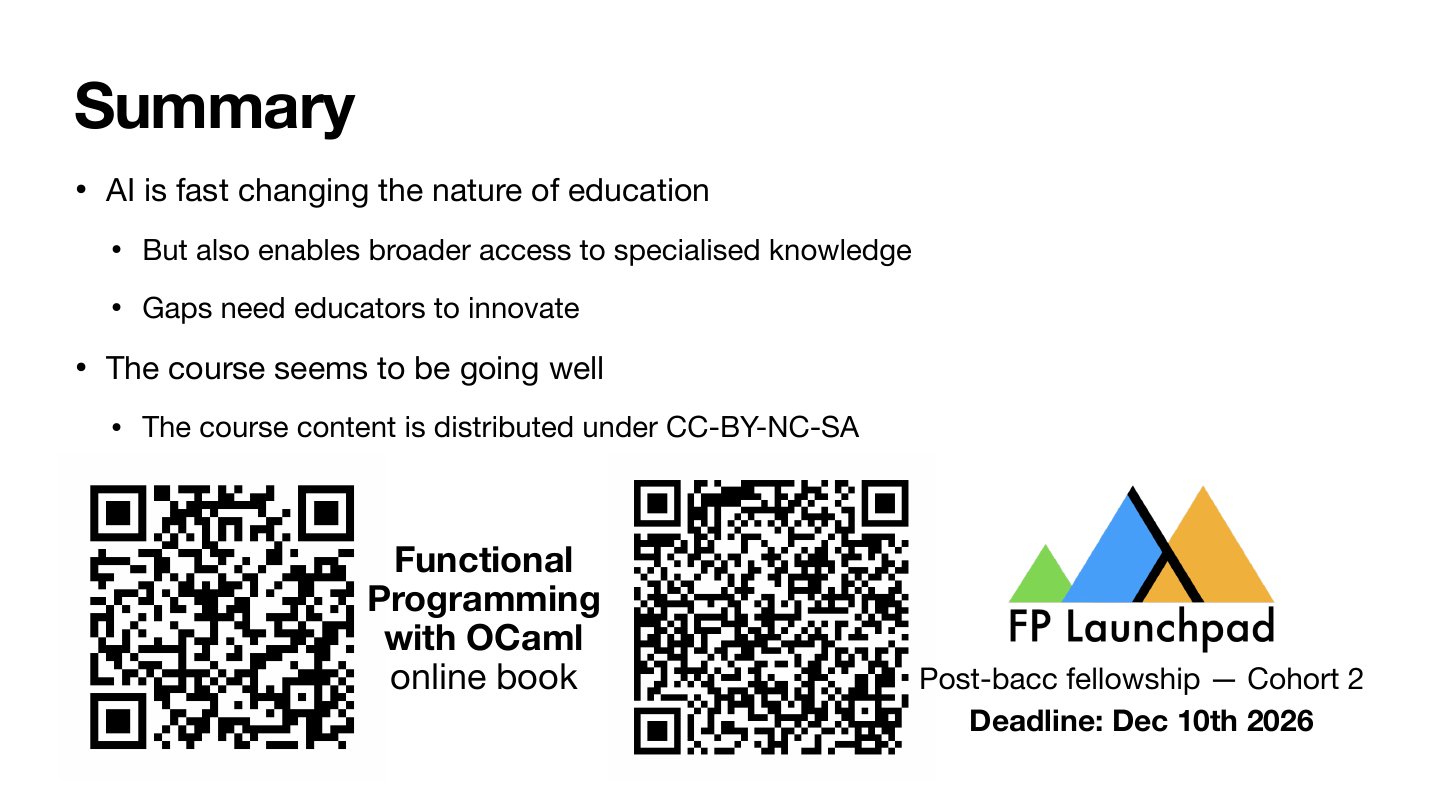
AI helped me build the platform and turn existing lectures into a book that students can use on their own. It also made the gaps in the teaching process very visible. Closing those gaps required decisions about examples, prerequisites, and what a student should do next.
Someone asked about AI support within the book. As I wrote in An O(x)Caml book that runs, we would like to build agentic books that evolve with the reader and become personalised to them. A tutor could use the reader’s questions and attempts at exercises to adapt explanations, revisit prerequisites, and set new exercises at an appropriate difficulty. For programming exercises, it could compile and test its examples before presenting them. This is a direction we would like to explore.
The course seems to be going well so far. The examinations are due in October, and I plan to write a retrospective after the first run. For now, you can open the book and try it. The course material is available under CC BY-NC-SA, and the source is on GitHub. If you teach, you are welcome to adapt it under those terms.
I also closed the talk with a call for applicants to FP Launchpad. Applications are open for the second cohort of our post-baccalaureate fellowship. If functional programming and formal verification interest you, take a look.

 点赞
点赞 收藏
收藏 点踩
点踩 分享
分享