2026-2027 DWU: Middle School Design Challenge

10 min read
Preparations for Next Moonwalk Simulations Underway (and Underwater)
2026-2027 DWU: Middle School Design Challenge
Overview
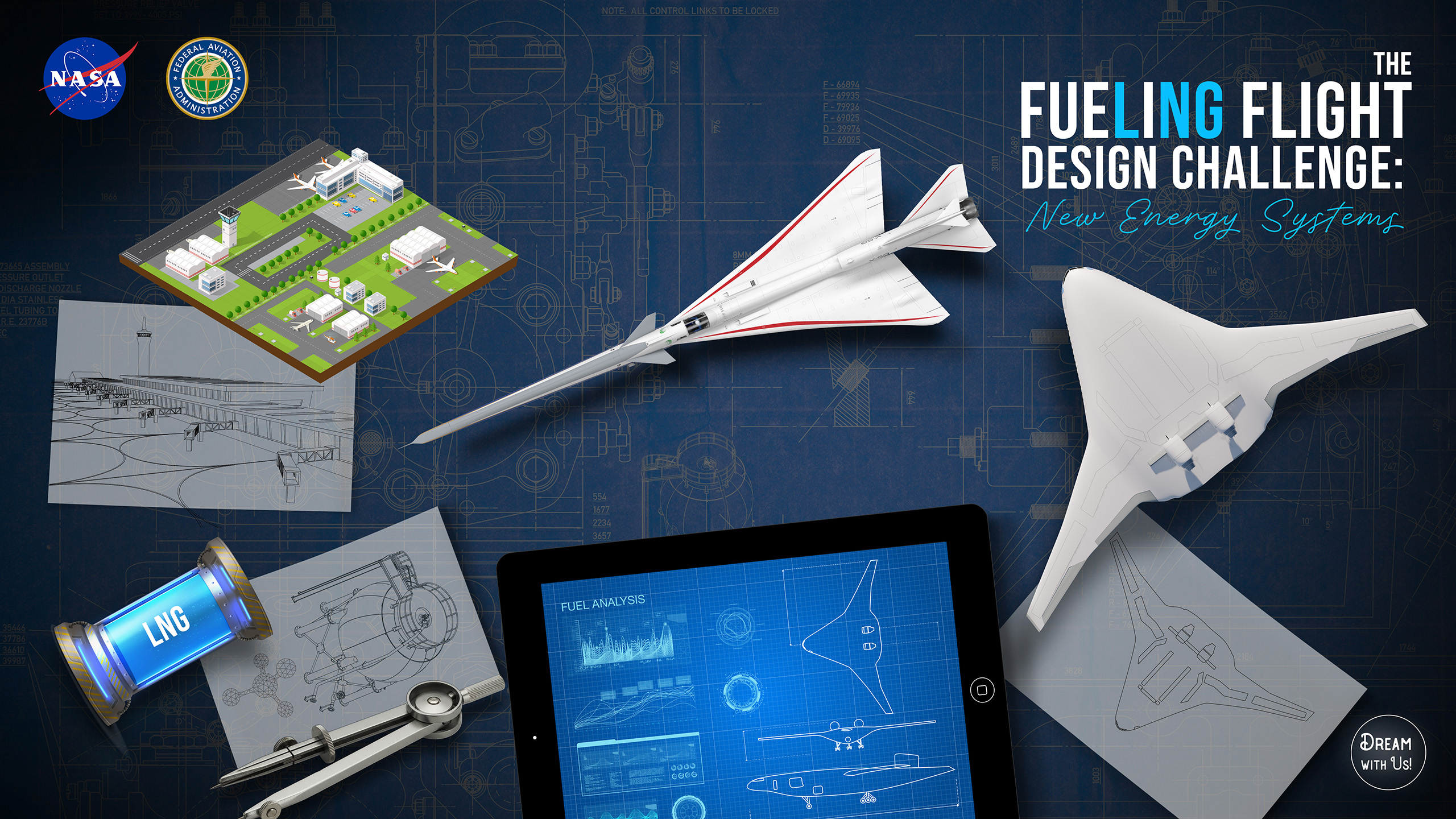
The 2026-2027 challenge theme is, “Fueling Flight Design Challenge: New Energy Systems.”
As more and more aircraft are a part of the US’ National Airspace System (NAS), NASA and partners at the FAA, at universities, and in the aviation industry are searching for ways to increase safety, make flight more affordable, find new fuels for aircraft, and reduce the amount of time passengers and cargo spend in the air. This year’s Dream with Us Challenge focuses on new aircraft fuels and how even the addition of one new fuel will change both the aircraft they are used in and the airports where aircraft take off and land.
The “Fueling Flight Design Challenge: New Energy Systems” challenge is open to middle and high school students, with a different task for middle school teams and high school teams. Teams for both categories will focus on the addition of an emerging aircraft fuel source, liquid natural gas (LNG) into our aviation environment. This will require teams to learn more about LNG, how it might be used in aviation, the benefits of an additional fuel source, and what kind of changes would need to be made to aircraft and to airports to adapt to these new changes.
Since the early days of aviation, commercial aircraft have relied on traditional designs and infrastructure. Aircraft have been a similar “tube-and-wing” design, with limitations that were made because of the materials aircraft were made with, along with the technology to build these aircraft. With the increasing availability of new technologies and new materials, aircraft no longer need to follow the same basic design. In addition, new research about fuel types, increasing demand for more flights and more fuel has resulted in many different options that include types of fuel, increasing electrification, and more. That also means airports are going to need to adjust. Changes in airport infrastructure will be needed to add multiple fuel types, different gateway configurations to allow for new aircraft types, and perhaps even different areas for different aircraft. What will this all look like? That partially depends on researchers and designers in the future since these are challenges the aeronautics community is starting to face now and will continue to do in the future.
Challenge Description
Middle school student teams of 2-4 members will adapt an existing airport (or create one of their own) that incorporates the use of both liquefied natural gas (LNG) and traditional aviation fuel. The airport design should include the overall airport layout that includes (but is not limited to): control tower(s), hangars, fuel locations, terminal, passenger parking, runways. See requirements below for specific details.
Challenge Rules
The 2026/2027 Dream with Us Design Challenge for middle and high school students opens September 25, 2026. The submission period for middle school entrants begins September 25, 2026, and concludes on January 22, 2027, at 11:59 pm ET. Schools, organizations, and community groups should communicate to parents and guardians that submissions are limited to one entry per team and team registration requires someone over the age of 13 to create the account (adult team sponsors may create the registration on the team’s behalf if desired). Entries must be submitted through the submission link on the Dream with Us Design Challenge webpage: https://www.nasa.gov/dream-with-us/. Signed permission forms from parents or legal guardians are required for all participants that agree to the terms and requirements listed below and on the submission form.
Use of AI
Use of artificial intelligence tools for challenge-related work is not permitted. Teams must not upload, process, or generate any content using AI systems, including publicly available browser‑based GenAI services, AI‑assisted code generation tools, or AI‑generated imagery. All submissions must be created solely by team members without the assistance of AI.
Grade Eligibility
The middle school challenge is open to all participants in grades 6 – 8 who are attending public, private, parochial, and home schools in the United States of America and children of U.S. military members stationed overseas.
Students in grades 9 – 12 will use the high school module. See the Dream with Us main webpage for details. Note: for teams that have both middle and high school students, those teams will compete in the high school challenge.
Dates
Submissions for the Dream with Us: Middle School Aviation Challenge are accepted September 25, 2026 – January 22, 2027. Submission link: INSERT LINK HERE. Winners will first be announced during a virtual awards reception (date TBD) then shared on social media and the Dream with Us design challenge webpage after the reception.
Key Dates
Submissions for the Dream with Us: Middle School Aviation Challenge are accepted September 25, 2026 – January 22, 2027. Submission link: INSERT LINK HERE. Winners will first be announced during a virtual awards reception (date TBD) then shared on social media and the Dream with Us design challenge webpage after the reception.
- Challenge begins September 25, 2026 through January 22, 2027
- Registration Deadline: ?
- Submission Deadline: ?
- Finalists selected and announced: ?
- Finalist presentations (Virtual): ?
- Winners Announcement: ?
Challenge Rules
Challenge Rules
The 2026/2027 Dream with Us Design Challenge for middle and high school students opens September 25, 2026. The submission period for middle school entrants begins September 25, 2026, and concludes on January 22, 2027, at 11:59 pm ET. Schools, organizations, and community groups should communicate to parents and guardians that submissions are limited to one entry per team and team registration requires someone over the age of 13 to create the account (adult team sponsors may create the registration on the team’s behalf if desired). Entries must be submitted through the submission link on the Dream with Us Design Challenge webpage: https://www.nasa.gov/dream-with-us/. Signed permission forms from parents or legal guardians are required for all participants that agree to the terms and requirements listed below and on the submission form.
Requirements
Each team submission will have two separate categories: technical and creative. Both categories must be included for consideration. Note: all sources for the presentation should be cited, including images. Please see the section above for rules about the use of AI.
- All submissions must be the original work of the students.
- Any graphics that are included in your submission must meet accessibility standards.
- To make your documents accessible and compliant with Section 508, it’s important to add descriptive alt tags to all images, diagrams, and graphics. Alt tags provide text descriptions that assist screen readers in conveying visual information to users with disabilities. When adding alt tags, use clear and concise language to describe the purpose and content of each image. In Microsoft Word, right-click the image, select “Edit Alt Text,” and enter your description. This simple step ensures everyone can access and understand your content, regardless of their abilities.
- Alt Text Sample on a PC (right click over the image and a drop down will appear, select “inspect accessibility properties and it will open the web inspector.”View Alt Text” option. If you select that option an “Alt Text” window opens with a grey box and instructions for how to create the alt tag.
- Alt Text Sample on a Mac (right click over the image and a drop down will appear, select inspect accessibility properties and it will open the web inspector. There is a gray area that is highlighted. It is the location of the image alt tag in the code. You may need to click the gray arrow next to the word “image” in order to see the whole alt tag. To hide the properties window click on the X in the top right corner of the window.
Technical Category Requirements
The technical presentation, using PowerPoint or similar, must include:
- Title slide: Include Team name, school or organization, and first name, last initial of each team member (DO NOT INCLUDE LAST NAMES OF TEAM MEMBERS)
- Labeled layout of the airport
- Explanation of the changes that were made to the airport to accommodate multiple fuel types
- There should be a focus on safety, airport benefits, and any considerations of new types of aircraft that will be taking off and landing from the airport.
- The presentation can be recorded with a narrative but is not required. If there is no audio with the presentation, slides should be self explanatory.
Creative Product
The team’s creative submission will be a presentation that advertises the benefits of the new airport modification, allowing two different types of fuels to be utilized at the airport. The audience could be city or state leadership, stores interested in investing in a location at the airport, airlines who may want to now fly to this airport (this is up to you!). How you choose to present this advertisement for improvements is up to you. It could be any of the following (or maybe you have another creative idea):
- Video
- Brochure
- Flyer
- Infographic
- Commercial
- Website
- Other
- Any videos, commercials, websites, or similar will require you to provide a link to us (this can be done by attaching a Word document or PDF with a link or QR code to access the content); be sure we are able to access those links to accurately judge the project.
Submitting Entries
All middle school entries will be submitted through the NASA Gateway link found INSERT GATEWAY LINK HERE and on the Dream with Us Design Challenge webpage. All entries must include the following:
- Signed permission form completed by parent or legal guardian of each student.
- Presentations must be submitted in a PDF format. PDFs are limited to 10 MB.
- Artwork must be submitted as high-resolution images of the original artwork in .jpg or .png format (minimum of 2,400 pixels on the longest edge). Note: AI-generated work will not be accepted.
- Any included videos must be uploaded to YouTube with a “watch URL” link or QR code submitted as a PDF document.
Challenge Resources
The following lessons and activities can be used to help participants learn more about aircraft and airport design, along with other aircraft considerations:
Do you need to find out more about research on liquefied natural gas (LNG) as an aviation fuel source? Find out more here:
- AACES 2050
- Fundamental Experimental Tests and Modeling of LOX/CH4 Engines at High Pressures
- “As Jet Fuel Supplies Tighten, Can Other Fuels Meet Demand?”
Judging and Criteria
Entries will be evaluated by industry experts based on impact, practicality, originality, and how well the idea is communicated. Judges will make award selections based on the above-mentioned criteria to determine which projects will be recognized.
Mid-Point Check-In
Are you an educator who needs to know more about how to support a team or multiple teams? Are you a student wanting to know more about how to participate? Join us in October, when we will set up a mid-point check-in! Stay tuned for those dates to be released on the Dream with Us design challenge webpage.
Questions:
If you have any additional questions, please reach out to the NASA Aeronautics STEM team at aeroSTEM@nasa.onmicrosoft.com.
Dream With Us: High School Engineering Challenge
@NASA@NASAaero@NASAes@NASA@NASAaero@NASA_es@NASA@NASAaero@NASA_es@NASA
Explore More
2026-2027 DWU: High School Engineering Challenge
2025-2026 Dream with Us Design Challenge Winners
Article
5 months ago
4 min read Flight Log—About Pilots
Article
6 years ago
Keep Exploring
Discover More Topics From NASA
Share
Details
Last Updated
Sep 25, 2026
EditorLillian GipsonContactApril Lanotte

 点赞
点赞 收藏
收藏 点踩
点踩 分享
分享