The impact of phase change material on rear-side PV heat transfer

A research group at Italy’s Polytechnic University of Milan has studied rear-side heat transfer in PV modules equipped with a phase change material (PCM). The year-long experimental study focused on reconstructing and interpreting convective and infrared radiative heat transfer at the rear of the modules. The researchers aimed to determine how PCM integration affects rear-side heat exchange and assess its potential for improving PV module thermal management.
PCMs are substances that can absorb, store and release large amounts of latent heat as they undergo a change of physical state, such as melting and solidification. In PV applications, they are primarily investigated for passive thermal management. PCMs installed at the rear of a module absorb excess heat as temperatures rise, helping to limit module operating temperatures and potentially improve electrical performance. Previous pv magazine coverage has highlighted research into PCM-based PV cooling, multiple PCMs with different melting temperatures, and paraffin wax as a passive cooling material. PCMs can also act as thermal storage media, retaining excess heat from PV modules for later use.
“Our research moved beyond the usual assessment of PV-PCM systems in terms of temperature reduction or electrical performance and looked directly at the rear-side heat-transfer mechanisms,” corresponding author Domenico Mazzeo told pv magazine.
“We experimentally reconstructed and separated convection, long-wave infrared radiation and rear short-wave contributions over almost one year of outdoor operation,” he said. “This allowed us to investigate how PCM integration changes the thermal boundary condition itself, including the effects of thermal storage and thermal memory, rather than considering the PCM simply as an additional passive cooling layer.”
For the experiment, the researchers tested two 305 W monocrystalline PV modules on a rooftop at the Polytechnic University of Milan from June 11, 2024, to May 31, 2025. Each module comprised 60 cells, measured 1,660 mm × 990 mm and was installed at a 30-degree tilt. One served as the reference module, while the other was equipped with 6.83 kg of an inorganic hydrated-salt PCM contained in 258 sealed pockets and designed to melt at around 29 C.
The researchers measured rear-surface temperatures, heat flux and weather conditions and then analyzed synchronized one-minute measurements to estimate heat released through convection and infrared radiation. This enabled them to compare how the two modules dissipated heat over nearly a year of outdoor operation. The dataset comprised 502,364 synchronized records, of which 125,469 met the criteria for paired comparison.
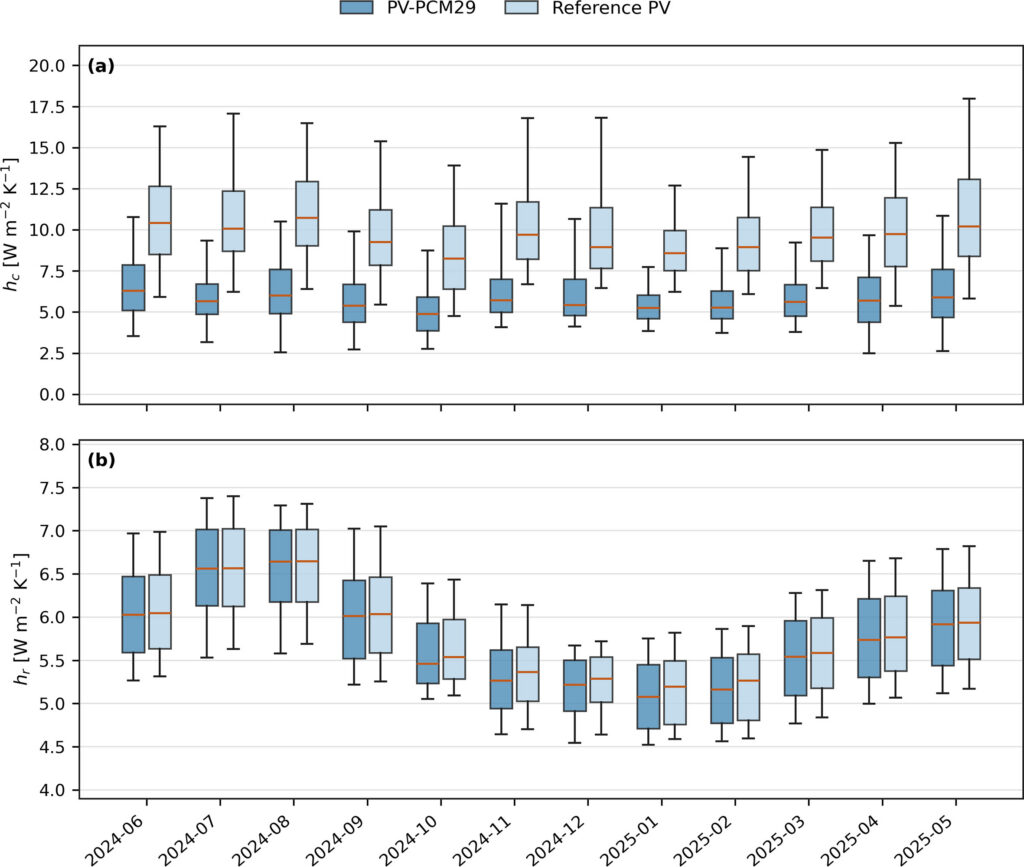
“The most striking result was the very different effect observed on convection and radiation,” Mazzeo said. “The annual median effective convective heat-transfer coefficient was 5.64 W/(m² K) for the PV-PCM module and 9.74 W/(m² K) for the reference PV module, corresponding to a 42.1% reduction at the assembly level. The median convective heat flux was also 45.2% lower. This separation was remarkably persistent across all months, wind-speed ranges and convective regimes, and remained robust in the uncertainty analysis.”
By contrast, the long-wave radiative coefficients remained very similar, at 5.85 W/(m² K) and 5.88 W/(m² K) under the matched-emissivity baseline, despite a 15.4% difference in infrared heat flux.
“In other words, PCM integration strongly modified the timing and magnitude of effective convective heat rejection, while the radiative coefficient remained mainly governed by emissivity and absolute temperature,” Mazzeo said.
“Another interesting observation was the importance of thermal history,” the researcher said. “Mixed convection accounted for about 61% of the paired observations, and the PCM rear surface spent approximately 433 hours within the practical 27 C to 31 C transition range. The same surface temperature could occur under different internal thermal states, showing that instantaneous temperature alone is not sufficient to describe the heat-transfer behavior of a PV-PCM system.”
For follow-up research, Mazzeo’s team plans to extend the experiment over multiple years and complement it with direct measurements of local airflow behind the modules, distributed temperature and heat-flux sensing, and a geometrically matched inactive-PCM reference configuration.
“We are also interested in pre- and post-campaign characterization of the PCM and in using these long-term measurements to validate dynamic PV-PCM models driven by multi-year weather data,” Mazzeo concluded. “Ultimately, the objective is to develop more reliable boundary conditions and design tools for predicting the long-term thermal and electrical performance of PV-PCM systems under different climates and configurations.”
The study is described in “Annual-scale experimental rear-side convective and infrared heat transfer in a tilted photovoltaic module with a phase change material,” published in Applied Thermal Engineering.
The post appeared first on pv magazine Global.

 点赞
点赞 收藏
收藏 点踩
点踩 分享
分享