IBM’s Spacetime PEC Cuts Error-Mitigation Sampling Overhead 63× – But the Exponential Wall Remains

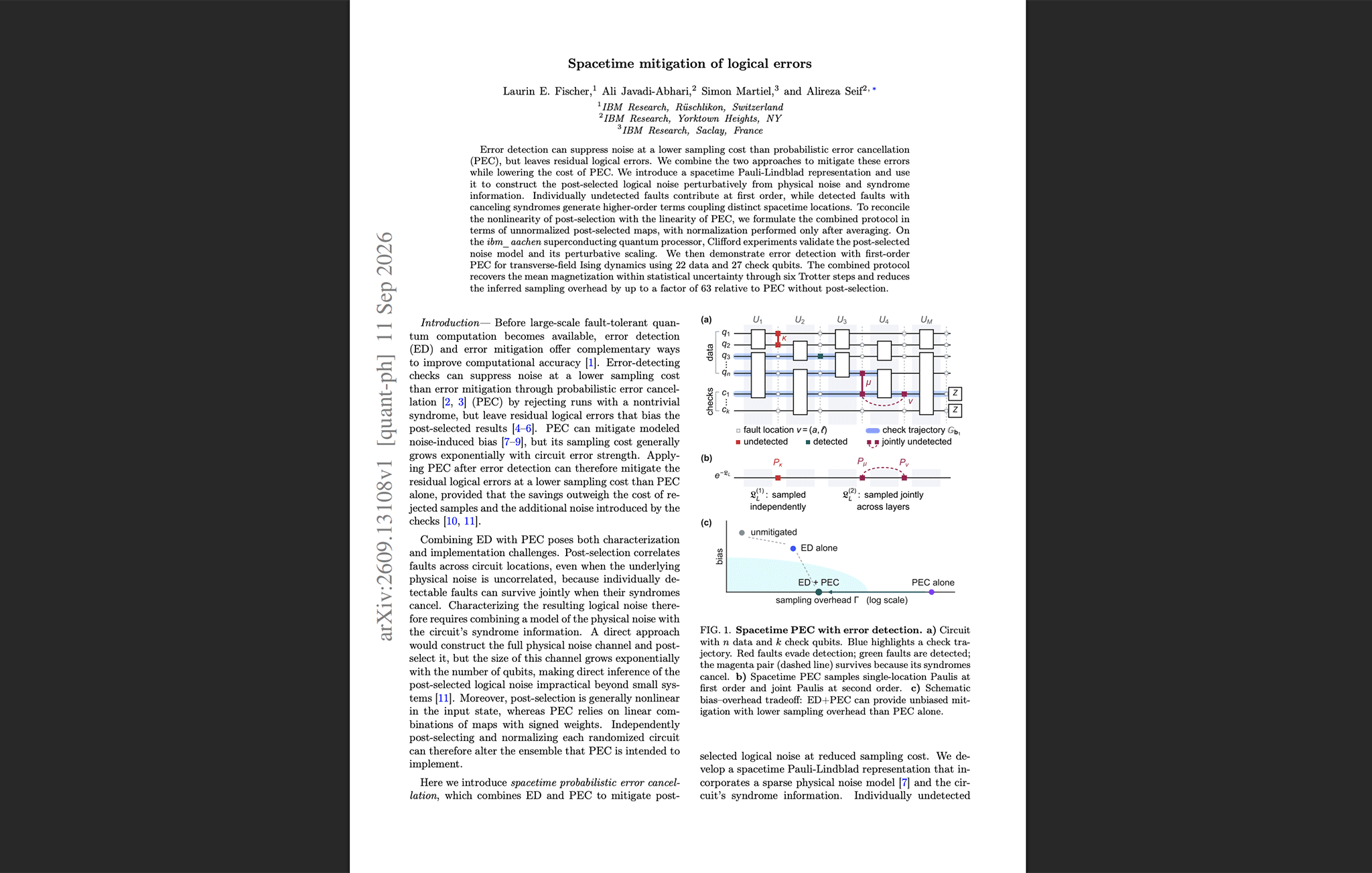
September 11, 2026 – Researchers at IBM Quantum submitted a preprint (arXiv:2609.13108), “Spacetime mitigation of logical errors,” introducing Spacetime Probabilistic Error Cancellation, a hybrid protocol that layers probabilistic error cancellation (PEC) on top of post-selected quantum error detection. The combined method reduced the inferred sampling overhead of PEC by up to 63× on IBM‘s ibm_aachen, a 156-qubit Heron r3 superconducting quantum processor.
The team – Laurin E. Fischer, Ali Javadi-Abhari, Simon Martiel, and Alireza Seif – ran Trotterized transverse-field Ising dynamics on a six-plaquette hexagonal lattice using a 49-qubit subset of ibm_aachen: 22 data and 27 check (ancilla) qubits. At six Trotter steps, the circuit executed 648 two-qubit CZ gates. Standard PEC on this circuit carried an inferred sampling overhead – computed from the reconstructed Pauli-Lindblad noise model and inclusive of post-selection cost – of 85,545. The Spacetime PEC protocol recovered the ideal mean magnetization within statistical uncertainty at an inferred overhead of 1,359 – a 63× reduction.
The gains scaled with circuit depth. The reduction was 3.7× at two Trotter steps, 15.9× at four, and 63× at six. The authors modeled the post-selected logical noise with a spacetime Pauli-Lindblad representation, which they constructed perturbatively from physical noise and syndrome data. In that representation, detectable single-location faults drop out of the PEC sampling exponent. The protocol applies first-order PEC to the residual noise that escapes detection; higher-order undetected errors remain.
The work builds on IBM’s Qiskit Paulice toolkit, released in June 2026, and a companion preprint by Martiel, Javadi-Abhari, and collaborators (arXiv:2607.25941) demonstrating spacetime codes on a 76-physical-qubit circuit that achieved a roughly 10× effective reduction in gate error rates and a certified state fidelity lower bound of 0.349 at 95% confidence.
In a note added to the preprint, the authors acknowledge concurrent independent work by Yuan, Zhao, and Liu (arXiv:2605.12149), who developed a related Zeno-enhanced PEC framework combining error detection with probabilistic cancellation. Separately, at least two other groups published related approaches in 2026: Kumar et al. at Yale (arXiv:2604.19871), who explored the co-design of error mitigation and detection for logical qubits, and O’Leary, Egger, and Jaksch (arXiv:2607.01072), who optimized symmetry-informed PEC.
The paper is a preprint and has not undergone peer review.
My Analysis
The 63× reduction is real, and its scope is narrow. IBM made error mitigation cheaper by discarding the runs that fail error-detection checks, so PEC has less noise to cancel. The result extends how deep a circuit can run under mitigation before the sampling cost becomes impractical. It does not eliminate the exponential scaling that makes PEC impractical for large circuits in the first place.
What the paper actually demonstrates. PEC works by learning a processor’s noise model and then sampling modified circuits whose statistical weights cancel the estimated effects of that noise. The technique produces approximately unbiased expectation values – a real advantage – but its sampling cost is exponential in total circuit noise. For a 648-CZ-gate circuit on ibm_aachen, that cost was an inferred overhead of roughly 85,000 samples per expectation value. That number was already a problem. At twelve Trotter steps it would be orders of magnitude worse.
Spacetime PEC compresses the exponent by inserting error-detection checks into the circuit and discarding runs that fail them. The checks flag most single-location faults, so PEC has to cancel only the residual noise that escapes detection. The overhead drops from 85,545 to 1,359 at six Trotter steps. The cost of post-selection – discarding runs – is already included in that 1,359 figure, and even after accounting for it, the net reduction is substantial.
The engineering is solid. The spacetime Pauli-Lindblad representation of post-selected logical noise, which the authors build perturbatively from physical noise and syndrome data, is a clean piece of theoretical work. The perturbative scaling was validated with Clifford experiments on real hardware, which is the right verification approach. Yuan, Zhao, and Liu arrived at a related construction independently, and groups at Yale and Oxford/IBM published co-design proposals. Combining error detection with mitigation is therefore less likely to be an artifact of one team’s assumptions.
What it does not do. The 63× reduction started from a very large number. An inferred overhead of 85,545 dropping to 1,359 is still an overhead of 1,359. For the transverse-field Ising dynamics studied here, that was manageable. For circuits with more qubits, more depth, or less structured noise, the combined overhead will still grow exponentially in the noise that escapes detection. The paper’s own framing acknowledges this: it explicitly describes the protocol as first-order PEC, meaning it cancels only the leading contribution from undetected faults. Higher-order undetected errors remain.
The experiment used 49 of ibm_aachen’s 156 physical qubits – 22 for data and 27 for syndrome checks. That roughly doubles the physical resource count relative to an unencoded computation on 22 qubits. The overhead is modest compared to full quantum error correction, which at surface-code ratios requires roughly a thousand physical qubits per logical qubit at current error rates. But it is not free: the 27 check qubits could otherwise expand the computation.
How error mitigation relates to fault tolerance. IBM’s blog post framing the result describes a “continuous path from error mitigation to fault-tolerant quantum computing.” That framing is accurate in the narrow sense that error detection, mitigation, and correction are points on a spectrum of noise-management techniques. It is less accurate as a description of engineering reality. The techniques that make near-term computations trustworthy – PEC, zero-noise extrapolation, tensor-network error mitigation – face fundamental sampling-cost barriers that error correction resolves by an entirely different mechanism. There is no continuous path that optimizes one into the other.
IBM can apply the cost reduction in its quantum advantage program, where the July 2026 demonstrations used error mitigation and post-selected detection techniques on Heron processors to produce results that outperformed classical simulations on specific physics problems. Cutting the sampling cost of mitigation by 63× directly expands the class of circuits that can be run within a practical compute budget. For the narrow goal of producing trusted expectation values on structured physics problems using 50–100 qubits, this is a meaningful advance.
The relevant comparison is with competing approaches to the same intermediate zone. Quantinuum’s Iceberg error-detection codes add two physical qubits to each block of logical qubits, on trapped-ion hardware with intrinsically lower gate error rates. QuEra’s high-rate qLDPC codes pack six logical qubits into a block of 16. IBM’s approach keeps the encoding overhead minimal – the spacetime checks add ancillas but do not implement a full error-correcting code – and uses PEC to handle the residual. The tradeoff is sampling cost versus qubit cost. IBM spends circuit repetitions. Quantinuum and QuEra spend physical qubits. Neither is universally superior; the right choice depends on the hardware’s gate fidelities, cycle times, and the depth of the target computation.
For the longer goal – a quantum computer that does something a classical one cannot on a problem someone pays to solve – the timeline has not changed. IBM’s trusted-quantum-advantage demonstrations remain in the territory of physics simulations that are beyond exact classical verification but whose practical value is scientific rather than commercial. Spacetime PEC makes those demonstrations cheaper to run. It does not make them commercially relevant.
No change to the CRQC timeline. This result has no direct bearing on the timeline to a cryptographically relevant quantum computer. Error mitigation techniques do not contribute to the error-correction capability stack that a CRQC requires. A machine running Shor’s algorithm at production key sizes needs sustained fault-tolerant operation over days, at logical error rates below $10^{-15}$ per gate, across roughly 1,400 logical qubits. No amount of sampling-overhead reduction changes those requirements. IBM’s own fault-tolerant roadmap targets the Starling architecture for the first fault-tolerant quantum computer, with a timeline that has not shifted on the basis of this result.
The bottom line. IBM’s Spacetime PEC is a well-executed engineering contribution that makes near-term error mitigation approximately 63× cheaper for structured circuits on current hardware. It extends the utility of IBM’s existing processors for scientific simulations. Its sampling cost still scales exponentially with the noise that escapes detection, which is the constraint that separates error mitigation from correction. The technique does not move the timeline to fault-tolerant quantum computing or to a CRQC. Several independent research groups have arrived at related approaches, which supports the direction. IBM has not yet shown that the combined technique can scale to circuits large enough to produce scientific results that matter beyond the quantum-computing field.
The post appeared first on PostQuantum - Quantum Computing, Quantum Security, PQC.

 点赞
点赞 收藏
收藏 点踩
点踩 分享
分享