WWII Tank, Aircraft, and Ship Identification guides

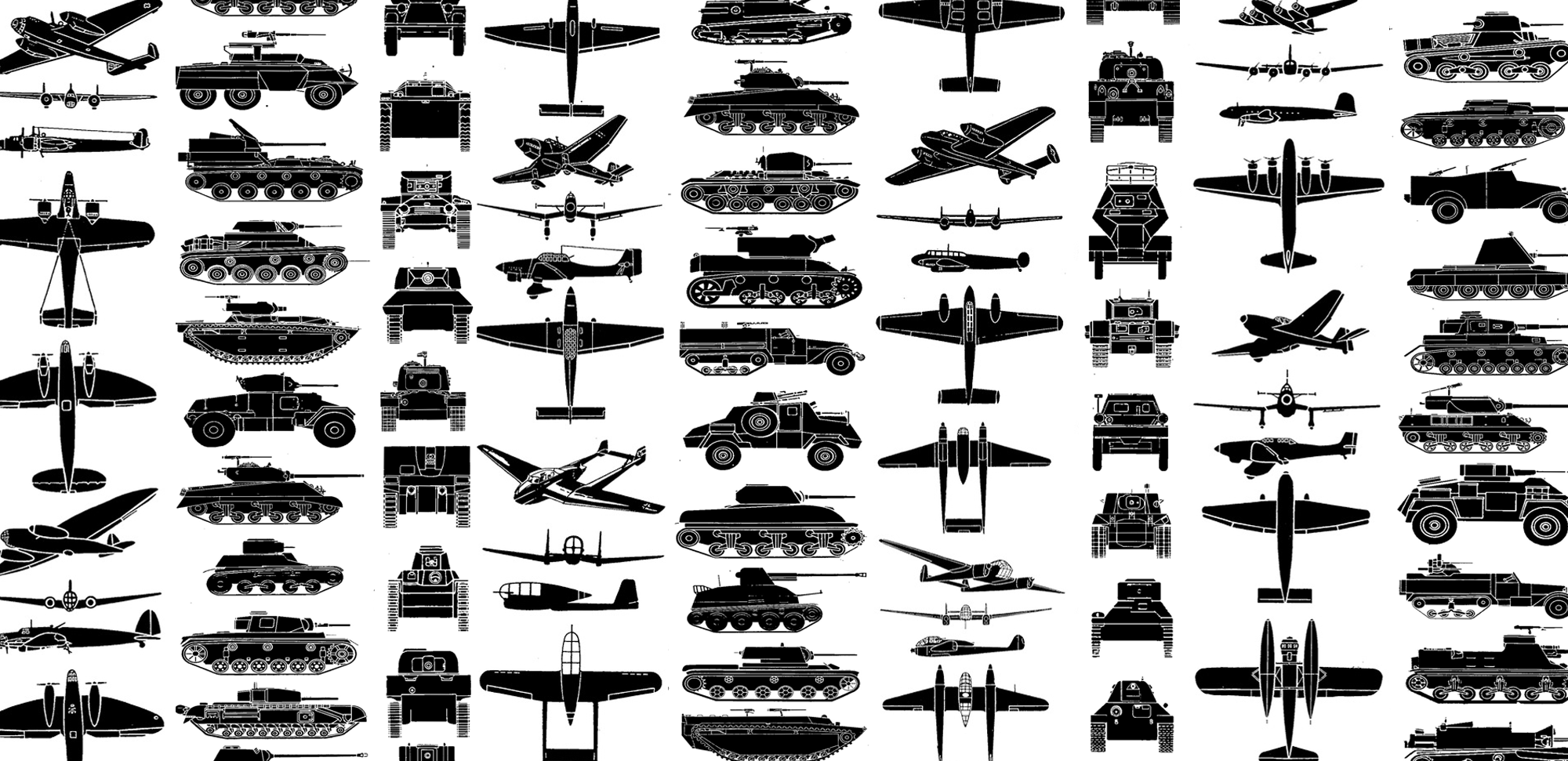
In the skies, seas, and battlefields of World War II, hundreds of different vehicles of all shapes and sizes meant US soldiers needed a fast way to tell which side a tank, plane, or ship was fighting for. The US War Department published a series of pictorial identification guides to train soldiers to quickly distinguish friend from foe.
“Before the outbreak of this war few realized the grave problems of recognition: Since then, mistakes in recognition, on the sea, on land, and in the air, have been too numerous to mention,” reads a 1943 “Recognition Pictorial Manual on Armored Vehicles.”
The same guide explained why soldiers needed to study the distinctive characteristics of these vehicles:
“What enables a person accurately and speedily to recognize a ship, a plane, or a tank? The process is no different from that of recognizing an automobile, a horse, a bird, or a friend. Ask yourself the question, ''When I see a friend walking down the street, do I look at every feature of him and, having gone through a process of analysis, I decide that it is Bill?" Obviously not. You know immediately that it is 'Bill" because you are familiar with his whole appearance, his various characteristics, and the way he stands or walks.”
Tanks and Armored Vehicles
Armored vehicles came in a crazy variety of shapes and sizes. The manual includes not only tanks, but armored personnel carriers and wheeled and tracked vehicles — sometimes combinations of both — equipped with weapons ranging from .50-caliber machine guns to massive 150 mm howitzers. Their distinctive combinations of angles, turrets, antennas, and gun barrels created silhouettes that could be recognized from a distance.
Let’s look at an example page from an armored vehicle manual.
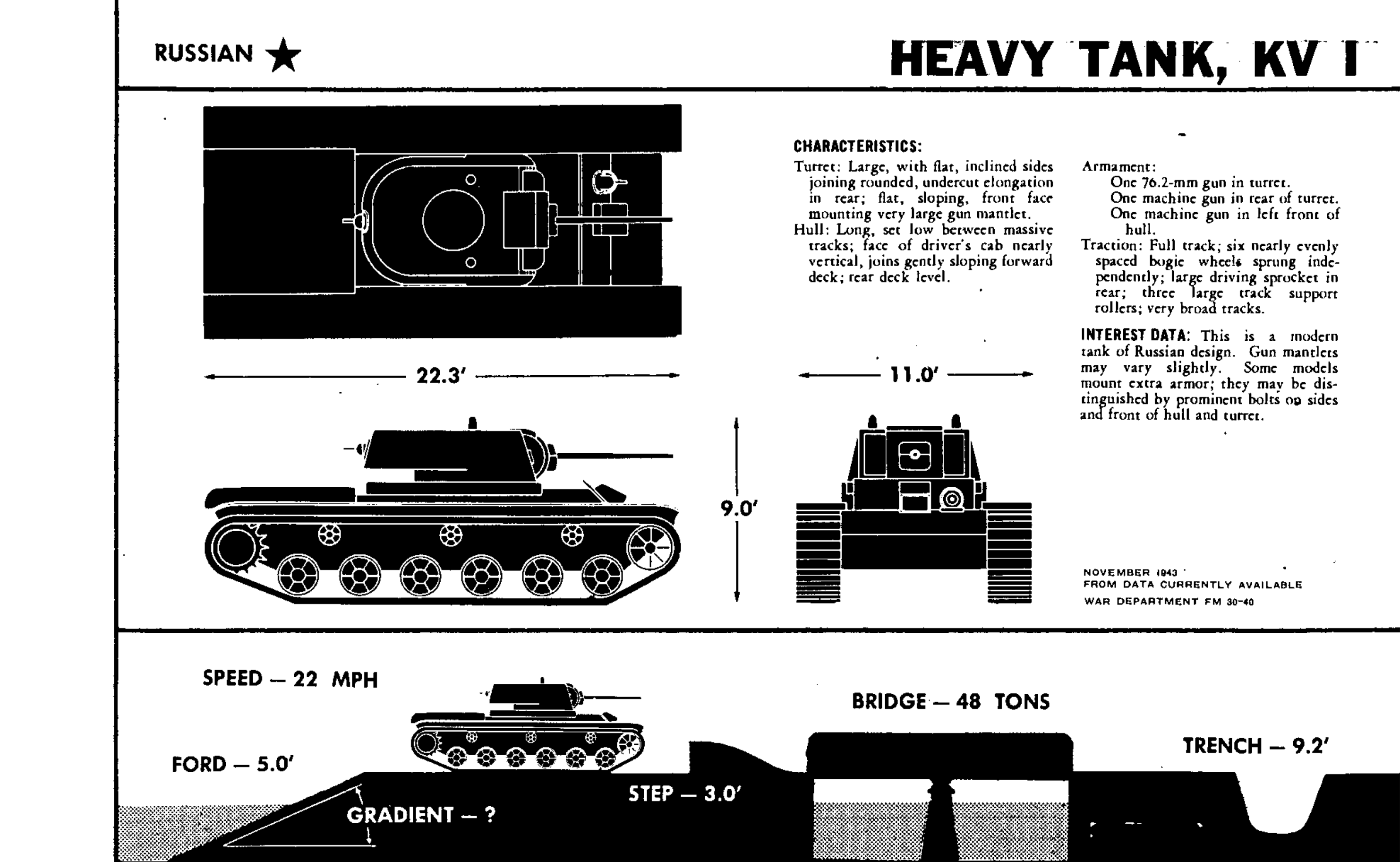
Each page presents crisp black silhouettes rendered at a consistent scale: viewed from 5 yards away, a silhouette represents the vehicle as it would appear at 400 yards.
Top, front, and side views are marked with measurements, alongside detailed statistics on the vehicle’s weapons, armor, and distinctive features. At the bottom, a diagram shows the vehicle’s top speed, bridge-crossing weight classification, the steepest slope it can climb, and the maximum width of a trench it can cross.
Aircraft
The task of identifying aircraft is complicated by the many angles that soldiers could be viewing an enemy plane from — is a pilot looking down on the plane parked at an airfield? Is it turning toward the viewer in a three-quarter view?
One aircraft identification guide highlighted the unique challenges of identifying planes: “The Air Forces, both of the Army and the Navy, have even more problems to solve because the views from which crews may see the enemy are not confined to those from underneath. The fighter pilot may hope to dive on the enemy from above and behind, but to him the underneath view is important, too. The tail gunner needs the head-on view. All must know their aircraft well. In a completely different category are the photographic interpreters who have to recognize the top-plan views of aircraft dispersed on air-dromes or in ports.”
If you thought the variety of tanks was wild, the mix of aircraft was even crazier. Troops peering through binoculars scanned the skies for fighters and bombers with distinctive wings, tails, fuselages, guns, and engines. Heavy bombers, transport planes, seaplanes, and single-engine dive bombers filled the skies, often leaving troops far less time to make an identification.
And it wasn’t just soldiers who needed to identify aircraft. Civilian plane spotters watching the skies over England and the East and West coasts of the US also needed detailed information.
Merch featuring data from our stories
War and WEFT
Developed in England, the “WEFT” system offered a framework for identifying aircraft based on four main components — Wings, Engine, Fuselage, and Tail. The system encouraged trainees to memorize the distinguishing features of each component. A series of training films with animated diagrams was made to help teach aircraft identification.
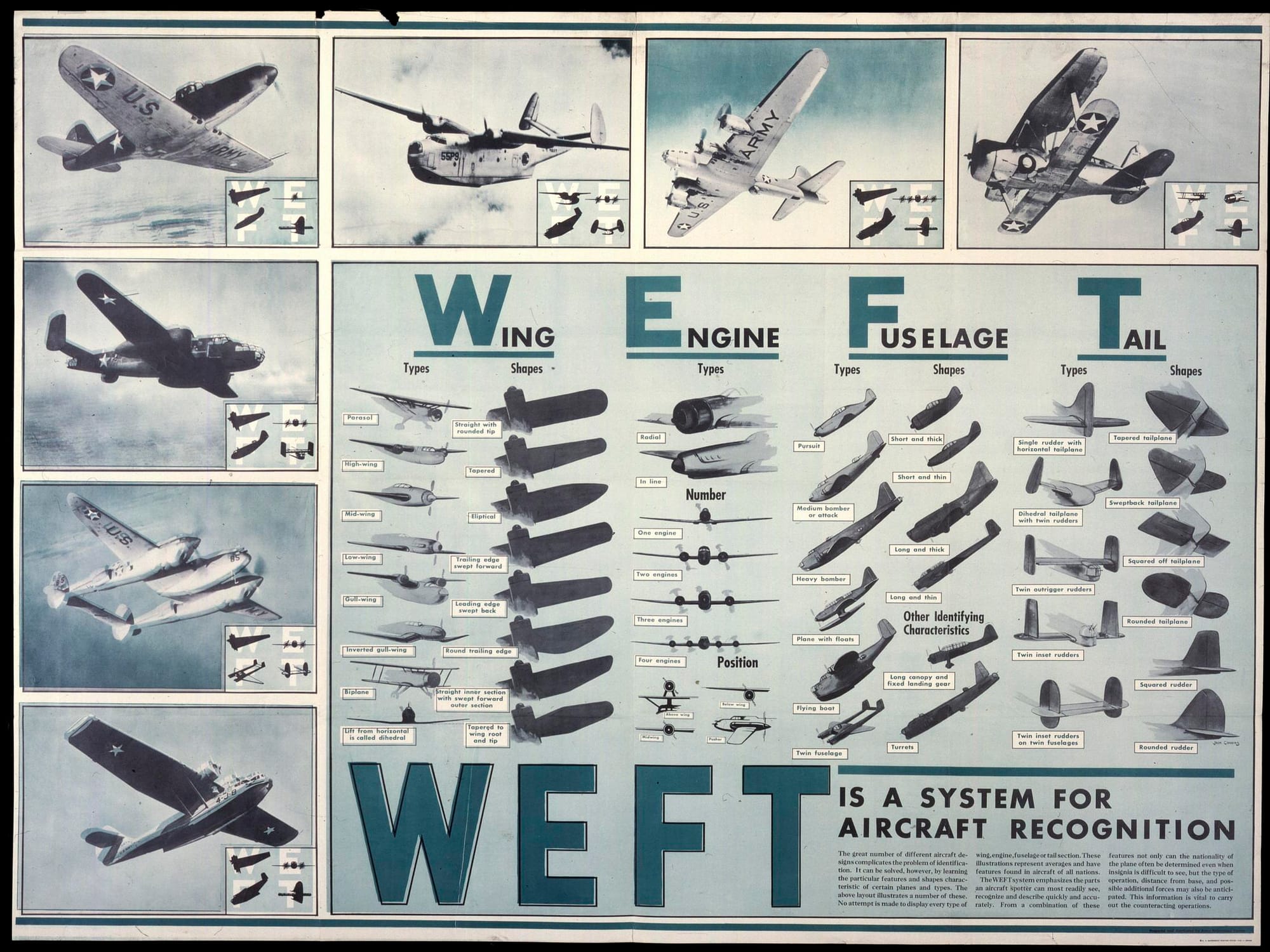
While the US armed forces embraced WEFT as a training tool, researchers also experimented with systems based on the psychology of visual perception.
Samuel Renshaw, a psychologist at Ohio State University, developed a radically different approach to rapid aircraft recognition. The Renshaw method, later known as the “Flash System of Instant Recognition,” used a tachistoscope — a device that displayed images for precisely controlled periods of time.
In the case of Renshaw’s research, images of planes were shown to subjects for as little as 1/100th of a second. According to a 1968 George Washington University report on aircraft-identification training, Renshaw believed repeated flashes encouraged trainees to memorize the plane’s overall shape rather than WEFT’s individual components.
Renshaw’s method was adopted by the US Navy in 1942, but questions lingered about the best way to teach this kind of rapid identification. Eventually studies showed that Renshaw’s method was less effective than longer exposures, and hybrid methods of training were adopted, to be followed later by competing approaches such as the Sargeant System, which used books of aircraft photographs grouped by visual similarity for self-directed study.
Ships posed a different recognition problem.
Ships
“With planes, all three views are of nearly equal importance for correct identification, but in ship recognition, the use of the beam, or side view silhouette, is by far the most important. If the beam silhouette is thoroughly known, the ship can be recognized from either the surface or the air.”
East Carolina University Digital Collections has a rich collection of naval vessel identification cards from the US Navy’s Division of Naval Intelligence.
The collection includes American, British, German, Japanese, Siamese, and Italian vessels ranging from small transport craft to massive aircraft carriers. Many of the included photographs show ships painted with “dazzle” camouflage – bold geometric patterns designed not to hide a ship but to break up its outline, making the vessel's range, speed, and heading hard to judge.
The cards are beautifully designed and cram a huge amount of data onto each page, complete with detailed illustrations from the top and from the side.
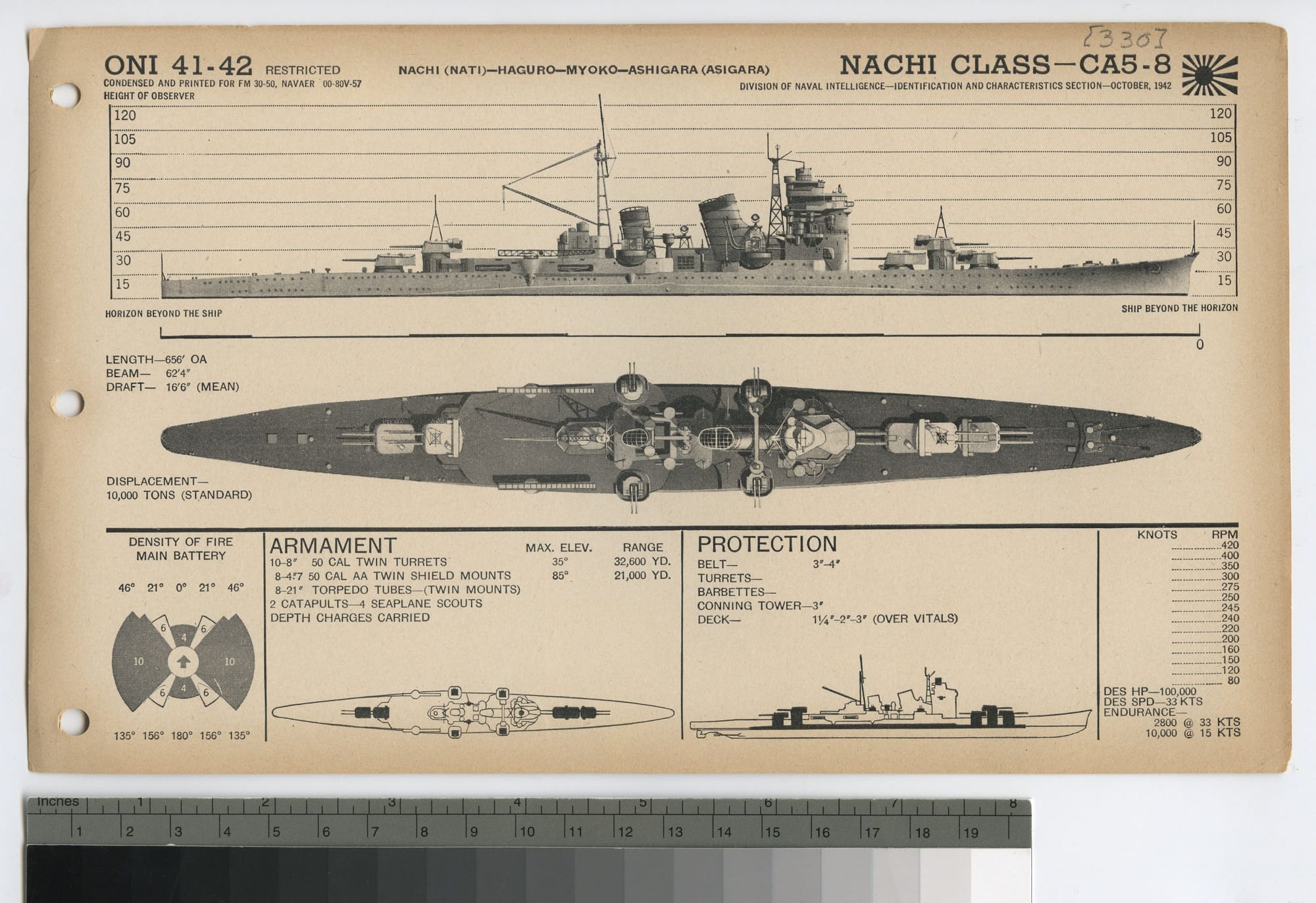
Diagrams show the placement and caliber of each ship’s armaments, along with its “density of fire” — the angles from which the ship could bring the greatest amount of firepower to bear. Other diagrams detail the vessel’s armor, engine speed, and overall dimensions.
🙏🏻Did you enjoy this post?
You can subscribe to our newsletter to get future posts delivered to your inbox for free. 👉🏻 📫 .
☕️ Buy me a coffee
Say thanks with a one time tip.
Sharing is caring
📣 If you think your followers or friends may like it, please consider sharing it.
👕🖼️ Buy Beautiful Public Data merch on our shop.
Unique t-shirts and prints inspired by our stories
🙋🏻♀️ If you have any suggestions, comments or requests, please email them to beautifulpublicdata@gmail.com
Thanks for reading!
- Jon Keegan
Bluesky: @jonkeegan.com

 点赞
点赞 收藏
收藏 点踩
点踩 分享
分享