KdK Part 5: The Aitkenator

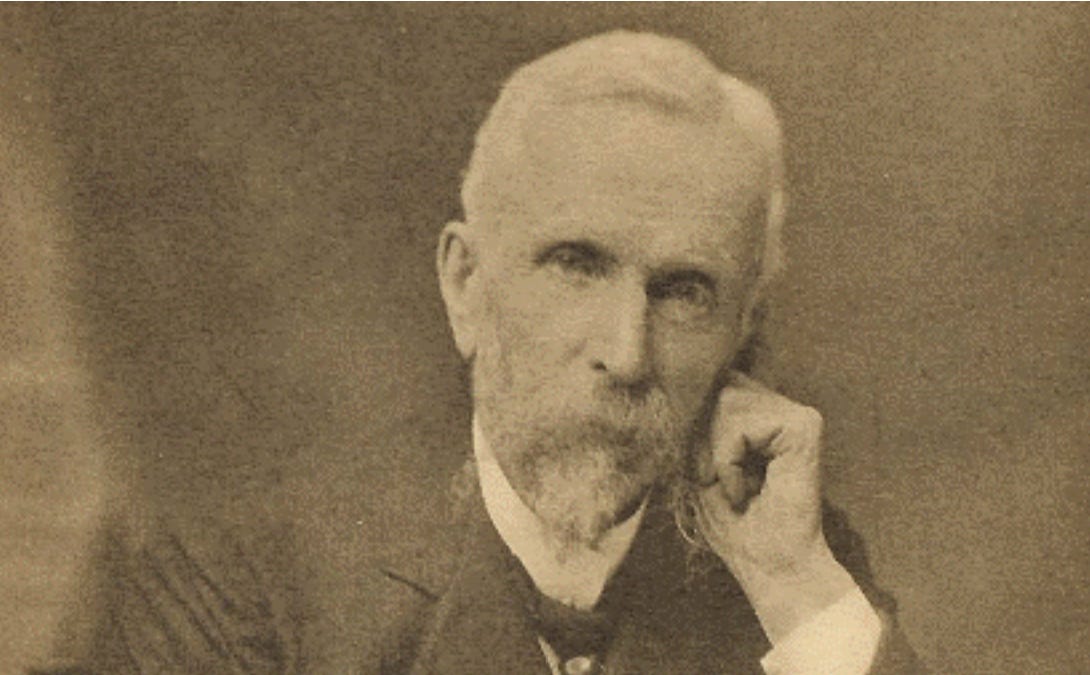
This instalment of has been a long time in coming, partly because I was trying, and ultimately failing, to find a certain 25 year old videotape, and partly because I had a trip to Scotland on the calendar to learn a little more about John Aitken, the first scientist I know of who studied what I’ve been calling KdK (Kinetik der Kontinua) - the physics of moving chains.
Aitken lived from 1839 to 1919 and spent most of his life in Falkirk, a town halfway between Glasgow and Edinburgh. Unlike other KdK researchers like and , who studied systems in which one end was free to move - so whips, basically - Aitken studied the movement of closed loops of chain, which he set in motion using a series of machines that he built in his home laboratory in Falkirk.
When I discovered his 1878 paper “An account of some Experiments on Rigidity produced by Centrifugal Force,” I began constructing similar machines so that I could see for myself the phenomena that were so interesting to Aitken. Out of respect for his achievements I called these machines Aitkenators. My wife dubbed them chain-flingers, which is the name that actually stuck.
I shot video of myself sharing an enclosed space with my chain-flinger, wearing a motorcycle helmet and other protective gear while reproducing some of the phenomena Aitken described in that paper. For as Aitken himself remarks, “Very light chains were used, as many experiments can be made with light chains which would be dangerous or impossible with heavy ones without more elaborate apparatus.” Mine were a little heavier than his. Dangerous, but not impossible.
I have been unable to find the video, alas. But the loss to chain-flinging science isn’t that great. You can observe many of the same phenomena in the more recent video that kicked off this whole series. And Aitken’s paper contains numerous well-crafted engravings showing the same, which I’ll reproduce below.
Aitken’s Milieu
Aitken’s paper is as idiosyncratic as the man himself. The opening sentence is
The experiments do not contain much that is new, many of the problems having previously been mathematically wrought out by Sir William Thomson and others.
The Sir William Thomson he’s referring to is the man later ennobled as Lord Kelvin. A footnote adds that the paper was personally communicated to the publisher by Thomson himself. Farther down the page, Aitken throws in a shout-out to Professor James Thomson, William’s older brother. At the time he published this work, Aitken was already a Fellow of the Royal Society of Edinburgh; the Thomson brothers had sponsored him for that honor. Later he was named a Fellow of the Royal Society of London.
During a career that spanned at least four decades (1872 to 1912) Aitken published a number of papers and invented a number of devices important to the world of meteorology. His chain-flinger paper seems to be the only thing he published in his whole career that wasn’t about atmospheric science. He came from a reasonably prosperous Scottish family and had a limited academic career—grammar school followed by engineering training at the University of Glasgow, and a stint in a shipyard. But “Ill health prevented Aitken from holding any official position; he worked instead in the laboratory in his home in Falkirk.” The man never had a job. A bit of poking around in Falkirk history suggests that the family in general had enough wealth to support Aitken as an independent scientist.
Whatever this “ill health” was, it didn’t prevent him from living to the age of eighty and earning several medals, prestigious memberships, and an honorary doctorate. I suspect that “ill health” was a Victorian euphemism for something psychological, or perhaps just a general disinclination to hold down a regular job. In any case he had the respect and support of the Thomson brothers, which I do not think was lightly given.
The Hunterian Museum at the University of Glasgow, thirty miles from Falkirk, contains an exhibit of scientific instruments, inventions, and classroom demonstrations produced by the Thomson brothers and the firm of Kelvin & James White Ltd., a company that lives on today, as it was eventually acquired by Hensoldt AG.
Some of these devices I first learned and wrote about 30 years ago when I was working on my article about submarine cables for WIRED. Others are solutions to problems related to navigation, or instruments needed to measure large and small electrical currents in various circumstances. There’s a ballistic pendulum used to measure the energy of bullets, an analog computer to predict tides, and models that Kelvin made when he was investigating the mathematics of soap bubbles and the phenomenon of piezoelectric crystals.
Mixed in with those exhibits are some classroom demos that Kelvin used when lecturing to students, such as the young John Aitken, at the University of Glasgow.
It is worth pointing what an extraordinary combination of activities is represented here (at least, compared to how things work in academia and business today). The Thomsons worked in an era when it was still possible to be doing work at the frontiers of science while also running a profitable business making technology that put that science into direct practical application—and all of this while also teaching university students.
I assume it’s in that latter connection that the young John Aitken entered the story. The Thomsons evidently recognized this lad from Falkirk as belonging to a particular type that they recognized and valued—what we would today call a nerd or hacker. The track into which Aitken had been slotted—engineering work at a shipyard—could not possibly have been as interesting to him as the things that were going on every day in the Thomsons’ complex of labs, workshops, and classrooms.
He ended up going back to Falkirk, which at the time was a powerhouse of the Victorian industrial economy. Its position at the intersection of canals and other transportation arteries made it a natural place to build heavy facilities such as foundries. In that world the Aitken family occupied a position one step removed from the heavy metal; John was the fourth son of a prominent lawyer. The home where he lived for much of his life and performed his experiments is one of a row of massive stone houses along a ridge that looks down on the commercial center of the town. This landform lies directly atop the remains of the old Roman Antonine Wall. The house is a solid but far from magnificent structure on a decent-sized parcel surrounded by a stone wall. But it’s not a country estate such as nobles or landed gentry would live in. It, and the people who lived in it, were embedded in the civic life of Falkirk.
Aitken’s Chain-Flinger
When I first came across Aitken’s paper about 25 years ago I was intrigued by the first sentence, in which he states that Sir William Thomson had been working on this problem. I made some cursory efforts to find some record of such research in Thomson’s biographies, but never found anything. A deeper dive with access to primary sources in Glasgow might turn something up.
It is entirely plausible that a man such as Thomson—a cutting-edge natural philosopher firmly grounded in the industrial practicalities of the Victorian world—would have seen moving chains and noted their peculiar behavior. Roll-up doors and winches are often controlled by moving chain loops, and once they get up to speed it is easy to observe some of the phenomena that Aitken studied in a more systematic way. At the warehouse in Seattle where I made my first chain-flingers, we had several roll-up doors that worked on this principle, and I would occasionally put them into service as quick cheap demo machines. This industrial video at about the 25 second mark gives a glimpse of KdK physics down at the bottom. Most of the chain hoist videos that I can find on YouTube are safety videos, the point of which is to prevent the chain from moving too rapidly, and so it’s hard to find good examples. There’s a bit of it toward the end of this video. The part of it most likely to attract the attention and stimulate the curiosity of a Victorian natural philosopher is the U-shaped bend (what I’ve been calling the Knickstelle) at the bottom, which tends to be cropped out of industrial videos.
So it’s pretty easy to construct a plausible scenario in which one or both of the Thomsons got interested in this simply by observing moving chain hoists in action, and mentioned it to the young Falkirk physics nerd John Aitken, who looked to be spending his career as an engineer in a shipyard, where moving chains and cables were to be seen all over the place. But this is just me wearing my historical/science fiction author hat, it’s in no way based on legitimate research.
Aitken was 39 years old when the paper was published and so it presumably covers work that he did during his mid thirties as a side hustle to his real passion of atmospheric science. He was well equipped:
The drawing-room of the house [Aitken] latterly occupied in Falkirk was transformed into a laboratory and workshop, with a fine turning-lathe placed in front of the window and supplied with all kinds of tools of the most approved pattern. A carpenter’s bench and work-tables laden with glass-work, blow-pipes, and many odds and ends of apparatus in the course of construction or apparatus which had served its purpose, covered the floor space, while cabinets along the walls contained drawers full of thermometers and other delicate meteorological instruments.
He seems to have begun by creating a simple machine that replicated the behavior of a chain loop hanging below a hoist. In the diagram below, the large wheel at lower left is rotated manually using a hand crank to spin the pulley A at high speed and move the dangling chain loop (n) that is draped over it.
This is the easiest kind of chain-flinger to make; when you run it at speed, you get something like this, which admittedly isn’t very exciting to look at:
At rest, the chain forms something closer to a V shape. In motion it broadens to a U and cocks slightly to one side in a phenomenon Aitken that calls the reverse curve and we referred to as “the sock.” Aitken put a lot of work into understanding the sock, and chalks it up to a combination of friction and the rotational inertia of the individual links.
What is actually more compelling when you see this in person is the rigidity that the shape takes on in the dotted-line state. When the chain isn’t moving, it’s loose and slack, and a light tap is enough to set it jiggling and swinging. In motion, however, it becomes stiff and reacts in a completely different way to taps. The stiffness becomes far more evident if the chain jumps off the pulley and becomes airborne. It then falls to the floor like any other dropped object, but instead of collapsing it basically retains its elongated vertical shape and skips around the room until it runs out of steam or collides with something, a phenomenon that, in person, is both fascinating and alarming:
This gets a lot more interesting if you also have a free-spinning pulley on the end of a stick. You can insert the pulley into the bottom of the loop while the machine is running and pull the chain to one side or the other. When you remove the pulley, the loop doesn’t just drop immediately back down, as it would in the case of a slack, stationary chain. Instead it progresses through an amazingly slow and graceful set of evolutions, which Aitken has shown by a series of dashed lines:
These movements propagate far more slowly than the actual speed of the chain, and seem to defy gravity.
More complex behaviors can be elicited by using multiple pulleys. In the illustration below, the upper left diagram (Fig. 1) shows how a small deformation slowly propagates along one side of the loop. The others show the results of complex starting conditions using multiple removable pulleys:
The Vertical Chain-Flinger and the Indian Rope Trick
Subsequently Aitken got to work flinging the chain upwards. In this case, hanging it from a pulley no longer works and so it’s necessary to make a device that pinches it between a spinning rubber ball (r) and a pulley with a concave rim (i):
This is similar to the chain-flinger I built. I used a hard rubber lacrosse ball and a custom-machined concave steel pulley to drive a length of sash chain. When in full operation it was impressive enough that my next purchase was a motorcycle helmet. It duplicated Aitken’s result:
When looking at one of these things in operation it’s natural to assume that the links of chain are being thrown up into the air and tracing out a parabolic trajectory, like a baseball or an artillery shell. In fact this is a completely different phenomenon. The key difference is that, in a moving chain, a given link’s velocity never changes. It can’t change because it’s part of an inelastic chain that is moving at a fixed velocity. By contrast, when you throw a projectile into the air, it starts out moving fast, with a kinetic energy that’s proportional to the square of its velocity. It also has potential energy. As its momentum carries it up away from the ground, it gains potential energy. But total energy must be conserved, and so this comes at the expense of its kinetic energy—the ball slows down the higher it rises, converting kinetic into potential energy. At its apogee it has no upward velocity at all, because all of its energy has been converted into potential energy. As it then falls toward the ground, this exchange is reversed, and its potential energy is converted back to kinetic. It strikes the ground with the same velocity as it had when it was launched.
This exchange between kinetic and potential energy drives all of our intuition about the physics of things that fly through the air, and it’s natural to assume that the same thing is happening with the chain links in the Aitkenator. But that’s not the case, because their velocity never changes.
What’s holding the loop up against gravity? Kucharski figured it out in his paper some 60 years later. I’ll reproduce a flipped-upside-down graphic from his paper:
As Kucharski proved, the Knickstelle or U-shaped bend at the top acts as a virtual pulley. It produces a tension in the chain equal to
where the “curly rho” symbol is the linear density of the medium — the mass per unit length of the chain—and v is the velocity with which the chain is moving. The tension is a real force capable of acting on anything below it. Kucharski, a bit whimsically, suggested that it could explain an Indian rope trick. But applied to Aitken’s vertical chain-flinger, it explains why the upside-down U-shaped bend at the top of the loop is capable of supporting the lengths of chain hanging below it. The faster the machine runs, the greater the value of v. The tension T goes as the square of v and so by running the machine faster you can rapidly scale up the tension and make it possible to hang higher and higher chain loops from it until you reach the limit imposed by the tensile strength of the chain.
By his own admission, Aitken isn’t a math whiz. He’s more of an experimentalist and observer. He devotes a few pages and some diagrams to constructing a geometrical proof that owes more to Euclid than to Newton. The upshot is
This is consistent with Kucharski’s more modern Lagrangian proof 60 years later. Aitken and Kucharski are both concluding that the tension is not a function of how sharply the chain bends, or of how many degrees it bends through; the tension is always the same at a given velocity. This explains the apparent rigidity of the shapes adopted by the moving chain loop. For if sharp bends had greater or lesser tension in them than more rounded bends, the chain would tend to straighten out or to kink.
Advanced Apparatus
Aitken performed more variations on these experiments and documented them in this paper. I won’t rehearse everything he did, but as a testament to his thoroughness and his mechanical cleverness I did want to show some of his more advanced experiments.
He built the device shown above because he wanted to find out what would happen if the movements he was studying were no longer confined to a single plane. It’s a disk of sturdy but flexible paper with pellets of lead shot glued to its circumference. When he spun it and deformed it as shown in B, the deformation remained stable.
He was also interested in the question of whether gravitation affected the behavior of the chain, and so he looked for ways to perform experiments in such a way that the chain was confined to a horizontal plane. Like Kucharski, he experimented with chains sliding around on a smooth floor, but he was concerned about the effects of friction and so he built this:
In the device pictured above, the links of the chain are suspended by long cords (d) from a freely spinning turntable (e) above, so that the chain loop (n) can move in a basically horizontal plane without having to slide along the floor. The cords need to be pretty long—probably longer than is implied by this diagram—in order to really make this work. In the event Aitken refers darkly to “evident imperfections” in the device and doesn’t seem to think it taught him much.
Conclusion
There’s a lot more detail in Aitken’s paper that you can learn about by downloading it and reading it yourself, but it’s couched in weird geometric proofs and a somewhat discursive style of exposition that, to put it mildly, wouldn’t get published in a scientific journal today.
If I ever find the old VHS videotape I made of my chain-flinger trials from 25 years ago I’ll digitize it and put it up here.
This is as far back as I can trace the historical record of KdK science. Aitken holds out the tantalizing possibility that the future Lord Kelvin worked on the problem, but doesn’t provide receipts.
In a future post here I’ll talk about speculative practical applications of KdK including some that made their way into the pages of my novel Seveneves.

 点赞
点赞 收藏
收藏 点踩
点踩 分享
分享