CommentBench: Can Models Match Human Comments on AI Safety Posts?

TL;DR
- We measure how well model-generated comments match human comments on conceptual AI-safety posts, drafts and shortforms.
- We built a pipeline that goes from a corpus of conceptual documents with comments to a set of target human points.
- Fable 5 performs best, matching 8.3% of targets, followed by Fable 5.1 (7.5%). We find that performance across models is highly correlated across different settings (LW posts, drafts, shortforms, replies).
- We checked whether memorisation explained performance. We found no consistent performance advantage on posts published before model’s knowledge cutoffs. All public documents postdate the top-performing model’s knowledge cutoff (Fable 5).
CommentBench performance by number of comments from three of the four settings: forum posts, shortforms and Google Doc research drafts. The reply setting is excluded because comments are not ordered. For each document we compute the share of its human target points matched by at least one model-written comment. Each line is the mean of that share across documents, averaged over four samples.
Introduction
As progress in AI speeds up, we want to make sure that AI labour is used effectively to also differentially accelerate AI safety (we do not argue for this in depth, see Joe Carlsmith and related discussions here, here and here). One of the capabilities we think is important to accelerate is conceptual reasoning about how to mitigate risks from transformative AI.
Comments on blog posts and research drafts are a naturally occurring source of conceptual reasoning about AI safety. They often contain directed insights towards improving conceptual work.
We measure how well comments generated by frontier models match human comments on conceptual AI safety documents. First, we collect LessWrong/EA Forum posts, shortforms, and private Google Doc research drafts with high-quality comments. Then, we split each human comment into target points and filter out those that are infeasible for models to make without additional context. Finally, we elicit comments from frontier models and use Opus 5 as a “matcher” to determine how many of the human target points are matched by AI comments.
We find that:
- Fable 5 performs best as a commenter, matching 8.3% of human target points.
- OpenAI models underperform relative to their performance on other capabilities benchmarks. Astra (5.5%) performs similarly to Sol (5.3%).
- Performance is consistent across pairs of settings (Pearson r = 0.86–0.97). We calibrated our methodology on the Google Docs setting and found that it generalised to the others with minimal adaptation.
- Qualitatively, some models are able to make insightful comments (see examples below), including some that humans did not make.
Our current plan is to selectively share this benchmark with AI labs.
Motivation
We care about this for three reasons:
Differentially accelerating beneficial capabilities. The ability to produce insightful feedback on highly conceptual AI safety docs seems particularly good to accelerate for a few reasons:
- In the short-term, it would be good if every AI safety researcher could easily get thoughtful feedback from the equivalent of a experienced AI safety researcher on all their drafts.
- Making models better at conceptual reasoning about AI safety seems desirable for helping us understand and reduce AI risks, and in particular to accelerate and eventually automate parts of alignment research (see CRI).
- Improving capabilities which enhance human-AI collaboration makes it easier to keep humans in the loop for longer, and keep AI work legible to humans. We think commenting on Google Docs is inherently collaborative, and we expect hill-climbing CommentBench to select for making AI comments more human-like.
We want CommentBench to help build prompt scaffolds that give valuable comments on conceptual work. With some elicitation, we think frontier models are already good enough to provide useful conceptual feedback on drafts. CommentBench provides a way to validate performance.
Forecasting AI safety research acceleration. Performance on CommentBench might tell us something about uplift from using AI in AI safety, or even AI research in general. Commenting on research drafts is a fuzzy task often performed by senior researchers. To benchmark model performance against humans, we would need to get human researchers to leave comments under comparable conditions. This would allow us to track capability improvements over time.
Methodology
Selecting the corpus
Our corpus consists of four settings. We calibrate our methodology primarily using Google Doc comments, and then find that it generalizes to other settings with minimal adaption.
Setting | Documents | Target points | AI comments |
Forum posts (LW/EAF) | 96 | 1,559 | 20 comments / doc |
Research drafts (Google Docs) | 21 | 410 | 20 comments / doc |
LW shortforms | 23 | 294 | 20 comments / doc |
Replies to forum comments | 28 posts / 237 threads | 584 | 1 reply / thread |
For the public forum settings, we filter LessWrong and EA Forum posts and shortforms by karma, number of comments, and topic relevance. Every public document in our corpus was published after 17 February 2026. Out of the models we evaluate, around half have knowledge cutoff dates that precede this, except for Gemini 3.8 Flash (March 2026), GPT-6 Astra (April 2026), Opus 5 (May 2026) and Fable 5.1 (June 2026). Kimi K3's cutoff is reportedly early 2026, Muse Spark 1.3 has no disclosed cutoff.
The research drafts are private Google Docs sent to other researchers for feedback. They include documents from researchers at Anthropic and Redwood Research.
The reply setting is slightly different to the others: we ask the model to reply to a set of human comments on a doc, and measure how well it matches the points made by the human replies. We also use karma and topic as filtering criteria for the reply threads.
Extracting target points
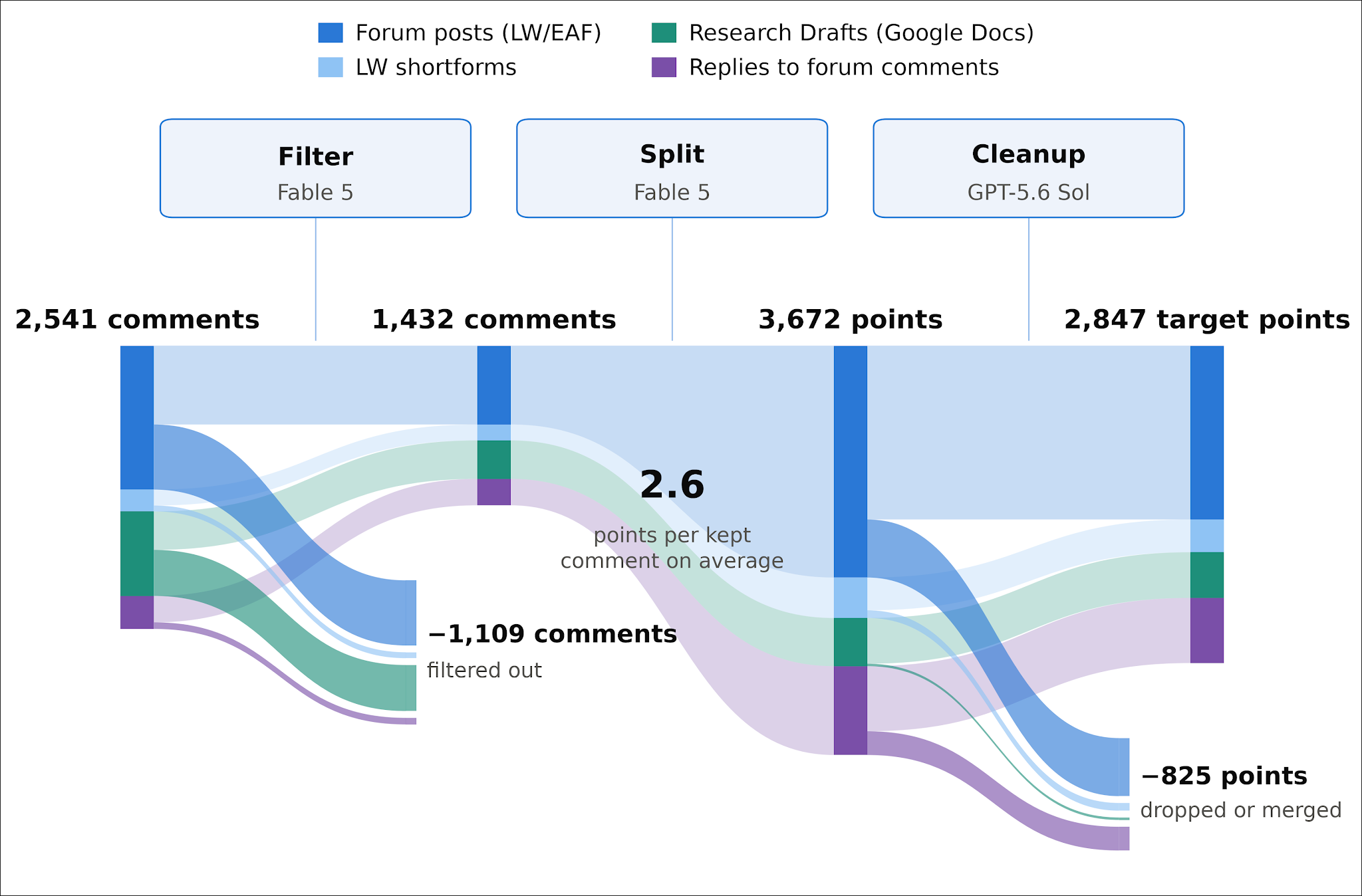
Our pipeline works as follows:
- Filter human comments: We retain comments that a) make substantive points, and b) are feasible for models to make without additional context
- Split comments into points: We split each comment into distinct points.
- Cleanup: We merge duplicate or tightly coupled points, and again filter out individual points that are infeasible for a model to make, primarily because they require additional context or are too specific.
Eliciting models to write comments
Each model is asked to leave 20 ordered comments on each document. We give models a strict length range of 50-70 words per comment. We explicitly tell models that their task is to predict the substantive points a human commenter would raise. We found that this improved performance across the board compared with asking models to just write comments. We run 4 resamples with “high” reasoning effort.
Matching AI comments to human target points
An LLM judge (Opus 5, medium effort) scores each (AI comment–human target point) pair. The rubric gives the judge a set of anchors (1.0 = “near-paraphrase”, 0.8 = “delivers most of the value the human point adds”, 0.6 = “gesturing at the same thing”). For each document, we take the share of human target points with at least one model-generated comment with a "match" score ≥ 0.8. We report the mean of that share across documents. To save time and cost, we pre-filter candidate pairs using a weak matcher (GPT-5.6 Luna, no reasoning) before the strong matcher (Opus 5) sees them. On a random set, this weak matcher only dropped 3/363 pairs that were eventually scored above 0.8 by the strong matcher.
For the reply setting, we filter down to human comments which have a reply, and prompt models to reply to them. We split the human replies into points and measure how well models’ replies match the human target points. We use the same pipeline as the other settings (filtering, splitting, cleaning up, matching) with minimal adaptation. We average performance over 4 resamples, where models write 1 reply per thread per resample.
We validated the matcher with a blind review: we (Hasan and Oscar) each scored 62 pairs of (AI comment, human target point) in 0.1 increments. We found our scores to be within 0.1 55% of the time (n=62). We discussed our >0.1pts disagreements and agreed on revised golden labels, taking the mean of our scores where we differed by just 0.1. Against those golden labels, we found that 23/25 matcher scores at or above 0.8 had a golden label of 0.75 or above. Our subjective experience from investigating disagreements with the matcher throughout the project is that the matcher is comparable to our ability when spending ~1 minute per pair.
Results
CommentBench performance across all four settings (168 documents, 2,847 human target points): forum posts, shortforms, replies and Google Doc research drafts. Each document is weighted equally. Each bar is a mean of four samples, error bars are ±1 standard error.
Over the full set of 2,847 points from 168 documents, Fable 5 performed best, matching 8.3% of target points, followed by Fable 5.1 (7.5%), Opus 5 (6.3%), and Gemini 3.8 Flash (6.1%).
We find OpenAI models underperform compared to their performance on other capabilities benchmarks. Interestingly we find that GPT-6 Astra performs very similarly (5.5%) to GPT-5.6 Sol (5.3%). We included GPT-5.6 Luna as a clearly weaker model to serve as a baseline, it performs significantly worse than other models (2.4%).
CommentBench performance in each setting: forum posts (96 docs, 1,559 human target points), shortforms (23 docs, 294 human target points), research drafts (21 docs, 410 human target points) and replies (28 docs, 584 human target points). Replies are shown as a bar chart because the comments are not ordered.
The performance numbers we report are dependent on the number of comments we asked models to leave (20). For instance, 5.6 Sol underperforms on the first few comments, particularly in the shortform and research drafts settings. Using the metric of “area under the curve of matched comments”, 5.6 Sol falls from 6th to 7th best, but the ordering of models is otherwise preserved.
FAQ
Here we address potential concerns with our methodology.
Is the difference between different models noise?
We have several measures of reliability:
- Performance across models is highly correlated across pairs of settings (Pearson r = 0.86-0.97), despite each setting containing comments from a different distribution.
- Considering random halves of the documents separately produces model scores which agree at mean Pearson r = 0.96.
- While there is a lot of variance in match rate across documents, we find that, for a given document, model performance is relatively stable when resampling (standard deviations of about 3.2% between samples vs 6% across documents). This is true despite the fact that models often match different comments when resampled: only 17.6% of the points a model matches in any sample get matched in all four. On the current benchmark, all observed gaps of at least 0.8 percentage points are distinguishable from noise using 95% confidence intervals.
Are human comments sensible targets?
Concern: Human comments are sometimes bad.
We heavily filtered comments, and later target points, using frontier models as LLM-judges. We filtered out comments which don't make substantive points, which require additional context, or which are too specific. We validated the full filtering pipeline by sampling from the final set of target points and manually labelling how many were worth keeping: we judged 45 of 50 sampled points adequate.
Concern: There are plenty of good comments that humans don't make.
This is definitely true. Models are worse than human experts at leaving insightful comments, and we think that matching a human point is a good quality signal. In an earlier small validation, we manually blind-scored a set of 63 model-written comments on a 1-5 quality scale. The comments came from 5.6 Luna, Grok 4.5 and Sonnet 5. The mean score for comments that matched a human target point was 3.46 (n=35, CI 3.14–3.77), whereas comments which did not match scored 2.11 (n=28, CI 1.79–2.46). We did not run a similar test on larger models. A valid concern about CommentBench is that human comments stop being a good signal once models are as good as humans.
Is the gap in performance between models explained by more recent models densely packing a lot of points in their comments?
We investigated this on a set of 1,000 comments from four models (Fable 5, Opus 5, Astra and Sol). We ran our splitter LLM-judge and found that 6% of those AI comments made more than 1 substantive point (2.1% for Fable). Two-point AI comments matched human target points at the same rate as single point comments (4.2%).
Maybe the Opus judge favours itself? Or other Anthropic models?
On a sample of 3.5k points (on which Claude Fable performed best overall) we found that 5.6 Sol scored Anthropic models relatively higher (+0.01, CI −0.005 to +0.026) than Opus 5, after controlling for average score.
What about knowledge cutoffs?
Knowledge cutoff does not have a strong effect on performance. The forum posts we use in our data are public, and therefore likely in the pre-training corpus. It is thus a sensible worry that models might have memorised human comments and repeated them in our task. We found no strong evidence of this effect when looking at models which had sufficient documents both before and after knowledge cutoff. Fable 5.1 and Opus 5 performed slightly better before cutoff (1.0% and 1.1% better respectively). None of the differences are statistically significant, and performance varies a lot across documents, making it hard to draw conclusions without more data.
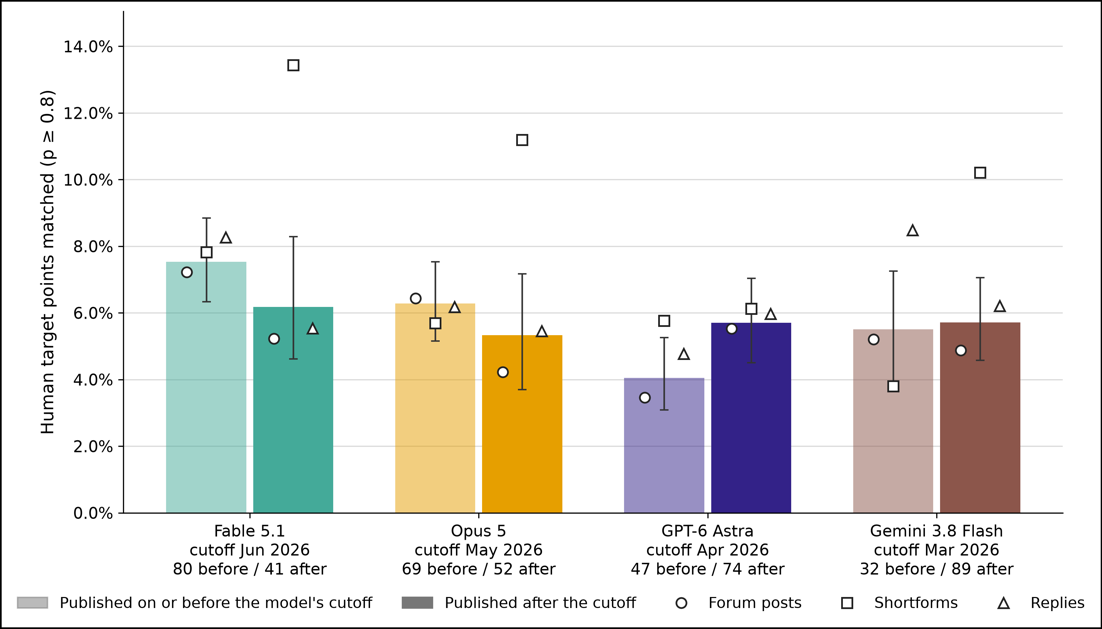
CommentBench performance before and after each model's knowledge cutoff, for the four models whose stated cutoff falls inside our date range. Error bars are 95% document-bootstrap intervals.
Example comments
Human comment on "Why we should expect ruthless sociopath ASI".
Human comment on Nina Panickssery’s shortform.
Human comment on Thomas Larsen’s shortform. Note that this example's match score is below the 0.8 threshold.
Takeaways
We think this work demonstrates that it’s possible to build high-quality conceptual reasoning benchmarks using sufficient amounts of naturally occurring data. With careful elicitation, filtering of points and validation of each LLM-judge, we feel quite good about the signal-to-noise ratio we’ve managed to achieve.
Next steps: Our main goal for CommentBench is for a frontier lab to use it as a held-out eval to hill-climb towards better performance in future models. Separately we’re considering building scaffolds to effectively leave feedback on Google Doc drafts for AI safety researchers, using CommentBench as a metric.
We would love to get access to more high-quality Google Docs. If you have AI safety drafts with good substantive comments that you are willing to share, reach out.
Thanks to Arya Jakkli, Alex Serrano, Brian Davies, Hamzah Mahmood, Alex Jackson for comments on a draft of this post. Thanks to Christine Ye for feedback during the project.

 点赞
点赞 收藏
收藏 点踩
点踩 分享
分享