OpenAI’s Next Round


This week, we and others reported that OpenAI has been in early talks with investors about a new private round that could value it at $1.2 trillion or more. That follows CEO Sam Altman’s recent statement that an initial public offering wouldn’t happen this year, not that anyone was actually expecting that!
There are plenty of unanswered questions about the recent turn of events. But the biggest—why stay private?—seems obvious. It buys the company more time to rev up sales without the pressure of disclosing on how much it’s paying for that growth, such as offering margin-crushing discounts to lure business from rival Anthropic.
It could also use the time and new cash to secure more AI servers. That could deepen OpenAI’s cash burn—but also make life harder for Anthropic, which seems to be in a mad dash to line up every last AI server it can get its hands on, as Valida’s scoop on Anthropic’s compute deal with a Trump-affiliated cloud provider shows.
There could well be demand for OpenAI shares in another private funding round from large hedge funds looking for a quick-ish pre-IPO pop. Say OpenAI values its IPO at $1.5 trillion, around the estimated valuation for Anthropic’s upcoming IPO. That would be a 25% bump from a $1.2 trillion valuation—a tidy return at a time when tech stocks look vulnerable to rate hikes and AI pacing fears.
The bigger question is which investors will write the big checks to anchor a round that will likely amount to the tens of billions of dollars. The company has already raised or received commitments for an incredible $182 billion in funding, by far the most equity ever raised by a private company, according to PitchBook, and topping Anthropic’s total $130 billion in equity funding.
As a reminder, OpenAI previously projected it would burn about $170 billion this year through 2028, largely due to rising AI training costs from renting or leasing servers. And OpenAI’s financial performance earlier this year sure made it seem like it would make good on that cash-burn promise. So putting in capital at this elevated valuation isn’t for everyone, even if the vibes around OpenAI’s GPT-6 Astra model are pretty good. After all, many of its researchers are saying publicly that it needs to slow down the pace of model development so that safety practices can catch up!
Plus, OpenAI has tapped many of the big pocketed private and public investors already. The blog post announcing $122 billion fundraise in March listed nearly 30, including asset managers such as T. Rowe Price, Fidelity and BlackRock, crossover funds such as Coatue Management, D1 Capital Partners and Dragoneer Investment Group, and Silicon Valley VC firms like Andreessen Horowitz and Sequoia Capital. All command big pools of cash, but few can write checks in the tens of billions of dollars that anchor these mega (super mega?) funding rounds.
Indeed, with the exception of SoftBank, which pledged $30 billion in the latest round, most of OpenAI’s biggest backers in its last fundraising were companies that supply the ChatGPT maker with chips and compute. Nvidia pledged $30 billion and Amazon committed to invest up to $50 billion in two stages. Amazon has since made the entire investment, after OpenAI negotiated a new agreement with long-term partner Microsoft so that it could run its AI on competing cloud services, according to a person familiar with the arrangement.
The wrinkle here is that several of OpenAI’s backers are dealing with their own capex strains—or, in SoftBank’s case, already are navigating loans to fund their past obligations.
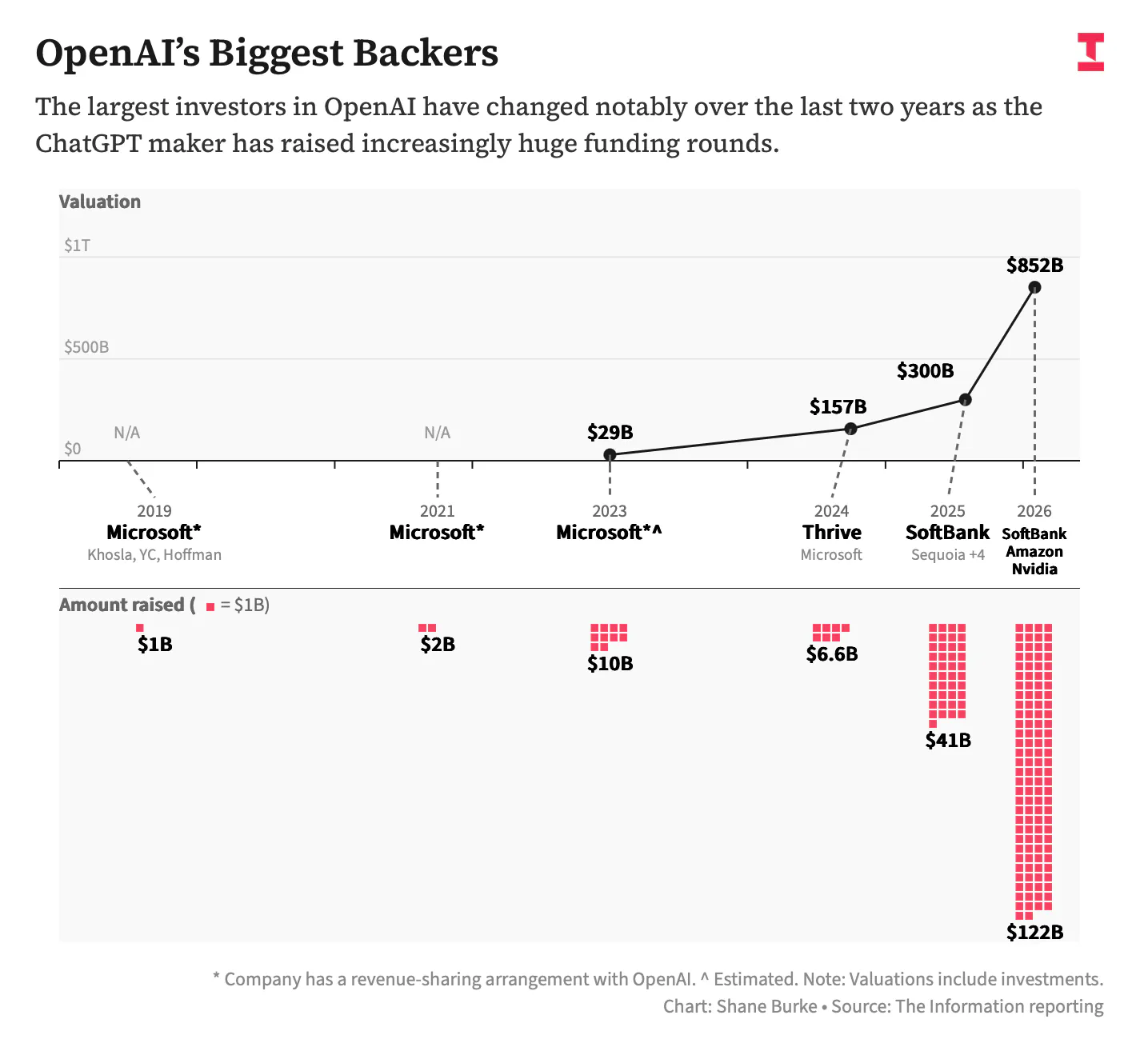
For instance, SoftBank was seeking a $10 billion loan as it worked to deliver the last, $10 billion installment of its pledged OpenAI investment, Bloomberg reported in August. Amazon in July projected capital expenditures of $200 billion this year, likely far more than the cash its operations will generate. And Nvidia, as part of a dealmaking sprint over the last few months, is providing credit support covering up to $105 billion of a massive data center in Ohio that OpenAI will use for its AI. Any of these companies may be loath to rattle their own creditors and shareholders by taking another big slug of OpenAI equity.
Who does that leave? In theory, other suppliers that may expect OpenAI’s business will keep growing. These include Broadcom, with which it’s designing custom chips. The cash and marketable securities of its suppliers isn’t bottomless, of course (Broadcom had about $24 billion in cash and equivalents as of August) and some are facing their own funding constraints. With suppliers that have the cash, however, the gamble may seem smart—especially if OpenAI’s revenue picks up steam.
That’s the big question. OpenAI’s annualized revenue growth in July rose past $40 billion, well behind Anthropic’s $65 billion. In recent weeks, OpenAI has touted gains in use of its Codex coding product and from its recently released models, including 5.6 and Astra. But it also cut prices, a tactic that’s great for user growth but doesn’t help as much with cash receipts.
Laura Mandaro is an editor in San Francisco who supports our reporters covering venture capital, startups and artificial intelligence. She can be contacted at [email protected].

 点赞
点赞 收藏
收藏 点踩
点踩 分享
分享