Either Meta Glasses are selling extremely well or this Citi survey might have some issues

Some research from Citi landed in FT Alphaville’s inbox on Tuesday, presenting the bank’s latest consumer survey. Its Global Consumer Electronics team wrote:
We collaborated with Citi’s Research Innovation Lab to survey 4,000+ global consumers ahead of the back-to-school season to explore how purchase behavior and spending intentions for consumer electronics have evolved.
We collaborated with Citi’s Research Innovation Lab to survey 4,000+ global consumers ahead of the back-to-school season to explore how purchase behavior and spending intentions for consumer electronics have evolved.
Their main finding is that more Americans and Brits plan to buy technology, like printers, than they used to:

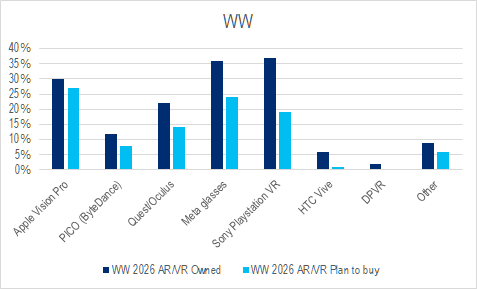
But scrolling through the charts, we found ourselves a little confused about what type of people they’re surveying. Most strikingly, here’s their chart for worldwide adoption of augmented and virtual reality headsets:

The analysts write:
Looking ahead, we expect a continued category shift towards AI glasses. 35% of survey respondents owned Meta Glasses globally, with 25% looking to purchase in 2026, with US penetration the highest of all regions at 45% ownership and 30% planning to buy.… we would expect greater adoption of AI glasses going forward.
Looking ahead, we expect a continued category shift towards AI glasses. 35% of survey respondents owned Meta Glasses globally, with 25% looking to purchase in 2026, with US penetration the highest of all regions at 45% ownership and 30% planning to buy.… we would expect greater adoption of AI glasses going forward.
We found this statistic perplexing. At the start of this year, Ray-Ban Meta Glasses maker EssilorLuxottica reported it had sold 7mn of the controversial eyewears in 2025, on top of 2mn sold across 2023 and 2024. Around the same time, Bloomberg reported the company was looking to increase production capacity to 20mn pairs by the end of this year.
Although impressive in its own disturbing way, we were sceptical that could translate to a third of the global population, perhaps 2.9 billion people, owning the “pervert glasses”. There is no way that is what Citi intended to imply.
Confused, we asked Citi about their methodology. They told us it was an online opt-in survey, conducted by WPP / Kantar agency, of 1,000 people from each region who own or plan to buy “at the least” one device from the following list: “smartphone , computer, tv set, video game, computer accessories, tablet, ar/vr glasses, smartwatch”. We assume the “plan to buy” respondents were in an internet café or borrowing someone’s phone.
Still confused, we asked whether that means it’s 35 per cent of this device-minded cohort who own Meta Glasses. We were told “obviously” they meant 35 per cent of the subset of respondents who already own AR/VR/smart glasses, despite that not being indicated anywhere in the note.
Still confused, we asked how big that subset is. We were told “22% have an AR/VR/smartglass device and/or plan to buy one at a global level”. That’s a wider cohort than initially indicated (since it includes plan to buys), which makes it all the stranger. Based on the 35 per cent Meta Glasses ownership figure, that would translate to about 8 per cent of all humans who are engaged with basically any form of computer technology, which realistically will mean the majority of humans. In this context, the numbers would be skewed by all the respondents being from developed countries, but even if we imagine that number is a conservative 6bn, it would translate to about 480mn people owning Meta Glasses.
Still confused, we checked that 8 per cent figure with Citi, who to our mild surprise told us “yes”, and that penetration was “higher” in the US.
Still confused, we asked Citi if they meant to imply hundreds of millions of people own Meta Glasses. They noted that the questions are “framed more as [household] penetration”, and said that “if the avg. HH size is ~4 people, then that suggests personal Meta glasses device penetration closer to ~2%”.
Right. Let’s run those numbers in an extremely generous fashion. Using that ~4 person average household size figure (the reality is likely to be about 2.5 people per household across those particular four countries, and might be different for the type of households where somebody owns Meta Glasses) to create a 2 per cent penetration rate, and then applying it to only the combined populations of the UK, US, China and Japan (about two billion), that still translates to about 40mn Meta Glasses sold. Extrapolating it to the global population gives a figure of about 160mn. EssilorLuxottica’s next earnings report is next month. If those numbers are true, it might be quite the event.
Still confused, we asked Citi one more time if they felt these numbers are realistic. A spokesperson told us:
The team does this to show from a time series perspective how the overall responses have changed and moved up/down. They are looking at it more directionally versus a point in time.
The team does this to show from a time series perspective how the overall responses have changed and moved up/down. They are looking at it more directionally versus a point in time.
Still confused, we gave up and filed this piece.
Further reading:
— There’s something a bit phishy about this sell-side note…

 点赞
点赞 收藏
收藏 点踩
点踩 分享
分享