20 Ancient Artifacts That Rewrote History: Discoveries That Changed What We Know

Archaeology Physical Evidence & Paradigm Shifts
20 Ancient Artifacts That Rewrote History (And The Paradigms They Shattered)
Physical evidence has a way of embarrassing the written record. These twenty objects, spanning 75,000 years, forced archaeologists to revise what they thought they knew about cognition, law, writing, and power.
20 ObjectsCase StudiesForensic AuditPhysical EvidenceInstitutional ArchivesPrimary Sources
ALI MUJTUBA ZAIDI Independent History Researcher · The Historical Insights
Published: September 2026
The Physical Evidence That Forces Us to Rewrite the Books
History is not a fixed record of what happened. It is a working consensus, built from whatever evidence happened to survive, and it changes every time something new is pulled out of the ground. For a long time, that consensus leaned heavily on written sources, which meant it favored literate societies and left enormous gaps everywhere else. It also leaned on what early antiquarians thought was worth keeping, which was usually gold, statuary, and anything that photographed well, not the layers of dirt around it that actually explained what an object was for.
These twenty ancient artifacts that rewrote history are the kind of discoveries that don’t fit quietly into an existing narrative. A carved bone forces a rethink of when mathematics began. A gold mask forces historians to take Homer more seriously than they wanted to. A single crystal lens raises an uncomfortable question about what an 8th-century BCE craftsman actually understood about light. None of them “changed everything” on their own, and a few of the claims made about them, in popular writing at least, go further than the evidence supports. What follows tries to keep that distinction intact: what the object shows, what it changed, and where the argument is still open.
In This Feature
Cognitive Evolution & Early Society
Statecraft & Imperial Architecture
Technological Leaps & Realism
Texts, Chronicles & Propaganda
Industry, Science & Faith
Section One
Cognitive Evolution & Early Society
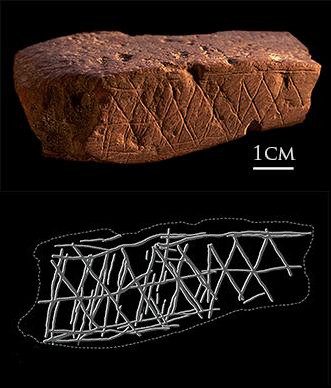
No. 01 · Blombos Cave, South Africa
Blombos Cave Engraved Ochre
Datec. 75,000 BCE CultureMiddle Stone Age Homo sapiens Discovery1999–2000 Current LocationIziko Museums of South Africa
Pushed back the timeline of human symbolic thought by over 30,000 years. Paradigm Shattered
For decades, the standard timeline held that complex symbolic thinking arrived with a “creative explosion” among modern humans in Ice Age Europe, roughly 40,000 years ago. A small piece of red ochre excavated from Blombos Cave, on South Africa’s southern Cape coast, by Christopher Henshilwood’s team between 1999 and 2000, pushed that timeline back by more than 30,000 years.
The surface carries a deliberate cross-hatched geometric pattern, not the accidental scoring you’d expect from grinding pigment. Microscopic wear analysis supports intentional engraving with a controlled hand, and the surrounding layer has been dated to roughly 75,000 years ago through methods including thermoluminescence on burnt lithics found nearby. Whether the engraving counts as language-adjacent symbolism or simply decorative marking is still debated, but the date itself is well accepted, and it places abstract mark-making on the African continent tens of thousands of years before Europe’s more famous cave art.
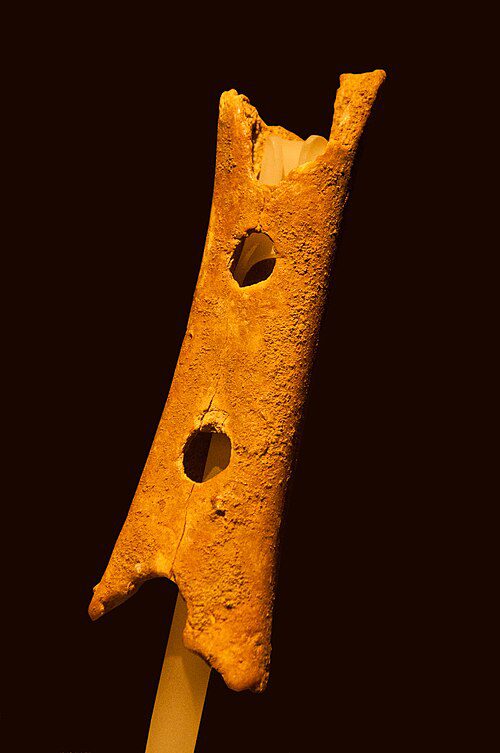
No. 02 · Cerkno, Slovenia
Divje Babe Flute
Datec. 43,000 BCE CultureNeanderthal Discovery1995 Current LocationNational Museum of Slovenia, Ljubljana
Suggests Neanderthals were capable of abstract musical expression. Paradigm Shattered
Neanderthals spent much of the 20th century cast as cognitively limited cousins of modern humans, unlikely to have made art or music. This fragment of a young cave bear’s thigh bone, pierced with several evenly spaced holes, is one of the objects that complicated that picture, provided it is what its early excavators claimed.
That “provided” is doing real work. A vocal group of researchers, including Ivan Turk’s original team, argue the spacing and shape are consistent with a deliberately drilled instrument capable of producing a musical scale. An equally serious body of research, led by paleontologists like Cajus Diedrich, argues the holes match the puncture pattern of a hyena’s canine teeth gnawing through a discarded bone. This is a genuinely unresolved argument, not a settled discovery, and any account that presents it as one or the other without the caveat is oversimplifying the evidence.
Ongoing Debate The “flute or hyena bite” question has not been resolved in the peer-reviewed literature. Treat claims in either direction with some caution.

No. 03 · Willendorf, Austria
Venus of Willendorf
Datec. 28,000–25,000 BCE CultureGravettian Discovery1908 Current LocationNatural History Museum Vienna
Shifted focus to Paleolithic female symbolism, fertility cults, and long-distance trade. Paradigm Shattered
Early Paleolithic archaeology was built almost entirely around hunting technology, tools, and weapons, an inevitably male-centered story given what survives from the period. The 1908 discovery of this 4.4-inch limestone statuette, its face left blank beneath deeply carved braided hair, its body and reproductive features exaggerated, forced a wider conversation about what else Ice Age people were making and why.
Scholars still debate its purpose. It may relate to fertility ritual, to a widely shared representational convention for the female form, or to something closer to a self-portrait carved from a low vantage point, an interpretation proposed more recently by researcher Catherine McCoid. What’s less disputed is the stone itself: the oolitic limestone isn’t local to the Danube valley site, which means the people who carved it, or the raw material, traveled a real distance, evidence of a wider Ice Age exchange network than the “isolated hunter-gatherer band” model once assumed.
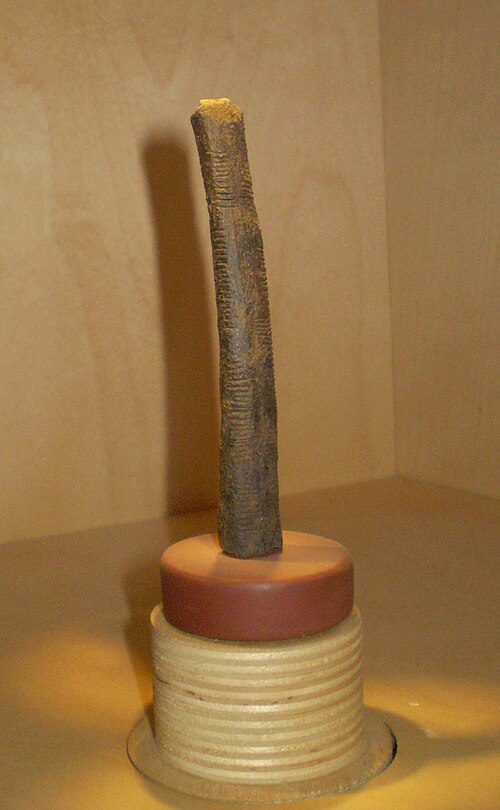
No. 04 · Ishango, Democratic Republic of the Congo
Ishango Bone
Datec. 20,000 BCE CultureUpper Paleolithic Discovery1950 Current LocationRoyal Belgian Institute of Natural Sciences, Brussels
Suggests an early understanding of mathematics, multiplication, and prime numbers before agriculture. Paradigm Shattered
The origins of counting were long assumed to sit with the agricultural bookkeeping of Mesopotamia and Egypt. Jean de Heinzelin’s 1950 discovery of this notched baboon fibula, tipped with a quartz point, at a fishing site on the DRC-Uganda border, pushed organized numerical thinking back into the deep hunter-gatherer past, well before agriculture existed anywhere.
The bone carries three columns of notches in irregular groupings. De Heinzelin himself, and later researchers, noticed patterns that could represent prime numbers between 10 and 20, or doubling and near-doubling sequences. Those readings remain actively debated; other specialists, including the mathematician Olivier Keller, argue the groupings are just as consistent with a simple lunar tally or an unstructured tool-handle grip, with the “mathematical” pattern more visible to modern eyes than it would have been intentional to its maker. What isn’t disputed is that the notches are deliberate and structured, evidence of organized symbolic counting tens of thousands of years earlier than once assumed, even if exactly what was being counted remains an open question.
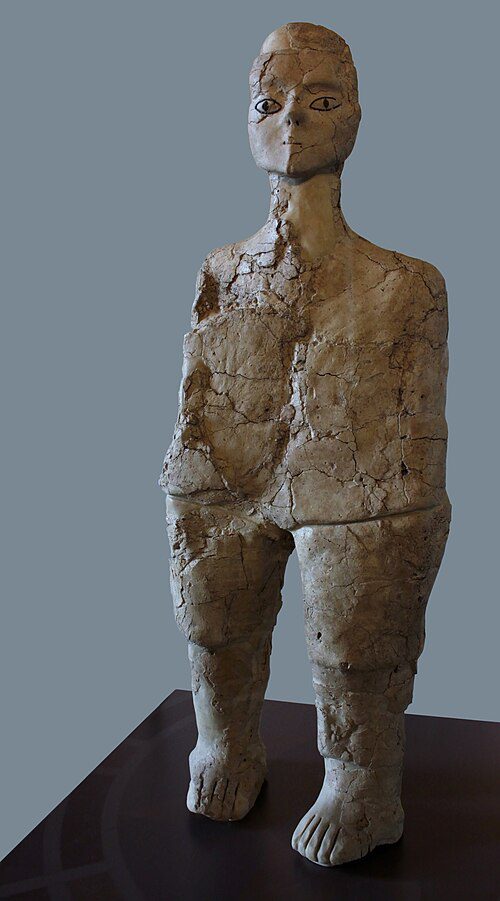
No. 05 · Amman, Jordan
Ain Ghazal Statues
Datec. 7000–6500 BCE CulturePre-Pottery Neolithic B/C Discovery1983 Current LocationJordan Museum, Amman / Louvre
Proved sophisticated artistic monumentalism emerged during the fraught transition to early agriculture. Paradigm Shattered
Large-scale representations of the human body were long assumed to be a product of settled, pottery-using urban civilizations, the kind that showed up later in Mesopotamia. The half-scale plaster figures recovered from ‘Ain Ghazal, built up over armatures of bundled reeds with cowrie-shell eyes and painted features, are considerably older than that assumption allowed for, dating to the Pre-Pottery Neolithic, before ceramics existed in the region.
The statues were deliberately buried in pits beneath the floors of abandoned houses, which suggests a ritual function tied to ancestor veneration rather than casual display. That points to something specific: a community only a few thousand years into farming already had the surplus labor, social organization, and shared symbolic vocabulary to produce monumental art, long before anything resembling a city or a state existed at the site.
Section Two
Statecraft & Imperial Architecture
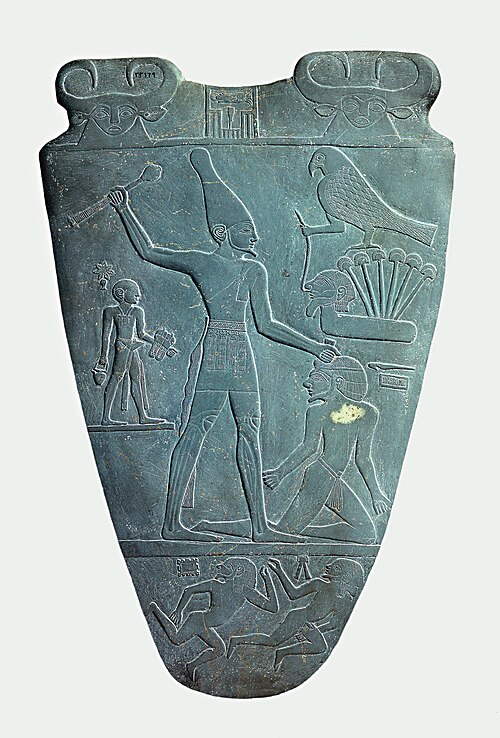
No. 06 · Hierakonpolis, Egypt
Narmer Palette
Datec. 3100–3000 BCE CultureEarly Dynastic Egypt Discovery1897–1898 Current LocationEgyptian Museum, Cairo
Provides the earliest physical record of a politically unified Egypt under one king. Paradigm Shattered
This shield-shaped siltstone palette, originally a ceremonial version of an everyday cosmetics-grinding tool, is one of the earliest surviving pieces of physical evidence for a unified Egyptian state. One face shows King Narmer wearing the White Crown associated with Upper Egypt; the other shows him wearing the Red Crown associated with Lower Egypt, standing over a defeated enemy.
Modern archaeology treats unification as a gradual process that unfolded over generations rather than a single conquest, so the palette is best read as a monument commemorating and legitimizing an already-consolidating state, not a snapshot of the literal unifying battle. What it undeniably established was a visual language, the smiting pose, the hierarchical scaling of figures by importance, that would define Egyptian royal propaganda for the next three thousand years.
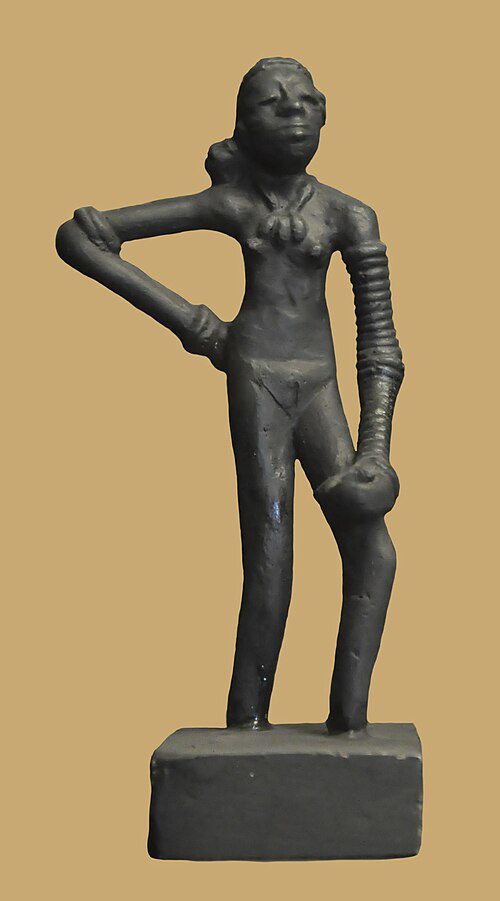
No. 07 · Mohenjo-Daro, Pakistan
Mohenjo-Daro Dancing Girl
Datec. 2500 BCE CultureIndus Valley (Harappan) Discovery1926 Current LocationNational Museum, New Delhi
Shifted perceptions of Indus Valley metallurgy and social expression. Paradigm Shattered
Because the Indus script remains undeciphered, early 20th-century assessments of Harappan society leaned heavily on its uniform brick architecture and drainage systems, painting a picture of an austere, administratively rigid culture. This four-inch bronze figure, standing with one hand on her hip and both arms stacked with bangles, complicated that reading considerably.
She was cast using the lost-wax (cire perdue) method, which requires real metallurgical sophistication, and her relaxed, confident pose reads as individual and expressive rather than institutional. The statuette doesn’t tell us what Harappan society believed or how it was governed, since we still can’t read its writing system, but it makes clear the culture had room for personal adornment, leisure, and artistic expression alongside its famous urban planning.
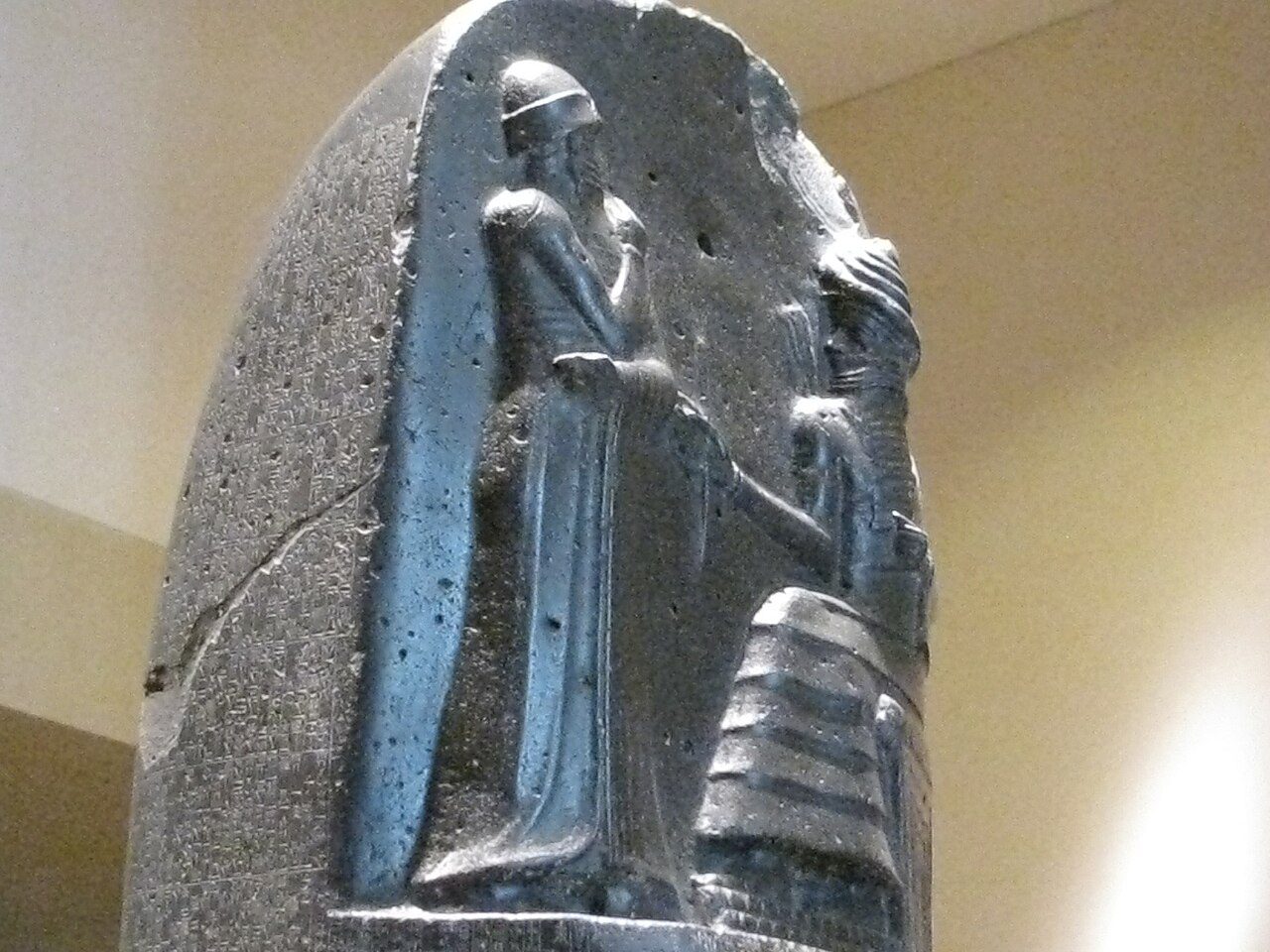
No. 08 · Susa, Ancient Elam (Modern Iran)
Code of Hammurabi Stele
Datec. 1754 BCE CultureFirst Babylonian Dynasty Discovery1901 Current LocationLouvre Museum, Paris
Demonstrated the codification of the presumption of innocence in early law. Paradigm Shattered
Codified law with a claim to universal application across an empire was, for a long time, credited mainly to later Greek and Roman traditions. Excavated at Susa in 1901, where it had been carried off as war booty by an Elamite king centuries after it was carved, this 2.25-meter diorite stele records 282 laws in Old Babylonian cuneiform, pushed the genesis of monumentalized, publicly displayed law back to 18th-century BCE Mesopotamia.
It is not, as it is sometimes framed, the first known law code; earlier, more fragmentary codes from Ur-Nammu and Lipit-Ishtar predate it by centuries. Its significance is different: this is the most complete, most publicly staged example, setting out commercial regulations, wage standards, and a requirement for evidence before conviction, carved somewhere every literate subject of the empire could, in principle, see it. It monumentalized law as a structural feature of the state, not a private prerogative of the ruler.
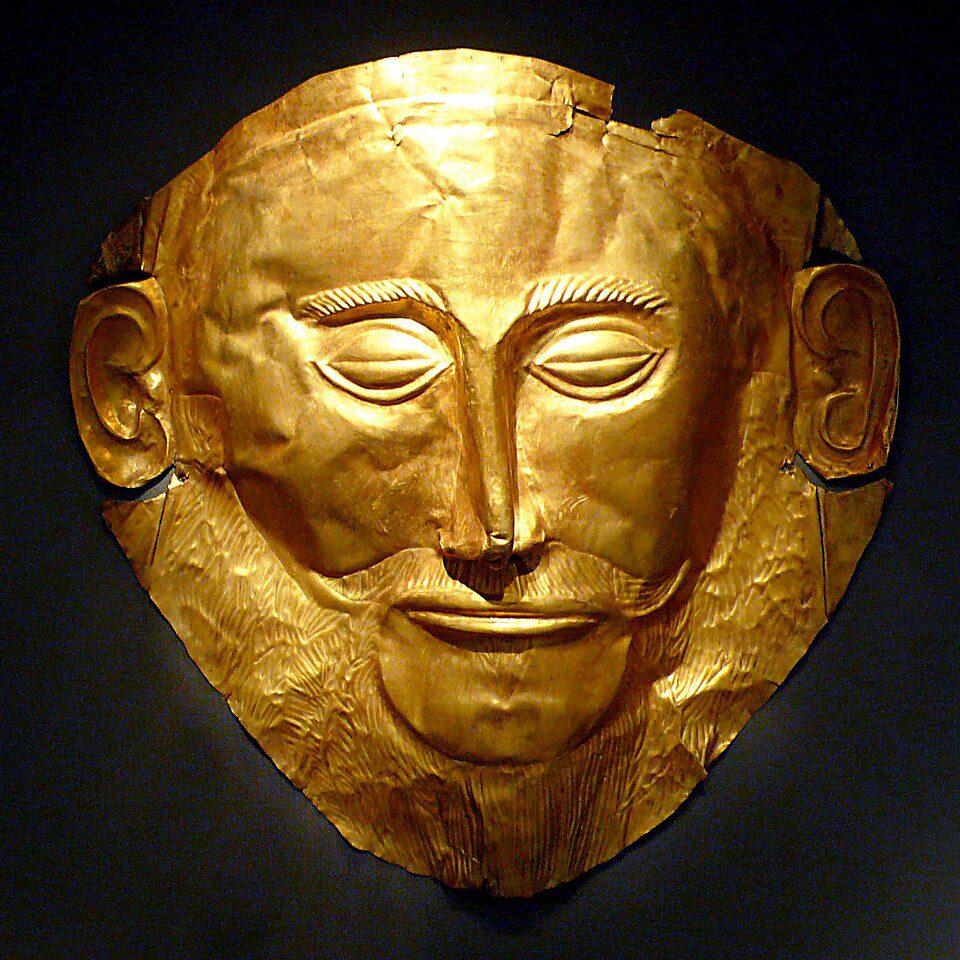
No. 09 · Mycenae, Greece
Mask of Agamemnon
Datec. 1550–1500 BCE CultureMycenaean Greece Discovery1876 Current LocationNational Archaeological Museum, Athens
Proved the existence of a wealthy Mycenaean civilization, validating Homeric epic themes. Paradigm Shattered
Into the late 19th century, mainstream scholarship treated Homer’s Iliad as literature, not history, with no expectation that a real Bronze Age culture lay behind it. Heinrich Schliemann’s 1876 excavation of Grave Circle A at Mycenae, and this gold repoussé death mask in particular, forced a reassessment: a wealthy, martial, gold-rich Mycenaean civilization had genuinely existed.
Schliemann is often quoted claiming he had “gazed upon the face of Agamemnon.” Stratigraphy later showed the mask predates the Trojan War era by roughly three centuries, ruling out any literal connection to Homer’s king. A smaller, separate controversy has also followed the mask for over a century: a handful of scholars, most notably William Calder in the 1980s, have questioned whether Schliemann, an excavator with a documented history of embellishing his own discoveries, altered or enhanced the mask after unearthing it. Most archaeologists today regard it as genuine, but the debate is a useful reminder that even foundational finds carry a documented chain of custody worth examining.
Section Three
Technological Leaps & Realism
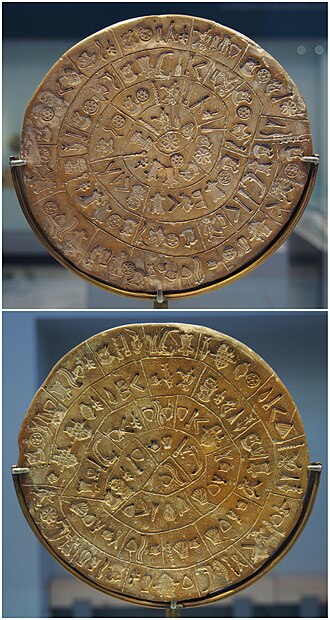
No. 10 · Palace of Phaistos, Crete
Phaistos Disc
Datec. 1850–1600 BCE CultureMinoan Discovery1908 Current LocationHeraklion Archaeological Museum
Represents an unprecedented conceptual leap toward stamped (typographic) text. Paradigm Shattered
Movable, reusable type is usually dated to Gutenberg’s 15th-century printing press, or to earlier Chinese and Korean woodblock and metal-type systems. This fired clay disc, found in 1908 and bearing 241 tokens made from 45 distinct signs arranged in a spiral, is a genuine outlier: the symbols weren’t drawn with a stylus but pressed into the wet clay using individual, reusable stamps.
That’s a real conceptual leap toward typography, made in Bronze Age Crete. But the disc comes with real limits on what it can prove. It is the only object of its kind ever found; no comparable stamps, tools, or companion texts have surfaced anywhere else, which makes it archaeologically isolated. Its script remains undeciphered, and without other examples to compare it against, scholars can’t fully rule out a later origin or a non-Minoan source, though the balance of expert opinion accepts it as an authentic Bronze Age Cretan artifact. It demonstrates that the idea of stamped, reusable text existed millennia before it became a widespread technology, not that it triggered a broader printing tradition.
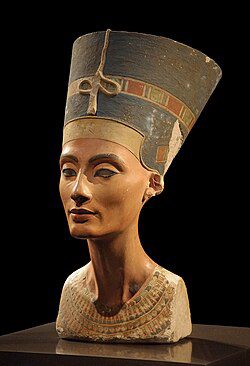
No. 11 · Tell el-Amarna, Egypt
Bust of Nefertiti
Datec. 1345 BCE CultureNew Kingdom Egypt (Amarna Period) Discovery1912 Current LocationNeues Museum, Berlin
Revealed the sophisticated use of sculptor models and a dramatic shift in Egyptian artistic realism. Paradigm Shattered
Egyptian royal art was, for most of its three-thousand-year history, rigidly stylized: idealized proportions, unchanging poses, theology over likeness. Ludwig Borchardt’s 1912 discovery of this limestone-and-stucco bust in the ruined workshop of the sculptor Thutmose revealed a sharp, if temporary, break from that convention during the reign of Akhenaten.
The piece was likely never meant as a finished monument. Missing an inlaid left eye and showing tool marks consistent with a working model, it was probably used to train other sculptors in a new house style. Its anatomical precision, down to subtle signs of age around the eyes, shows Egyptian artisans were fully capable of naturalistic portraiture. They generally chose not to use it, which says as much about Egyptian religious convention as the bust’s existence says about Egyptian artistic skill.
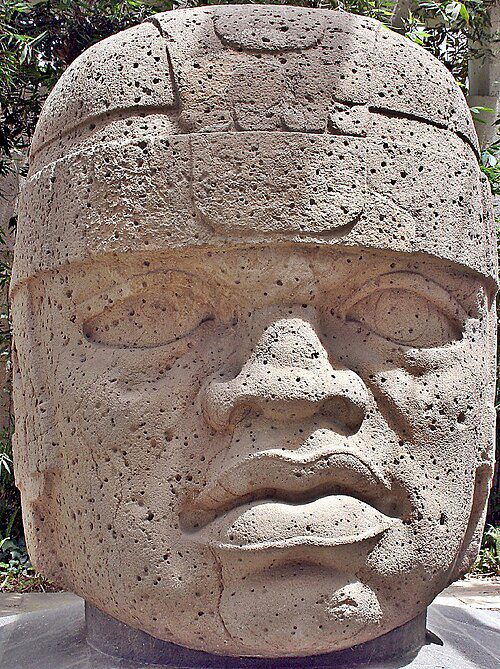
No. 12 · Tres Zapotes, Veracruz, Mexico
Olmec Colossal Head 1 (Tres Zapotes)
Datec. 900–400 BCE CultureOlmec Discovery1862 Current LocationMuseo de Antropología de Xalapa / INAH
Established the Olmec as the foundational “mother culture” of Mesoamerica. Paradigm Shattered
For much of the 20th century, the Maya were treated as Mesoamerica’s founding complex civilization. The Olmec colossal heads, individualized basalt portraits of rulers wearing fitted headgear, some weighing up to 50 tons, pushed that timeline back by centuries and repositioned the Olmec as an earlier, foundational culture whose influence spread across the region.
The basalt itself wasn’t local. It had to be quarried in the Tuxtla Mountains and moved dozens of miles, likely by river raft and overland sledge, without draft animals or the wheel. That logistical feat, as much as the carving itself, is the real evidence: it points to centralized authority capable of organizing large-scale labor long before anything resembling an empire existed in the region.
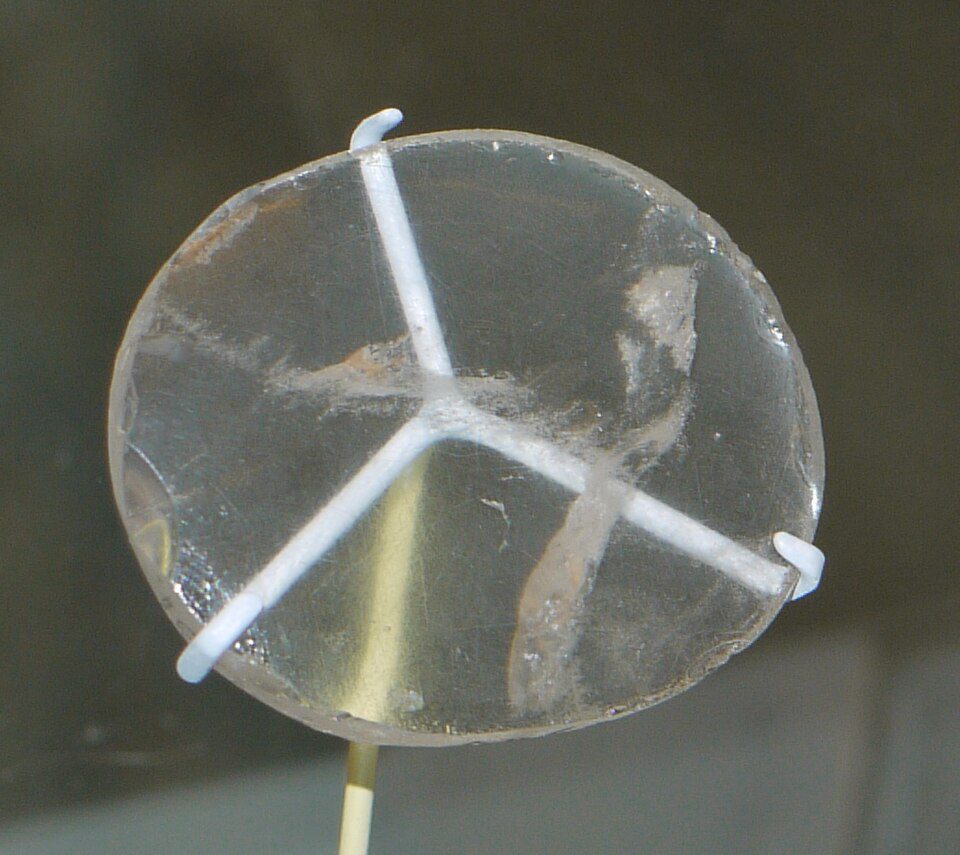
No. 13 · Nimrud, Modern Iraq
Nimrud Lens
Datec. 750–710 BCE CultureNeo-Assyrian Empire Discovery1850 Current LocationBritish Museum, London
Sparked ongoing debates regarding the existence of ancient optical technology. Paradigm Shattered
Optical lenses are conventionally traced to medieval Europe. Austen Henry Layard’s 1850 discovery of this ground rock crystal, oval, flat on one side, slightly convex on the other, with a focal length of roughly 11 centimeters, complicated that history without settling it.
It genuinely does function as a crude magnifying glass. Whether the Assyrians who made it used it that way is a separate, unresolved question: some archaeologists read it as a decorative furniture inlay or a seal-cutter’s tool, not a deliberate optical instrument. What keeps the debate alive is that surviving Assyrian cuneiform carvings exist at a scale that’s genuinely difficult to produce, or read, without magnification. The lens doesn’t prove Assyrian opticians existed. It proves the raw capability for magnification was available in the 8th century BCE, and leaves open how, or whether, it was deliberately used.
Ongoing Debate Functional lens versus decorative inlay remains unresolved; the British Museum itself presents both interpretations without endorsing one.
Section Four
Texts, Chronicles & Propaganda
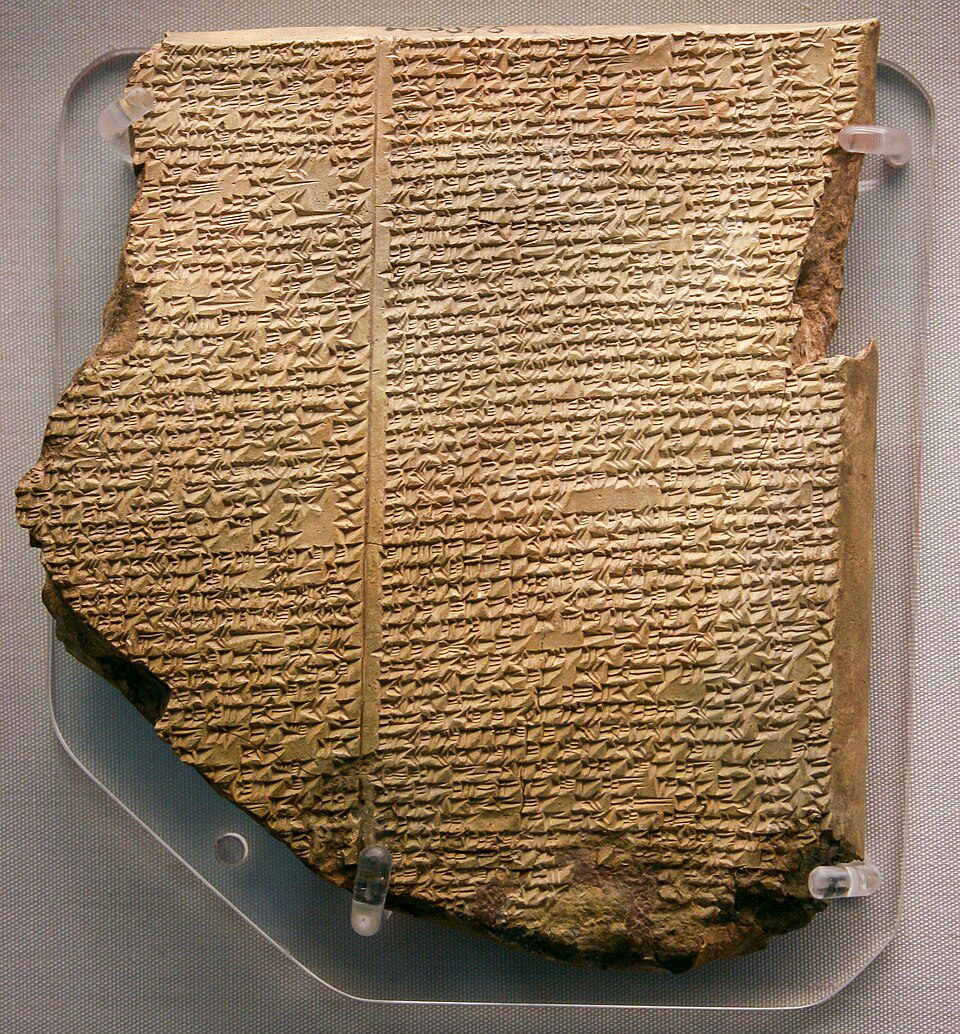
No. 14 · Library of Ashurbanipal, Nineveh
The Flood Tablet (Epic of Gilgamesh)
Datec. 7th century BCE CultureNeo-Assyrian Empire Discovery1853 Current LocationBritish Museum, London
Proved the biblical flood narrative was preceded by earlier Mesopotamian epics. Paradigm Shattered
Through most of the 19th century, the Hebrew Bible was widely treated as the oldest surviving narrative of its kind. In 1872, the self-taught Assyriologist George Smith translated this tablet, the eleventh in the Epic of Gilgamesh, in front of the Society of Biblical Archaeology and realized it described a flood story strikingly close to that of Noah: a man ordered to build a boat, preserve animals, and release birds to find land.
The tablet is a 7th-century BCE copy of a much older Mesopotamian tradition, predating the biblical account by centuries. That didn’t discredit the biblical text, but it did permanently change how historians and theologians think about it, as part of a shared, older Near Eastern literary and flood-narrative tradition rather than a wholly original account. It reframed the relationship between religious texts and their surrounding literary culture.
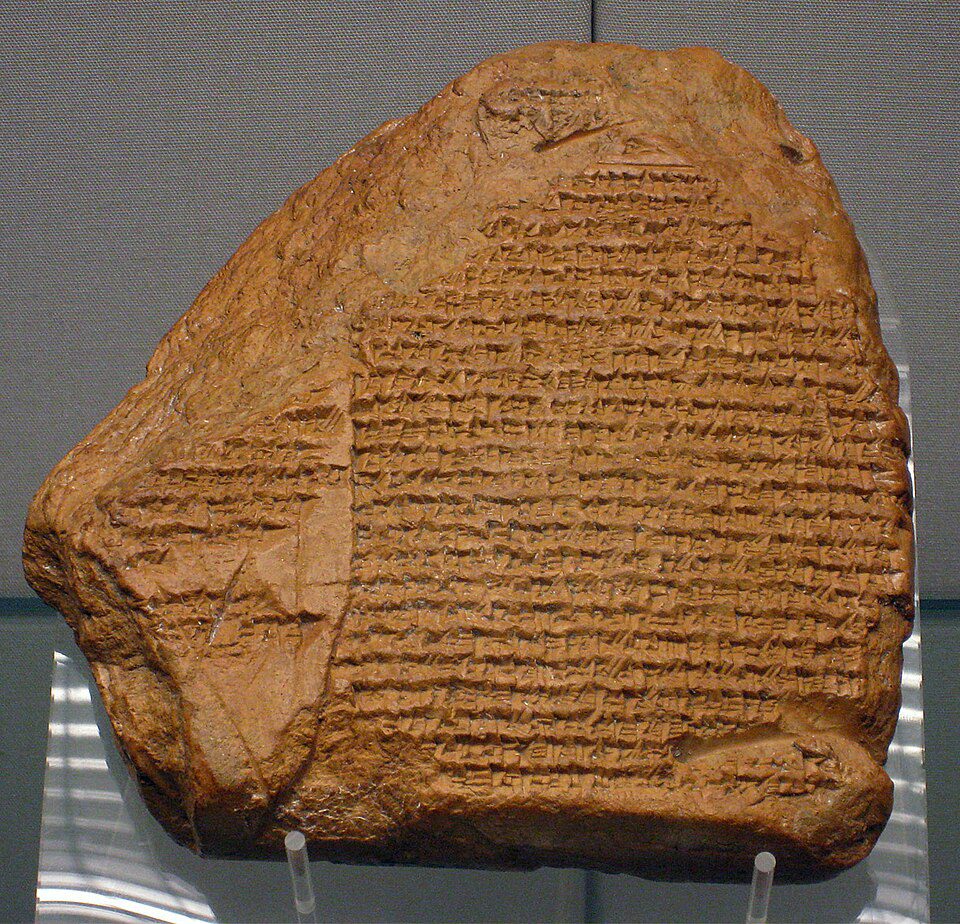
No. 15 · Babylon, Iraq
Nabonidus Chronicle
Date556–539 BCE CultureNeo-Babylonian Empire Discovery1879 Current LocationBritish Museum, London
Demonstrates the evolution of sequential historical recording in cuneiform. Paradigm Shattered
Ancient Near Eastern history reached European scholars for a long time filtered through Greek writers like Herodotus, who mixed reportage with legend. This clay tablet, part of a wider series of Babylonian chronicles, is closer to administrative record-keeping than storytelling: a dry, year-by-year account of King Nabonidus’s reign, including his prolonged, unexplained absence in Arabia and his failure to attend Babylon’s annual spring Akitu festival.
It’s an unflattering document, and that’s exactly what makes it useful. Royal inscriptions are usually self-promotional; a chronicle recording a king’s political failures suggests a scribal tradition working somewhat independently of pure propaganda. It’s one of the texts that lets historians reconstruct Babylon’s final years, and Cyrus’s subsequent conquest, from something closer to a contemporary internal record rather than a later, outside account.
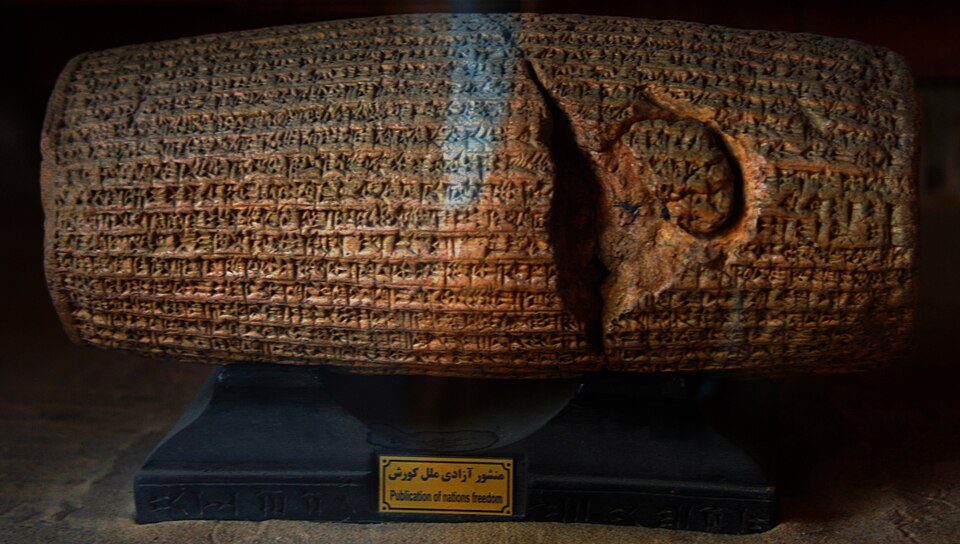
No. 16 · Babylon, Iraq
Cyrus Cylinder
Datec. 539–530 BCE CultureAchaemenid Persian Empire Discovery1879 Current LocationBritish Museum, London
Illuminated Achaemenid imperial propaganda and repatriation policies, shattering the Greek narrative of Persian tyranny. Paradigm Shattered
Before this baked-clay cylinder surfaced at Babylon in 1879, most European understanding of the Achaemenid Persian Empire came filtered through hostile Greek sources, which painted it as despotic. The cylinder, written in Akkadian cuneiform, records Cyrus the Great’s largely peaceful capture of Babylon and a set of restoration policies: rebuilding desecrated temples, ending certain forced-labor practices, and returning displaced peoples and looted cult statues to their home sanctuaries.
The cylinder is genuinely significant as evidence of an imperial governing style built around religious tolerance and administrative continuity rather than pure destruction. It is worth being precise about a claim that circulates widely, however: the popular description of it as the “first human rights charter” is a 20th-century framing, not an ancient one, and most Assyriologists consider it an overstatement. The text follows a long-established Mesopotamian genre of royal building and restoration inscriptions, similar in form to declarations by earlier Assyrian and Babylonian kings. It also does not name the Jewish exiles or Jerusalem specifically; the connection to the biblical account of the Jewish return, described in the Book of Ezra, is an inference based on Cyrus’s general repatriation policy, not a statement in the cylinder’s own text.
Correcting a Popular Claim The cylinder documents a real and consequential restoration policy. It is not a rights charter in any modern legal sense, and it doesn’t mention Jerusalem or Jewish exiles by name.
Section Five
Industry, Science & Faith
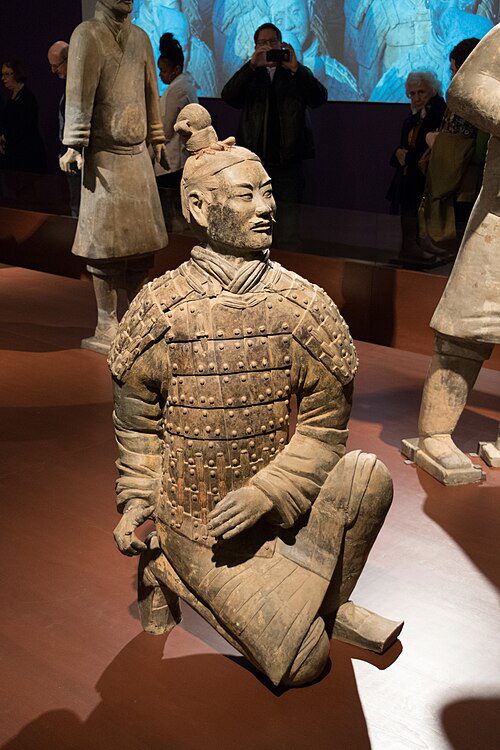
No. 17 · Xi’an, China
Terracotta Kneeling Archer
Datec. 210 BCE CultureQin Dynasty Discovery1974 Current LocationEmperor Qinshihuang’s Mausoleum Site Museum
Revealed the industrial scale, standardization, and modular assembly of Qin weapon systems. Paradigm Shattered
The Terracotta Army is famous as a spectacle of scale. This individual kneeling archer, recovered largely intact from Pit 2 (many standing figures elsewhere were crushed when the wooden roof above them collapsed), is more useful for what close analysis of a single figure reveals about how the whole army was actually built.
The figure wasn’t sculpted whole. Its head, torso, arms, and legs were produced separately, in molds, by specialized workshops, then assembled and individualized with unique facial features and hand-applied details before firing. That’s a genuinely industrial process, closer to modular assembly than singular sculpture, organized at a scale that implies standardized workshops and a coordinated labor system roughly two thousand years before anything resembling an assembly line existed in Europe.
No. 18 · Khujut Rabu, near Baghdad, Iraq
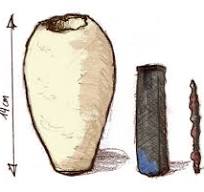
Baghdad Battery
Datec. 250 BCE–224 CE CultureParthian Empire Discovery1936 Current LocationNational Museum of Iraq
Challenges assumptions about the limits of ancient electrochemical understanding. Paradigm Shattered
Wilhelm König’s 1938 identification of this vessel, a ceramic jar housing a copper cylinder and an iron rod sealed with bitumen, as an ancient galvanic battery has made it one of the most persistently repeated “ancient technology” claims in popular archaeology. It’s worth being direct about where the evidence actually stands: most specialists who have studied Parthian and Sassanian material culture are skeptical of the battery interpretation.
The vessel can, when filled with an acidic liquid such as vinegar, produce a weak current, and modern replicas, including one built for a television experiment, have demonstrated this. But no wires, electrodes, or electroplated objects have been found at the same site or at any comparable Parthian context, and nothing in the surviving textual record describes anything resembling electroplating or battery use. The leading, more conservative interpretations are that the vessel held a sacred scroll, similar to containers found at other regional sites, or served some other storage or ritual function. The object is real and its physical capability is real; the ancient-battery narrative built around it is not well supported.
Correcting a Popular Claim Mainstream archaeological opinion favors a storage or ritual function over an electrical one. Treat “ancient battery” framing as a popular hypothesis, not an established fact.
No. 19 · Qumran Caves (West Bank)
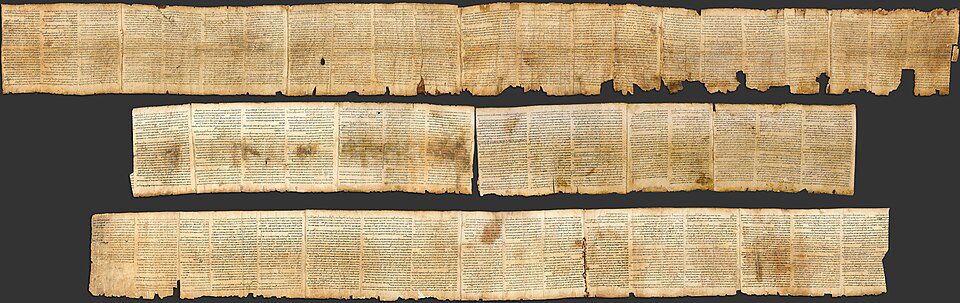
Great Isaiah Scroll
Datec. 125 BCE CultureEssenes (Qumran) Discovery1946–47 Current LocationIsrael Museum, Jerusalem
Proved the unprecedented textual stability of the Hebrew Bible over a millennium. Paradigm Shattered
Before this scroll’s discovery by Bedouin shepherds in a Qumran cave in the winter of 1946–47, the oldest complete Hebrew Bible manuscripts available to scholars dated to around the 10th century CE, roughly a thousand years after the texts were believed to have taken shape. The assumption was that a millennium of manual copying had introduced substantial drift.
Sewn from 17 parchment sheets into a 7.34-meter scroll, and dated to around 125 BCE, it is the only nearly complete biblical book found among the Dead Sea Scrolls. When compared against the much later Aleppo Codex, the text proved to be largely consistent, with mostly minor spelling and orthographic differences rather than substantive changes in content. That’s not “identical” in every literal sense, scholars have catalogued thousands of small variants, but it demonstrated a level of careful, disciplined scribal transmission across a thousand years that historians hadn’t had direct evidence for before.
No. 20 · Temple of Hathor, Dendera, Egypt
Dendera Zodiac
Datec. 50 BCE CulturePtolemaic Egypt Discovery1799 Current LocationLouvre Museum, Paris
Unveiled the complex syncretism of Egyptian, Greek, and Babylonian astronomy. Paradigm Shattered
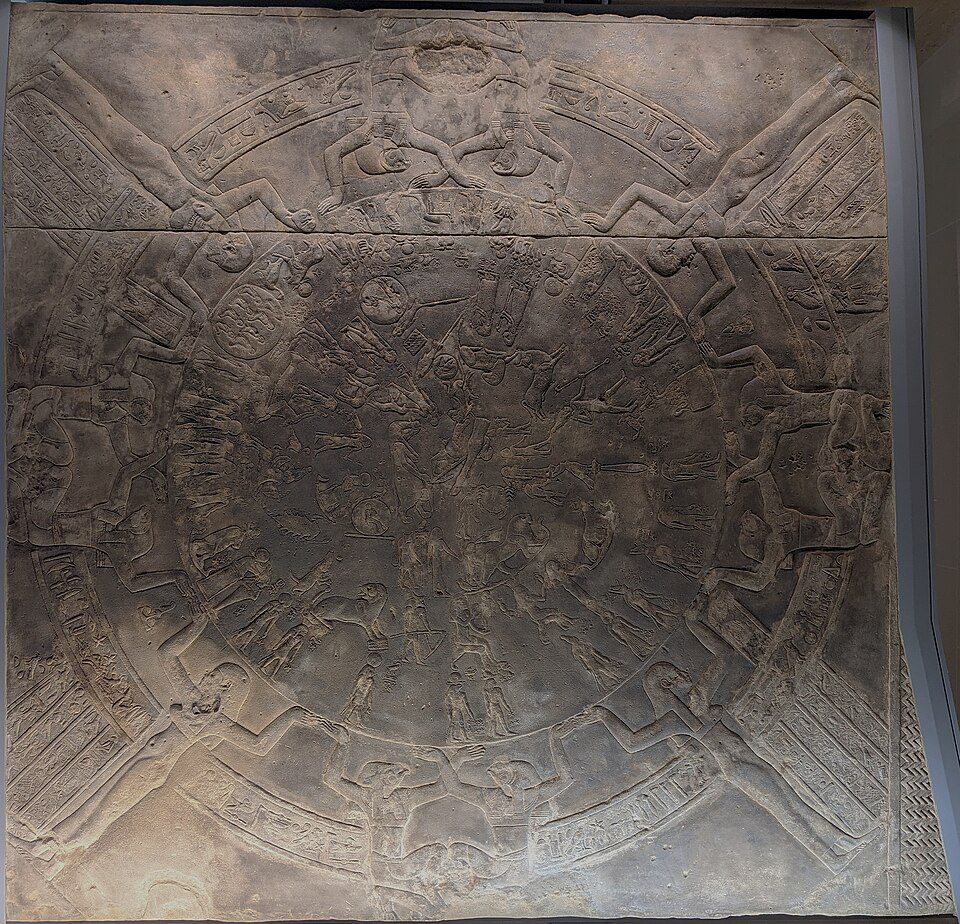
This circular sandstone relief once decorated the ceiling of a chapel dedicated to Osiris within the Temple of Hathor. Traditional Egyptian constellations, the hippopotamus, the ox-leg, sit alongside Babylonian zodiac signs like the scorpion and the balance, and astronomical methods with clear Greek mathematical influence. Rather than three separate traditions, it shows a genuinely blended, cross-cultural system of astronomical knowledge circulating through the late ancient Mediterranean.
Egyptologist Sylvie Cauville has proposed dating the relief using a depicted solar eclipse and planetary alignment consistent with 51 or 50 BCE, though this reading, like much of the zodiac’s iconographic interpretation, isn’t universally accepted among specialists. The object’s later history is its own story of disruption: in 1821, the engineer Sébastien Louis Saulnier removed the relief from the ceiling using saws and gunpowder charges, an act of extraction that scandalized contemporary European archaeologists and helped spur later reforms in how antiquities were removed from Egypt.
What survives is never a neutral sample of the past. It’s the product of what happened to be preserved, and what a later excavator happened to think was worth keeping.
Conclusion
What Survives Becomes History
Organic materials rot. Gold gets melted down and reminted. Clay tablets survive largely by accident, baked hard in the fires that destroyed the buildings holding them. What actually reaches a museum case is never a representative sample of the ancient world; it’s the residue of environmental luck intersecting with archaeological attention, and for a long time, that attention was unevenly distributed toward literate, monumental, Mediterranean-adjacent cultures.
The twenty objects above don’t rewrite history in the dramatic sense the phrase implies. What they actually do is force a narrower, more honest kind of correction: pushing a timeline back by tens of thousands of years, revealing a trade network no text mentioned, or exposing a popular claim, the human rights charter, the ancient battery, that turns out to be less settled than repetition has made it sound. That’s a more useful lesson than “history is fascinating.” It’s a reminder that historical consensus is only ever as strong as the evidence currently sitting in a museum drawer, and that the next excavation, the next reanalysis, is always capable of quietly moving the line again.
Ali Mujtuba Zaidi
Ali is an independent historical researcher and writer at The Historical Insights, where he covers archaeology, ancient infrastructure, and the physical evidence behind historical narratives.
Related reading on The Historical Insights: archaeological and historical discoveries, how radiocarbon dating and modern science are rewriting history, and how institutions have used monuments to shape historical narrative.
Sources & Further Reading
Primary documentation, institutional records, and archaeological journals supporting the historical paradigms discussed in this feature.
Paleolithic & Neolithic Evidence
- Henshilwood, C. et al., “Emergence of Modern Human Behavior: Middle Stone Age Engravings from South Africa,” Science 295 (2002); Iziko Museums of South Africa collection records.
- National Museum of Slovenia, excavation records for the Divje Babe assemblage; d’Errico, F. et al. on the taphonomic debate over the “Neanderthal flute.”
- Natural History Museum Vienna, collection record for the Venus of Willendorf.
- Royal Belgian Institute of Natural Sciences, Ishango collection; de Heinzelin, J., “Ishango,” Scientific American (1962).
- Jordan Museum and Smithsonian National Museum of Natural History, ‘Ain Ghazal statue conservation records.
Bronze Age & Early Empires
- Egyptian Museum, Cairo, and University College London, Narmer Palette digital archive.
- National Museum, New Delhi, and Archaeological Survey of India collection records for the “Dancing Girl.”
- Louvre Museum, Code of Hammurabi collection record; Yale Law School Avalon Project, translated text.
- National Archaeological Museum, Athens, Grave Circle A collection; Calder, W. and Traill, D., on Schliemann historiography.
- Heraklion Archaeological Museum, Phaistos Disc collection record.
- Neues Museum, Berlin, and Staatliche Museen zu Berlin, Nefertiti bust collection record.
- Instituto Nacional de Antropología e Historia (INAH), Olmec colossal head research.
Iron Age to Antiquity
- British Museum collection records for the Nimrud Lens, Flood Tablet, Nabonidus Chronicle, and Cyrus Cylinder.
- Finkel, I., The Cyrus Cylinder: The King of Persia’s Proclamation from Ancient Babylon (I.B. Tauris, 2013).
- Emperor Qinshihuang’s Mausoleum Site Museum, Terracotta Army excavation reports, Pit 2.
- Craddock, P. et al., “The Baghdad Battery — Myth or Reality?” Journal of the Historical Metallurgy Society.
- Israel Museum, Jerusalem, Shrine of the Book, Great Isaiah Scroll digital collection.
- Cauville, S., “La Zodiaque de Dendera,” Journal for the History of Astronomy; Louvre Museum collection record.
Frequently Asked Questions
What does it mean for an artifact to “rewrite history”?
It rarely means historians were completely wrong before. More often, a single object provides physical evidence that pushes a known timeline earlier, confirms a debated interpretation, or reveals a capability, connection, or practice that written sources never recorded. The Blombos Cave ochre didn’t invent symbolic thought, but it moved the earliest confirmed evidence of it back by tens of thousands of years.
Is the Baghdad Battery really an ancient battery?
Most archaeologists are skeptical. The vessel can produce a weak electrical current when filled with an acidic liquid, as later replicas have shown, but no wires, electrodes, or electroplated objects have ever been found alongside it. The leading interpretations favor a scroll container or ritual object, not a power source.
Did the Cyrus Cylinder really create the first human rights charter?
That label is a modern description, not an ancient one, and most Assyriologists consider it an overstatement. The cylinder follows an established Mesopotamian genre of royal restoration inscriptions. It documents a genuinely significant repatriation policy, but the text does not name the Jewish exiles or use anything resembling modern rights language.
Was the Divje Babe flute definitely made by Neanderthals?
The bone itself is Neanderthal-associated and undisputed. Whether the holes were deliberately carved to make a musical instrument is genuinely contested, with some researchers favoring deliberate drilling and others attributing the holes to a scavenging hyena’s bite marks. The debate remains open in the scientific literature.
What is the oldest artifact on this list?
The Blombos Cave engraved ochre, dated to roughly 75,000 BCE, is the oldest object discussed here, followed by the Divje Babe flute at approximately 43,000 BCE.
© 2026 The Historical Insights · Researched from primary museum, archaeological, and institutional records.

 点赞
点赞 收藏
收藏 点踩
点踩 分享
分享