We need a ‘The Day After’ moment for AI X-risk

Right now AI is gaining capability at an astonishing pace, from solving a Millennium Prize Problem math problem, assisting in the production of new drugs, to being able to paint the Golden Gate bridge using a robot arm. It is insane to remember that it was only ~4 years ago that ChatGPT released.
If this pace continues, very soon we may create misaligned ASI that will kill literally everyone.
In the face of such risks I am reminded of the intense nuclear risks of the 1980s, and how media impacted politics in ways that helped us avoid oblivion. As well as how a moment like this for AI X-risk could make a difference.
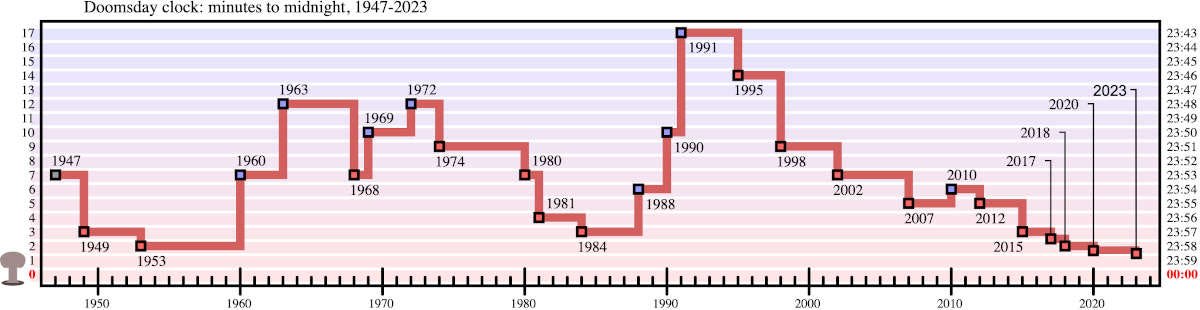
This is a graph of the Doomsday’s Clock minutes to midnight, it is a rough indicator of existential risk from nuclear weapons until 2007 when other existential risks were added. The largest positive swing comes from the time period of 1984 to 1991.
So, what caused this abrupt decrease in nuclear risk?
I think this change was obviously polycausal, partially decisions made by Mikhail Gorbachev impacting policy in the USSR, partially increased communications, all were crucial motivating factors.
Although, a surprisingly important factor in this was the movie “The Day After”.
The Economy Crumbles and Existential Risk Increases
Oil Shock
In 1979 the Iranian Revolution sparked a series of conflicts in the middle east that reduced the oil output of the Persian Gulf. Directly causing oil prices in the US to (eventually) more than double.
As a result of the increased cost of energy, by 1980 the US was going through one of the worst recessions it had ever seen with not just a stagnating economy but also deflation, then coined as stagflation.
This price increase caused devastating inflation
To control this the FED raised interest rates to the highest in history, approaching 20%.
Together these factors caused a deep recession. The macro tumult experienced in this era also likely crept to the social world with high unemployment, cult formation, and urban decay.
Nearing the end of Jimmy Carter’s term in 1980, the people were ready for political change, this was most prominently a hawkish then senator Ronald Reagan.
X-Risk
1974: 9 minutes to midnight
In the mid 70s both the US and USSR were developing MIRVs (Multiple independently targetable reentry vehicles, these are single missiles with multiple war heads) which were thought to change the offense defense balance towards Mutually Assured Destruction (MAD) as well as India gaining nuclear weapons. Increasing risk from the previously 12 minutes to midnight which was the result of notable arms control agreements.
1980: 7 minutes to midnight
SALT 2 (Strategic Arms Limitation Talks) was signed by Jimmy Carter in June of 1979 but were never ratified by the senate because the USSR invaded Afghanistan ending détente, reopening the cold war, then leading the then president Jimmy Carter to withdraw it from consideration in January of 1980. With the US boycotting the 1980 Moscow Olympics.
The Federal Emergency Management Agency (FEMA) was founded in 1979 to prepare for nuclear conflict. The changing opinions on its survivability are evident on a 1981 publication on claiming:
A close look at the facts shows with fair certainty that with reasonable protective measures, the United States could survive nuclear attack and go on to recovery within a relatively few years.
This rhetoric softened the perspectives of policy makers on the direct impacts of nuclear war.
Ronald Reagan is Elected
Due to the perceived failures of the Carter administration, and the poor economic landscape under Carter Ronald Reagan won in a landslide.
1981: 4 Minutes to Midnight
From the outset of Ronald Reagan’s presidential aspirations there was a strong criticism of the relaxing of relations between the US and USSR détente by President Ford and Carter. Reagan had a policy of “peace through strength” which increased military spending and saber rattling against communist countries.
He supported active rollback of communist countries, just containment was no longer enough. This caused his administration to put more pressure on the USSR raising tensions.
This includes:
- Treating the USSR as an untrustworthy adversary rather than something worthy of negotiation (notably as an ‘evil empire’)
- Increasing military budgets (some call it the largest peacetime buildup in history)
- Put forward the strategic Defense initiative (SDI) also known as star wars in opposition to MAD doctrine
- Reviving the B-1 lancer program
Also, some Reaganite officials mused that humanity could easily survive all out nuclear war most notoriously T.K. Jones who was the deputy undersecretary of defense for research and engineering, strategic, and theater nuclear forces. Stating:
“If there are enough shovels to go around, everybody’s going to make it” and that in an all out war scenario the US could fully recover in two to four years.
These actions likely moved the US and USSR closer to nuclear exchange.
1984: 3 minutes to midnight
In this time of heightened risk Petrov Day (1983) occurred, highlighting the immense tensions between the US and USSR.
The world was racing towards nuclear annihilation, communications between the US and USSR had almost completely broken down, given up on serious arms control, pushing the rating to be near the highest nuclear risk that had ever been.
“There has been a virtual suspension of meaningful contacts and serious discussions. Every channel of communication has been constricted or shut down; every form of contact has been attenuated or cut off. And arms control negotiations have been reduced to a species of propaganda.”
In 1983 the world was at its highest nuclear risk in decades.
The Day After (1983)
If you have not seen ‘The Day After’ I highly recommend it, for those who don’t have time to watch it all I suggest this clip.
It, in short, is a movie about nuclear Armageddon and its aftermath.
It viscerally displays:
- Alarms shrieking, panicked crowds trying to escape annihilation, and society breaking down
- People being vaporized in the direct nuclear blast
- Hospitals filled with those dying from burns and the slow progression of radiation poisoning
In its television debut it had an audience of 100 million and made a strong impact on the public’s perception of what nuclear war would look like
It was used by nuclear freeze advocates to argue viscerally for freezing nuclear weaponry.
Ronald Reagan saw this movie, and as evidenced by his diary writings it deeply affected him.
“It’s very effective & left me greatly depressed.”“My own reaction was one of our having to do all we can to have a deterrent & to see there is never a nuclear war.”
“A most sobering experience with Cap W. & Gen. Vessey in the situation room—a briefing on our complete plan in the event of a nuclear attack.”“Simply put, it was a scenario for a sequence of events that could lead to the end of civilization as we knew it. In several ways, the sequence of events described in the briefing paralleled those in the ABC movie. Yet there were still some people at the Pentagon who claimed a nuclear war was ‘winnable.’”
“A nuclear war can never be won and must never be fought.”“The only value in possessing nuclear weapons is to make sure they can't be used ever. I know I speak for people everywhere when I say our dream is to see the day when nuclear weapons will be banished from the face of the Earth.”
In some ways this is a contrary position to that of those in his cabinet, and previous policy stances! This shift has been called the ‘Reagan Reversal’.
The public also responded to this in its growing Nuclear Freeze campaign and although freeze legislation failed legislatively, it put immense pressure on the Reagan administration.
X-Risk Reduction
1988: Six minutes to midnight
After softening rhetoric, the Reagan administration resumed communications with the USSR and met with Gorbachev beginning work on international nuclear weapons agreements.
Towards the end of Reagan’s term he supported the INF treaty (1987) and loosened his posturing towards the soviet union.
1990: Ten minutes to midnight
Tensions continue to reduce as the US and USSR were on a path to uphold the conditions of the INF treaty.
1991: Seventeen minutes to midnight
START I was signed (it successfully reduced nuclear capabilities for each side), and the world left the cold war without a nuclear exchange.
Conclusion
When I ask myself what successful X-risk communication looks like, I think of ‘The Day After’ and its impact on the public and policy makers in the face of intense nuclear X-risk.
Right now conditions in the US are similar to this time of heightened tensions of the early 1980s, we are in an oil shock, we have a hawkish right wing US president, and some are ignoring or downplaying risks.
I feel hopeful for the channels like Drew and AI in Context may produce something piercing like this that breaks into the normal world people exist in. In some of their videos I see flickers of what could move the needle, and could have a lasting impact on politicians IF they are exposed to it.
To do this for AI X-risk, maybe this would entail visualizing what would it feel like to have a child die in your arms from an AI generated plague, or to be boiled alive by ai’s impact on the atmosphere, or for an AI killbots to slaughter entire cities and to destroy humanity’s accomplishments. Although other formats or approaches may work much better.
These are ghastly but maybe realistic visions in of what it might be like to die in an unaligned intelligence explosion.
In a future where humanity continues to exist, for any substantial period of time, I think there will be a ‘The Day After’ moment for AI X-risk.
- SALT: Strategic Arms Limitations Talks. If ratified this would have banned new missile programs and limited the amount of strategic launchers each country could have. If these talks would have passed and held, nuclear X-risk would have substantially decreased.
- as well as many many other things outside of scope
- The USSR historically has done many things that increased X-risk but it is out of scope to focus too much on that since this is about ‘The Day After’ and its impact on Ronald Reagan!
- He actually saw it earlier than its public release, supposedly on October 11th 1983
- These are just the first ideas to come to my mind, they are fairly unpolished!
- I am hopeful that this has already occurred with the Jacob Coxon resignation but we will see!

 点赞
点赞 收藏
收藏 点踩
点踩 分享
分享